Inspiration
As a filmmaker and editor, I’ve witnessed the 'logistical gap' that stalls visionary projects during the gruelling transition from script to a visual plan. Traditionally, breaking down a screenplay requires a specialized crew with a range of talents like cinematographers and storyboard artists—which can be a barrier for independent storytellers. We built CineNova to empower creators to bridge this gap, using the next generation of Amazon Nova models to transform a script document into a visual tale suitable for experimentation , client pitches , and production logistics planning.
What it does
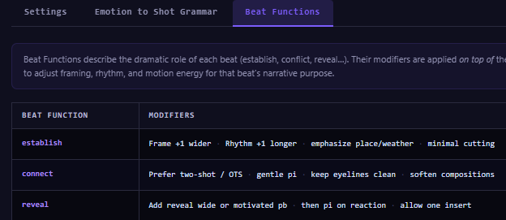
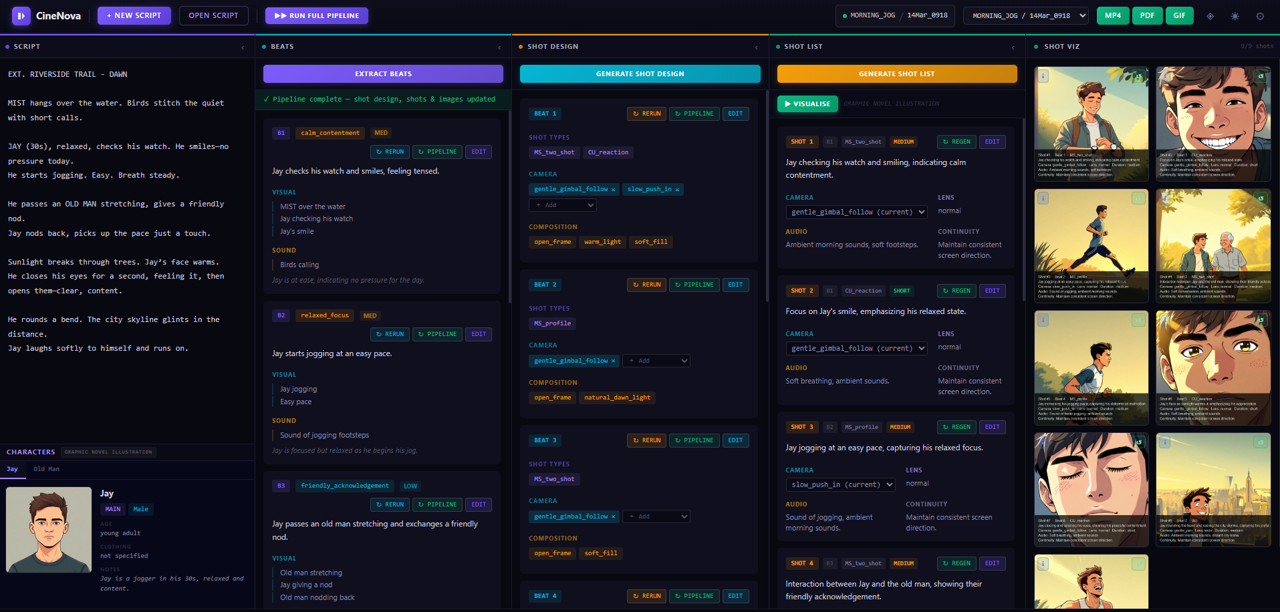
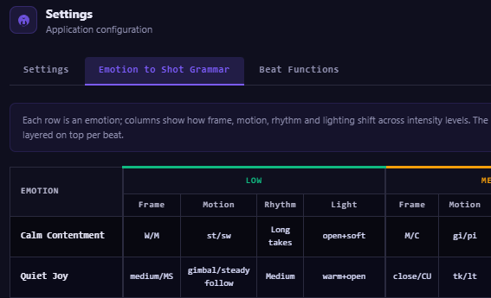
CineNova acts as an AI-driven Film Director. It ingests a standard screenplay and performs a high-level analysis of the narrative, moving beyond keyword scanning to interpret emotional subtext, spatial requirements, and dramatic pacing. It then uses a Emotion vs Intensity Mapping (/path/to/img.jpg) to contruct Beats - A key moments that structure the scene. 1 scene may contain many bests. It then uses another set of heuristics Beat Modifiers to help generate the prompts for a shot design . 1 Beat can have many shots to convey its meaning.
The output is a production-ready 'Creative Blueprint' consisting of:
Shot Lists: Automated generation of camera placements, lens choices, and movement logic (e.g., tracking, pans, dollies).
Shot Visualization Keyframes: Structured visual representations of the most pivotal story beats to align the creative vision.
How we built it
The platform is powered by a multi-stage pipeline using Amazon Nova 2 Pro on AWS Bedrock.
Contextual Ingestion: We leveraged Nova’s context window to process full-length screenplays in a single pass, ensuring narrative continuity across the entire story arc.
Reasoning Engine: We developed a 'Directorial Logic' layer using heuristic mappings that translates narrative tension and dialogue subtext into technical camera metadata.
Multimodal Synthesis: The system bridges the gap between text reasoning and visual representation using Amazon Canvas to generate the visuals, ensuring that technical specifications are reflected in the generated assets.
Challenges we ran into
The primary challenge was managing the LLM stochasticity across a complex script. We also navigated the nuances of screenplay structures , where white space and indentation and varying professional language of cinematography posed challenges in our mapping
Accomplishments that we're proud of
We successfully developed a system that retains precise creative control alongside the Nova generated content. Nova helps to map to genuine cinematographic intent. Seeing the agent independently suggest a 'Dutch Angle' for a disoriented character or a 'Slow Push-in' for a dramatic reveal—without explicit instructions—proves that CineNova understands the language of film, not just the text.
What we learned
Building CineNova taught us that the real power of Amazon Nova lies in its ability to handle high-level technical constraints while interpreting the text. By feeding the model professional filmmaking terms , we transformed a general AI into a specialized creative collaborator.
What's next for CineNova
** Production logistics planning : This is a hugely manual exercise and it maybe possible to produce artifacts related to what kind of locations and shoots we need to plan
Production Integration: Exporting directly to industry-standard scheduling and budgeting software for a seamless 'Script-to-Set' workflow.
Audio generation & mood experimentation: This is the holy grail of indie film making and being able to experiment at scale will unleash a lot of creativity
Dynamic Pre-Viz: Moving from static frames to generated motion sequences using Nova Reel video generation. This maybe an expensive project to pursue.
Real-time Collaboration: A conversational interface where directors can 're-shoot' or adjust scene moods via natural language.
Agentic Integration : Imagine a OpenClaw like integration that can translate the Directors commands into experiments .

Log in or sign up for Devpost to join the conversation.