-
-
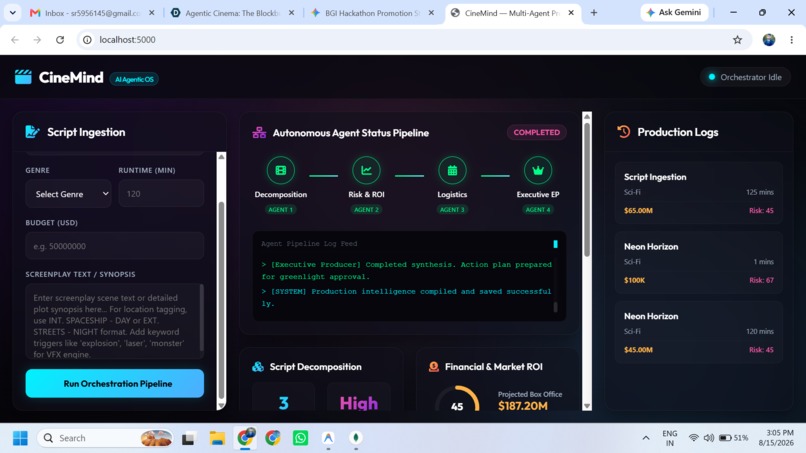
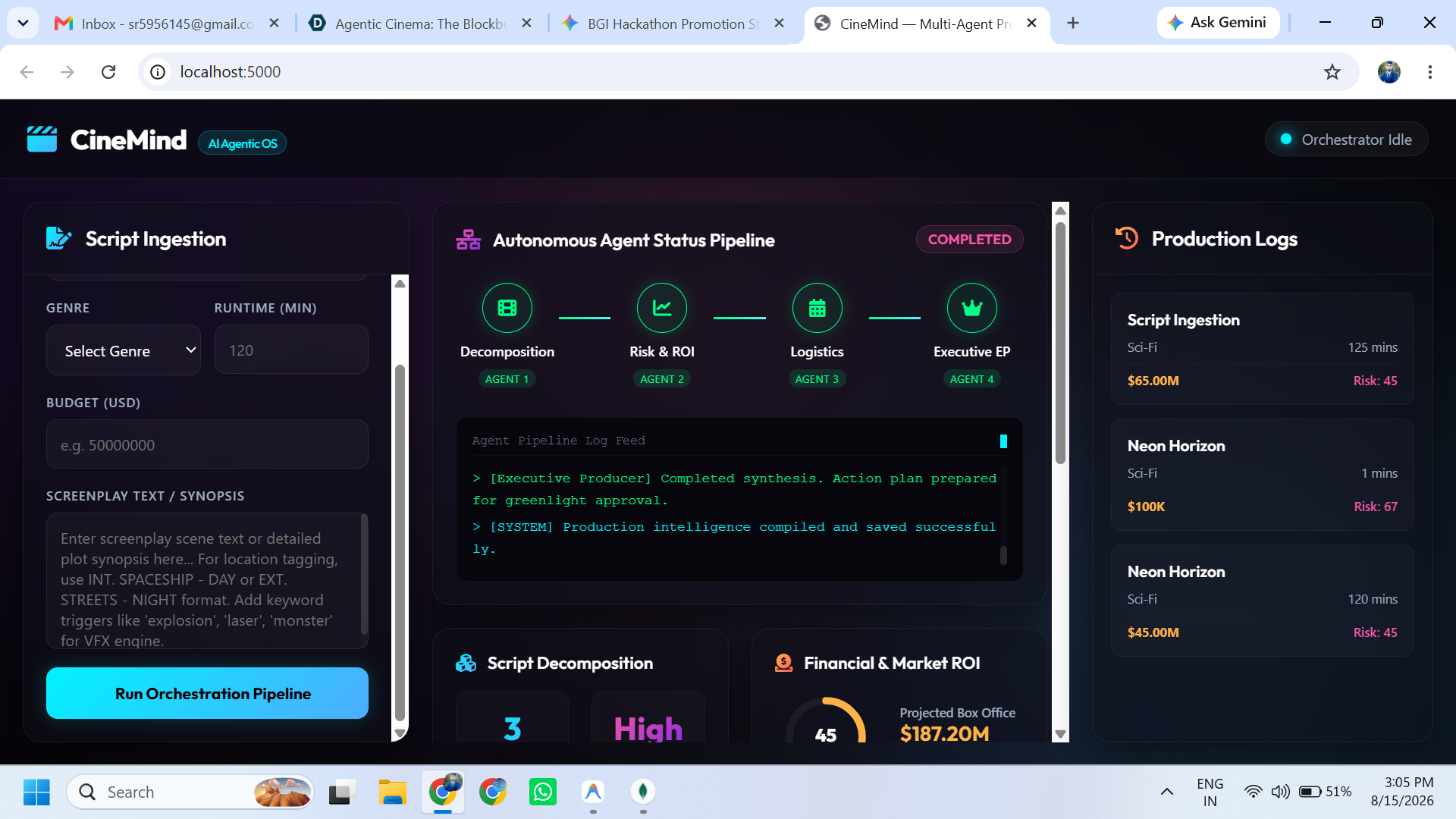
The CineMind real-time dashboard showing a completed multi-agent orchestration pipeline and active production logs.
-
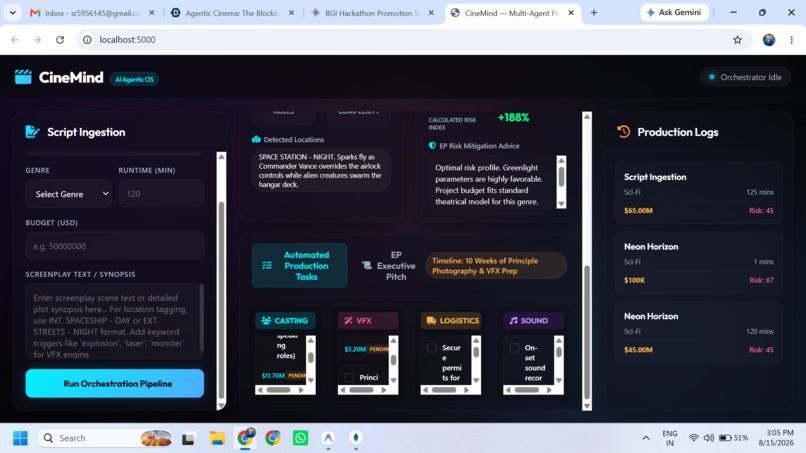
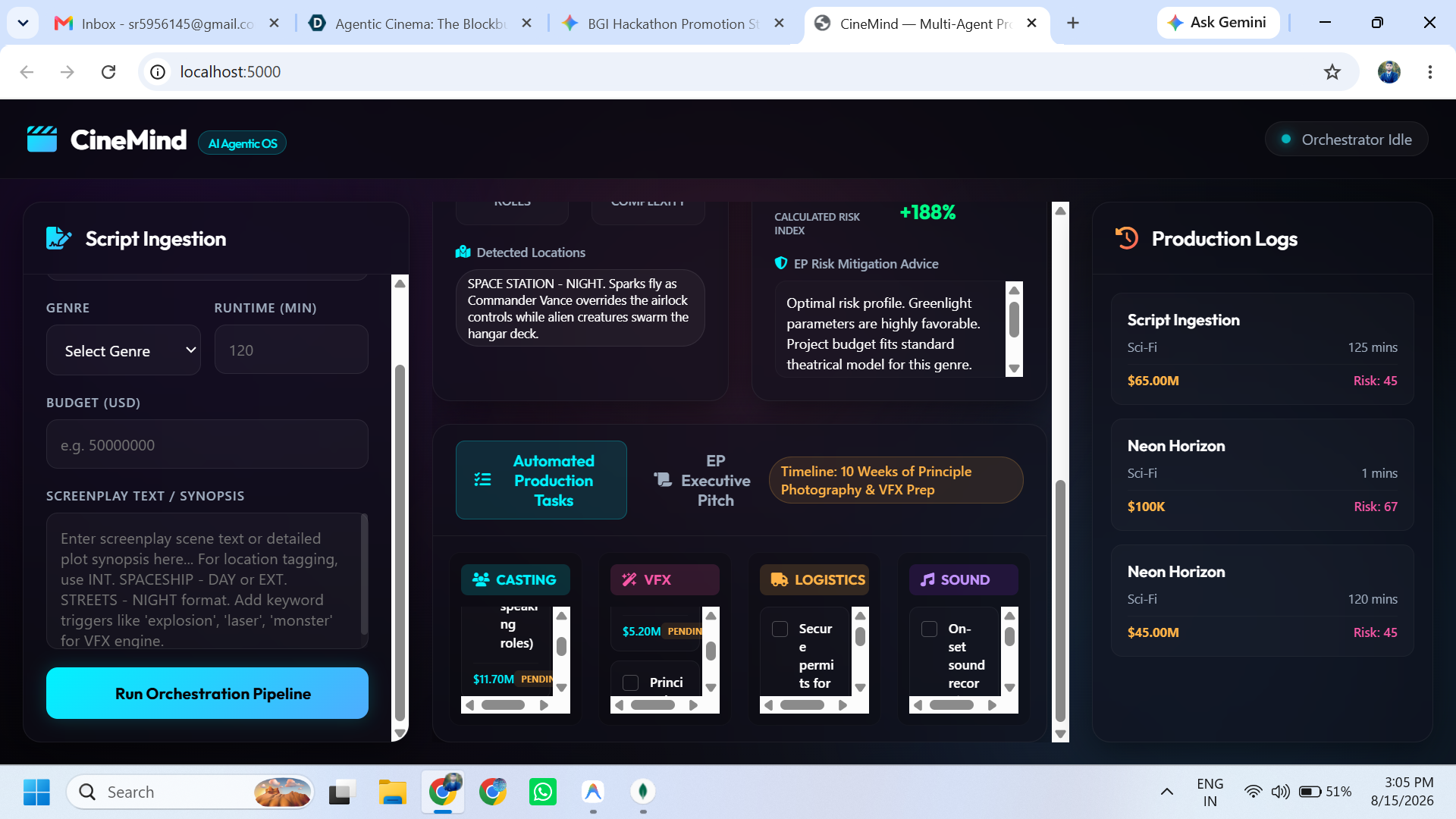
Main CineMind UI featuring real-time multi-agent pipeline telemetry, financial risk forecasting, and MongoDB data logs.
Inspiration
Inspiration
Pre-production in Hollywood is a logistical nightmare. Breaking down a screenplay, calculating visual effects complexity, estimating financial risk, and scheduling crew logistics typically takes weeks of manual work and costs studios millions before cameras even roll. We were inspired to eliminate this friction by asking: What if an entire studio's pre-production pipeline could be managed by an ensemble of autonomous AI agents in seconds?
What it does
CineMind is an autonomous multi-agent studio intelligence platform. When a user inputs a movie script synopsis and basic parameters (genre, budget, runtime), it orchestrates a sequential pipeline of 4 specialized AI agents:
- Agent 1 (Decomposition): Scans the script to extract physical locations, speaking roles, and visual effects (VFX) triggers.
- Agent 2 (Risk & ROI): Benchmarks the project against historical market models to generate a predictive risk index and box office projection.
- Agent 3 (Logistics): Generates department-specific tasks (Casting, VFX, Sound) with cost estimates.
- Agent 4 (Executive Producer): Synthesizes all data into a final greenlight action plan.
How we built it
We built CineMind using a robust, full-stack architecture:
- Frontend: A glassmorphic, cinematic dark-themed UI built with Vanilla JavaScript, HTML5, and CSS3 to display real-time telemetry.
- Backend: A Node.js and Express server that acts as the primary orchestrator, passing state between the multi-agent pipeline.
- Database: Local MongoDB instance to seamlessly persist screenplays, agent analysis reports, and dynamic production tasks.
The Financial Risk Engine (Mathematical Modeling)
To calculate the project's viability, Agent 2 utilizes a customized Risk Index formula. In our predictive model, the overall risk \( R \) is determined by weighting department costs against the total estimated budget[cite: 1].
Using Devpost's supported display math mode, our core algorithmic logic can be represented as[cite: 1]: $$ R = \sum_{i=1}^{n} \left( \frac{w_i \times C_i}{B} \right) \approx \text{Risk Index} $$ Where \( w_i \) is the risk weight of department \( i \), \( C_i \) is the estimated cost, and \( B \) is the total budget[cite: 1].
Challenges we ran into
One of the biggest hurdles was managing the asynchronous state between four different autonomous agents. Ensuring Agent 3 didn't start building a logistics board before Agent 1 finished extracting the script locations required strict promise-chaining in Node.js. Additionally, securing the local environment variables and bypassing browser CORS issues for our local REST API took some careful configuration.
Accomplishments that we're proud of
- Successfully orchestrating a multi-agent workflow that passes complex JSON state sequentially without breaking.
- Building a highly polished, real-time frontend dashboard that visually tracks the agent pipeline.
- Ensuring 100% database persistence—every generated report and task board is saved to MongoDB and can be fetched instantly from the UI history logs.
What we learned
We learned a massive amount about agentic orchestration—specifically how to strictly structure prompts so that AI agents return predictable JSON payloads instead of conversational text. We also gained deep experience in Mongoose schema design for complex, nested data structures.
What's next for CineMind
- Cloud Deployment: Migrating the local MongoDB instance to MongoDB Atlas and hosting the Node backend on Google Cloud Run.
- Agent 5 (Legal): Adding a new agent to automatically flag copyright risks or stunt-safety compliance issues.
- Real-Time Collaboration: Implementing WebSockets so multiple studio executives can view the agent dashboard updating live simultaneously. ## What it does
How we built it
Challenges we ran into
Accomplishments that we're proud of
What we learned
What's next for CineMind
Built With
- css3
- express.js
- google-antigravity
- html5
- javascript
- mongodb
- mongoose
- node.js

Log in or sign up for Devpost to join the conversation.