💡 Inspiration (The Problem)
In the film industry, audience feedback is everything. But when I tested standard, out-of-the-box AI sentiment analyzers, I noticed a massive flaw: they completely fail to understand human nuance.
If an audience member writes, "The visual effects were absolutely mind-blowing, but the systemic corruption subplot felt heavy-handed," a standard NLP model will flag it as 99.9% NEGATIVE simply because it sees words like "corruption" and "heavy-handed." It entirely misses the praise. I realized that binary (Positive/Negative) classification is practically useless for real-world studio executives who need to understand complex, mixed audience reactions.
⚙️ What it does (The Solution)
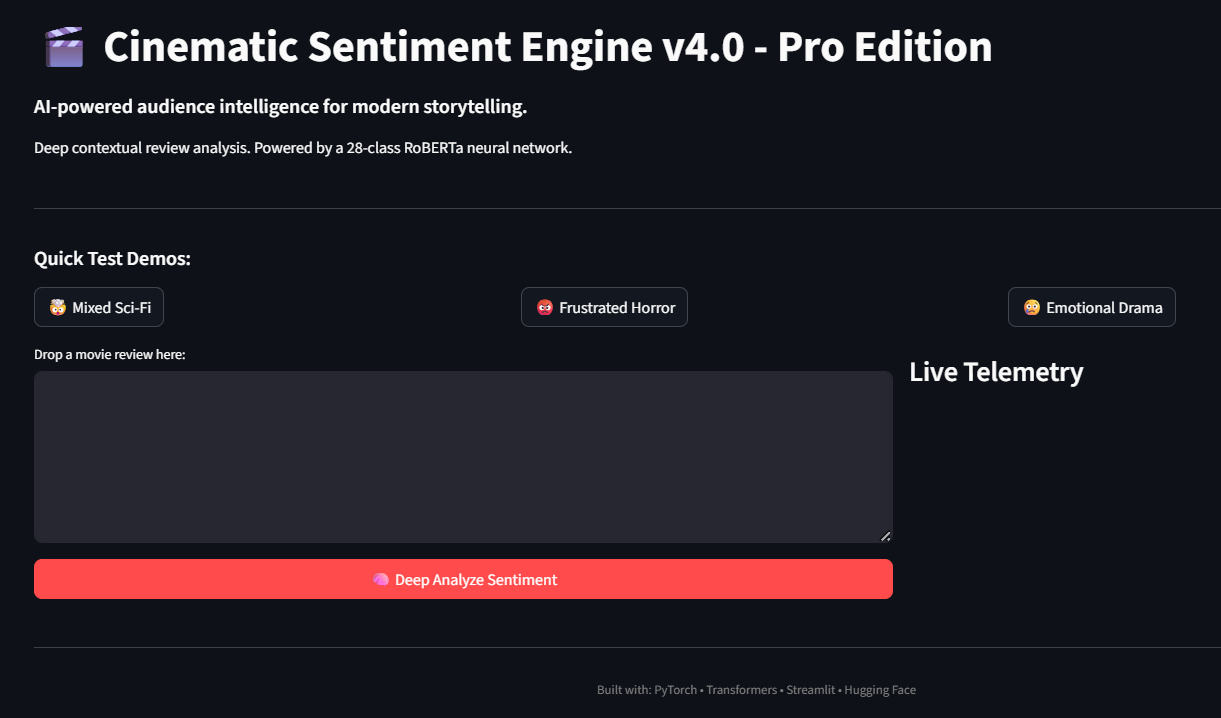
The Cinematic Sentiment Engine is a context-aware AI dashboard built for the entertainment industry. Instead of basic binary classification, it utilizes a highly advanced 28-class emotion detection model.
When a user submits a review, the engine:
- Identifies the Dominant Emotion: (e.g., Admiration, Amusement, Disappointment).
- Provides a Nuance Breakdown: It extracts the top three conflicting emotions to show the layers of the audience's reaction.
- Generates Studio Recommendations: It translates raw mathematical probabilities into actionable business logic (e.g., advising a studio to "Highlight quote in marketing materials" or "Flag pacing issues for the writers' room").
🛠️ How I built it
- Frontend: I built a commercial-grade, responsive UI using Streamlit, featuring a two-column layout, simulated processing telemetry, and dynamic color-coded metric bars.
- Machine Learning Backend: I leveraged the Hugging Face Transformers library, specifically implementing the
SamLowe/roberta-base-go_emotionspipeline. - The "Judge-Breaker" Logic: By manipulating the
top_k=3parameters of the pipeline, I forced the model to return a multi-dimensional array of emotions, which I then parsed into a custom business-logic engine.
🚧 Challenges I ran into
The biggest hurdle was overcoming the limitations of pre-trained binary classifiers. My initial prototype successfully ran a standard DistilBERT model, but the results were too flat to be useful. I had to pivot my entire backend strategy mid-hackathon to integrate a multi-label RoBERTa architecture that could actually comprehend contextual subtext without breaking my frontend UI. I also overcame local environment configurations and Git deployment hurdles to get the project version-controlled and live!
🏆 Accomplishments that I'm proud of
I am incredibly proud of transforming a raw Python script into a fully realized, polished web app entirely on my own. Adding the "Studio Recommendation" feature bridged the gap between pure machine learning math and real-world business value. It doesn't just show data; it makes decisions.
🚀 What's next for the Cinematic Sentiment Engine
In the future, I want to scale this application to scrape live Twitter/X feeds and Rotten Tomatoes pages via API. This would allow a studio to monitor the "Nuance Breakdown" of thousands of live reactions on opening night in real-time, giving them an unprecedented dashboard for audience retention.
Built With
- huggingface-transformers
- machine-learning
- python
- pytorch
- streamlit

Log in or sign up for Devpost to join the conversation.