-
-
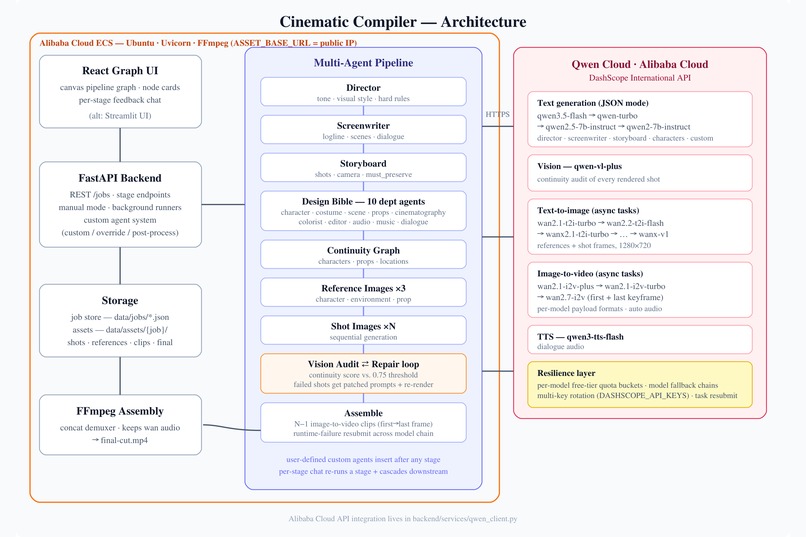
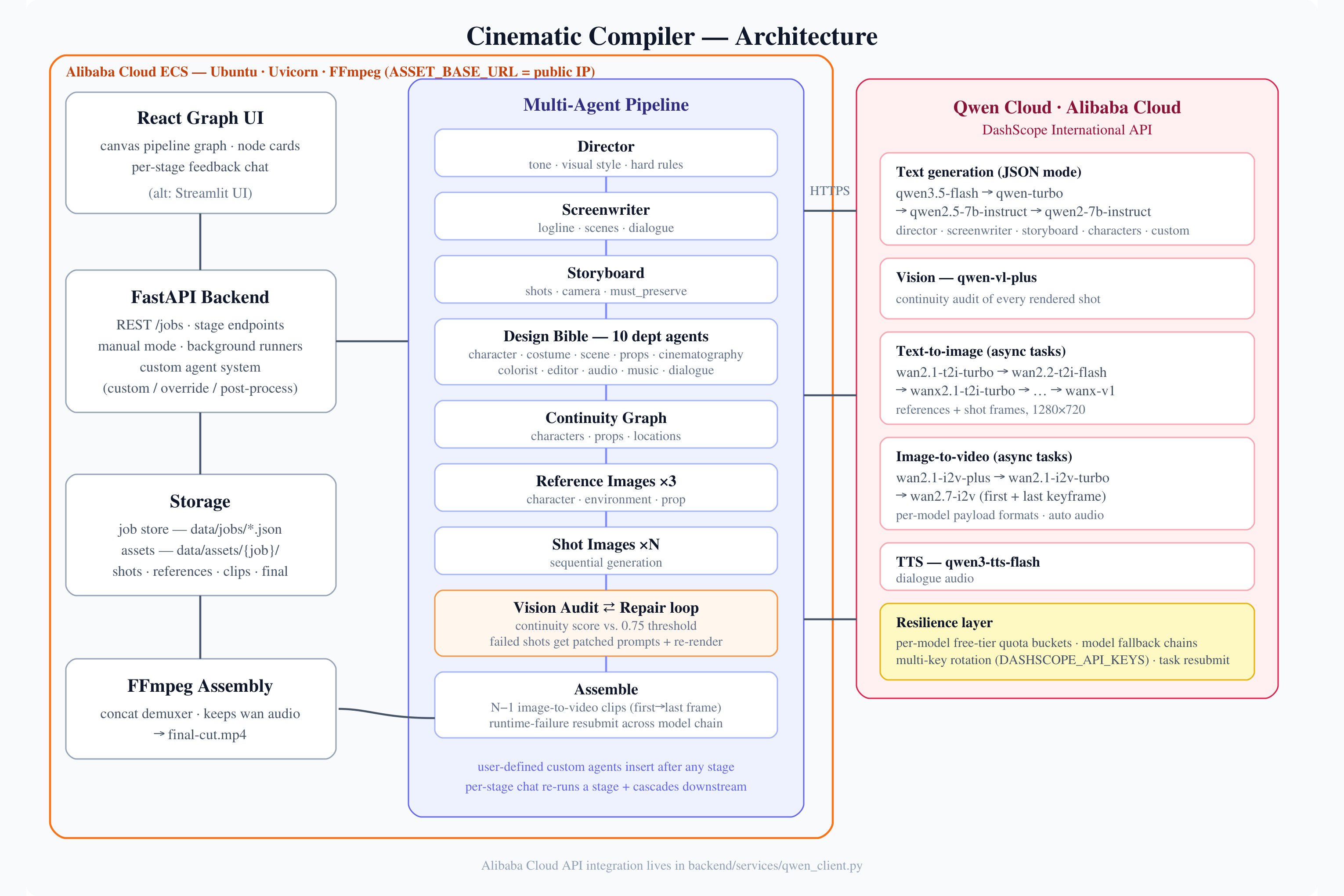
Architecture
Cinematic Compiler — Devpost Submission Writeup
Inspiration
Video generation models can produce a stunning 5-second clip — but a film is not a clip. The moment you ask for a second shot, the protagonist's coat changes color, the scar switches cheeks, and the alley becomes a desert. Every multi-shot AI video today quietly depends on a human quality-checking every frame. We wanted to build the missing layer: a production studio where AI agents don't just generate — they check each other's work and fix it, the way a real film crew does.
What it does
Cinematic Compiler turns a one-line prompt into a finished short film — screenplay, storyboard, design bible, reference images, per-shot frames, animated clips, and a final MP4 with audio — through a pipeline of 14 specialized agents:
- Director distills the prompt into tone, visual style, and hard rules the whole film must obey.
- Screenwriter and Storyboard agents produce scenes and shots, each with camera direction and a
must_preservecontinuity contract. - A Design Bible of 10 department agents (character, costume, scene, props, cinematography, colorist, editor, audio, musician, dialogue) locks the film's look before a single pixel is generated.
- A deterministic continuity graph tracks every character, prop, and location across shots.
- Reference and shot images are generated with the Wan text-to-image models.
- A vision audit agent (qwen-vl-plus) inspects every rendered shot against the director's hard rules and the shot's continuity contract, scoring it 0–1. Below 0.75 — or on any critical error — a repair agent writes a targeted corrective prompt and the shot is re-rendered and re-audited. The film ships with its own QA report.
- Assembly animates consecutive shot pairs with the Wan image-to-video models and concatenates the clips with FFmpeg, keeping Wan's auto-generated audio.
The studio is interactive: a canvas UI shows the agent graph building the film live. Click any agent to send a producer note ("make it more noir") — that stage re-runs with your feedback and downstream stages cascade automatically. Users can also inject custom agents (full-context, override, or post-process) at any pipeline position, and run the whole pipeline stage-by-stage in manual mode.
What makes the architecture different
- Multi-agent orchestration without coupling. 14 agents (4 Qwen-backed creative leads + 10 deterministic department agents) each consume only the context they need and write a typed section of shared job state. Agents compose cleanly; every output records which model produced it.
- A repair loop, not a retry loop. The vision audit doesn't just flag a bad shot — it produces a structured error list (critical/major/minor), and the repair agent converts those specific failures into a corrective prompt. The shot is re-rendered and re-audited until it clears the 0.75 threshold or hits the attempt cap.
- The continuity graph as a single source of truth. Characters, props, and locations are extracted into a deterministic graph before generation. The same graph feeds the image prompts and the audit checklist — the generator and the judge are grounded in identical facts, which is what makes the audit scores meaningful.
- User-extensible agent system. Custom agents slot into any pipeline position with three insertion semantics (full-context, prompt-override of a built-in agent, or post-processing a stage's output) — no code changes, rendered live as graph nodes.
- Surgical regeneration. Every stage declares its downstream dependencies in an explicit dependency map. A producer note to one node re-runs only that node and its true dependents: changing SHOT_03 never touches the screenplay; changing the design bible cascades to references and shots because identity genuinely depends on it. One node changes, the rest of the film stands.
How we built it
- Backend: FastAPI + Uvicorn, JSON-file job store, threaded background runners. Deployed on Alibaba Cloud ECS via Docker.
- Frontend: React (JSX) canvas graph UI served by the same process; Streamlit as an alternative UI.
- Models (all via DashScope International): qwen3.5-flash for structured JSON generation, qwen-vl-plus for vision audits, wan2.1-t2i-turbo for images, wan2.1-i2v-plus for video, qwen3-tts-flash for TTS.
- Assembly: FFmpeg concat demuxer.
Engineering highlights
Working against real quota limits forced production-grade resilience:
- Model fallback chains for every capability. DashScope free-tier quotas are per model, so text, image, and video calls each walk an ordered chain of models on quota errors instead of failing.
- Multi-key rotation. A comma-separated key pool; a key is only abandoned after its entire model chain is exhausted.
- Per-model payload construction. wan2.7 takes first+last keyframes; wan2.1 i2v takes a single start frame — the client builds the correct request body per candidate model.
- Runtime-failure resubmission. DashScope can accept an async video task and fail it minutes later; the assemble stage detects this and resubmits down the chain.
- Deterministic offline fallbacks for every agent, so the pipeline always completes end-to-end.
- Token-budget discipline: flash-tier models, JSON mode with schema validation and single-retry, compact context assembly per agent.
Every output records which model actually produced it — full provenance in the job file.
How we used Alibaba Cloud
- Model Studio / DashScope International powers every AI capability in the system: qwen3.5-flash (structured JSON generation for the creative agents), qwen-vl-plus (vision continuity audits), wan2.1-t2i-turbo (reference and shot images via the async task API), wan2.1-i2v-plus (shot-to-shot video clips via the async task API), and qwen3-tts-flash (dialogue TTS). The complete integration is one auditable module:
backend/services/qwen_client.py. - ECS hosts the production backend and frontend as a Docker deployment (
Dockerfile+docker-compose.ymlin the repo), withASSET_BASE_URLpointed at the instance's public address so generated images and videos are served from the cloud host.
Challenges we ran into
The hardest bugs were the silent ones. DashScope accepts a malformed video request at submit time and only fails the task at runtime — which once degraded our final cut to a still-image slideshow with no error anywhere. Qwen would also occasionally return continuity constraints as a comma string instead of a JSON array, or a character's appearance as a nested dict — the pipeline normalizes all of it. And the compatible-mode endpoint rejects JSON-mode requests unless the word "json" literally appears in the prompt.
What we're proud of — continuity you can measure
The audit→repair loop is a genuine self-correcting system: the film's continuity is measured, not hoped for. Every job records its own QA report — mean continuity score before and after repair, how many shots entered repair, and the repair success rate — with the full per-shot audit history (every attempt, score, and error list) preserved in the job file, so the improvement delta is reproducible from the artifact alone.
Across 24 generated films — 88 shots, 311 qwen-vl-plus audit calls — the repair loop lifts repaired shots from a mean continuity score of 0.616 to 0.643, with a mean gain of +0.108 on the shots it improves, against a strict grader (−0.15 per critical error, 0.75 approval threshold). Attempt-level analysis of the audit histories also identified our next optimization: 37 of 79 repaired shots produced a stronger intermediate render than the final one, so keep-best attempt selection raises the aggregate gain to +0.052 at zero additional generation cost.
We deliberately don't quote standard long-video benchmarks: those score the underlying generation model on single continuous shots, and would measure Wan rather than our system. Our contribution is cross-shot consistency, so our evaluation is an ablation — the same prompts with and without the repair loop, comparing continuity scores and cross-shot character identity similarity (CLIP/DINO embedding similarity of the protagonist across shots).
What's next
Reference-image conditioning for stronger identity locking, longer multi-scene films, and publishing aggregate ablation numbers across a multi-prompt evaluation batch.


Log in or sign up for Devpost to join the conversation.