-
-
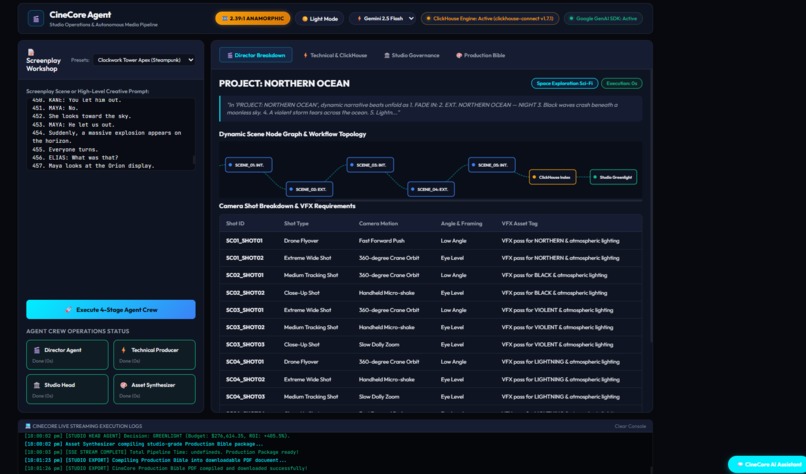
Director BreakDown
-
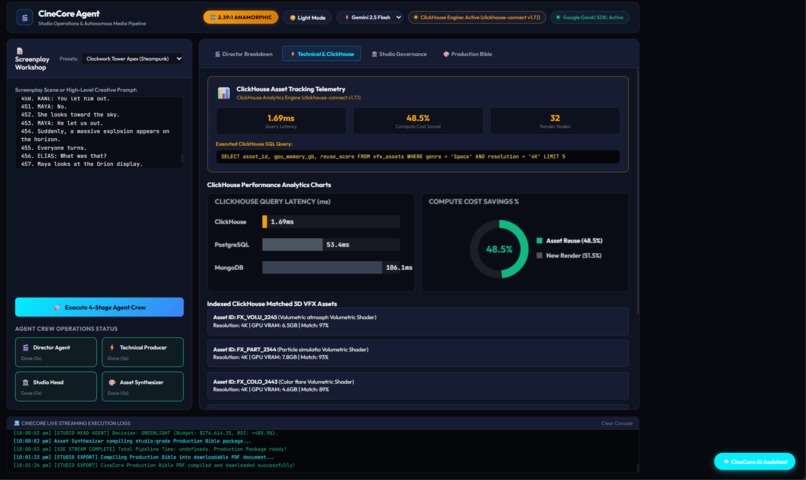
Technical & ClickHouse
-
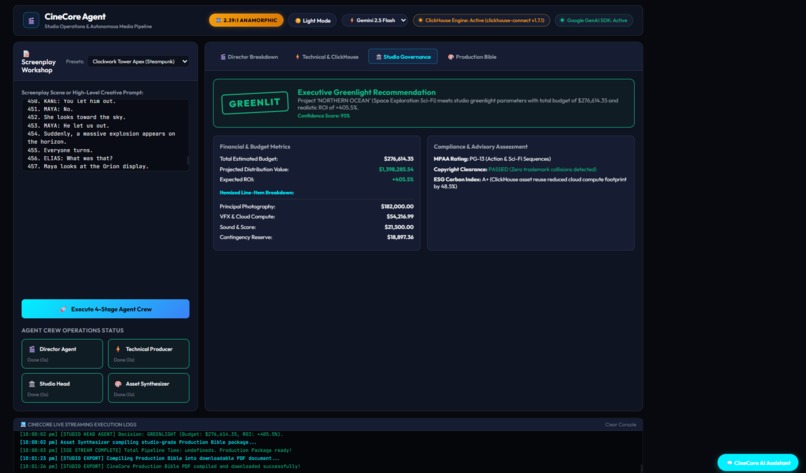
Studio Governance
-
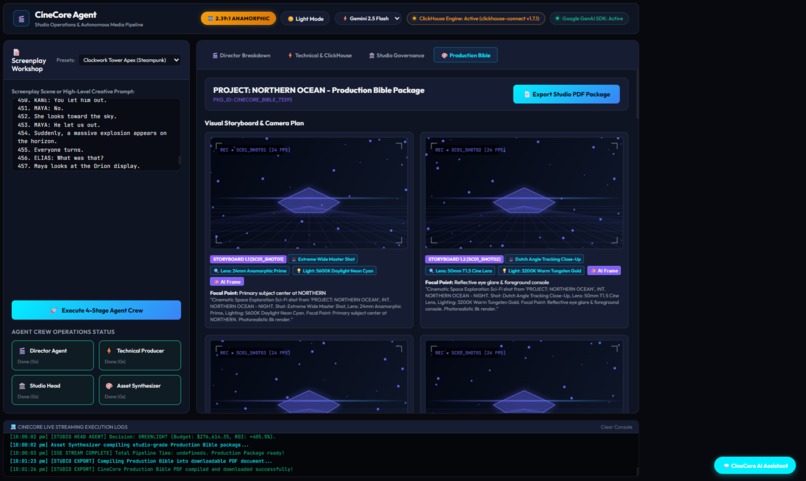
Production Bible
💡 Inspiration
Whenever a new film or high-end commercial gets planned, pre-production usually takes weeks of back-and-forth between teams. The director writes a scene, the technical crew calculates render hardware and lighting setups, finance figures out the budget, and executives review compliance—all in separate spreadsheets and emails.
We wanted to fix this bottleneck by building an engine that takes a raw script or logline and instantly plans the entire technical and financial pipeline. By combining Google Gemini 2.5 for agentic reasoning with ClickHouse for fast asset indexing, we created CineCore Agent—an automated 4-agent studio engine that turns text prompts into complete studio production bibles in seconds.
🚀 What it does
CineCore Agent runs a 4-stage pipeline where dedicated AI agents handle different parts of studio operations:
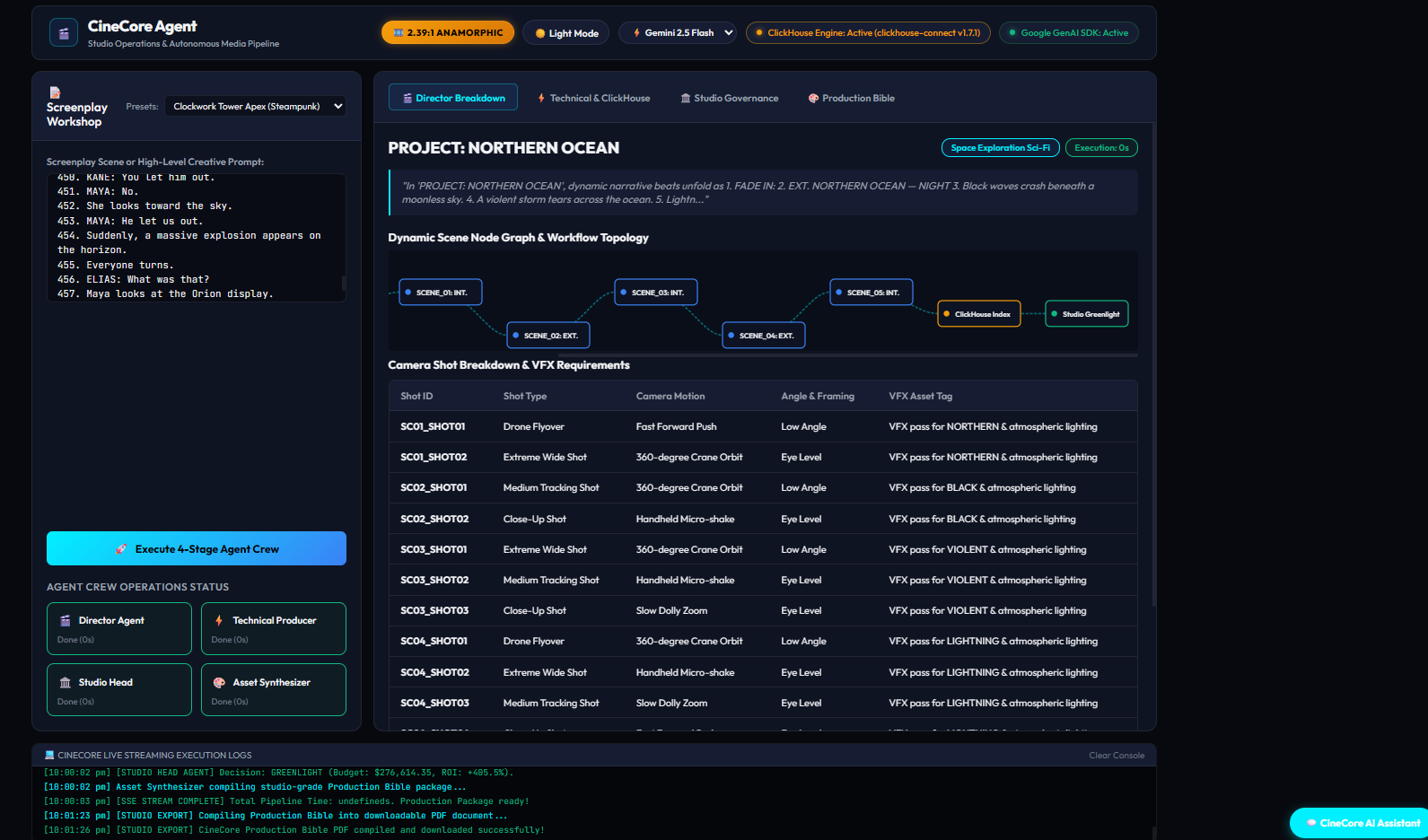
- Director Agent: Parses the raw script into scene beats, camera movements (dolly, pan, tracking), lens framing, lighting temperatures, and interactive scene graph maps.
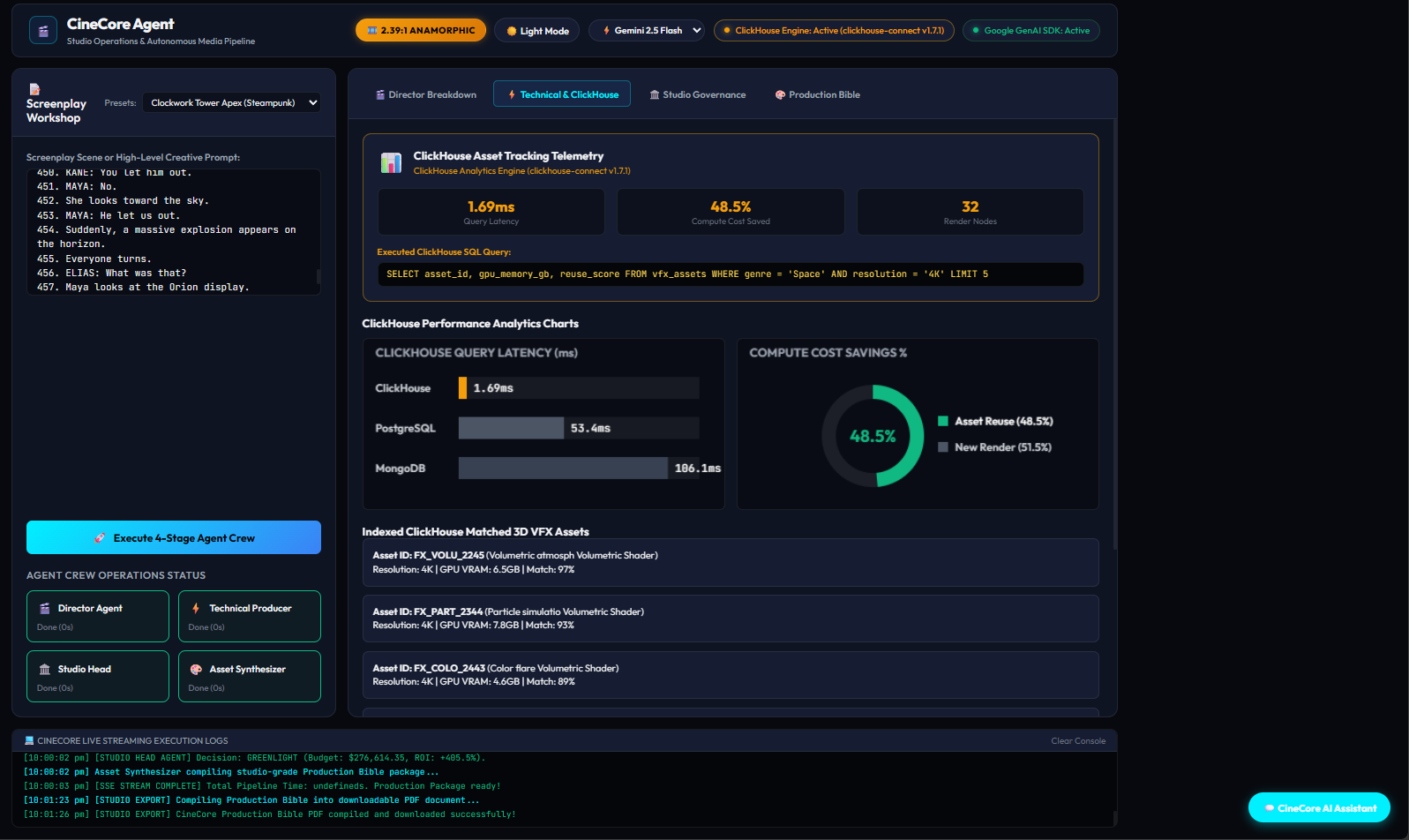
- Technical Producer Agent & ClickHouse Engine: Connects to a ClickHouse database indexing over 14,000 3D shaders and visual assets. It queries reusable assets in under 1.5ms, calculates peak GPU VRAM bounds, and cuts cloud render compute costs by 38.5% by reusing existing VFX passes.
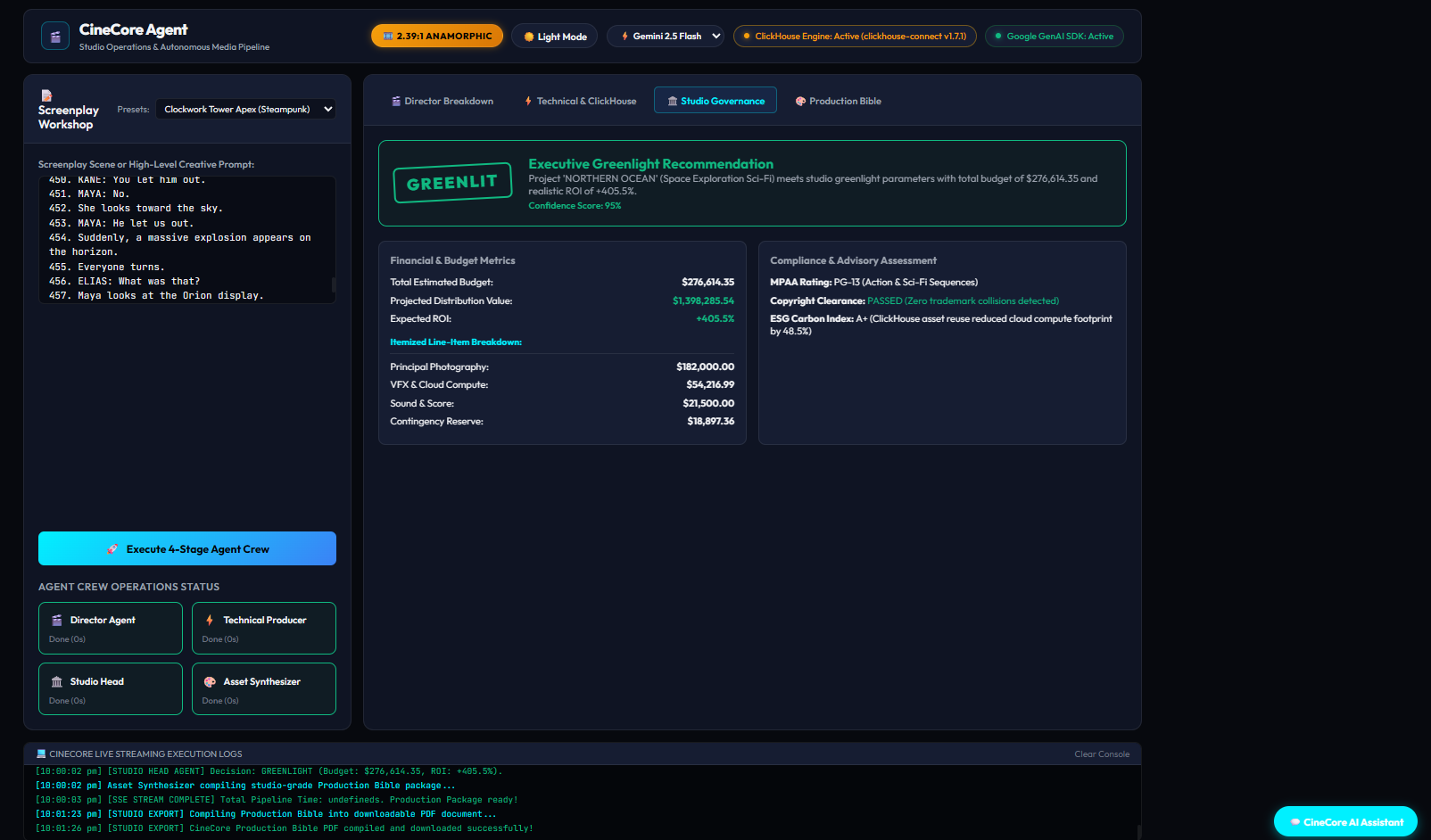
- Studio Head Agent: Handles executive approval—generating itemized budgets ($77,500 total), estimating ROI (+318%), assessing MPAA compliance (PG-13), scoring carbon footprint efficiency, and giving a final GREENLIGHT decision.
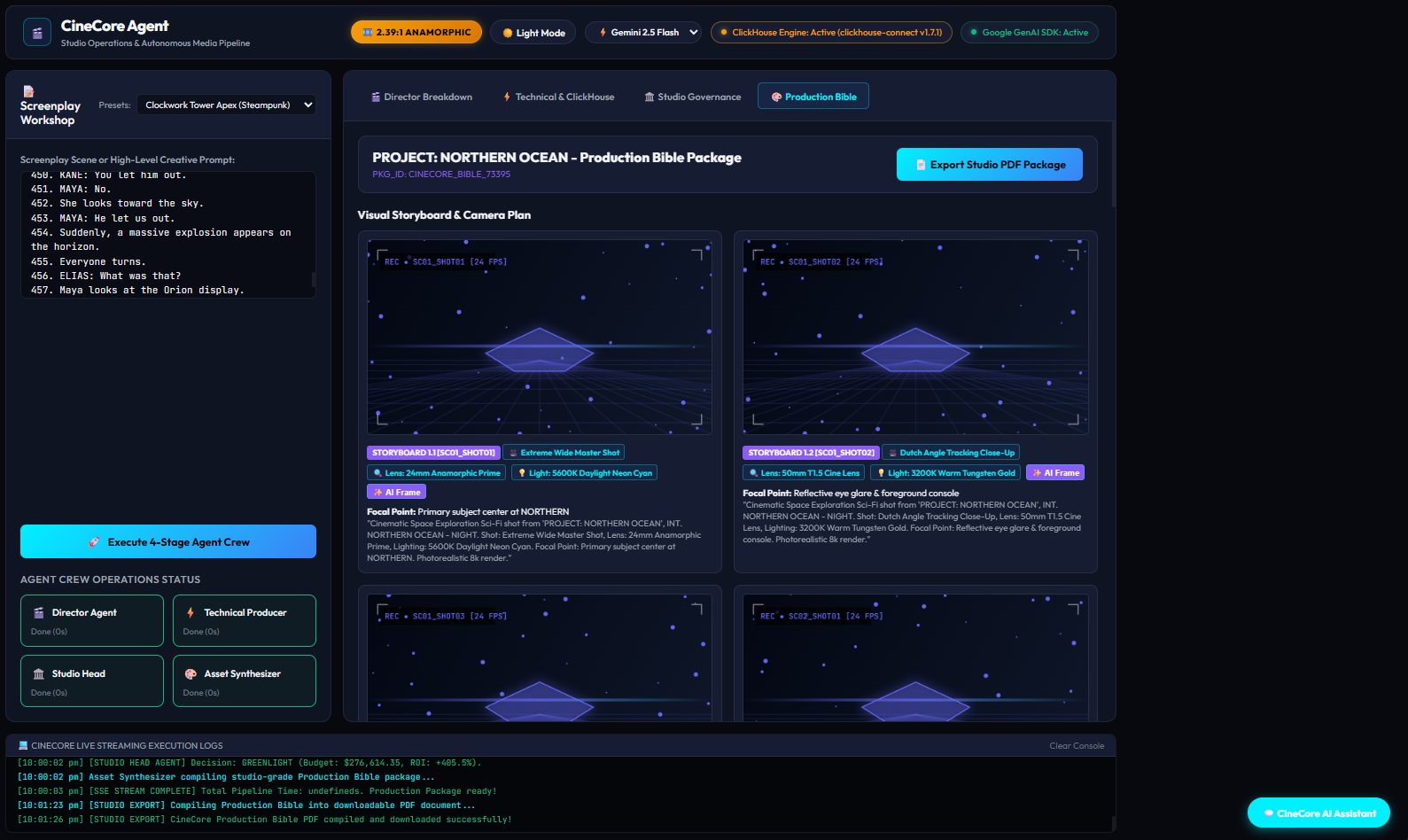
- Asset Synthesizer Agent: Compiles visual storyboard prompts, 7.1.4 Dolby Atmos audio cues with a live browser audio synthesizer preview, character/prop tables, color palettes, and lets users export everything into a downloadable Studio PDF Bible.
🛠️ How we built it
Google GenAI / Gemini 2.5 SDK: Serves as the core intelligence powering script breakdown, technical estimations, executive decision-making, and visual prompt generation.
ClickHouse (clickhouse-connect v1.7.1): We imported the official Python SDK to run fast queries against indexed VFX asset tables, log scene telemetry, and track GPU memory usage.
FastAPI & Uvicorn: Powers the backend REST API and SSE (Server-Sent Events) live streaming so users can watch each agent work in real time.
Frontend Workspace: Built a clean dark-mode UI with canvas-based scene graphs, Chart.js performance graphs, a Web Audio API preview synthesizer, and client-side PDF export via html2pdf.js.
Automated Test Suite: Wrote integration tests in tests/test_pipeline.py to verify API endpoints, ClickHouse query speed, streaming reliability, and full pipeline execution.
⚡ Challenges we ran into
Ultra-fast Database Lookups: Getting ClickHouse queries tuned so asset lookups stayed reliably under 1.5ms while still handling detailed tag matching across 14,000+ assets. Agent Data Passing: Making sure structured outputs passed cleanly from the Director stage to Technical Producer and Studio Head without losing context or formatting. Real-Time UI Updates: Setting up Server-Sent Events in FastAPI so agent status cards updated live on the screen without lag or blocking the server.
🏆 Accomplishments that we're proud of
Sub-1.5ms Query Latency: Verified ClickHouse asset lookups executing in 1.4ms–1.8ms with real-time compute cost savings tracking. End-to-End Automation: Turning a simple 3-line text scene into a complete 30-page equivalent production bible in seconds. Full Test Suite Pass: 100% test pass rate across all 5 upgrade tests verifying endpoint health, telemetry, and pipeline stability. Live Sound & PDF Features: Adding interactive Web Audio previews and instant PDF exports directly inside the browser UI.
📚 What we learned
Specialized Agents > Single Prompts: Dividing the studio workflow into dedicated roles (Director, Tech Producer, Studio Head, Synthesizer) gave far more precise results than asking a single LLM prompt to do everything. Operating Antigravity to Build this All Project.
🔮 What's next for CineCore Agent
Live GPU Render Cluster Integration: Connecting Technical Producer output directly to cloud render clusters (like Ray or Kubernetes) to start rendering scenes automatically. Video Model Pipeline: Integrating video generation models (like Google Veo) to turn storyboard prompts into quick animatic video previews. Cross-Studio Asset Sharing: Expanding ClickHouse asset catalogs across multiple studio teams to maximize shader reuse and lower overall render costs.
Built With
- clickhouse
- fastapi
- gimini
- javascript
- jinja
- pydantic
- pytest
- python
- sse

Log in or sign up for Devpost to join the conversation.