-
-
hero
-
copyright dashboard
-
-
-
-
-
-
-
-
Tech stack
-
userflow diagram


Inspiration
The rapid growth of generative AI has introduced both opportunities and challenges in the creative industry. While these models enable powerful content generation, they often rely on vast datasets that may contain copyrighted works without the creator’s consent.
This raises critical ethical and legal questions regarding ownership, attribution, and responsible AI use.
COPYSCALE was inspired by the need to protect digital creators and maintain fairness in the AI ecosystem. It aims to bridge the gap between AI innovation and intellectual property integrity by providing a transparent mechanism to detect unauthorized use of copyrighted material in AI training data.
What It Does
COPYSCALE is an AI-driven forensic tool designed to identify unauthorized usage of copyrighted images and videos.
It performs multi-layer neural similarity analysis, even when the suspect content is transformed — such as cropped, recolored, compressed, or stylized.
System Workflow
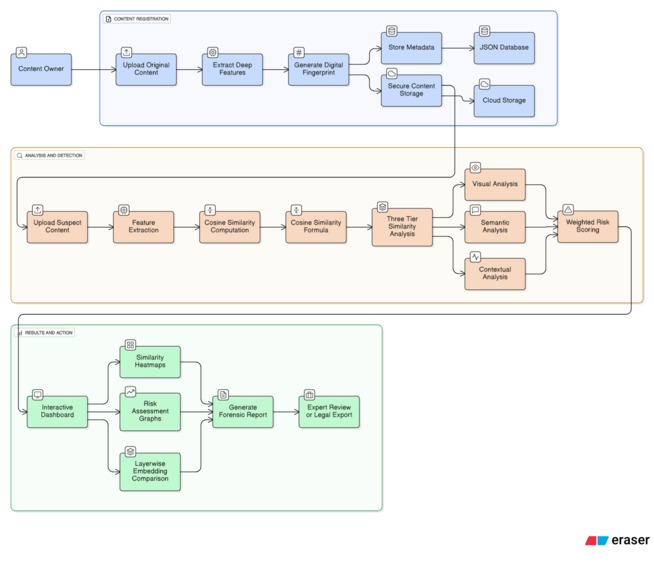
Phase 1: Content Registration
- User uploads original content (image or video).
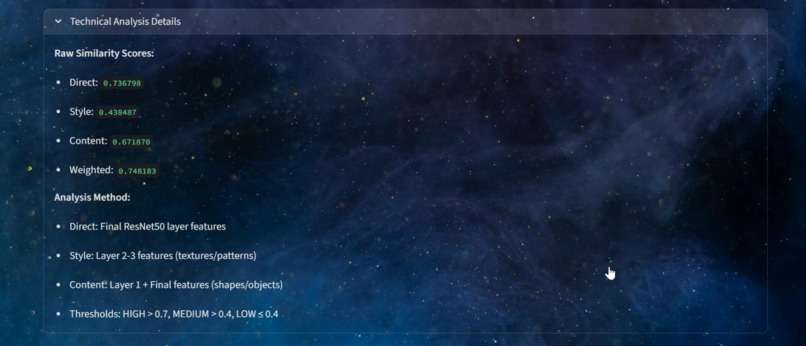
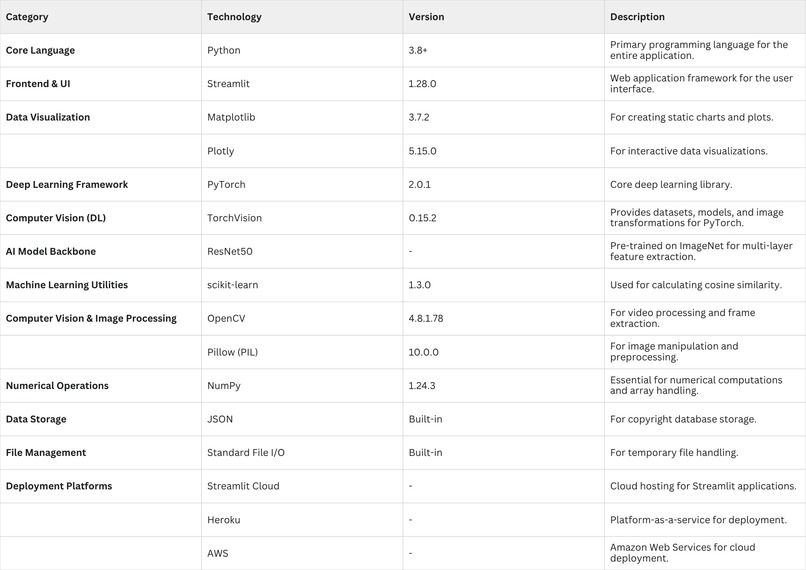
- The system generates a unique digital fingerprint using deep feature extraction via ResNet50.
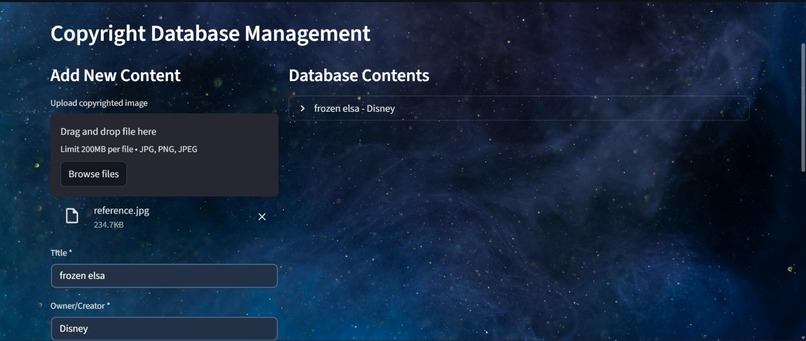
- Metadata such as title, creator, and description are stored securely in a JSON database.
Phase 2: Analysis & Detection
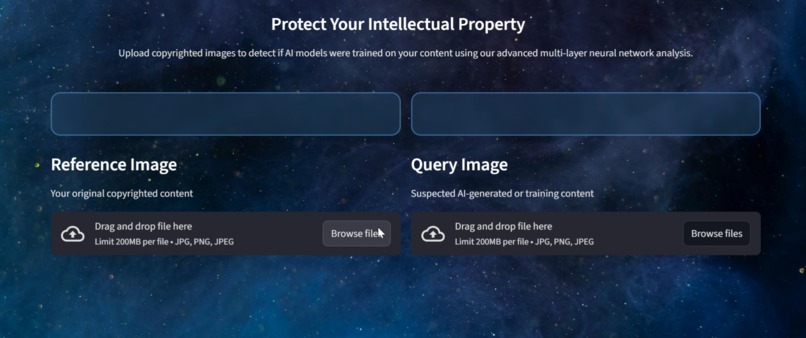
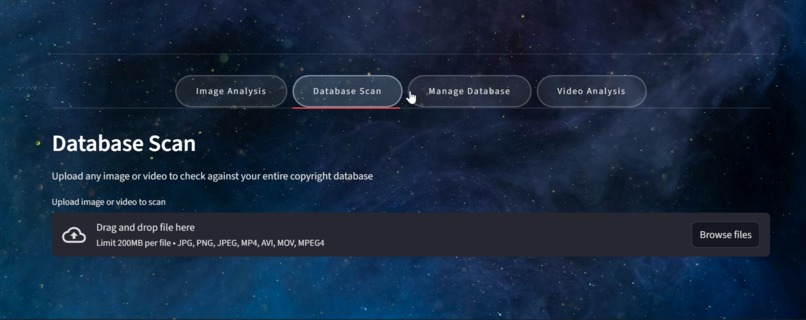
- User uploads suspect content for verification.
- COPYSCALE performs feature extraction using ResNet50 and compares embeddings using cosine similarity, defined as:
$$ \text{Cosine Similarity} = \frac{A \cdot B}{|A| |B|} $$
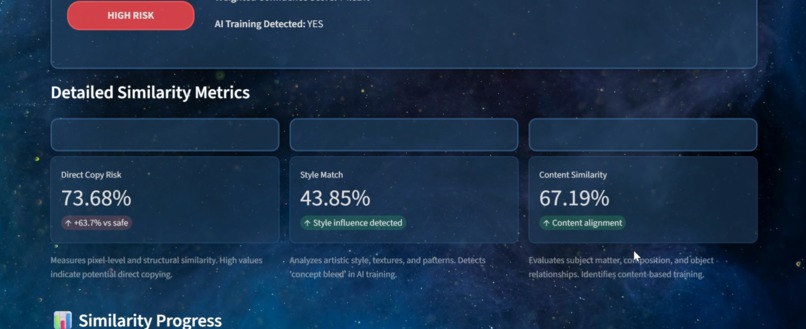
- A three-tier similarity analysis (visual, semantic, and contextual) computes a weighted risk score.
Phase 3: Results & Action
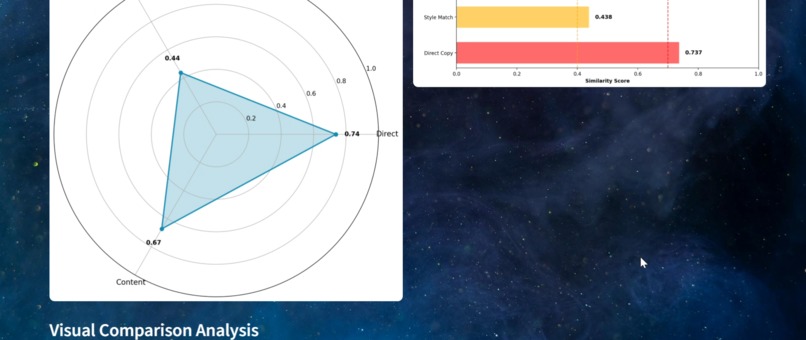
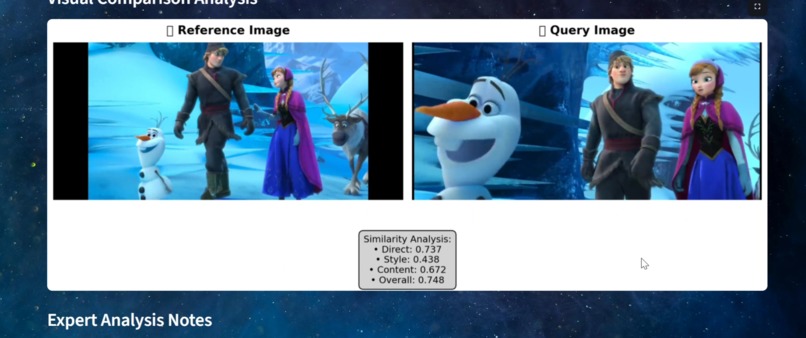
- The platform presents results in an interactive dashboard showing:
- Similarity heatmaps
- Risk assessment graphs
- Layer-wise embedding comparison
- Similarity heatmaps
- A forensic similarity report is generated, suitable for legal and compliance purposes.
How We Built It
The development of COPYSCALE followed a modular design integrating computer vision, deep learning, and data visualization.
Core Components
Feature Extraction Module
- Utilizes ResNet50 pretrained on ImageNet for hierarchical feature representation.
- Embeddings are normalized and stored as content fingerprints.
Similarity Computation Module
- Uses cosine similarity and multi-layer embedding comparison for robust detection.
- Operates across different neural abstraction levels to ensure accuracy.
Visualization & Reporting Layer
- Employs data visualization libraries for interactive and static plots.
- Generates a comprehensive forensic report summarizing findings.
Deployment
- Built in Python with Streamlit for a user-friendly web interface.
- Hosted on Streamlit Cloud, Heroku, and AWS for scalability and accessibility.
Challenges We Ran Into
Robust Detection of Altered Content:
Detecting similarities in modified media (cropped, recolored, stylized) required multi-level feature comparisons.Performance Optimization:
Processing high-resolution images and videos efficiently demanded optimization of batch sizes and GPU utilization.Scalable Fingerprint Storage:
Managing large volumes of feature vectors while maintaining retrieval speed led to a lightweight JSON-based schema.Interpretability of Results:
Translating high-dimensional similarity metrics into human-readable risk scores required visualization and normalization.Ethical and Legal Alignment:
Ensuring COPYSCALE’s outputs could serve as credible legal evidence required rigorous reporting framework design.
Accomplishments That We’re Proud Of
- Implemented a multi-layer neural similarity model capable of identifying subtle content reuse.
- Developed an end-to-end pipeline for content registration, analysis, and report generation.
- Built an interactive forensic dashboard for visualizing similarity metrics.
- Achieved high detection accuracy across various image and video transformations.
- Established a foundation for a transparent and ethical AI verification system.
What We Learned
- Deep feature embeddings from CNNs like ResNet50 capture semantic relationships beyond pixel-level similarity.
- Effective visualization enhances interpretability and user trust.
- Ethical AI design demands collaboration between ML, legal, and design experts.
- Streamlit enables rapid deployment of deep learning applications with intuitive UIs.
- Balancing computational efficiency and forensic accuracy remains a key technical challenge.
What’s Next for COPYSCALE
Blockchain Fingerprinting:
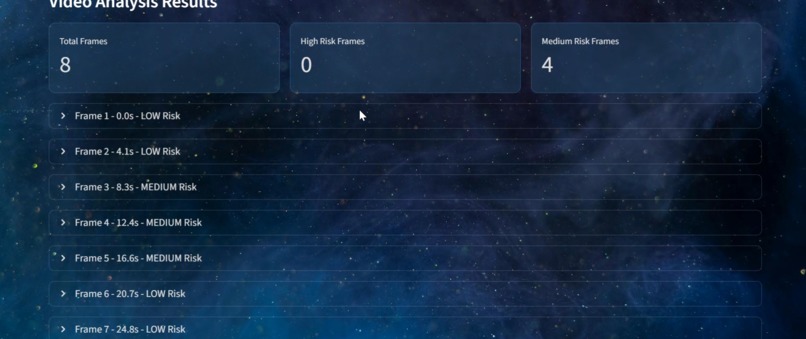
Integrate blockchain-based ownership proofs for tamper-proof digital verification.Video Timeline Analysis:
Extend similarity detection to frame-level and temporal tracking for partial reuse detection.Developer API:
Provide REST APIs for AI developers to verify originality of training datasets.Cross-Domain Expansion:
Add detection support for text and audio, covering multi-modal copyright protection.Partnerships and Compliance:
Collaborate with copyright boards, media organizations, and AI governance bodies to define ethical data verification standards.
Built With
- 3.8+)
- amazon-web-services
- cloud
- file
- heroku
- i/o
- json
- matplotlib
- numpy
- opencv
- pil)
- pillow
- plotly
- python
- pytorch
- resnet50
- scikit-learn
- standard
- streamlit
- torchvision

Log in or sign up for Devpost to join the conversation.