-
-
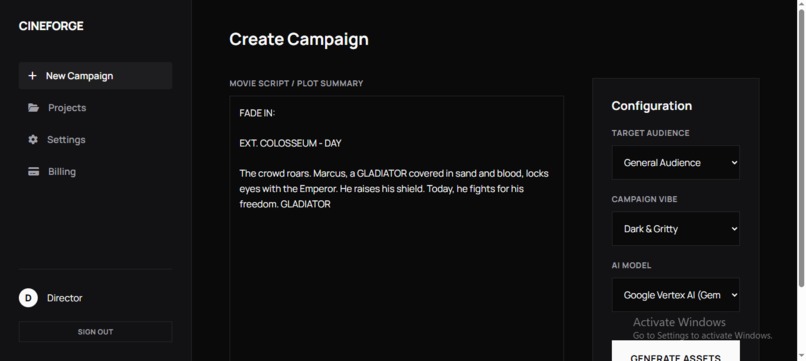
homepage
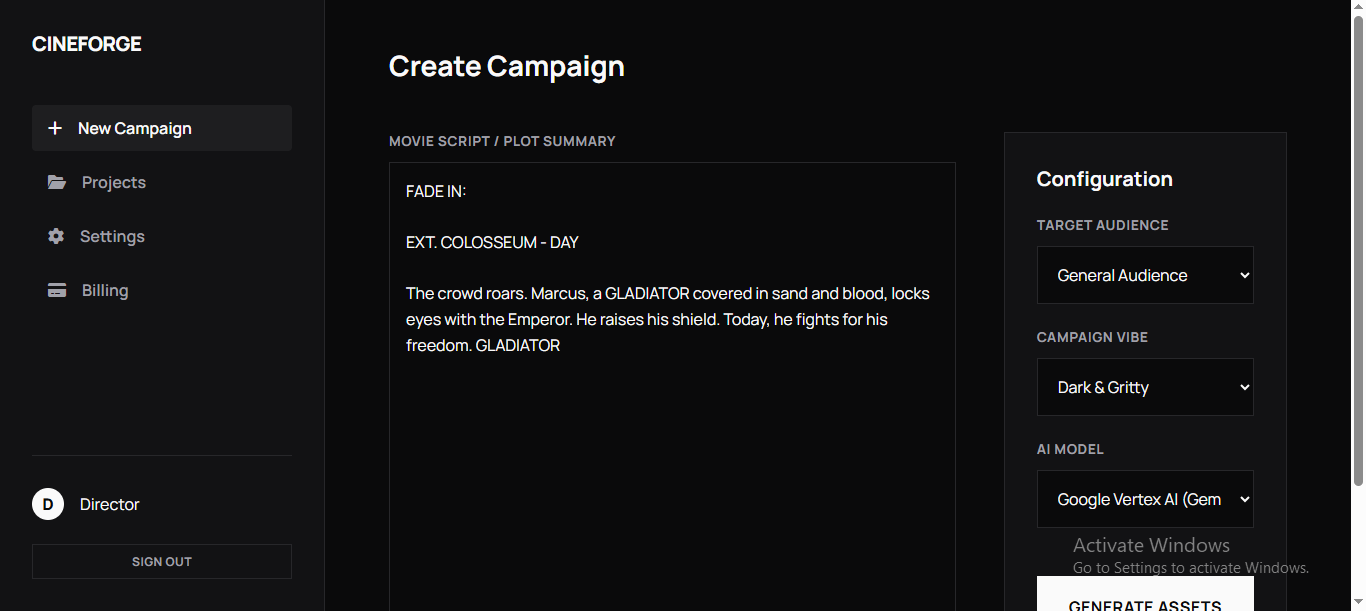
Inspiration
In the media and entertainment industry, producing a film is only half the battle; marketing it is often just as expensive and time-consuming. When a studio greenlights a script, they typically spend weeks hiring front-end developers, copywriters, and designers to build promotional campaign websites. We wanted to completely eliminate this friction by asking: What if an autonomous AI agent could read a raw movie script and instantly provision, design, and deploy a blockbuster marketing campaign on its own?
What it does
CineForge AI is a next-generation autonomous agent—a true "Taskmaster"—built for the entertainment industry. Instead of operating as a simple chatbot, CineForge takes real action.
You feed the agent a raw movie script, and it autonomously handles the heavy lifting in the background:
It analyzes the script to extract genres, themes, and lead characters. It engineers and styles a premium, dark-mode single-page web app (SPA) tailored to the film's aesthetic. It provisions a public GitHub repository and commits the code. It instantly deploys the live marketing site to Google Cloud Run. It securely logs projected Box Office and Rotten Tomatoes metrics to a live ClickHouse Cloud database for executive telemetry.
How we built it
We engineered CineForge AI with orchestration and enterprise scale in mind.
The Brains: We utilized Google Cloud Vertex AI (Gemma 2) as the core intelligence engine. Gemma 2 is responsible for parsing the complex script logic and generating the deterministic HTML, CSS, and JS assets. The Orchestration: We built the agent logic using Python, orchestrating the multi-step execution pipeline from text analysis to infrastructure-as-code generation. The Telemetry: We integrated ClickHouse Cloud using their native Python client to act as our real-time analytical backend. Every time the agent successfully provisions a new campaign, it executes a SQL transaction to securely log the film's engagement metrics into the ClickHouse data warehouse. The Deployment: The agent interfaces with the GitHub API to autonomously spin up repositories, acting as a bridge to deploy the final product to Google Cloud Run.
Challenges we ran into
Moving from a conversational LLM to an autonomous agent that writes and deploys its own code was a massive architectural shift. Our biggest challenge was ensuring Gemma 2 consistently returned strictly formatted code without conversational filler that would break the web deployment. Additionally, maintaining a secure, synchronous connection between the agent's background execution and our ClickHouse Cloud cluster required careful error handling and retry logic to prevent pipeline failures.
Accomplishments that we're proud of
We are incredibly proud of achieving a true "zero-click" workflow. Watching the agent take a raw block of script text and—without any human intervention—spin up a live, beautifully styled website while logging analytics to ClickHouse feels like magic. We successfully proved that agents can handle complex, multi-layered enterprise tasks safely and deterministically.
What we learned
We learned that the true power of Agentic AI lies in orchestration, not just generation. Connecting an LLM to deterministic infrastructure (like the GitHub API and ClickHouse databases) unlocks exponential value. We also gained deep, hands-on experience utilizing Google Cloud Vertex AI and structuring telemetry pipelines for AI systems.
What's next for CineForge AI
Currently, CineForge generates stunning web layouts and copy. Next, we plan to integrate multimodal video generation APIs (like Google Veo) so the agent can autonomously cut and embed video trailers into the campaign sites. We also plan to build out an executive dashboard on top of our ClickHouse database to visualize the telemetry data across hundreds of autonomously generated campaigns.
Built With
- clickhouse
- gemma-2
- github-api
- google-cloud
- langchain
- python
- vertex-ai

Log in or sign up for Devpost to join the conversation.