Inspiration
A great movie script is only the beginning—marketing and promoting it often requires an entire digital agency. We were inspired to build an AI that doesn't just "chat" with you about your movie, but actually does the work. We wanted to bridge the gap between creative writing and digital marketing by building an autonomous agent capable of turning a raw script into a fully deployed promotional campaign in seconds.
What it does
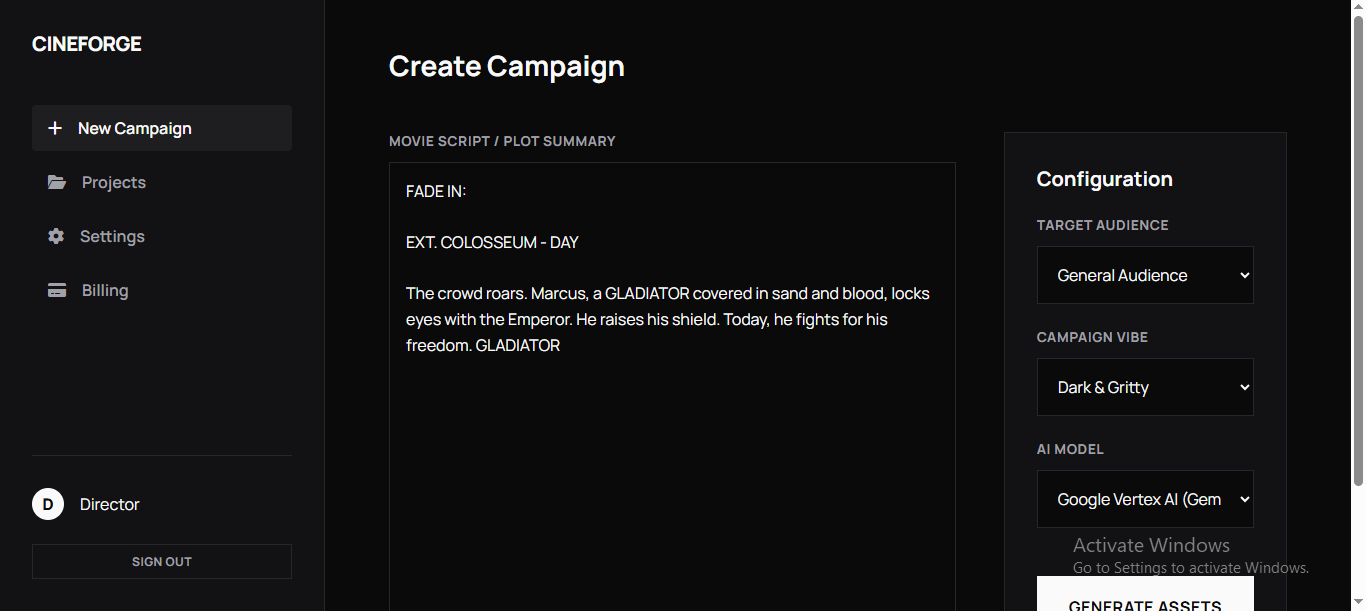
CineForge AI acts as an autonomous Cinematic Campaign Architect. You feed it a movie script or plot summary, and the agent takes over:
- Analysis & Planning: It analyzes the plot, characters, and tone of the script.
- Code Generation: It autonomously generates the complete frontend code (HTML, CSS, JS) for a single-page promotional website, strictly adhering to a "brutalist, ultra-minimalist" design language (actively avoiding tropes like rainbow colors or drop shadows).
- Tool Execution: Using our custom
GithubDeployertool, the agent autonomously authenticates with GitHub, creates a repository, and pushes the generated campaign files live to the web.
How we built it
We built the core agent loop using Python and LangChain.
- The Brain: The agent is powered by Google Cloud Vertex AI (Gemma) / Fireworks AI. We engineered strict system prompts to force the model to output parsed JSON containing the web files, enforcing rigid UI constraints.
- The Tools: We developed a custom
github_deployer.pyusing thePyGithublibrary. The agent calls this tool to programmatically wipe old repositories, initialize new ones, and push the generated code without human intervention. - Resilience: We implemented a local fallback mechanism that automatically mocks the GitHub deployment to local files if cloud credentials expire or fail.
Challenges we ran into
Getting an LLM to reliably output clean, multi-file code without hallucinating markdown blocks or breaking JSON syntax was incredibly difficult. We had to implement aggressive RegEx cleaning steps in the agent's pipeline. Additionally, controlling the AI's "design taste" was a challenge; we had to explicitly blacklist "forbidden tropes" in the prompt to force the agent to use the sharp, monochrome brutalist aesthetic we wanted.
Accomplishments that we're proud of
We are incredibly proud of achieving a true "agentic loop." CineForge AI isn't a simple chatbot—it takes a high-level goal (a script), makes architectural decisions, generates multiple structured files, and successfully executes external tools (GitHub API) to deliver a finished, deployed product.
What we learned
We gained deep hands-on experience with LangChain's tool-use capabilities and learned how to build resilient agents that can gracefully degrade (e.g., falling back to a local mock mode). We also learned advanced prompt engineering techniques to strictly constrain an LLM's stylistic output.
What's next for CineForge AI: Cinematic Campaign Architect
We plan to upgrade the agent with even more tools:
- Web Search: To autonomously research current movie marketing trends and adapt the site's copy.
- Image Generation Integration: Giving the agent a tool to generate and embed cinematic posters directly into the HTML.
- Domain Tools: Allowing the agent to automatically purchase and route a custom domain name for the campaign.
Built With
- agents
- artificial-intelligence
- css3
- github-api
- google-cloud
- html5
- langchain
- prompt-engineering
- python
- vertex-ai

Log in or sign up for Devpost to join the conversation.