-
-
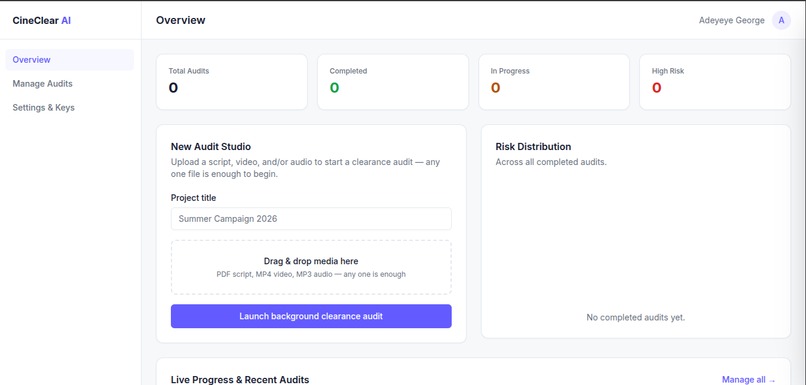
Dashboard
-
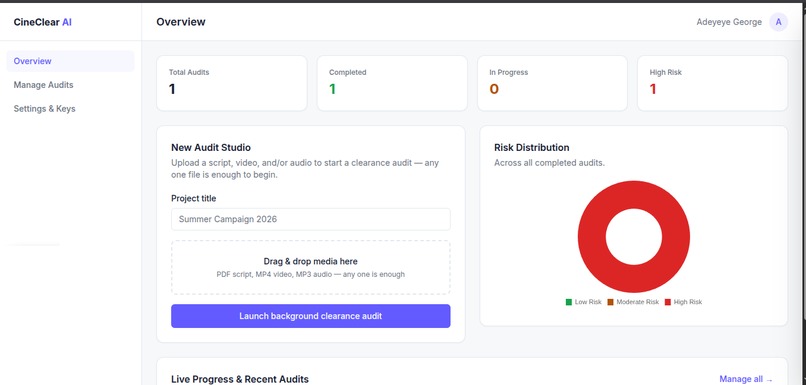
Dashboard
-
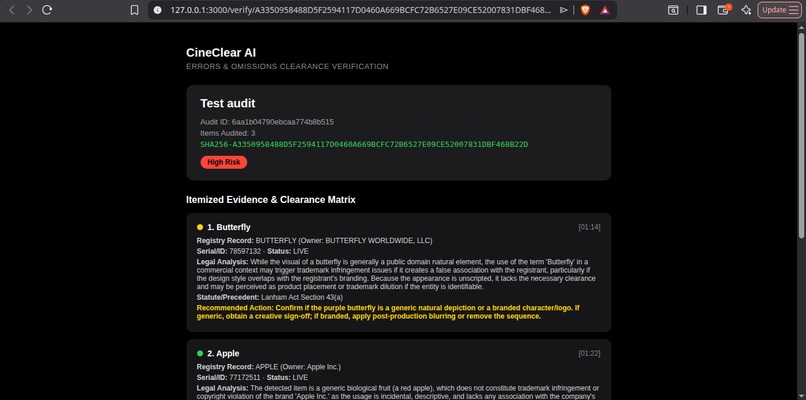
Certificate
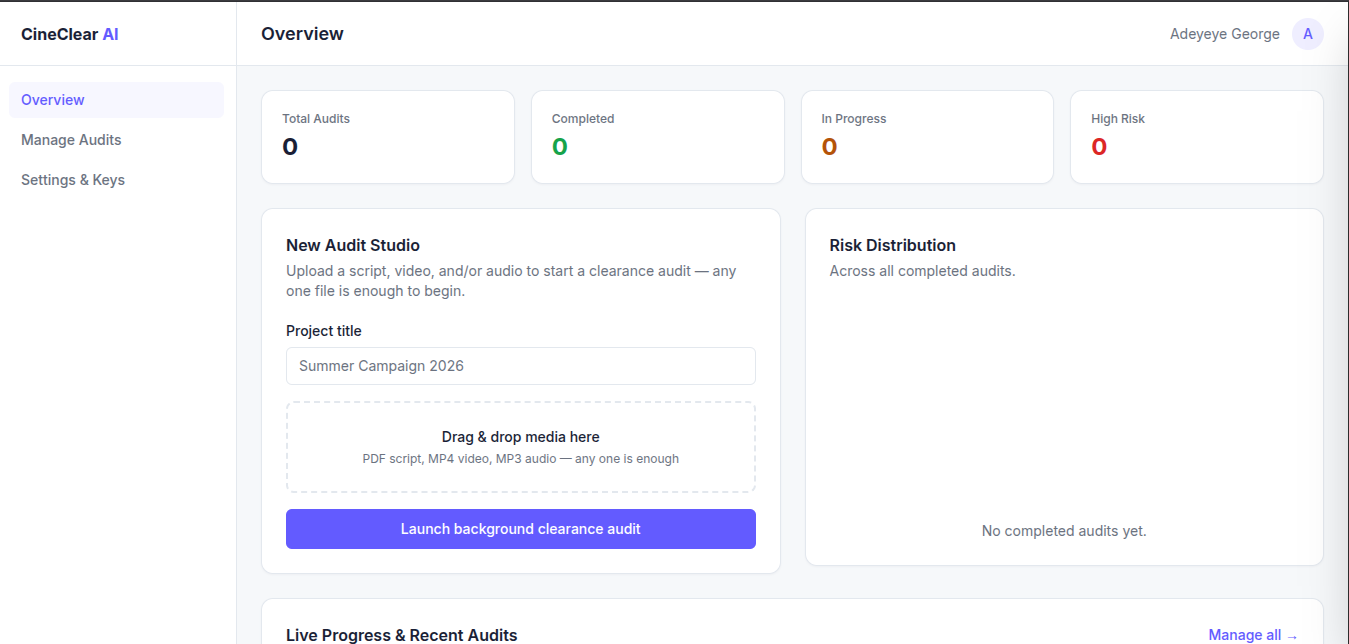
Inspiration
Every filmmaker knows the gut-wrenching, sinking feeling. It’s 3 AM, the picture is finally locked, the budget is exhausted, and then someone notices it: a recognizable brand logo on an extra’s jacket, a popular song fading in during the final montage, or a landmark that requires a filming permit nobody pulled. None of it was in the original script. None of it was cleared.
In an instant, months of grueling, passionate work are threatened. The financial stakes are catastrophic: a single uncleared asset can trigger a six-figure lawsuit, force a costly reshoot, kill a distribution deal, or cause a blanket denial of Errors & Omissions (E&O) insurance.
Today, preventing this financial hemorrhage relies on overworked paralegals and business affairs associates manually scrubbing a video frame-by-frame against a script, then searching trademark and music registries one entity at a time. It is agonizingly slow, exorbitantly expensive (often costing thousands of dollars in billable hours per project), and under crushing deadlines, things will slip through the cracks.
We built CineClear AI because creators deserve peace of mind, and productions deserve financial protection. We wanted to build a guardian for the editing room—a tool that catches the risks before the lawyers do, saving productions from devastating financial penalties and sparing legal teams from soul-crushing burnout.
🎬 What it does
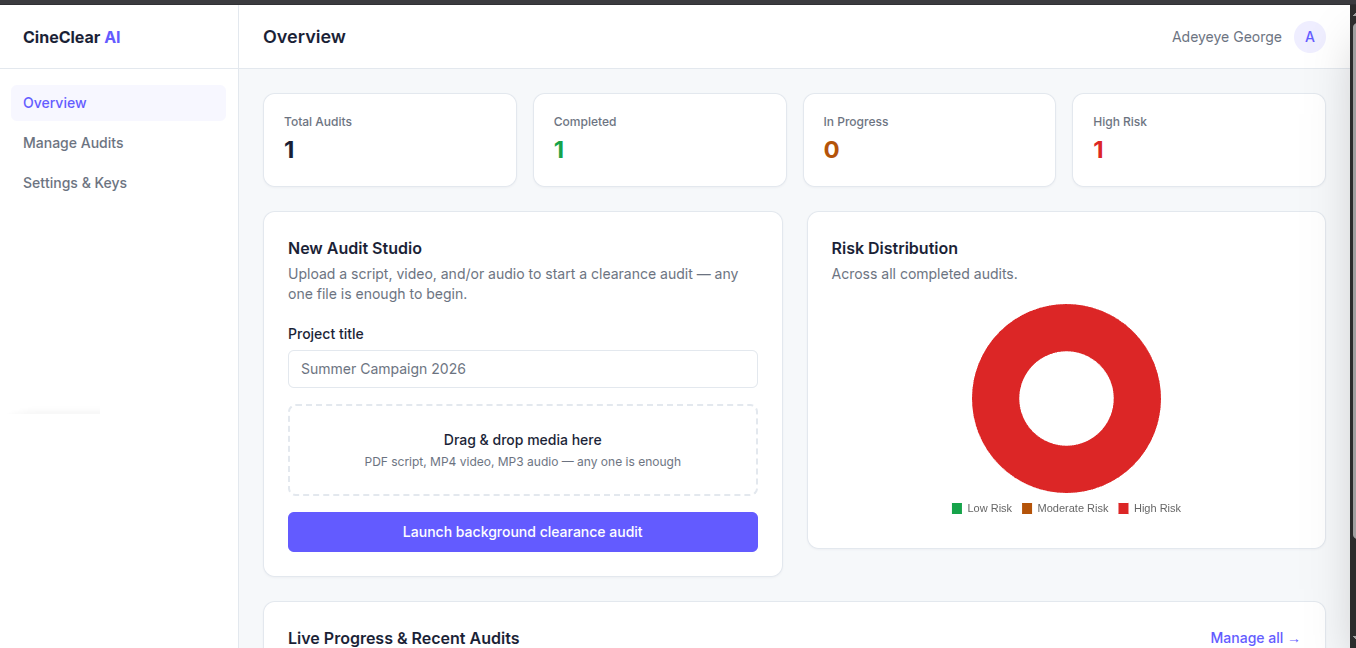
CineClear AI is an automated legal clearance engine that replaces expensive, manual billable hours with milliseconds of precise, AI-driven analysis.
It reads your script, watches your cut, and listens to your audio—all at once. Instead of relying on outdated, static "brands to watch" lists, CineClear cross-references every detected entity against live public registries (USPTO, WIPO, ASCAP, BMI). It intelligently flags costly discrepancies between what was declared in the script and what actually made it on screen or into the mix.
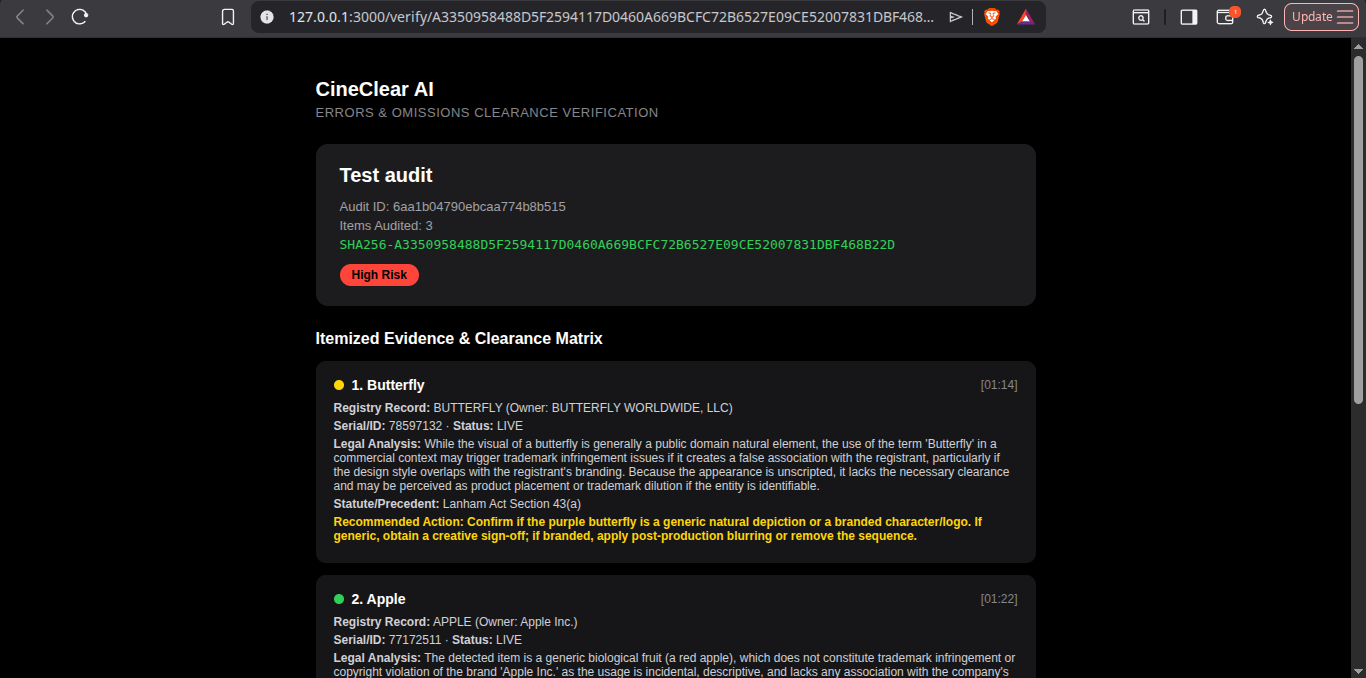
But we didn’t just stop at flagging risks. For every completed audit, CineClear generates a cryptographically verifiable certificate. A SHA-256 fingerprint of the full evidence matrix is embedded in a QR code and published to a public, no-login verification page.
CineClear doesn’t replace the lawyer who signs off on a release. It replaces the eight hours of tedious, $200+/hour manual cross-referencing a legal team spends before the lawyer ever sees the cut. It democratizes high-end legal protection, making it accessible to indie filmmakers who can’t afford a $10,000 clearance budget, while saving major studios hundreds of thousands in wasted legal review time.
🛠️ How we built it
We refused to build a fragile, monolithic hack. We engineered a resilient, production-grade architecture designed to handle high-stakes liability with speed, security, and cost-efficiency:
- Blazing Fast, Non-Blocking API: We chose Fastify 5 for its low overhead. To ensure a 20-minute video render never triggers expensive API timeouts or holds a browser tab hostage, we decoupled the system. The API instantly returns a
202 Acceptedand hands the heavy lifting to a BullMQ + Redis background worker, optimizing compute costs. - Multimodal AI Orchestration: We leveraged Google Gemini to natively process text, PDFs, embedded images, video keyframes, and audio tracks in a single, cohesive pass, eliminating the need for multiple disjointed (and costly) AI API calls.
- Live Registry Grounding: We integrated the Parallel Web API to perform real-time searches against actual legal databases, ensuring every flag is backed by real-world data, not expensive AI guesswork.
- Ironclad Security & Validation: In legal tech, a hallucination is a liability. Every LLM response and database write is strictly validated using Zod 4 schemas. User-supplied API keys are encrypted at rest using AES-256-GCM, ensuring enterprise-grade security.
- Tamper-Proof Verification: We used PDFKit and
qrcodeto generate downloadable E&O certificates, anchored by a SHA-256 hash of the evidence matrix, creating an undeniable audit trail.
🚧 Challenges we ran into
- The Cost of AI Hallucination vs. Legal Precision: AI can be creative; the law does not forgive mistakes. A false negative could mean a $100k lawsuit; a false positive wastes a lawyer's expensive time. We solved this by forcing every AI extraction through strict Zod schema validation and requiring the Parallel Web API to ground every single claim with a live, citable registry record before it’s flagged to the user.
- The "Hanging Browser" and Compute Drain: Early in development, processing a long video would timeout the HTTP request, freezing the user experience and wasting server resources. Architecting the decoupled Fastify-to-BullMQ pipeline was a steep learning curve, but it was the only way to guarantee a sub-50ms API response time and efficient resource allocation regardless of queue size.
- Multimodal Context Alignment: Getting the AI to reliably correlate a visual frame, an audio snippet, and a line of script text simultaneously was incredibly complex. We had to carefully orchestrate
ffmpegkeyframe extraction andpdfjs-distparsing to feed the AI the exact right context, minimizing token usage and maximizing accuracy.
🏆 Accomplishments that we're proud of
- Building a Real, Testable Product (Not Just a Mock): We didn’t fake our way to a demo. We wrote 188 tests with 0 failures, utilizing real FFmpeg pipelines, real Redis/BullMQ round-trips, and real PDF generation/parsing. We proved this system can handle real-world media, not just toy examples.
- Script-vs-Screen Discrepancy Detection: Successfully teaching the system to catch a prop swapped on set that was never in the legally reviewed script. This specific blind spot has cost real productions massive reshoot fees, and we automated its detection.
- The Cryptographic Certificate: Turning an AI audit into a legally defensible, tamper-proof artifact. The fact that anyone can independently verify an audit at
/verify/:hashwithout logging in is a huge leap forward in transparency and trust for media clearance. - Democratizing Legal Protection: Building a highly responsive, beautiful frontend using Vanilla JS and Tailwind CSS v4, served directly by Fastify, proving you don’t need a heavy, expensive tech stack to deliver a tool that saves independent creators from financial ruin.
🧠 What we learned
- Technical: The immense value of dependency injection in complex media pipelines. By designing our services to be injectable, we could test the actual logic with real tools (like synthetic FFmpeg videos) instead of reimplementing logic in mocks, saving us countless hours of debugging.
- Domain: The legal clearance bottleneck isn’t a lack of effort; it’s an outdated, financially draining workflow. We learned that AI’s most profound, immediate impact in media might not be generating content, but protecting it and giving creators their time and money back.
- Team: The critical importance of "failing loudly." By enforcing strict Zod validation at the boundary of every AI and API call, we learned that catching malformed data early is the only way to maintain trust in an AI-driven system where the cost of failure is so high.
🚀 What's next for CineClear AI
- Deeper NLE Integration: Building plugins for Premiere Pro and DaVinci Resolve so clearance checks can happen during the edit. Catching an uncleared asset at minute 14 of editing saves the massive cost and pain of a full re-export and re-review after picture lock.
- Global Registry Expansion: Expanding beyond USPTO/WIPO/ASCAP/BMI to include international film commissions, global music rights organizations, and talent guild databases to protect productions distributing worldwide.
- Collaborative Legal Workspaces: Adding role-based access for legal teams to comment on, dispute, or resolve flagged items directly within the CineClear dashboard, complete with audit trails to further reduce billable coordination hours.
- Preliminary "Fair Use" Analysis: Exploring safe, bounded AI reasoning to provide initial context on borderline cases (e.g., incidental capture or editorial use), giving lawyers an even stronger, more cost-effective starting point for their review.
Built for productions that would rather catch it before the lawyers do. 🎬

Log in or sign up for Devpost to join the conversation.