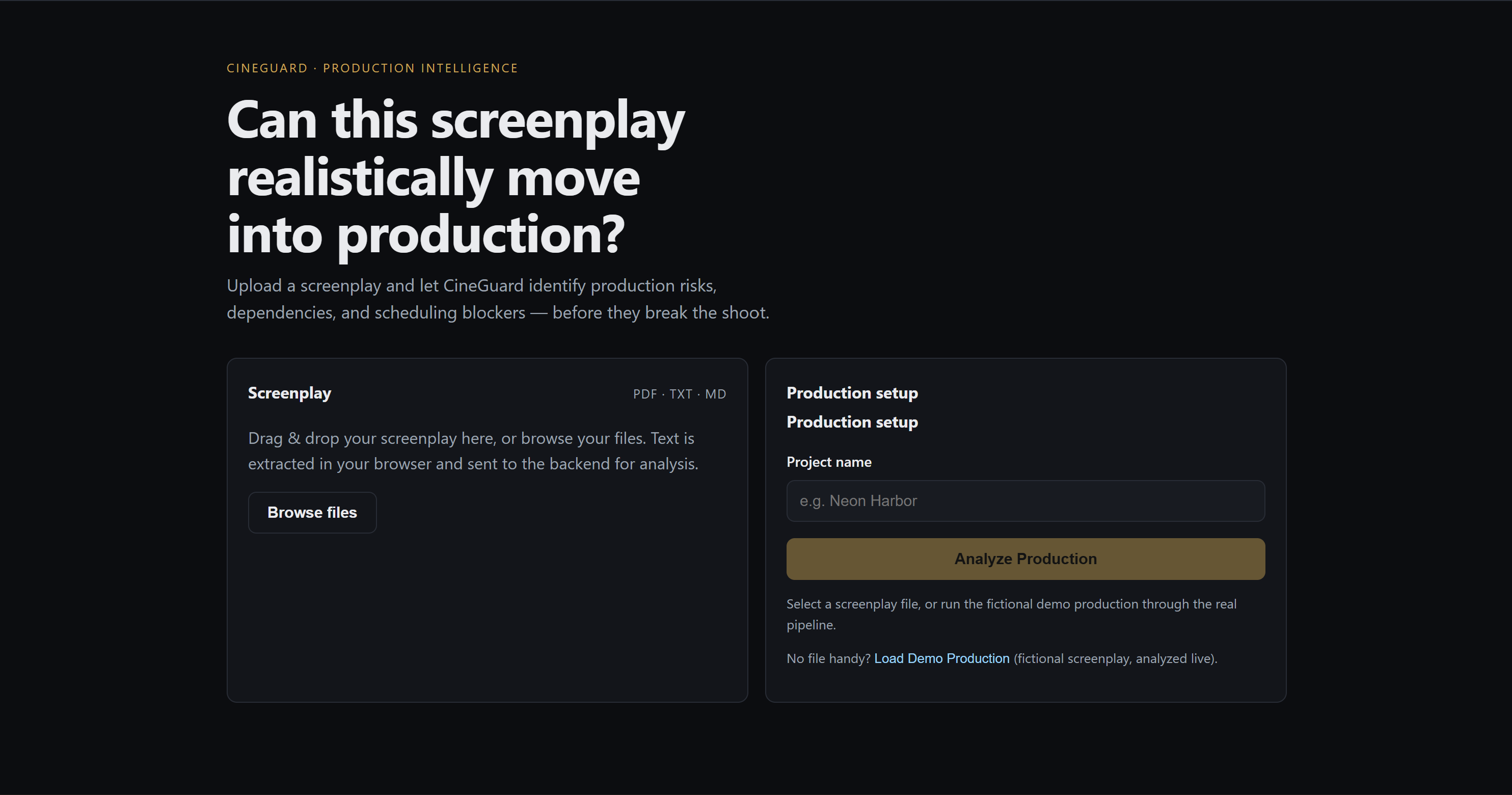
CineGuard — AI Production-Risk Agent
The Problem
A screenplay tells a story, but it does not tell a production team whether that story is actually ready to shoot.
A single scene can hide dependencies involving locations, permits, schedules, vehicles, weather, cast, VFX, equipment, music, and other real-world constraints. These dependencies are often scattered across hundreds of pages and may require information that does not exist inside the screenplay at all.
When these problems are discovered late, the result can be schedule changes, production delays, or expensive reshoots.
Our Solution
CineGuard is an autonomous production-risk agent that turns a screenplay into a live production intelligence system.
Instead of acting as a chatbot that waits for questions, CineGuard follows a workflow:
Screenplay → Analyze → Research → Detect Risks → Reason → Mitigate → Verify
It analyzes the screenplay, identifies production dependencies, determines which dependencies require external research, uses Parallel Search at runtime to investigate those dependencies, and then reasons over the combined screenplay and research evidence.
The result is a production risk map, an explainable readiness score, and an actionable mitigation plan.
How It Works
1. Screenplay Analysis
CineGuard uses Gemini to understand the screenplay and extract structured production information including:
- scenes
- characters
- locations
- time of day
- props
- vehicles
- stunts
- VFX
- weather dependencies
- scheduling dependencies
- other production constraints
The model output is schema-validated before it enters the production pipeline.
2. External Research
Not every production dependency can be answered from the screenplay.
CineGuard's Research Agent identifies which dependencies require external information and creates targeted research queries.
Those queries are sent to Parallel Search at runtime.
The returned evidence is retained with provenance so the system can distinguish researched information from screenplay facts and model inference.
3. Risk Reasoning
Gemini reasons over:
Screenplay facts + external research evidence
to identify production risks.
Every important piece of information is classified as:
SCREENPLAY_FACTRESEARCHED_FACTINFERENCEUNKNOWN
This is important because CineGuard should know when it does not have enough information rather than confidently inventing an answer.
4. Deterministic Readiness
Gemini does not simply make up a readiness percentage.
Gemini produces structured risk assessments, while CineGuard's backend calculates the final readiness score deterministically from the unresolved risks, severity, confidence, and mitigation state.
This makes the score explainable and reproducible.
5. Production Mitigation
CineGuard does not stop at finding problems.
A producer can select recommended mitigations and generate a revised production plan.
The system then calculates:
- projected readiness
- mitigated risks
- remaining blockers
- affected dependencies
- schedule impact
This creates a closed loop:
Find the problem → investigate it → understand the risk → change the plan → verify the result.
Why We Built It
We wanted to explore what happens when an AI agent is given responsibility for a real production decision rather than simply generating text.
Film production is a particularly interesting environment for agentic systems because a screenplay contains structured information, while many of the facts required to execute it live outside the screenplay.
That makes the workflow naturally agentic:
understand → decide what needs investigation → research → reason → recommend → verify.
What We Learned
Building CineGuard taught us that a useful agentic system needs more than a powerful model.
The most important parts were:
- giving agents clearly defined responsibilities
- separating reasoning from deterministic business logic
- treating external research as evidence rather than instructions
- explicitly representing uncertainty
- preserving evidence provenance
- making long-running agent workflows observable
- designing the interface around decisions rather than conversations
One of our most important design decisions was keeping the final readiness calculation outside the model. Gemini is responsible for understanding and reasoning; the backend is responsible for deterministic state and scoring.
Challenges
One of the biggest challenges was connecting unstructured screenplay content to structured production decisions.
The system had to extract useful information from screenplay text while preserving the distinction between what the screenplay explicitly says, what external research establishes, what the model infers, and what remains unknown.
Another challenge was making external research reliable enough for a production workflow. CineGuard therefore uses targeted Parallel searches rather than blindly searching every piece of screenplay text, and retains the resulting evidence and provenance.
We also had to design the system so screenplay content and external web content are treated as untrusted data. Content being analyzed must not be allowed to override the agent's instructions.
Agent Architecture
CineGuard uses a multi-agent architecture built around Google ADK and Gemini:
                    CineGuard
                        |
                        v
                Screenplay Input
                        |
                        v
             Screenplay Analysis Agent
                        |
                        v
             Production Dependencies
                        |
                        v
                 Research Agent
                        |
                        v
               Parallel Search API
                        |
                        v
                 Research Evidence
                        |
                        v
              Risk Analysis Agent
                        |
                        v
              Readiness Engine
                        |
                        v
          Production Planning Agent
                        |
                        v
              Revised Production Plan

Gemini provides screenplay understanding and reasoning.

Parallel provides fresh external web research.

The backend provides deterministic scoring, state management, validation, and persistence.

Built for the Parallel Track

Production risk frequently depends on information that is outside the screenplay.

That is why Parallel is not a decorative integration in CineGuard.

The Research Agent decides which production dependencies need external investigation, then CineGuard makes real Parallel Search API requests at runtime and feeds the resulting evidence into the risk-analysis workflow.

Parallel is therefore part of the core product loop:

Production Dependency → Parallel Search → Evidence → Risk → Mitigation

Impact

CineGuard is designed to help producers and production teams identify hidden dependencies earlier, understand which ones are blocking production, and evaluate potential fixes before those problems become expensive schedule disruptions or reshoots.

The long-term vision is a production intelligence layer that can sit between a screenplay and the practical realities of making the film.

Technology
Gemini
Google ADK
Google Cloud / Vertex AI credential support
Parallel Search API
Python
FastAPI
Next.js
TypeScript
SQLite
Try CineGuard

Load the fictional demo production and run the complete workflow:

Screenplay → Gemini → Parallel Research → Risk Analysis → Readiness → Mitigation Plan

The demo screenplay is fictional and is designed specifically to demonstrate production dependencies and risk analysis.

Open Source

CineGuard is released as an open-source project.

See the repository for setup instructions, architecture documentation, and implementation details.
Built With
- adk
- ai
- cloud
- fastapi
- gemini
- next.js
- parallel
- python
- sqlite
- typescript
- vertex

Log in or sign up for Devpost to join the conversation.