-
-
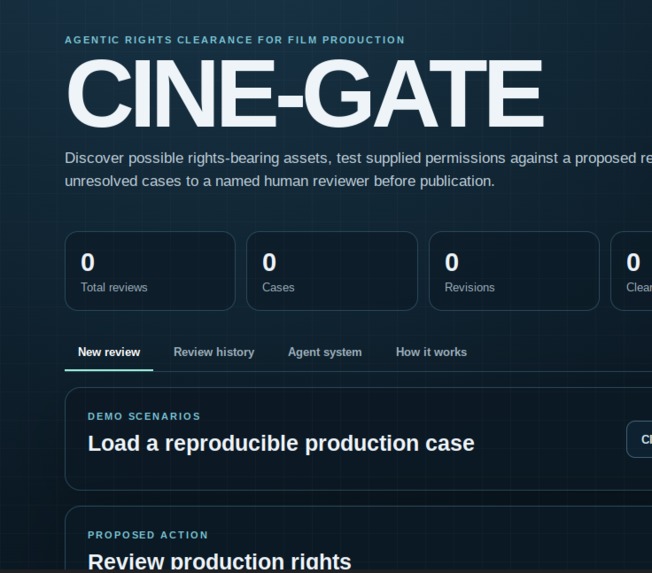
CINE-GATE platform interface showcasing secure AI runtime governance, human authorization workflows, audit visibility and execution control.
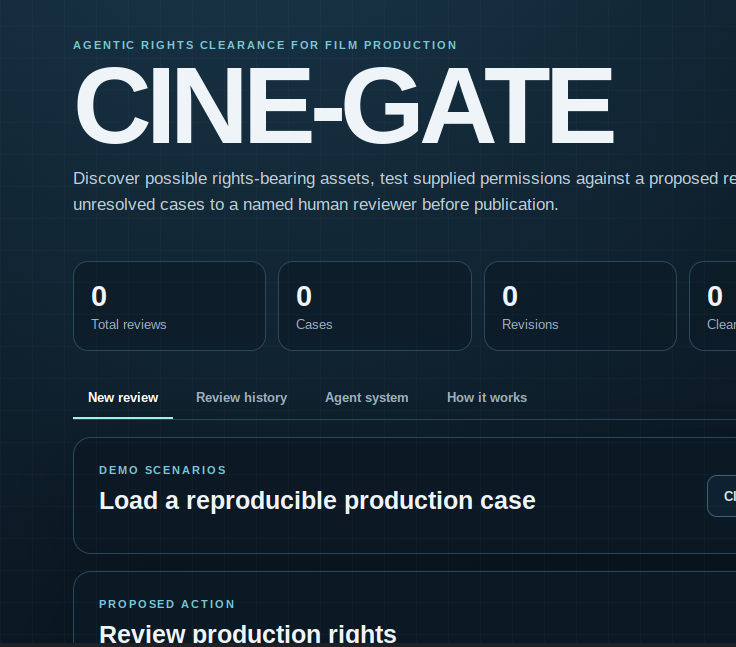
Inspiration
Film production is increasingly shaped by AI generated voices, likenesses, music, footage and automated creative workflows. Content may be technically ready for release while the required permissions, licences, territorial rights or human approvals remain incomplete.
CINE GATE was created to address this problem before publication or distribution takes place.
What it does
CINE GATE is an AI assisted rights clearance and human review system for film and media production.
A production team submits a proposed release together with its assets, permissions, licences, intended territories, distribution channels and usage conditions.
The system examines whether the available evidence covers the intended use and produces one of three outcomes: CLEARED, REVIEW REQUIRED or BLOCKED.
It identifies missing or expired permissions, territorial restrictions, unsupported commercial use, synthetic voice or likeness concerns, incomplete attribution requirements and evidence that does not match the proposed release.
Each assessment includes an asset level rights matrix, explainable findings, suggested corrective actions, a coverage score and an audit record. Cases requiring judgment remain subject to explicit human review.
How we built it
CINE GATE was developed as a new and independent web application using Python and FastAPI, with a browser based interface and persistent case records.
Its architecture separates deterministic rights checks, AI assisted evidence analysis, human review, reporting and audit evidence.
The current system includes revision controlled cases, printable reports, JSON evidence export, integrity checks, release packages, automated tests and deployment preparation.
The competition version is being prepared for live integration with Gemini, Google Cloud agent services and an IBM Bob assisted development workflow.
Challenges we ran into
The main challenge was designing an AI assisted workflow that remains useful without allowing an AI model to make unsupported legal conclusions.
CINE GATE does not present itself as legal advice. It identifies evidence gaps, inconsistencies and review requirements while preserving human control over consequential release decisions.
Another challenge was keeping the project narrowly focused on film rights clearance while building enough structure to support realistic production workflows.
Accomplishments that we're proud of
CINE GATE provides asset level rights and permission analysis, explainable CLEARED, REVIEW REQUIRED and BLOCKED outcomes, a human review workflow, revision history, rights matrix and evidence package exports, an audit timeline, integrity checks, automated tests and cloud deployment preparation.
The system was designed as a complete product workflow rather than a simple demonstration screen. It supports evidence review, correction, reassessment and accountable human intervention before content is released.
What we learned
Building CINE GATE reinforced that responsible AI is not only about the quality of model outputs.
It also depends on evidence, permissions, scope, accountability and the ability to stop or escalate an action before release.
The project also demonstrated that AI can support complex production decisions without replacing the people who remain responsible for approving them.
What's next for CINE-GATE
The next stage is to complete the live Gemini and Google Cloud agent integration, document the IBM Bob development workflow, deploy the hosted demonstration and test the full release clearance process with realistic production scenarios.
Further development will focus on stronger evidence ingestion, production team collaboration, configurable rights policies and clearer release readiness reporting.

Log in or sign up for Devpost to join the conversation.