-
-
Churuata Digital
Inspiration
In 2020, the Venezuelan/Colombian foundation Refugiados Unidos contacted Condast with the request to look for ways to connect the network of Refugee Led Organisations (RLO's) based in Colombia who work with and for Venezuelan refugees and displaced people to integrate into their host communities. The Venezuelan refugee displacement is at 6 million and rising, they include los caminantes , or 'the walkers', who are walking the continent fleeing hunger and the political/social disintegration of their homeland. The distinctive characteristic of an RLO that distinguish them from other NGOs or international organisations, such as the UNHCR or the OIM, is that they are led by refugees for refugees. This translates to lived experience knowledge of what is needed, in what location and at given time. RLO's are organizations with real know-how that offer wrap around services but are minimally funded and benefit from working together. However they have few resources available for networking. Creating a digital space where they can collaborate and communicate with refugees will get resources to people who need them in the moment they need them.
Refugiados Unidos is an RLO that is working to fund other RLO's, and they are part of a movement that is seeking to change the aid perspective worldwide from western based aid organisations to local initiatives. They proposed an online platform, the Churuata Digital, that aims to inform refugees about possible help in their immediate area, but which at the same time allows every RLO to become an information hub of other possible forms of aid that is offered. A refugee is usually not really helped with an occasional meal or a band-aid, if long term needs are not addressed. Churuata Digital aims to present an immediate overview of relevant aid that especially refugee families can find in the vicinity. As most families do have a mobile phone, the platform should be simple, and optimised for mobile use. In february 2022, just when the Million Dollar Challenge was published, Condast was able to offer the Churuata Digital as a project to three second-year students ICT at the Windesheim University of Applied Science in Almere, the Netherlands. They have been working on the platform ever since, and will keep on doing so until the end of the school term. The aim is to develop a demonstrator, that can be used as a base for an actual platform for refugees. The source code is made available under an Apache 2 open source license. Because of organisational issues, Refugiados Unidos is not the principal owner of the platform, but is part of the creative design process. When the Ukrainian Refugee movement started, it was decided to design the platform for this group in mind, using the learning from the experiences of Venezuelan refugees movement throughout South America. There are many groups helping but the lack of coordination between RLOs and other organizations translates into lost resources and opportunities.
What it does
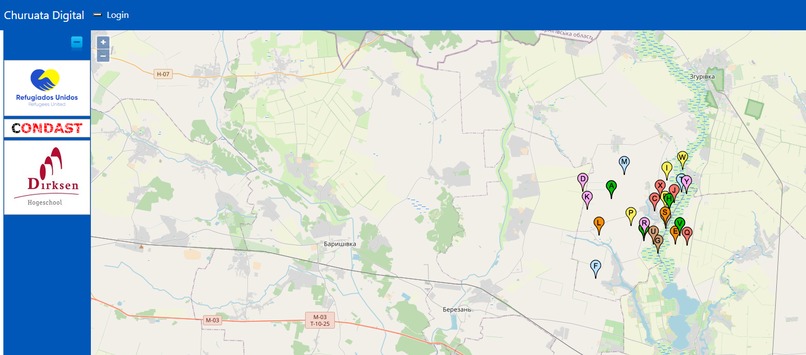
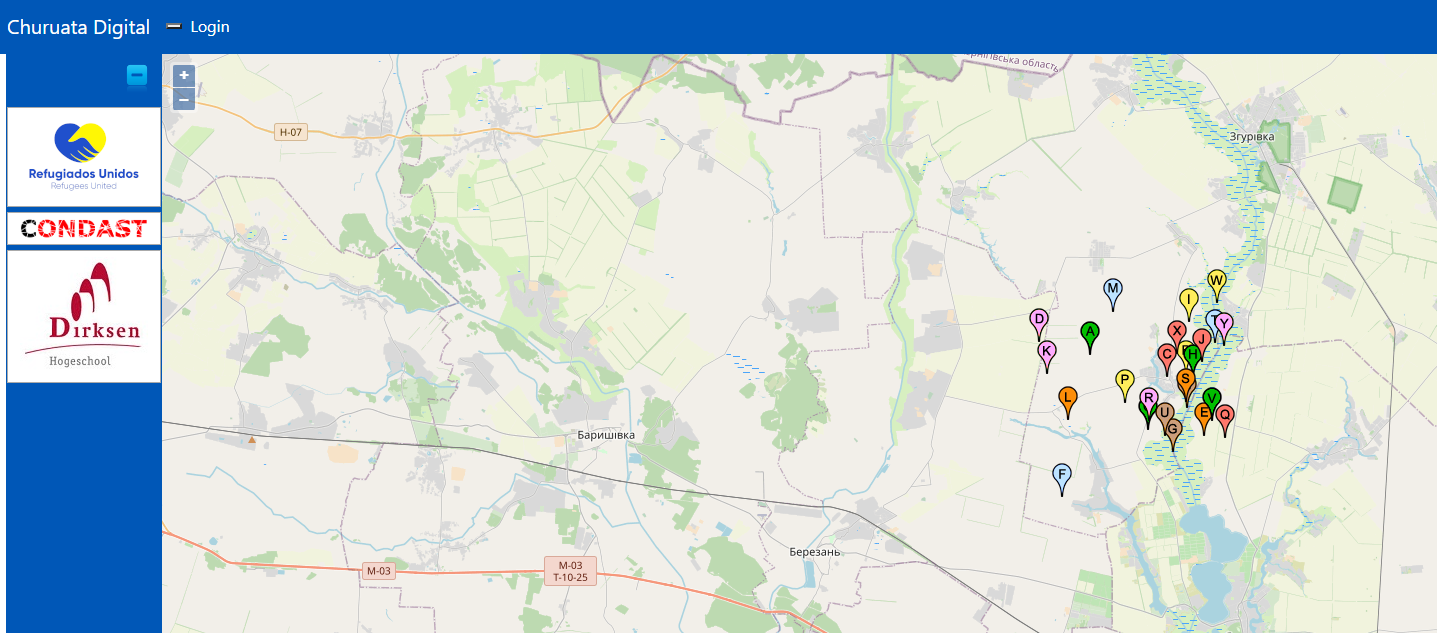
In itself the app is fairly simple. The main entry point is a location (latitude and longitude), which can be supplied with an optional address. The location is augmented with one or more services , such as food, shelter, medicine, education, legal aid, and so on. RLO's can register themselves with the services they provide, and the time periods in which these services are available. This part of the app is a fairly straightforward web application. The application for the refugees is even more simple, and is based on a map of the immediate environment, with markers showing the principal services that are offered. When someone clicks on the marker, a simple list of available services is displayed, including services on offer from other RLO's in the neighbourhood, or services that can be offered online, such as legal aid. This part of the application is based on an older demo that is still available here, and is currently being rewritten for the TigerGraph platform.
How we built it
The original demonstrator was built in JAVA/OSGI, using REST services to connect to a front-end that mainly uses html and javascript. The version that is submitted for the hackathon is aimed to be a fully new application, using the TigerGraph database, python, and HTML/Javascript, using the tools that TigerGraph offers as much as possible.
Challenges we ran into
The main reason why this application, despite its apparent simplicity, needs a graph database, is because of the enormous differentiation of services that can be offered, and which is difficult to implement in a tradional SQL database. It must be possible to expand the main categories of services if this is needed, but also subcategories have to be expanded at will. For instance, even a simple service, such as food may have to be expanded, such as food -> fruit -> pineapples, if a refugee is passing through a region where pineapples are grown, and there is a likelihood that many RLO's are offering the same fruit. The same challenge applies for the other services as well. for instance, a family may require a different form of shelter than someone who is traveling alone. Pairing refugees to available services poses a well-known fundamental problem of matching, that we eventually want to address with machine-learning algorithms.
Another reason why a graph database such as TigerGraph is well-suited for the proposed platform, is because of the nature of the queries needed to help the refugees. Some services are only useful if they are geographically 'nearby', but this subjective measure depends very much on the type of service that is offered. It is highly unlikely that a refugee family will walk ten kilometres to get a free pineapple, but proper shelter may be worth a significant detour. Other services such as legal aid may be offered online from the location of an RLO that is providing a different service. The platform should be able to support refugees in making informed decisions on the availability of these services. Also, services may fulfill more needs than those that are advertised. For instance, a single mother who is able to send her children to school, may create time to find work because of this.
Accomplishments that we're proud of
We are proud that we can help the refugees in Ukraine and eventually worldwide in a way through this application. With the use of TigerGraph we can make it easier for the refugees to find emergency services by using their location.
## What we learned
We have learned creating a application. We learned to make a presentable front end page, we learned to make a connection between the frontend and the back end. We also learned a lot by working with Python, HTML, CSS, Javascript and Pencil.
After doing some research of what refugees need we found out that it is sometimes hard for the refugees to find the right services that they are looking for. After learning more about TigerGraph database we learned that it is relatively easy to make graph data base that helps with providing the available services too the refugees.
What's next for Churuata Digital
The aim is that the students make a demonstrator that can be used to acquire additional funding for a definitive version that can be used by Refugiados Unidos and other RLOs. Hopefully this will be the beginning of adoption of the platform by RLOs wordlwide.



Log in or sign up for Devpost to join the conversation.