
Chudvis
Hands-off multi-modal coding in VS Code: your eyes point, your gestures commit, your voice does the rest.
Inspiration
Every developer tool assumes a mouse and a keyboard. That assumption excludes people with limited mobility, anyone recovering from an injury, and anyone whose hands are busy. We've spent millions in research understanding the ergonomics behind peripheral devices and it's the single hardest factor to remove, because navigating our IDE/OS needs precision. The obvious fix is eye tracking, but on its own it fails. Gaze-only interfaces suffer the "Midas touch" problem: everything you look at gets clicked. We wanted to know if separating where you're looking from what you're committing to would be enough to make hands-free coding actually usable.
What it does
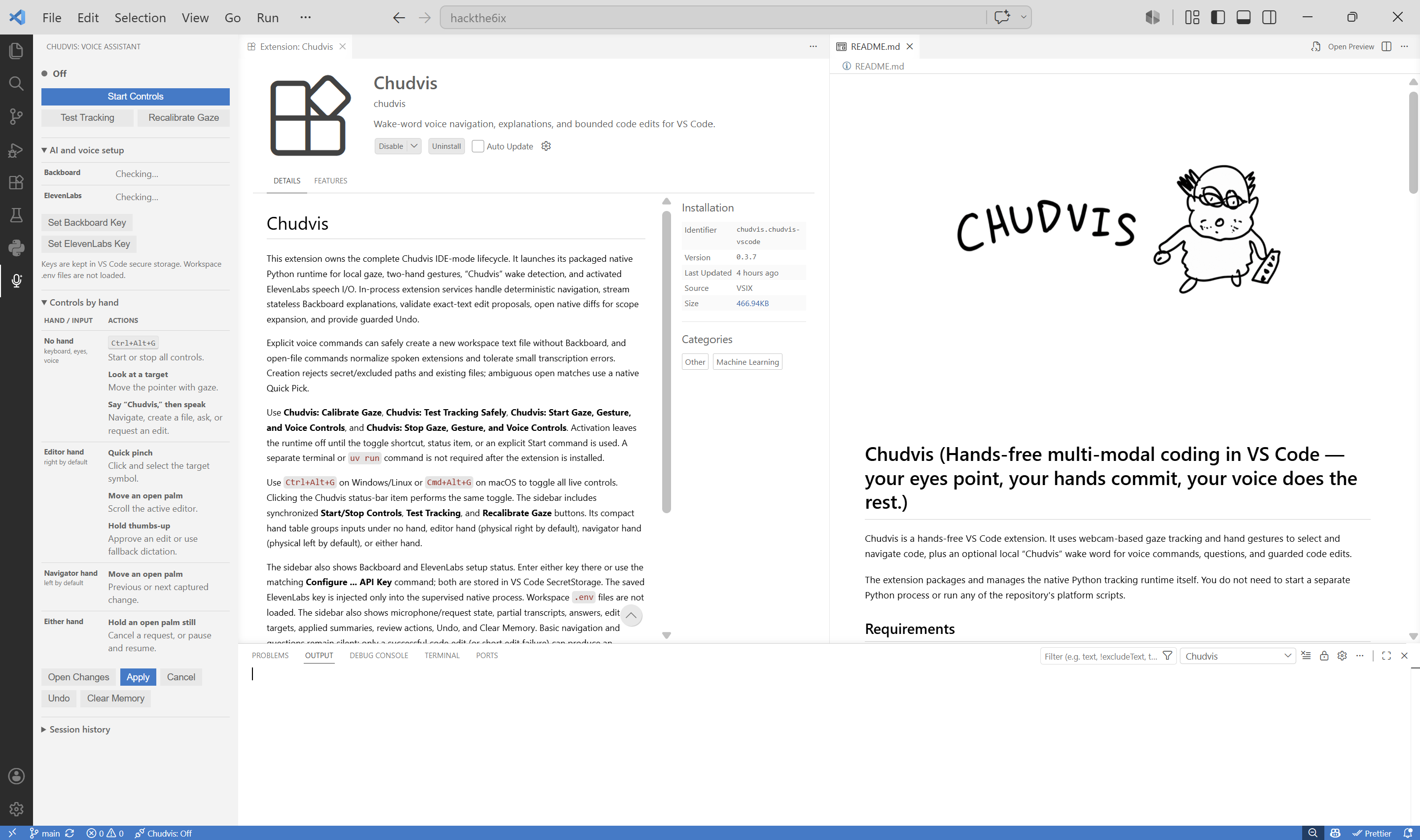
Chudvis is a VS Code extension that turns a webcam and a microphone into a complete contact-free coding interface. It splits control across three modalities, each doing only what it's good at:
- 👁️ Gaze → Your eyes move the cursor and select targets (think of this as your mouse sensor).
- ✋ Gesture → A deliberate hand gesture commits the action (think of this as your mouse clicks).
- 🎤 Voice → Complex actions simplified via human interaction (think of this as your shortcuts).
A typical flow: look at a function, pinch with your navigator hand to select it, say "Chudvis, refactor this to use async", and the proposed edit comes back for review. Thumbs-up with your editor hand applies it. Nothing irreversible happens without an explicit gesture, and every edit is undoable.
How we built it
- Architecture — A TypeScript VS Code extension supervising a native Python runtime, communicating via a token-authenticated loopback with a JSON schema.
- Gaze — MediaPipe
FaceLandmarkeriris landmarks, rebuilt into a head-normalized orthonormal face frame so gaze survives head movement, then fit with SVD-projected ridge regression. - Gestures — MediaPipe
HandLandmarkerfeeding a hold-gated state machine. Left and right hands get distinct navigator/editor roles so pointing and confirming never collide. - Wake word — sherpa-onnx int8 Zipformer keyword spotting, running entirely on CPU. No audio leaves the machine until you actually say "Chudvis."
- Voice I/O — ElevenLabs realtime WebSocket STT with server-side VAD in, streaming TTS out.
- Intelligence — Backboard fronting Anthropic and Google behind one key: tool-capable Claude for edits, cheaper Gemini for questions, with server-persisted threads so context carries across conversations.
Challenges we ran into
Calibration Drift. Feeding full-strength features straight into regression meant a profile that worked at the start of a session was noticeably off twenty minutes later. Standardizing to a bounded set of components before fitting is what made calibration hold and it's also what lets a profile converge from a few dozen samples instead of needing a per-user trained model.
Midas Touch as a Design Problem, not a Tuning Problem. No amount of time tweaking fixed accidental activation via gaze would fix false positives. Requiring a separate modality to commit was the only thing that worked.
Gesture Recognition on Raw Pose. Instantaneous matching fires constantly on incidental hand motion. Every gesture had to arm over a hold duration with visible 0–1 progress, plus a grace window so a momentary tracking dropout mid-pinch doesn't drop your drag.
Cross-Platform Compatability. The camera, screen geometry, and DPI awareness all live on the Windows host, but the repo lives in WSL so calibrating with a plain Linux uv run silently produces a profile with the wrong screen geometry. We ended up making the extension own the entire runtime lifecycle so calibration and live control are unified.
Accomplishments that we're proud of
- Zero Cloud Credentials for Gaze and Gesture Recognition. The whole tracking stack runs locally.
- Privacy-First Approach. Wake-word spotting is fully on-device.
- Ships as one
.vsixthat provisions its own Python runtime viauv(no separate repo clone, no manual environment setup). - Security-First Approach: keys in VS Code SecretStorage rather than workspace
.envso project code can't read them, SHA-256-verified model assets, and a camera that never starts without an explicit user action and a first-run disclosure. - Malleable AI Edits. We never let a model write to your files unsupervised.
It actually works for real coding, not just a scripted demo. It is precise enough to write/modify a specific function on a dense screen.
What we learned
- Modality Separation Beats Modality Accuracy. We spent early effort trying to make gaze smart enough to know when you meant it. Giving that job to a different body part solved it outright.
- Feedback is what makes an Interface learnable. The 0–1 arming progress fill did more for usability than any threshold we tuned (users need to see intent accumulating).
- Classical ML was the right call. Ridge regression over a projected feature space beat anything we could have trained in a weekend, and calibrates in under a minute. Furthermore, LLM parsing in comparison to regex allowed for a wide variety of complex translations to simple commands.
- Privacy Boundaries are Architectural. "Local until the wake word" had to be designed in from the start; it isn't something you can bolt on afterward.
- Distribution is a feature. Making the extension own the Python runtime eliminated an entire category of setup bugs and platform mismatches.
What's next for Chudvis
- Desktop Mode Beyond VS Code: the gaze and gesture stack is already editor-agnostic; the OS-level pointer path needs polish. The bridge protocol is versioned and schema-defined specifically so JetBrains and Neovim adapters are feasible.
- Real-Time Calibration, learning from confirmed selections rather than requiring a recalibration pass.
- Improved Gesture Database, including scroll and zoom, without sacrificing the deliberate-commit guarantee.
- Accessibility User Testing with the people this is actually built for.
- Latency Work on the wake-word-to-response path, which is where the experience still feels like waiting.
Built With
- backboard
- claude
- computer-vision
- elevenlabs
- gemini
- machine-learning
- mediapipe
- numpy
- opencv
- python
- sherpa-onnx
- typescript
- uv
- vscode-extension
- warp
- websockets


Log in or sign up for Devpost to join the conversation.