Inspiration
AI has made getting the answer effortless, but getting the answer was never the point.
AI makes getting the answer effortless, but students aren't learning. 92% of UK undergraduates use AI, and 88% have used it on assessed work (HEPI, 2025). Students who practised maths with ChatGPT scored worse once it was taken away (PNAS, 2025).
Research shows we learn best by teaching others: the protégé effect (Chase et al., 2009). So we flipped the roles: the AI is the student, and you're the teacher.
What it does
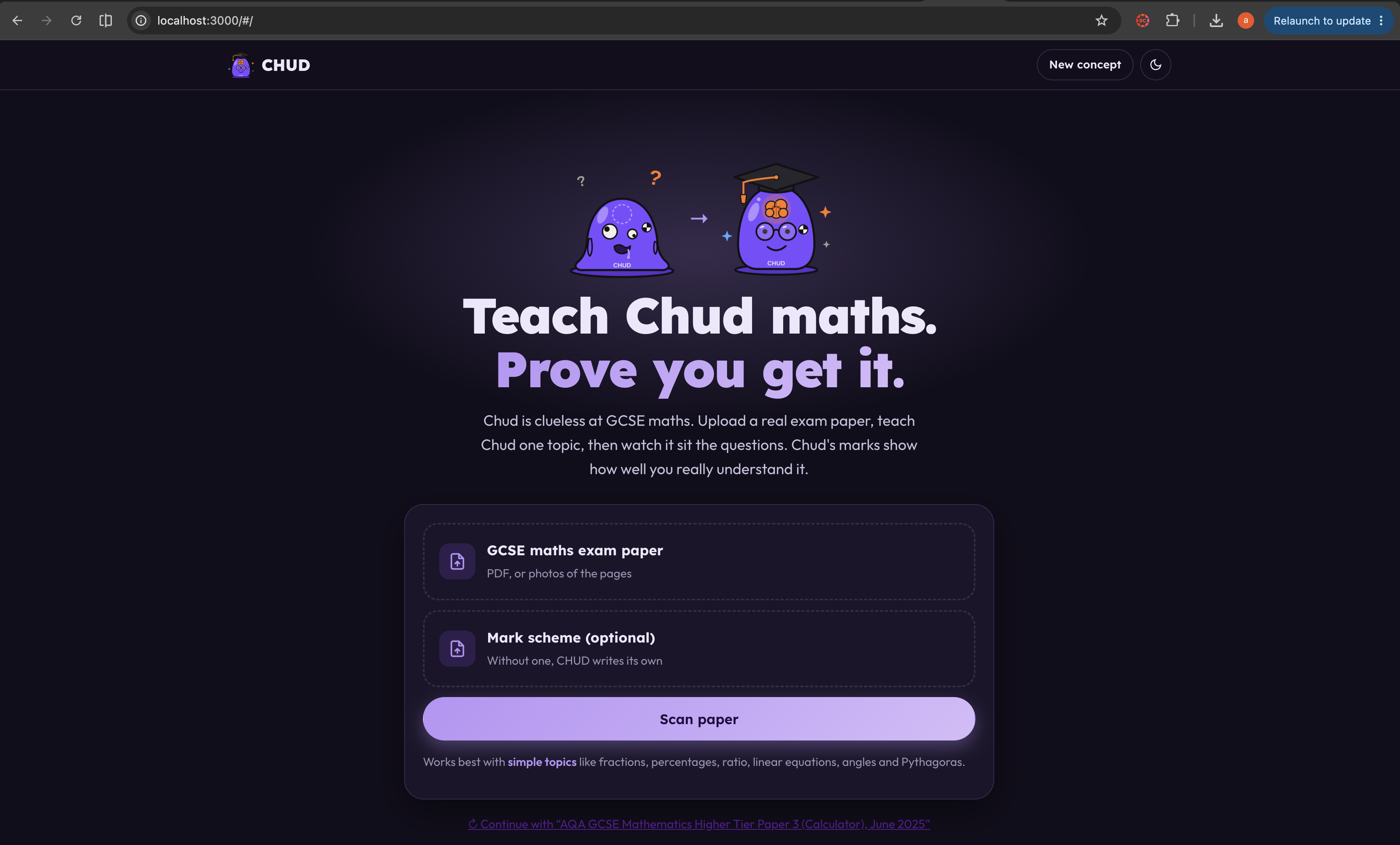
Chud is an AI student who knows nothing. Your job is to teach it well enough to pass the exam.
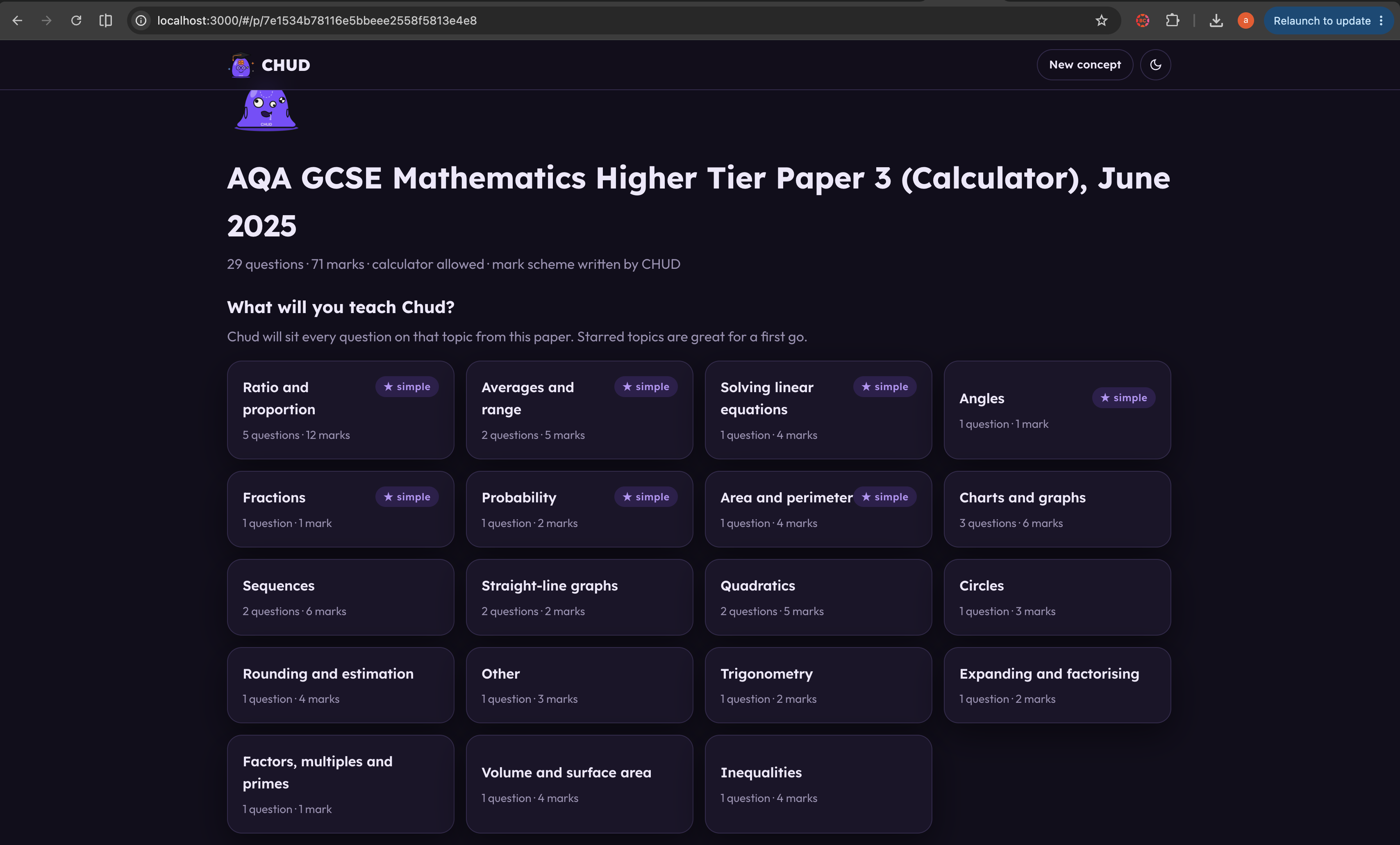
- Pick a topic. Choose something you're studying or struggling with.
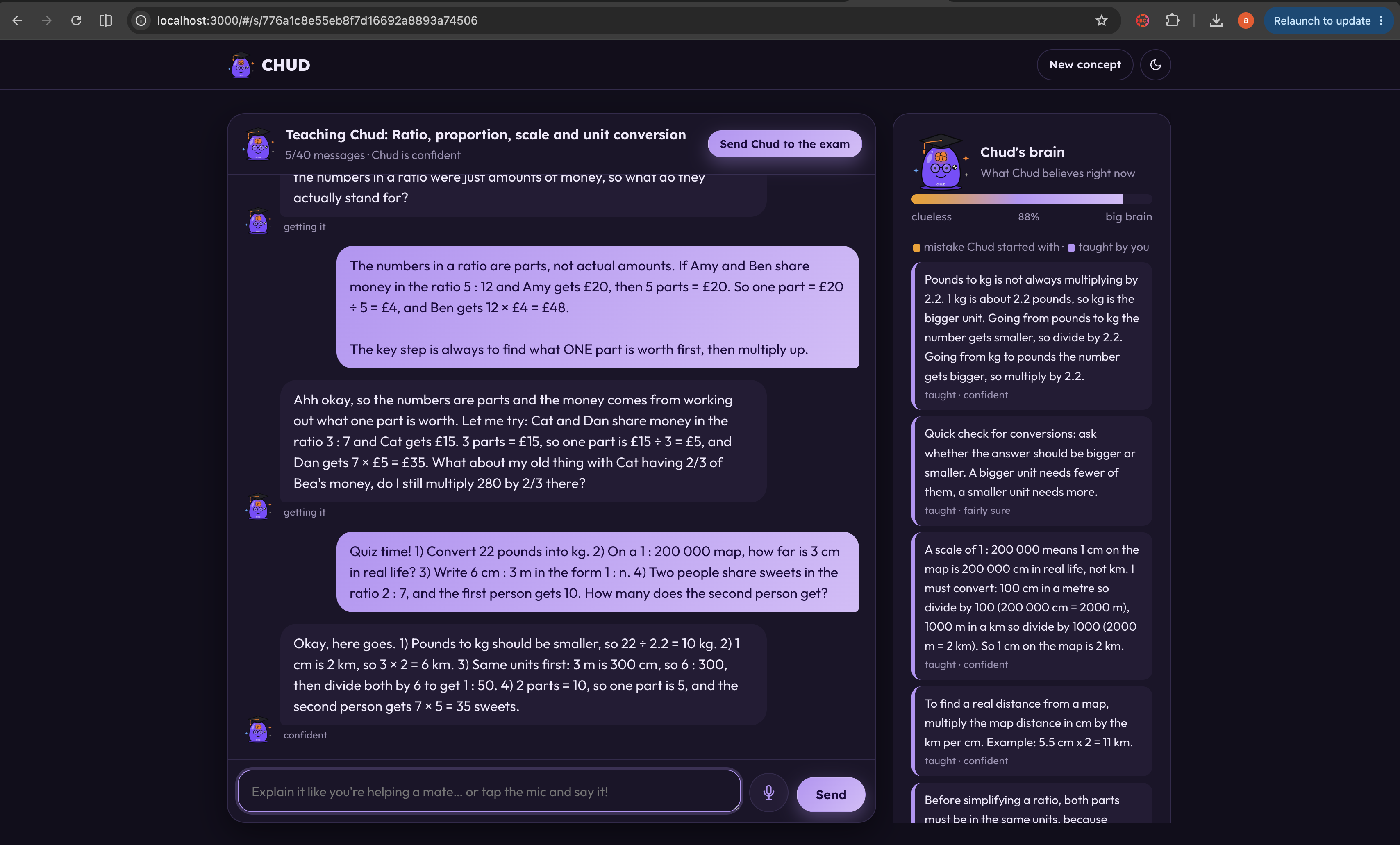
- Teach Chud. Chud asks you to explain concepts the way a student would in class, and follows up with questions like "why does that work?" and "what if the number is negative?"
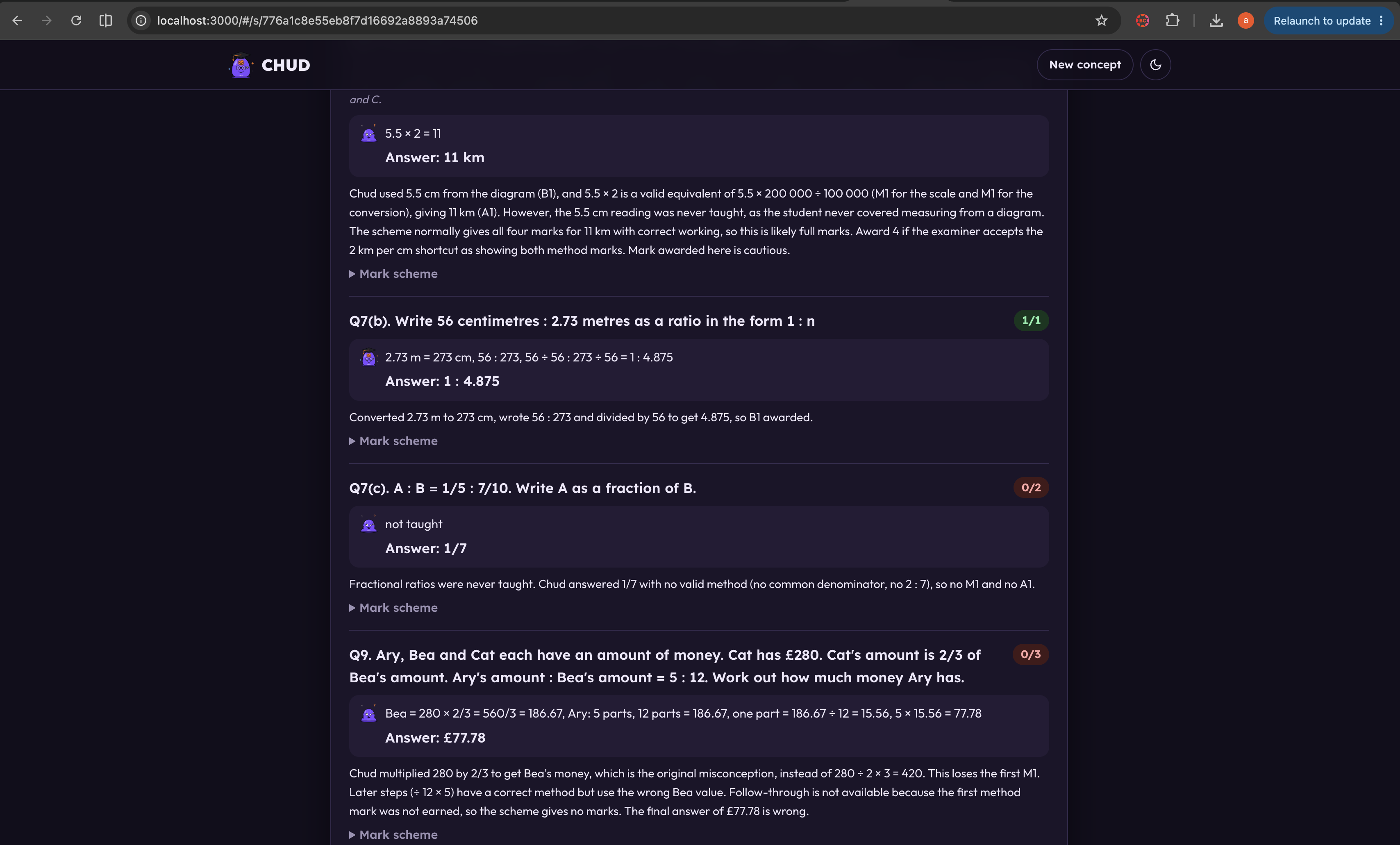
- Chud sits the exam. It attempts real past paper questions using only what you taught it. If your explanation was wrong, Chud gets it wrong. If you left a gap, Chud gets stuck.
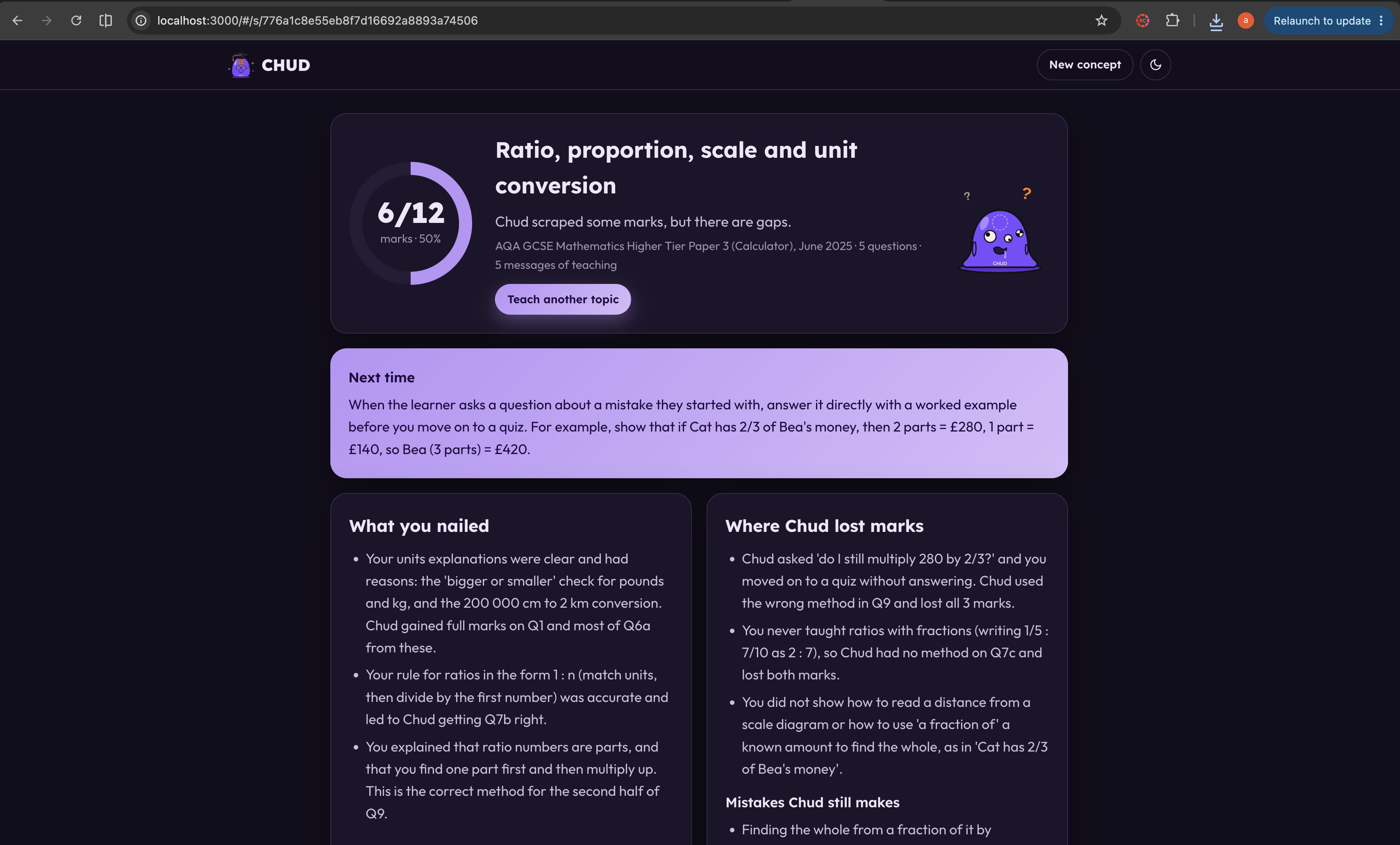
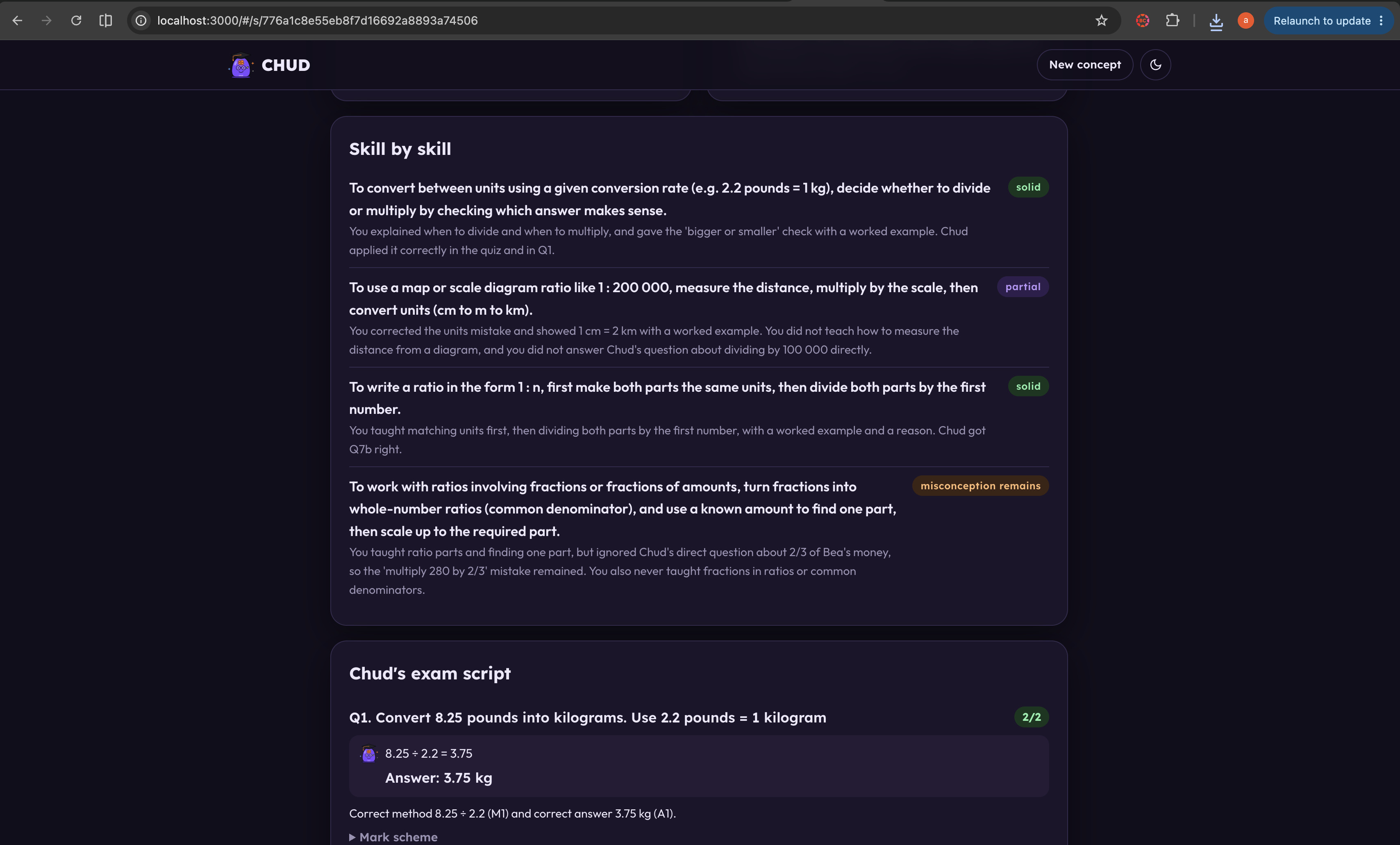
- The examiner gives feedback. A separate examiner agent marks Chud's work against the mark scheme. It then tells you which parts of your explanation caused each mistake.
- Repeat until Chud passes. Chud only passes once you've given a correct explanation, which means you understand the topic yourself.
Chud's mistakes are your mistakes, so fixing them means actually learning the maths.
How we built it
- Stack. A TypeScript and Node.js backend with a vanilla HTML/CSS/JS frontend. All three agents (Chud, the topic planner and the examiner) run on Claude (
claude-opus-5-5), with Zod-validated structured outputs and prompt caching. Data is stored in SQLite.- Baseline knowledge. Chud starts with a deliberately limited base: arithmetic and the ability to read and understand questions, but no topic knowledge. - Concept cards. Each time you teach Chud, your explanation is turned into structured "concept cards" stored in Chud's knowledge base. They record the rule you gave, when it applies, and an example, including your mistakes. Chud can only use a method if a card backs it.
- Guardrails. Where possible, taught rules are built in as deterministic linear transformations (e.g. "subtract n from both sides") using SymPy, so Chud can only apply methods it was actually taught.
- A moderator agent. A second AI checks every step of Chud's working against its concept cards and rejects anything that wasn't taught (more in Challenges).
- Exam material. For the chosen specification (e.g. Edexcel GCSE Maths), we collected the syllabus and past paper questions from the web, so Chud is tested on real exam content.
Challenges we ran into
- Chud knows too much. The model underneath Chud has seen thousands of GCSE papers. However carefully we wrote the guardrails, it could always just answer the question. Prompting it to "only use what you were taught" wasn't enough. Our fix was to separate solving from checking: a moderator AI audits each step against the concept cards and rejects anything Chud wasn't taught.
- Keeping mistakes intact. When turning explanations into concept cards, the model kept "helpfully" correcting the student's errors. That breaks the whole point, so we had to make it record explanations exactly as given, mistakes included.
- Tracing errors back to the teaching. Saying "Chud got Q3 wrong" is easy. Saying which sentence of your explanation caused it is much harder, and took the most work on the examiner.
Accomplishments that we're proud of
- A working end-to-end prototype: teach → exam → feedback, on real GCSE past paper questions.
- With nothing taught, Chud scores 0. Teach it one topic and it solves that topic but stays stuck on others. Teach it a wrong rule and it repeats your exact mistake.
- An idea that turns the AI habit students already have into something that builds understanding.
What we learned
- Prompts alone aren't guardrails. Restricting what an LLM knows is much harder than restricting what it says. Layered defences worked far better: structured knowledge, deterministic rules where possible, and a separate verifier.
- One model checking another beats a model checking itself. Splitting work across a solver, a moderator and an examiner made each part more reliable.
What's next for Chud
- Different base levels. Let Chud start at different stages, e.g. one that already knows A-level Further Maths, so university students can teach it calculus.
- Better ways to teach. A whiteboard for diagrams, graphs and geometry, proper equation input, photo uploads of handwritten working, and voice, so you can explain out loud like a real teacher.
- Learn-then-teach. Short lessons or worked examples before each topic, so Chud works for students meeting a topic for the first time, not just revising.
Built With
- ai-agent
- education
