Inspiration
Most expensive mistakes in a household don't come from a missing file. They come from a date buried inside a file you already have: a cloud plan that auto-renews unless you give 30 days written notice, a washer warranty that ran out last month, a tenancy break clause, a quarterly tax instalment. A NAS keeps all of these documents safe, but nobody reads them again. Cloud AI could read them, but only if you upload your contracts, policies and bills to someone else's server. We wanted the NAS to do the reading itself.
What it does
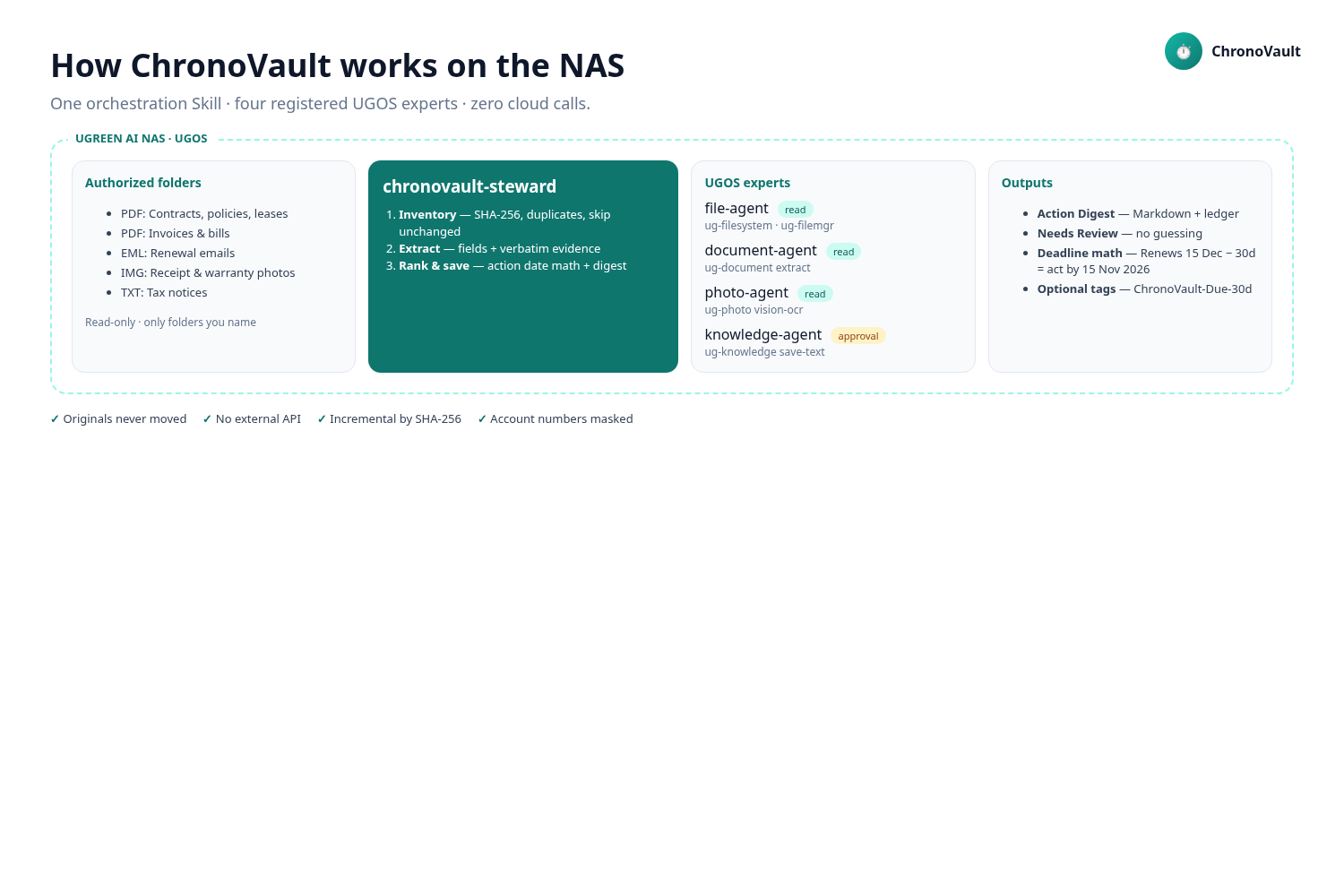
ChronoVault is a UGOS Skill for UGREEN AI NAS that acts as a private deadline steward.
- Reads only what you authorize. You name the folders. The originals are never moved, renamed or edited.
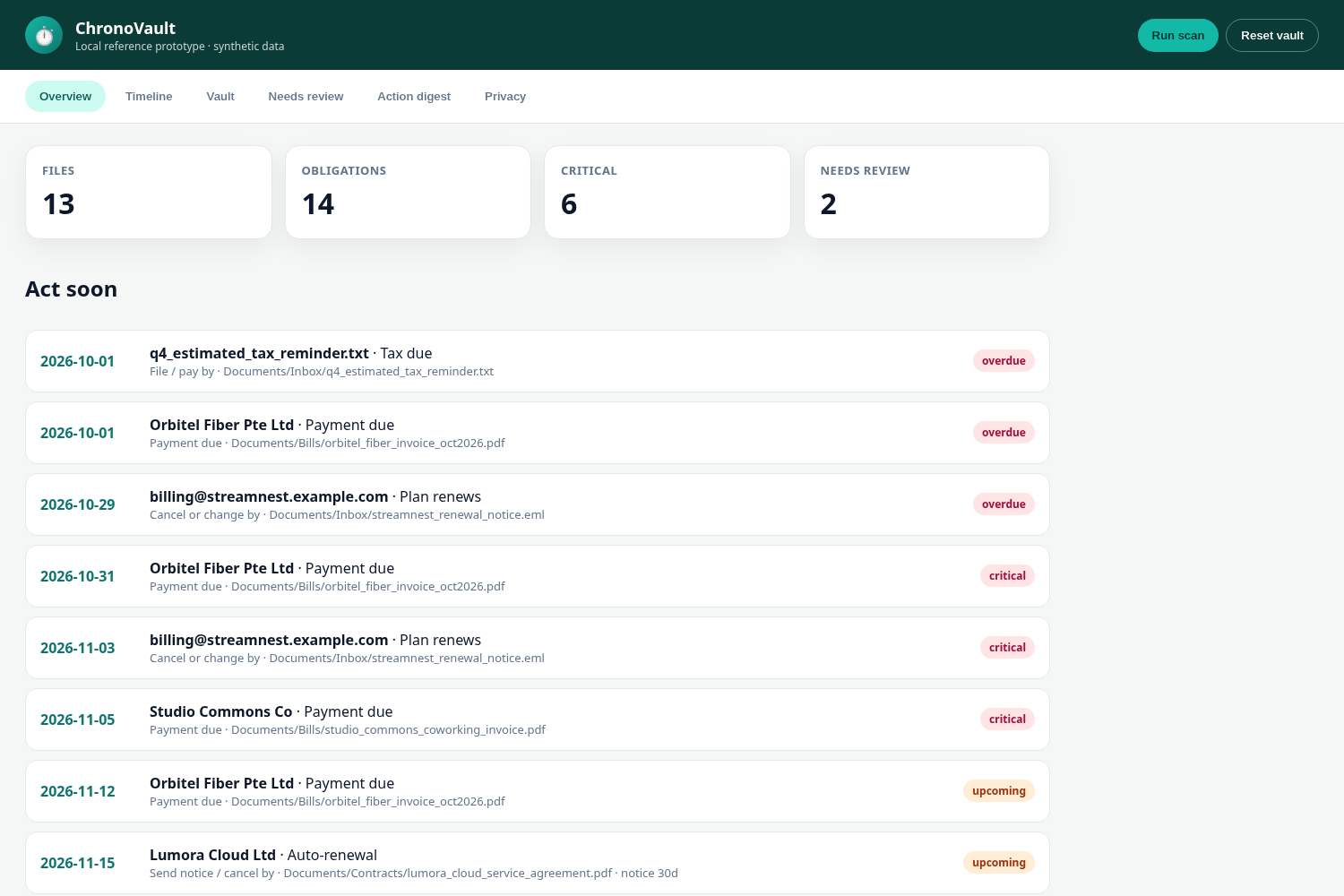
- Finds every obligation. It extracts warranty ends, renewals, notice periods, due dates, amounts and reference numbers from PDFs, emails, text files and photographed receipts.
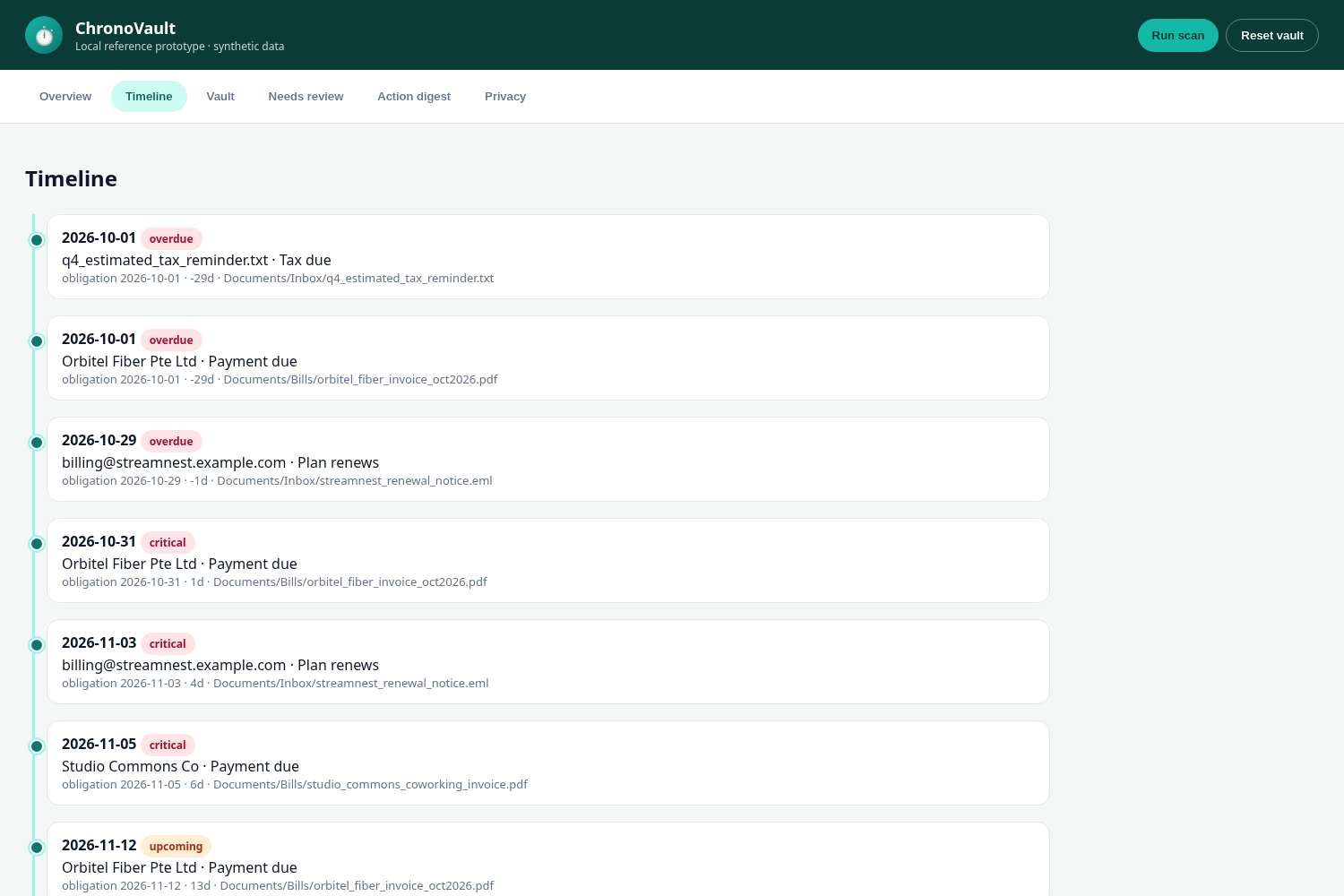
- Does the deadline math. Action date = obligation date minus the notice period. "Renews 15 Dec 2026, 30 days notice" becomes act by 15 Nov 2026.
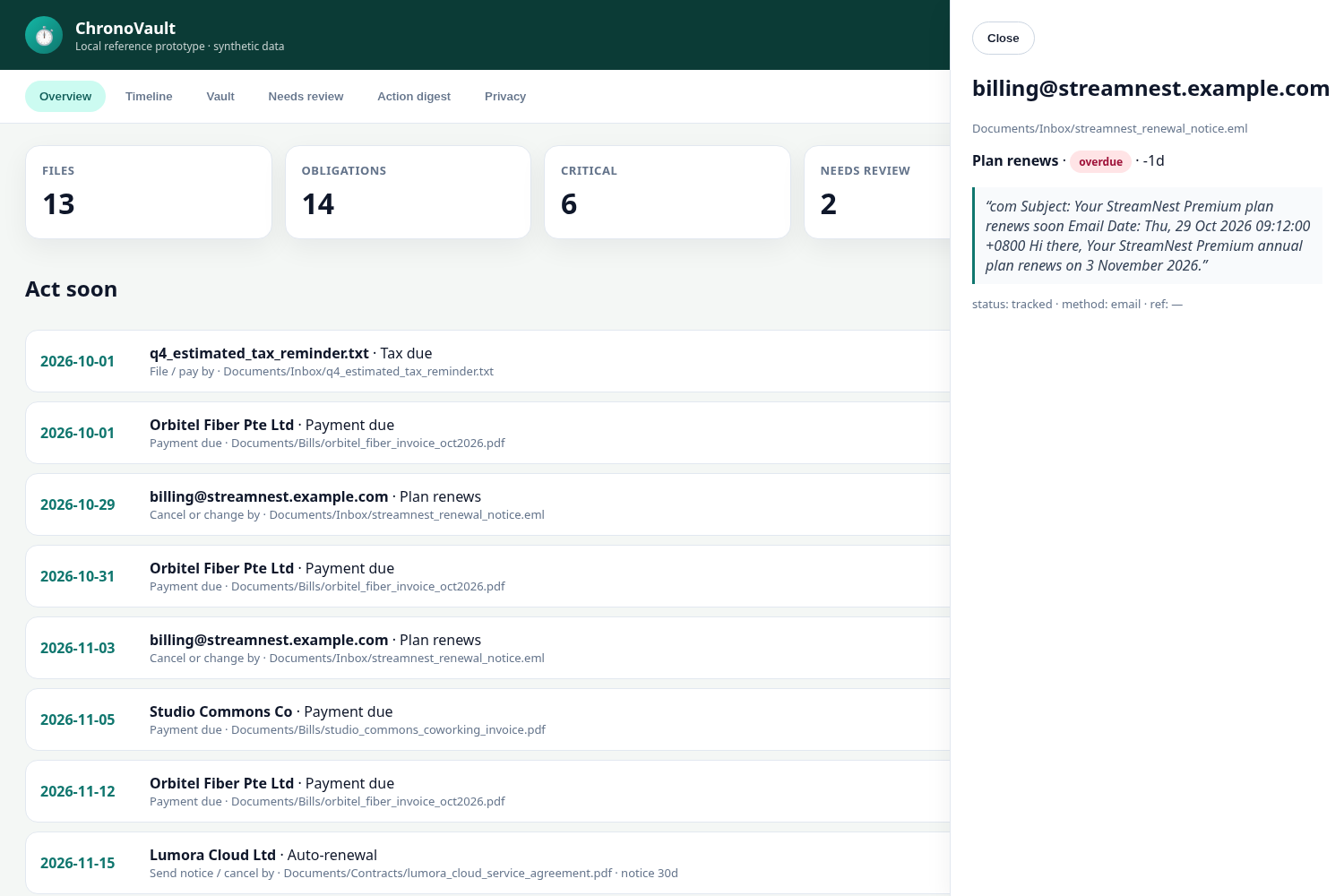
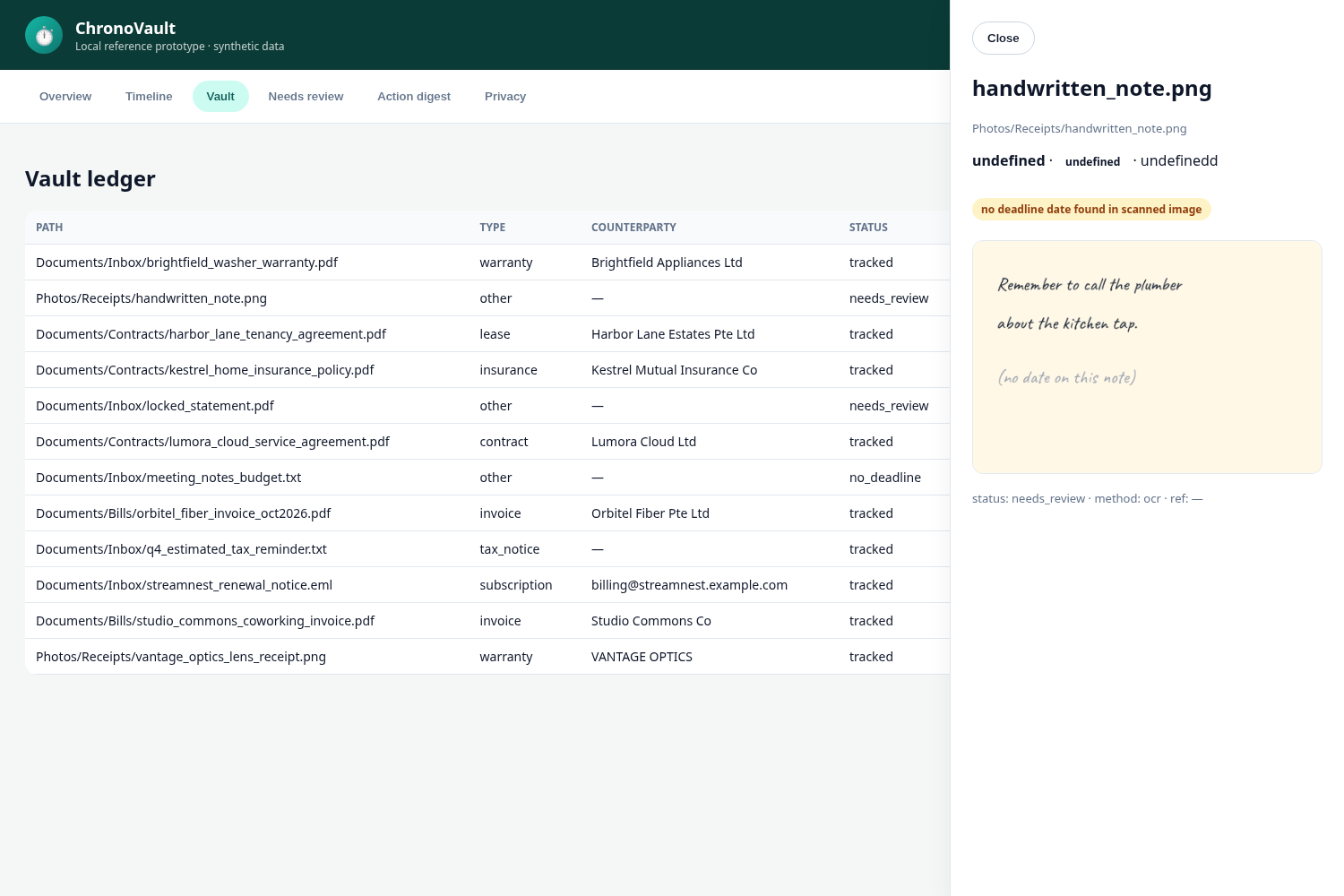
- Shows its evidence. Every date and amount carries the verbatim sentence it came from. Anything without a quote, with low confidence, damaged or undated goes to Needs Review instead of being guessed.
- Ranks and remembers. Items are sorted into Critical, Upcoming and Planned, with duplicates merged by SHA-256. Unchanged files are skipped on the next run, so a weekly scheduled run only reads what is new.
- Saves a digest after approval. A Markdown Action Digest with an embedded ledger is saved to the NAS knowledge base, and optional
ChronoVault-Due-30dtags can be added to the originals, both only after the user approves.
How we built it
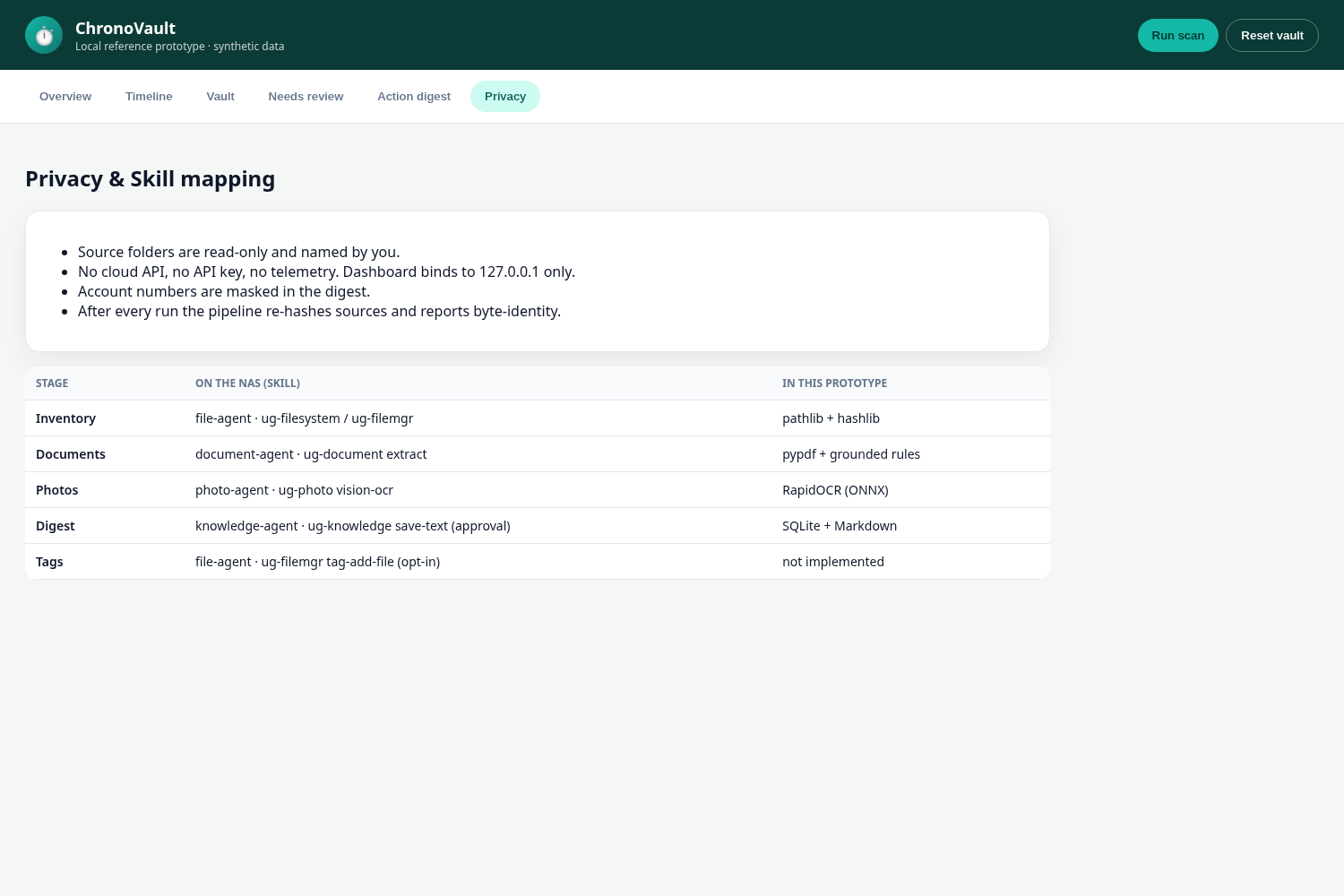
The Skill follows the Uliya Skill Development Standard: one SKILL.md plus four Markdown references. It contains no scripts and calls no invented capabilities. On the NAS it delegates to the built-in experts: file-agent lists the authorized folders, document-agent reads PDFs, emails and text, photo-agent OCRs receipt photos, and knowledge-agent saves the approved digest. Every run ends in one of five defined end states, including partial results and nothing-found.
To prove the logic before hardware access, we built a local Python prototype with the same pipeline: text extraction and offline OCR, date and amount extraction with the source sentence kept as evidence, the notice-period math, a SQLite ledger with SHA-256 de-duplication, and a localhost-only dashboard. 19 automated tests cover the extraction, the deadline math, duplicates, damaged files, a no-network scan and path-traversal protection.
Challenges we ran into
- Not guessing. Undated scans, damaged PDFs and OCR mix-ups (0 vs O) are common. We made "quote or it didn't happen" a hard rule. An item without verbatim evidence is routed to Needs Review rather than silently dated.
- Staying inside the platform. Our first package failed the official checker: it had shell code, hard-coded volume paths and missing failure states. Rewriting it to use only catalog capabilities and approval-gated writes made it simpler and safer.
Accomplishments that we're proud of
- A Skill package that passes the official static check cleanly and uses only real, registered UGOS capabilities.
- Deadline math that catches the "act by 15 Nov, not 15 Dec" case.
- Evidence highlighting for every extracted field, including OCR'd receipt photos.
- A provable privacy story: read-only sources, a byte-identical re-hash after every run, masked account numbers, and no network access.
What we learned
For personal documents, trust comes from grounding more than from intelligence. Users accept an AI reminder when they can see the exact sentence behind it, and when the system admits what it could not read. We also learned that the NAS is the natural place for this kind of AI: the data is already there, and it never needs to leave.
What's next for ChronoVault
- Validate the Skill on UGREEN AI NAS hardware and record the runtime for the finals.
- Scheduled weekly runs with a "what changed since last week" summary.
- More obligation types: subscription price changes, medical follow-ups, vehicle inspections, passport and visa expiry.
- Calendar export (ICS) and family sharing, so each member sees only their own folders.
- Multilingual extraction, starting with Chinese and Malay documents for Singapore households.
All documents shown in the demo are synthetic. Every company, person and number is fictional.

