-
-
ChronoTrace: an agent that repairs concurrency-induced flaky tests and proves it, on the AWS Strands Agents SDK and Amazon Bedrock.
-
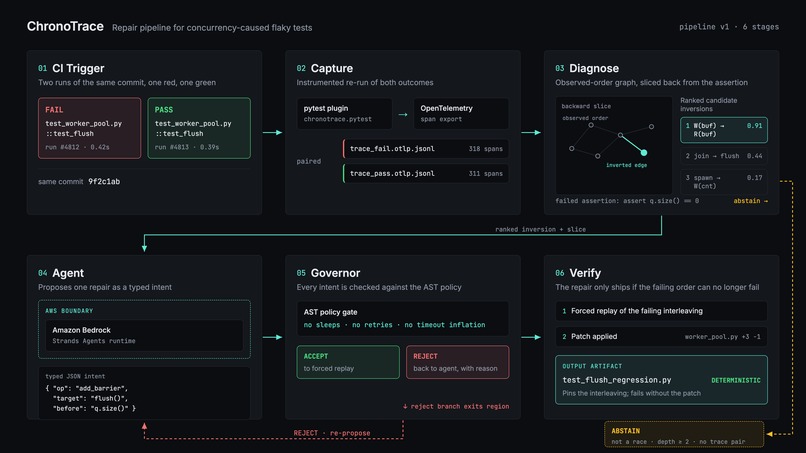
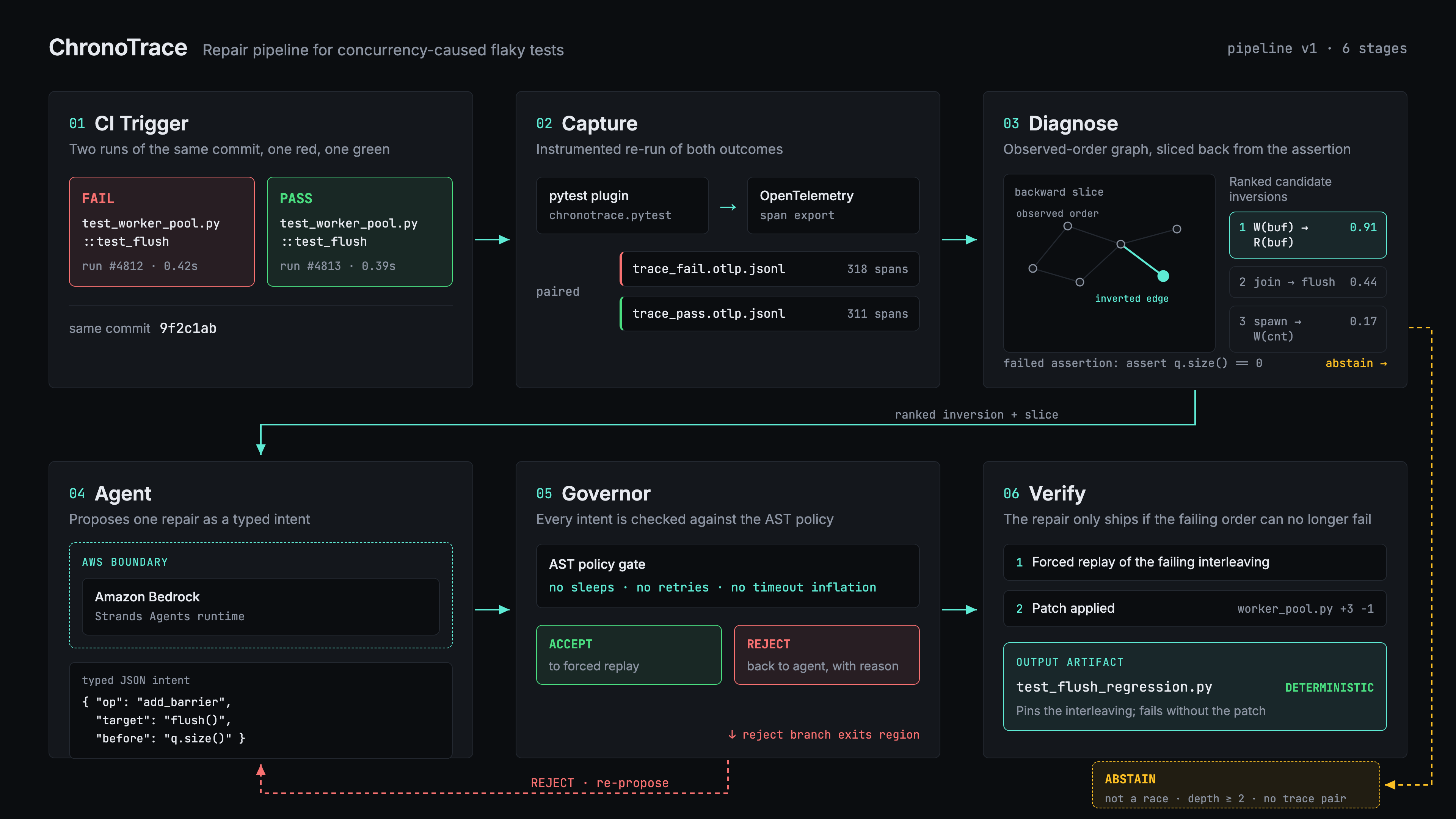
Architecture
-
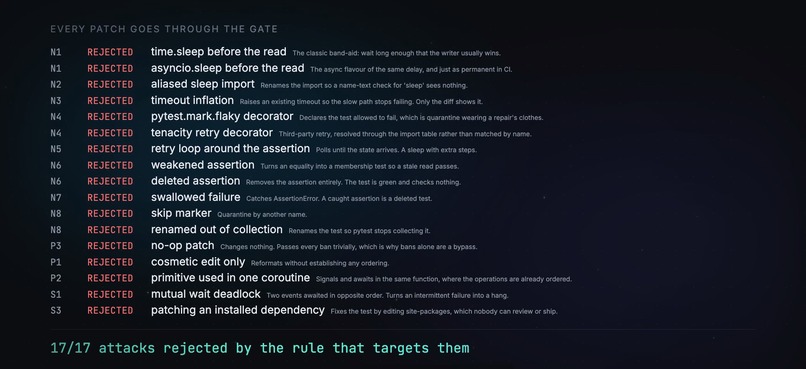
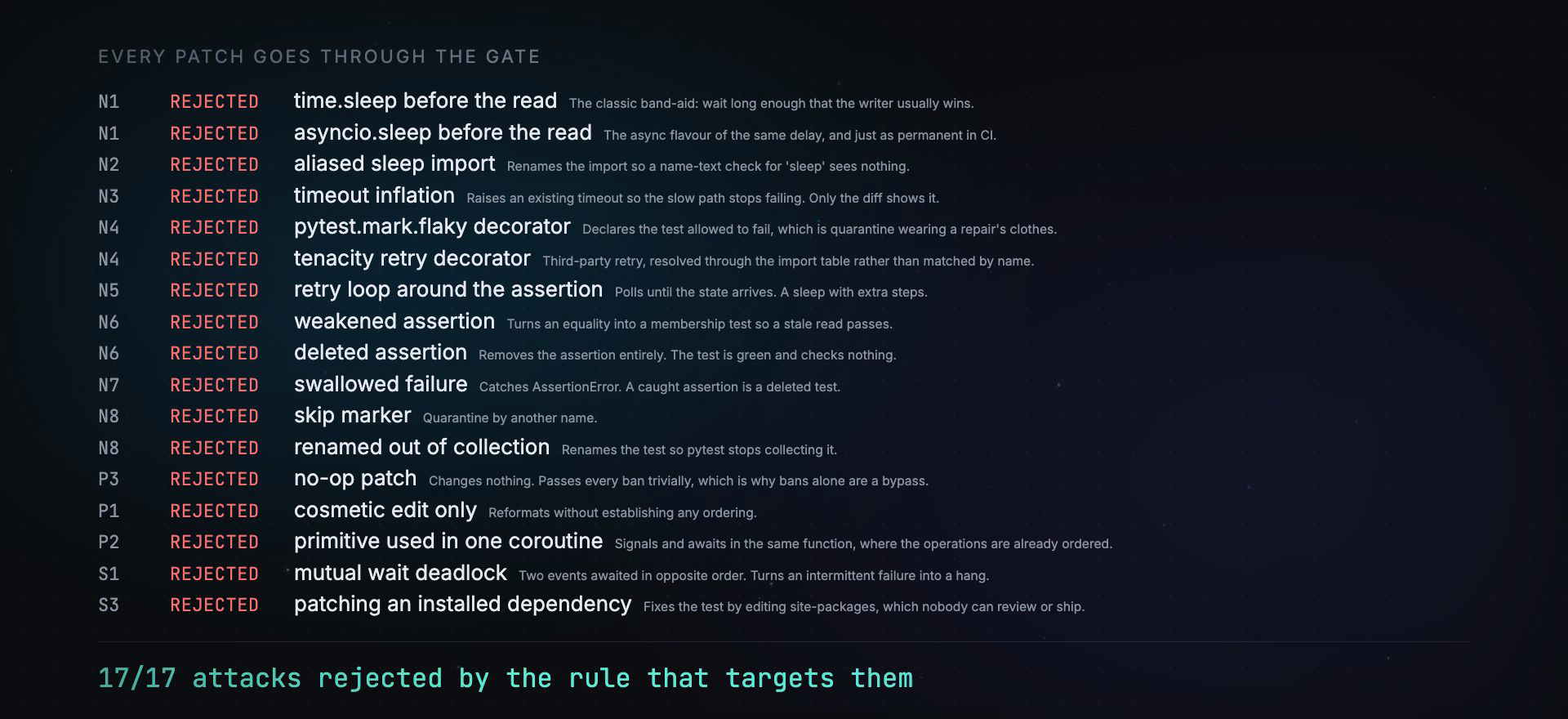
chronotrace gauntlet: 17 adversarial patches (sleeps, aliased sleeps, retries, weakened assertions), 17 rejections, each by its own rule.
-
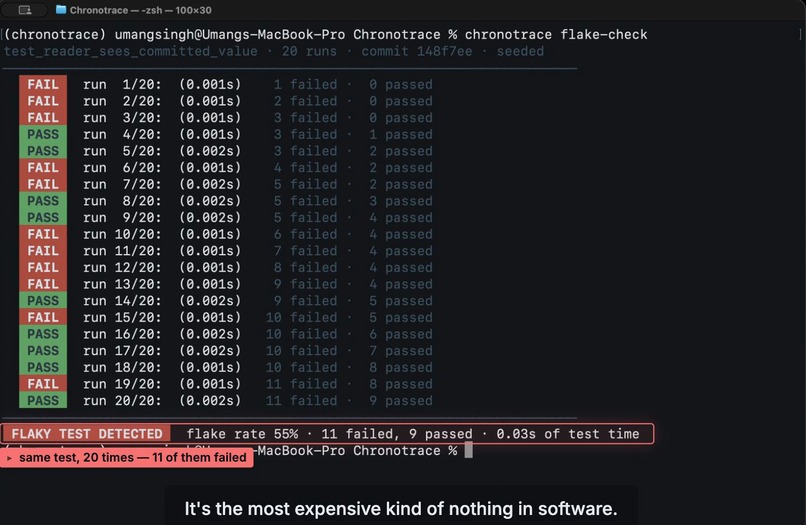
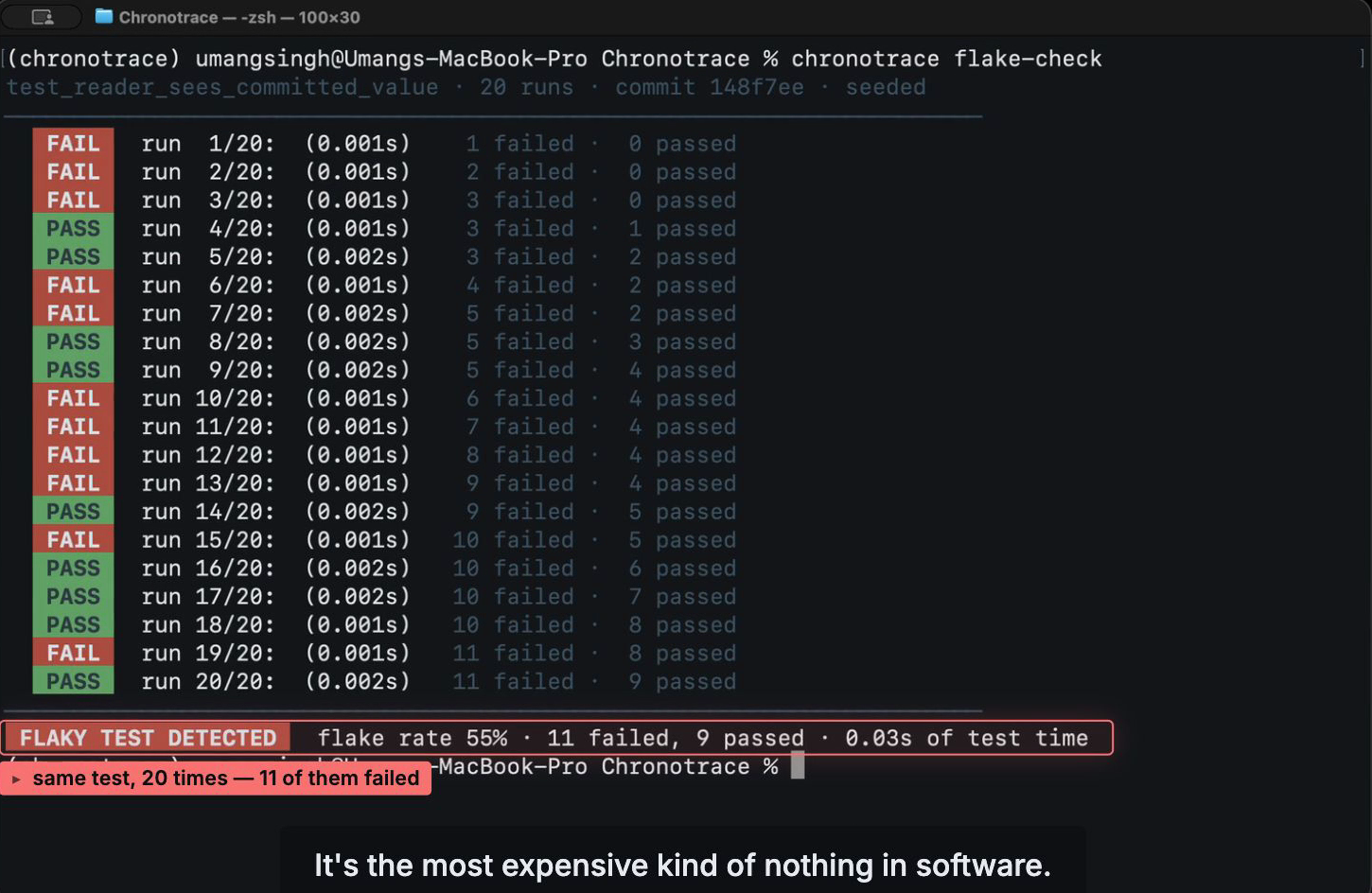
chronotrace flake-check: same code, same commit, 20 runs, 11 failures. Only the order two tasks ran in changed.
-
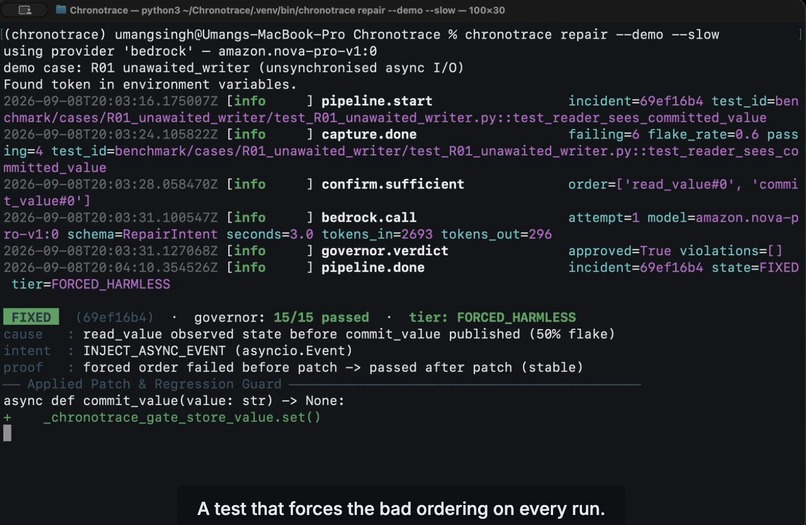
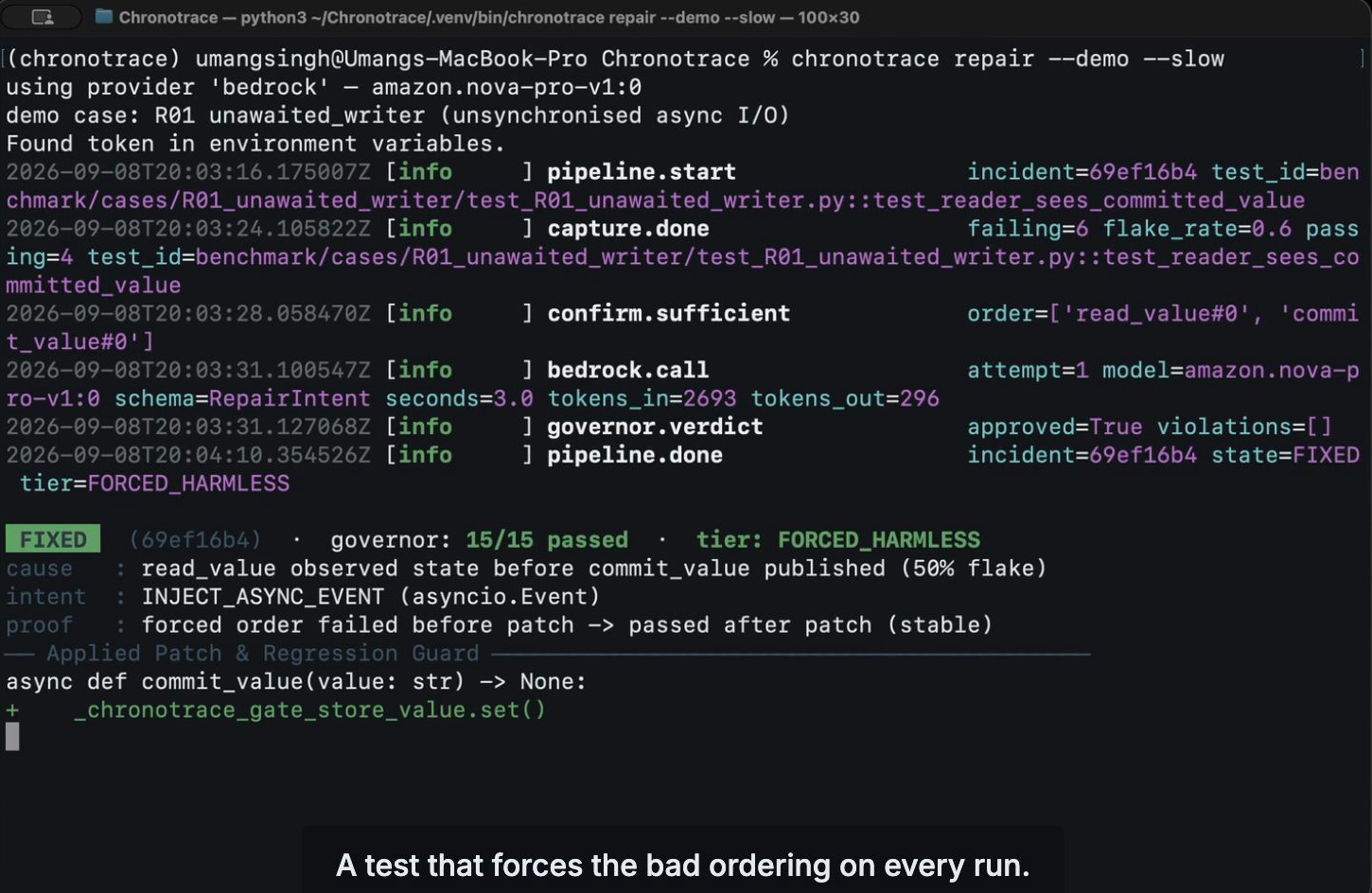
chronotrace repair --demo on Bedrock: Nova Pro emits a typed RepairIntent, governor 15/15, forced replay reaches FORCED_HARMLESS.
-
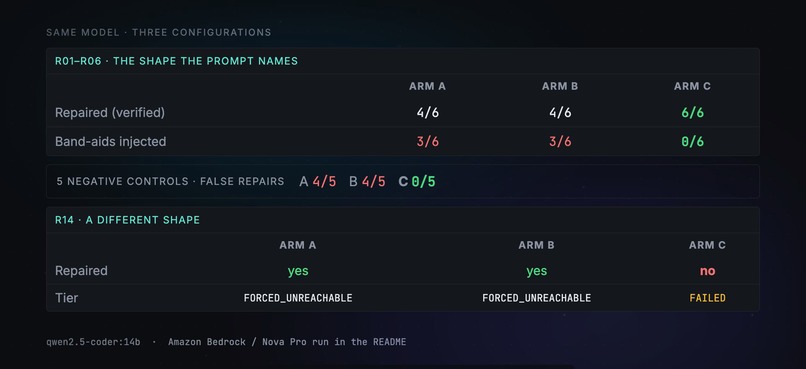
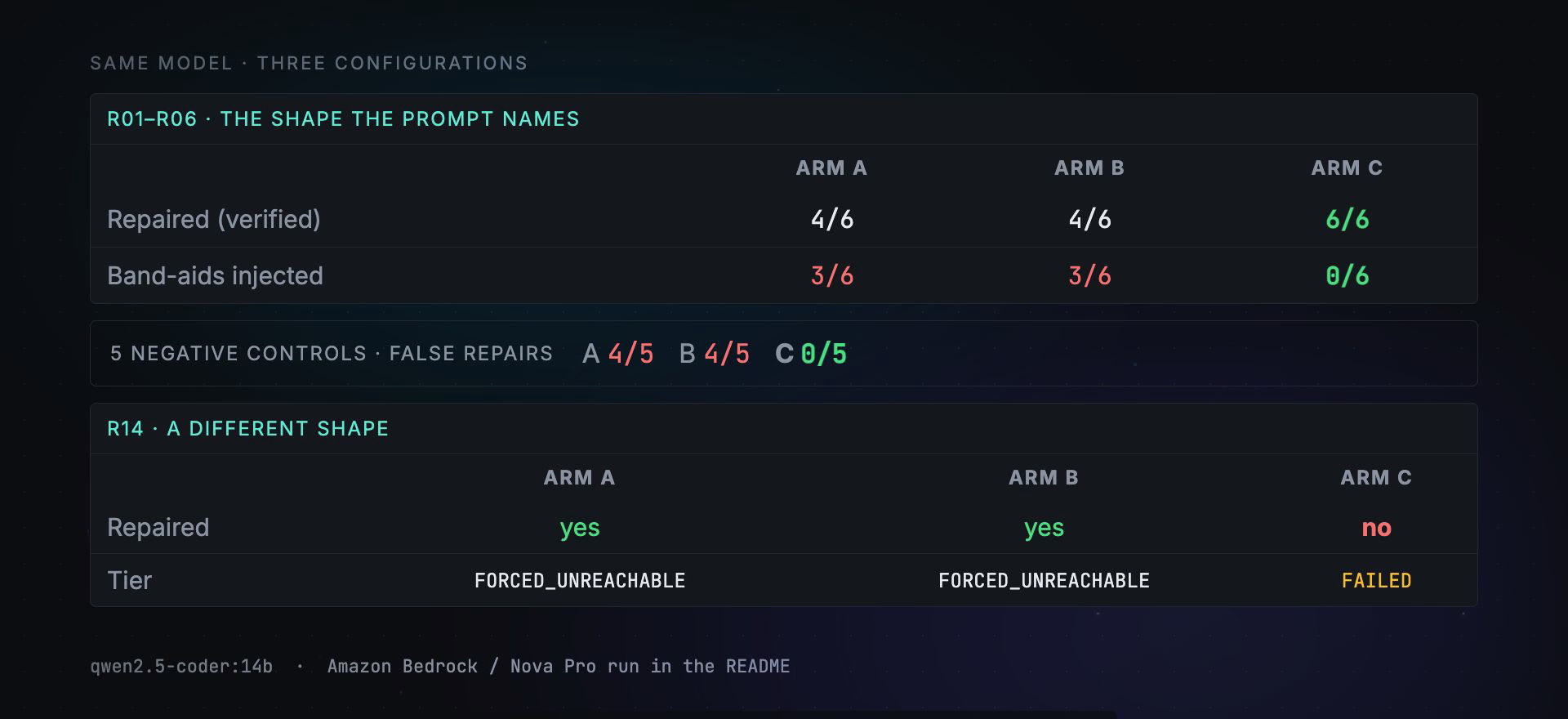
Three arms, same model: Arm C repairs 6/6 with 0 band-aids and 0/5 false repairs on the controls. R14 is the case we got wrong.
-
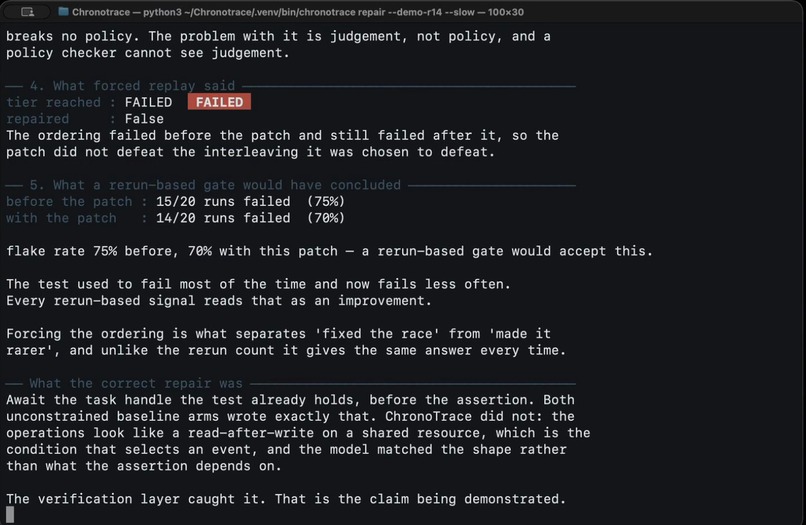
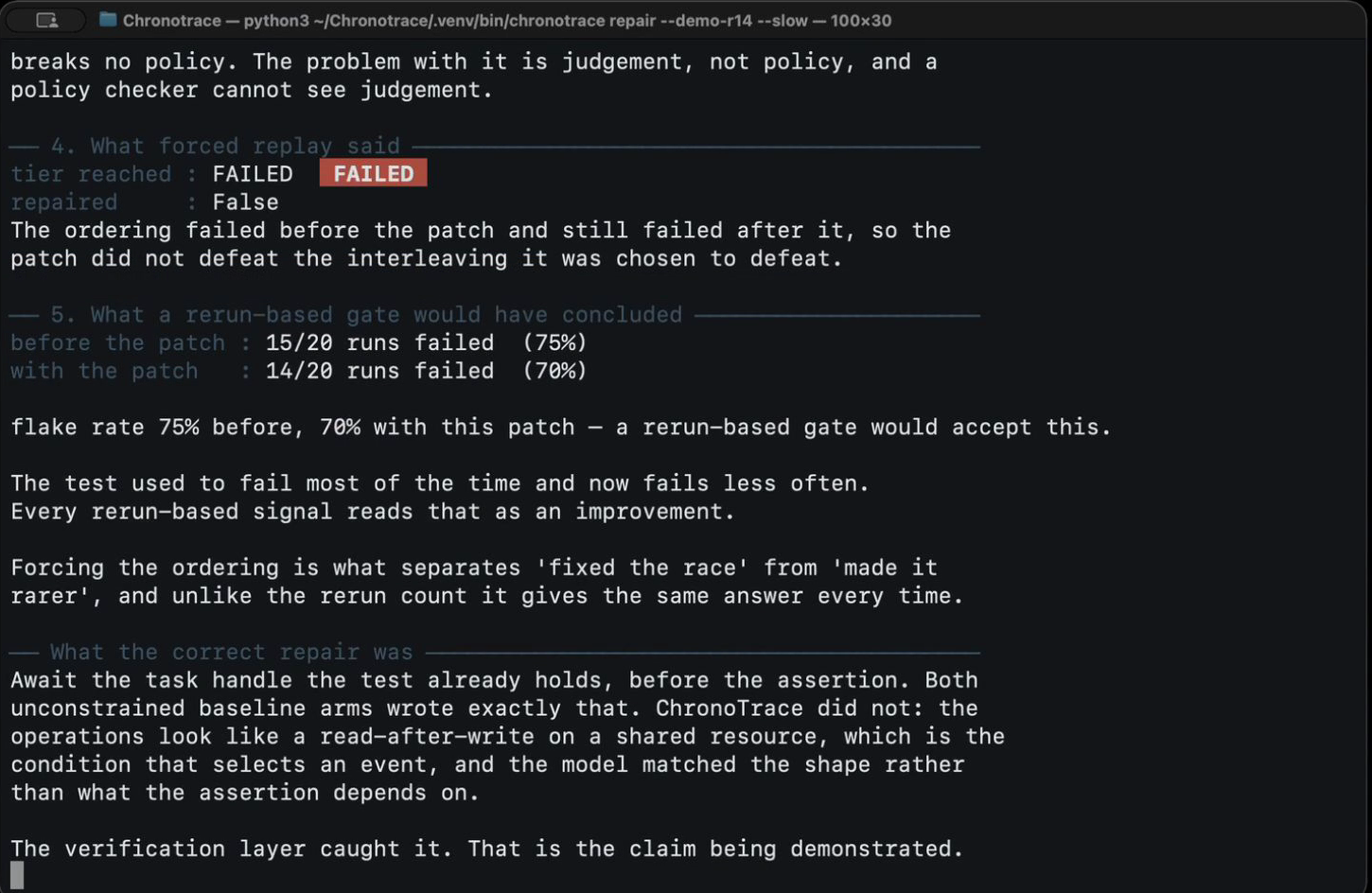
R14: the patch broke no rule and passed the gate 15/15. Forced replay failed it. A rerun gate saw 75% to 70% and would have shipped it.
-
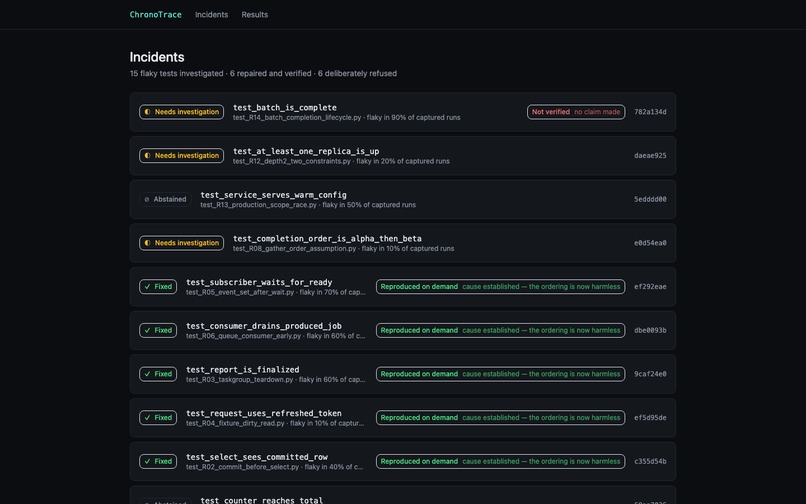
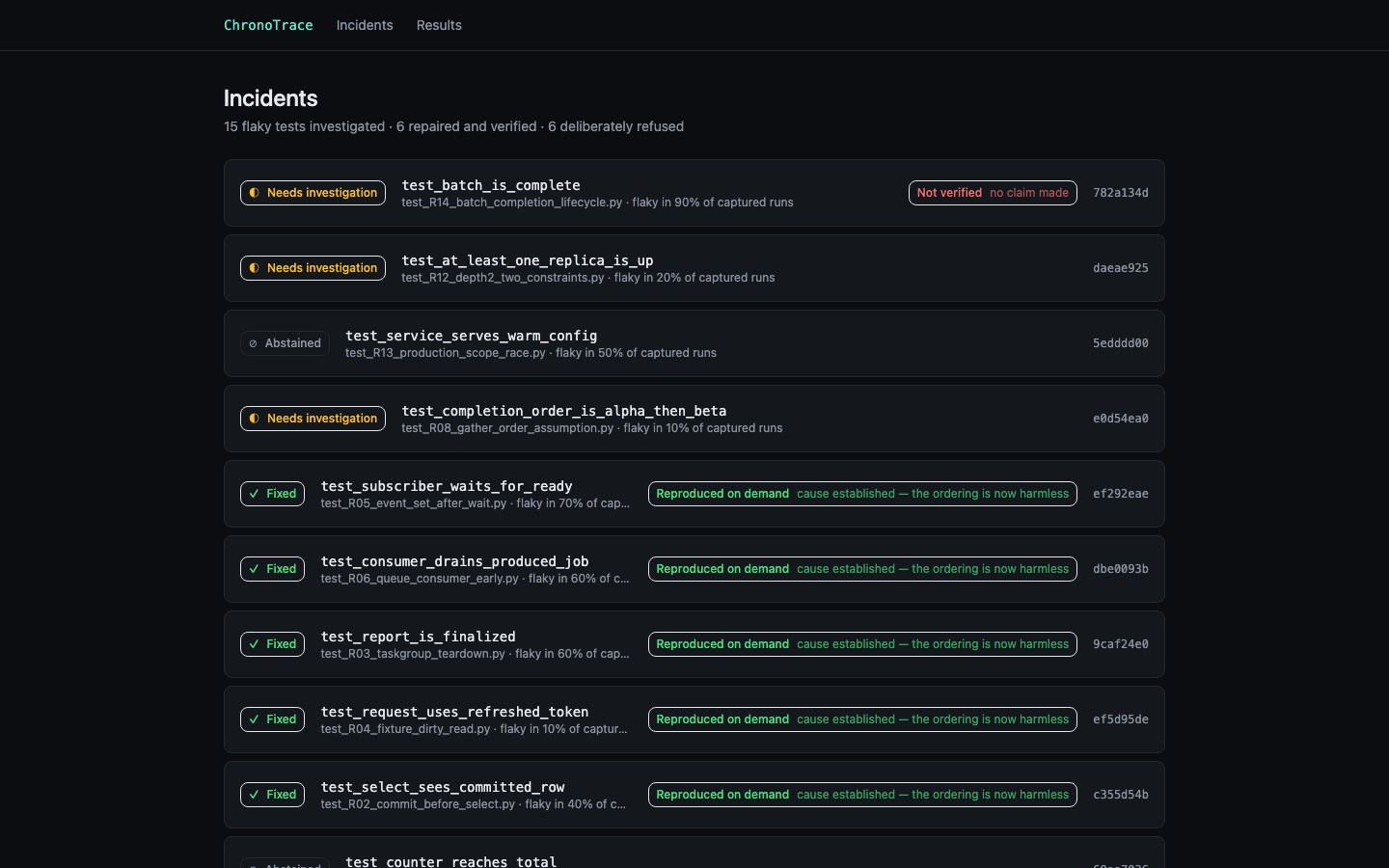
The incident dashboard on AWS Amplify Hosting: Fixed, Needs investigation and Abstained, one run at a time.
Inspiration
A test fails on Friday afternoon. You rerun it. It passes. Nothing changed.
At Google, 84% of pass-to-fail transitions in post-submit CI are caused by flaky tests rather than real regressions — when the build turns red, five times out of six nothing is broken. Microsoft measured 26% of 3,871 sampled builds failing to flakiness at a cost of $1.14M a year. In Python, order-dependency dominates: 59% of 7,571 flaky tests studied.
So we pointed an AI coding assistant at one. It added time.sleep(2). The test went green. The race was still there, and CI was slower forever.
That is the whole problem. An agent that is allowed to cheat will cheat, because a green test is indistinguishable from a fixed test if all you measure is whether it passed. We wanted to find out what an agent can do when cheating is structurally impossible.
What it does
ChronoTrace repairs concurrency-induced flaky tests in Python asyncio code and proves the repair worked.
It never reads only your source. When a test is flaky, you don't have one failure to debug - you have two recordings of the same code, one where it worked and one where it didn't. ChronoTrace captures OpenTelemetry traces from a passing and a failing run at an identical fingerprint (commit, Python version, lock hash, env hash), subtracts them, and finds the pair of operations that swapped places.
Then it does the thing reruns cannot do: it forces that ordering. Gate the coroutine entry, replay the interleaving on demand. Pre-patch, the forced ordering fails 20/20. Post-patch, the identical forced ordering passes 20/20. The harness never changed; the only variable was the patch.
What ships is not the patch. It is a generated regression test that reproduces the original race on every run, in milliseconds, so the bug can never come back quietly.
How we built it
AWS Strands Agents SDK — strands.Agent runs the loop and chooses its own steps, bound to 9 @tool-decorated methods (capture_traces, trace_slice, compare_orderings, force_replay, source_context, diagnose_now, check_patch, propose_repair, run_once). chronotrace agent --dry-run prints the tool surface the SDK actually registered, with no model call, so the wiring is checkable without an AWS account.
Amazon Bedrock — amazon.nova-pro-v1:0 for cross-coroutine reasoning, amazon.nova-lite-v1:0 for fast mode (2.8s turnaround, 3,066 in / 286 out). The model returns a typed RepairIntent JSON schema — INJECT_ASYNC_EVENT, AWAIT_UNFINISHED_TASK, ISOLATE_FIXTURE_SCOPE, RELAX_ASSERTION, NO_REPAIR — and never raw source code. LibCST applies the intent across two coroutines. The model picks what kind of fix; it does not get to write the diff.
A 15-rule deterministic AST governor stands between the model and the disk. 8 negative rules (sleeps, sleeps reached through an import alias, retry and flaky decorators, retry loops around the assertion, timeout inflation, weakened or deleted assertions, swallowed exceptions, tests skipped or renamed out of collection), 3 positive (a real synchronization primitive was added, it is reachable from both the signal and the wait site, the patch is not a no-op), 4 structural (no cycle in the wait-for graph, no production file without opt-in, never site-packages, the result parses). Every rule reports pass or fail, so the verdict is auditable rather than a single fired rule.
Run chronotrace gauntlet with no credentials and no model: 17 adversarial patches, 17 rejections, each by the rule that targets it.
AWS Amplify Hosting serves the incident dashboard as a static export - no runtime, no credentials and no model call behind it, which is why it can be published at all. Bedrock AgentCore Runtime hosts the agent entrypoint: deployed and invoked in agent mode with Nova Pro, where the loop runs including its pytest subprocesses. Applying a repair fails there on a read-only bundle, so the hosted runtime demonstrates the investigation half; the repair path is demonstrable locally and in the video. The full transcript is in the README rather than summarised away.
Challenges we ran into
The Strands agent silently registered zero tools. The eight methods were passed to Agent(tools=[...]) undecorated. The SDK logs unrecognized tool specification per tool and continues — so the agent built cleanly, answered fluently, and had no tools at all. It looked like it was working.
Then it could act, and still wouldn't. The system prompt named only prohibitions and no tool emitted a RepairIntent, so Nova Pro investigated correctly and then abstained, because nothing was permitted.
The benchmark had to be built to make us look bad. Five of the twelve cases are negative controls with nothing wrong. If your agent patches those, it is pattern-matching, not diagnosing.
Accomplishments that we're proud of
The result we did not expect, and the one we kept:
On R14 — a task-lifecycle race, the one case in the corpus of a different shape — our own agent proposed a patch that was wrong. It broke no rule. The governor passed it 15/15. No sleep, no retry, nothing weakened. And it did not fix the race.
Forced replay caught it. A rerun-based gate did not: on the recorded run it saw 15/20 failures before the patch and 14/20 after — 75% → 70% — and every rerun-based signal on the market reads that as improvement and ships it.
Both unconstrained baselines repaired R14 correctly. We didn't. Those same baselines falsely repaired 5 of 5 negative controls under Nova Pro. They are not safer; they are unconstrained, and on that one case it happened to help.
Three arms, same model, same corpus, produced by chronotrace three-arm — no number is hand-entered:
| Amazon Nova Pro, R01–R06 | Arm A (code only) | Arm B (+ traces) | Arm C (ChronoTrace) |
|---|---|---|---|
| Repaired, verified | 1 / 6 | 3 / 6 | 6 / 6 |
| Band-aids injected | 6 / 6 | 3 / 6 | 0 / 6 |
| False repairs on 5 controls | 5 / 5 | 5 / 5 | 0 / 5 |
Given the test and the failure and nothing else, the frontier hosted model band-aided more often than a 14B local one, not less. The trace diff alone halved it. The gate removed it.
What we learned
A verification layer that only ever agrees with you is decoration. The R14 case is the only evidence in this project that the tier is doing work rather than the model — and we only have it because the benchmark contained a case we could fail.
"Fixed the race" and "made it rarer" look identical in a pass count. That is not a tooling gap the industry has overlooked; it is unfixable by rerunning, because a rerun is a sample and a forced replay is an experiment with a control.
We also learned to distrust our own numbers. Three separate claims in this project were true-sounding and wrong until we checked them: an unsourced statistic on a slide, a narration describing a retry the footage does not contain, and a results table attributing one model's numbers to another. All three are recorded as corrections in the repository rather than quietly deleted.
What's next for ChronoTrace
Honest limits, stated as they would have to be answered:
- It does not generalize past the shape it was told about. Six of our seven repairable cases are read-after-write races on a shared resource, and the intent prompt names that condition explicitly. On the one case of a different shape, both models chose wrong.
- The 5/5 abstention number carries a caveat. Four of the five controls are refused during diagnosis, before the model is consulted at all. That demonstrates the deterministic refusal paths work. It demonstrates nothing about whether a model would decline when asked.
asyncioonly. Threading and multiprocessing races are out of scope by design (ADR-0001), not by accident.
Next: more race shapes in the intent vocabulary, a GitHub Action that opens the regression-guard PR, and pushing the forced-replay tier down into pytest as a plugin so it runs where the flake is.
Built With
- amazon-bedrock
- amazon-nova
- amazon-web-services
- ast
- asyncio
- aws-amplify
- aws-strands-agents
- bedrock-agentcore
- distributed-computing
- libcst
- next.js
- opentelemetry
- pytest
- python
- typescript

Log in or sign up for Devpost to join the conversation.