-
-
-
-
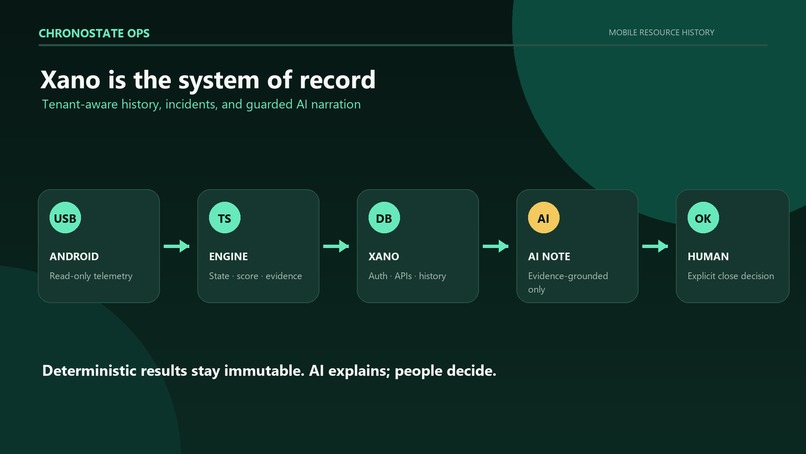
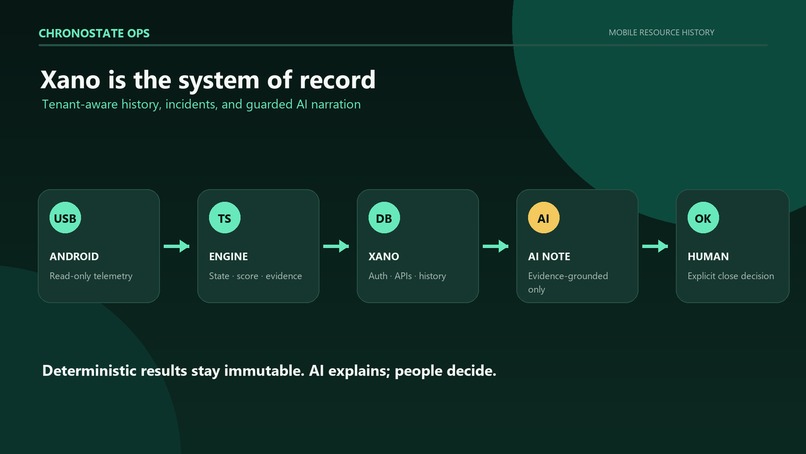
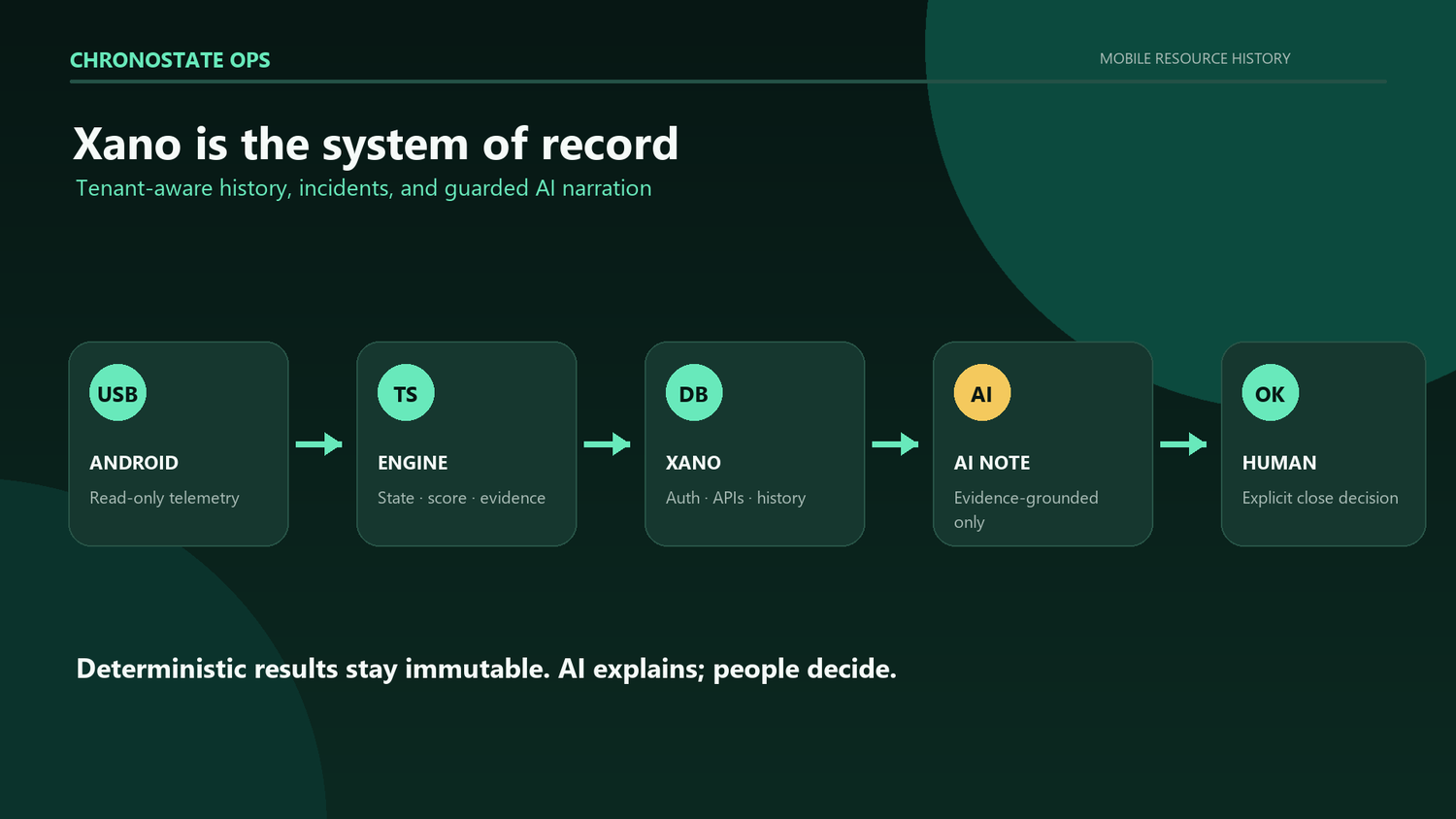
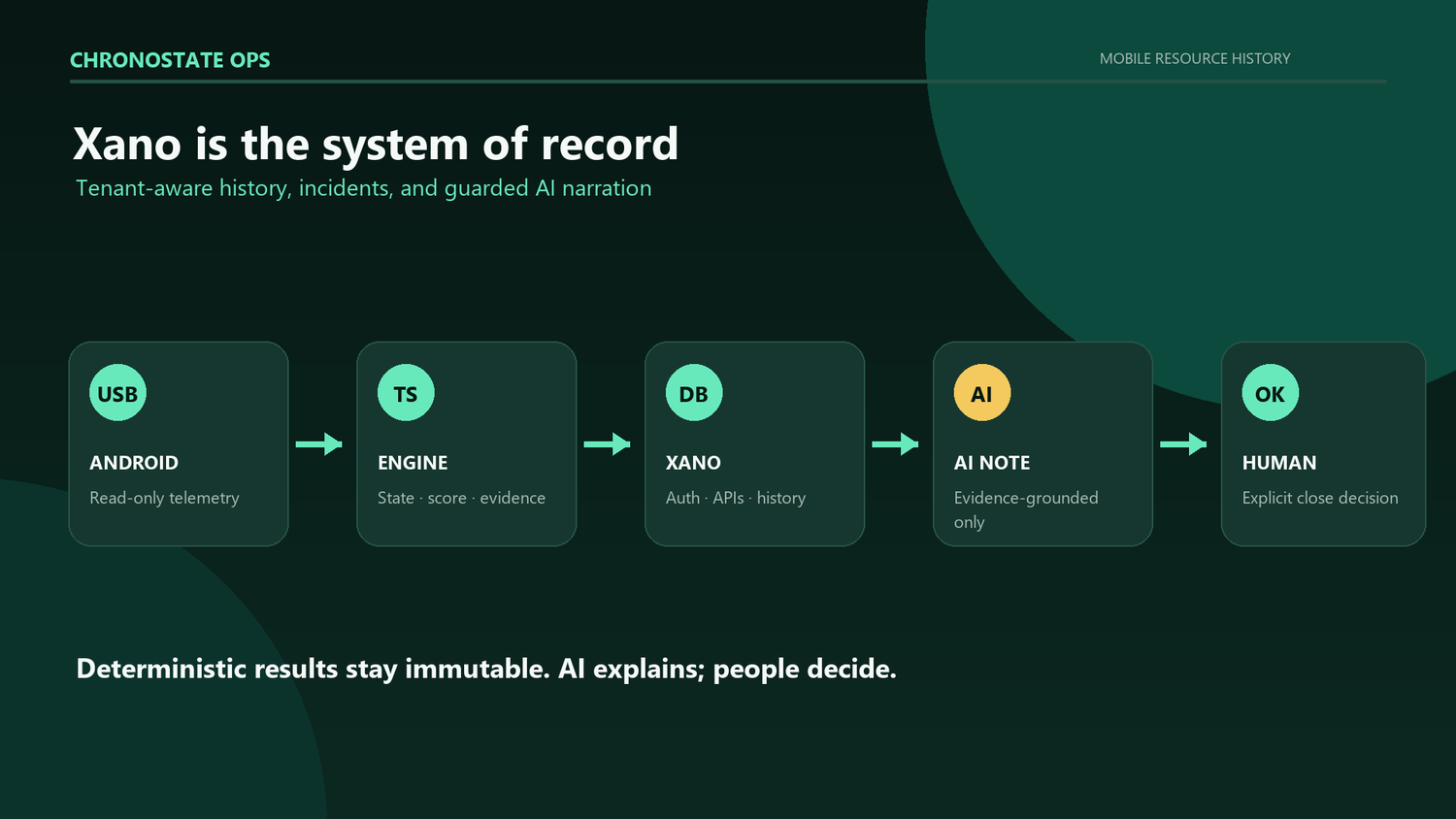
Xano system of record: authenticated history, incident workflow, guarded AI narration and explicit human closure.
-
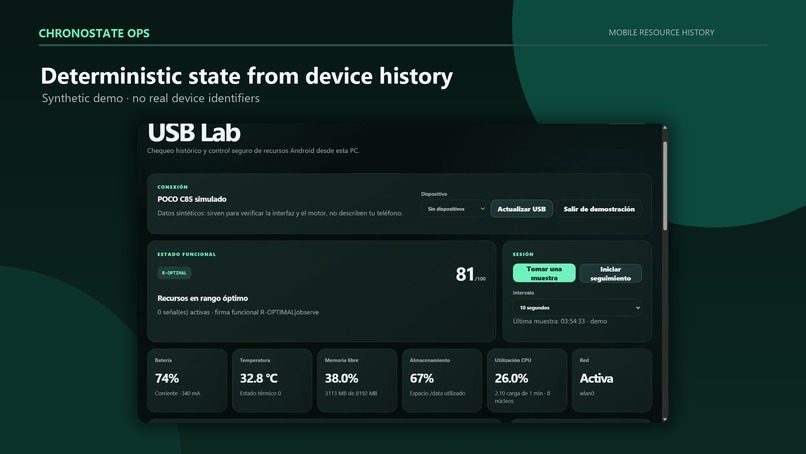
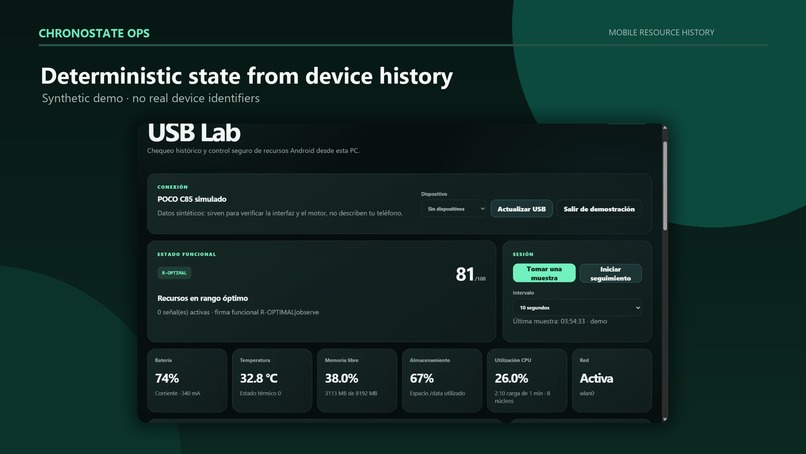
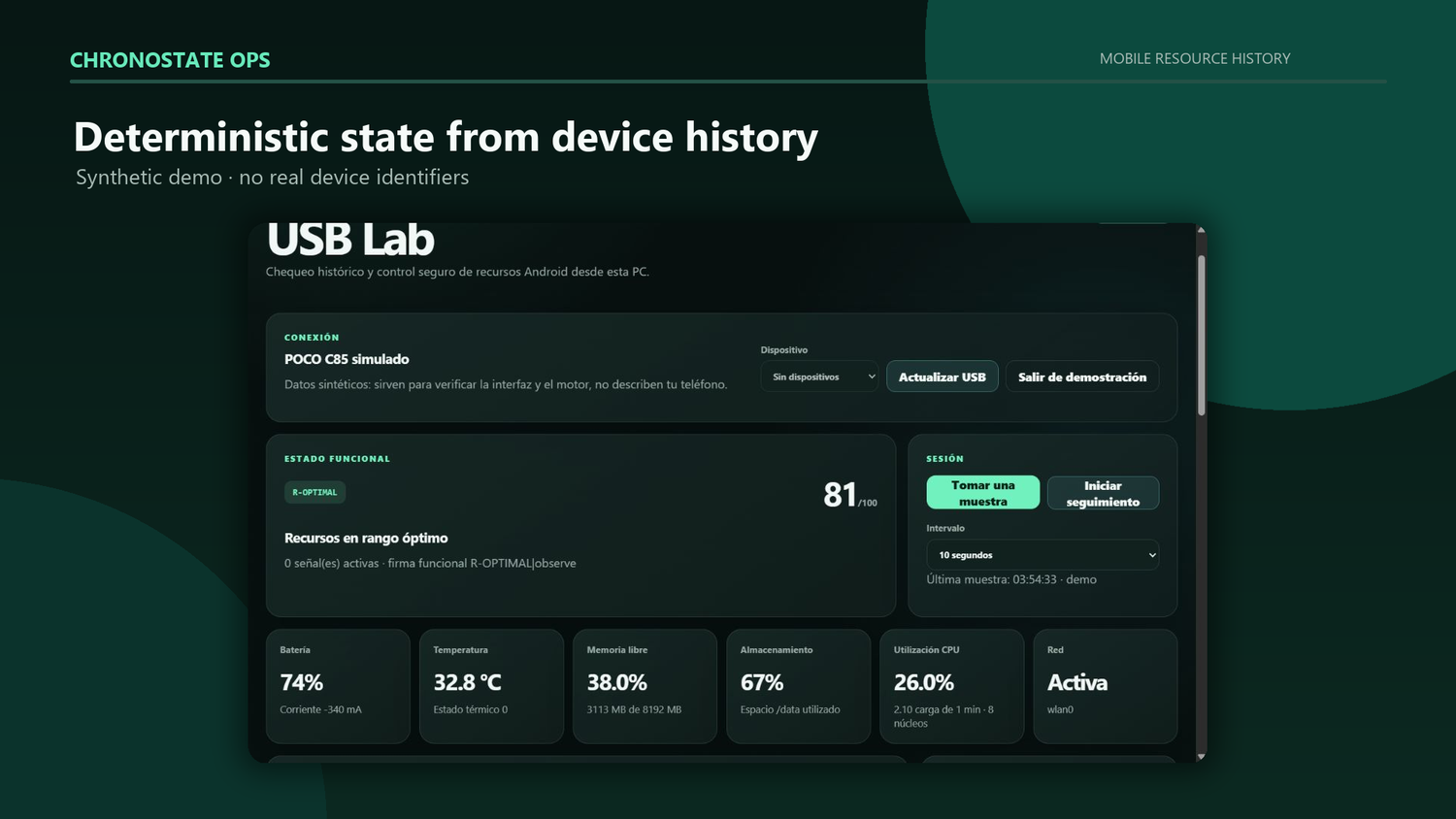
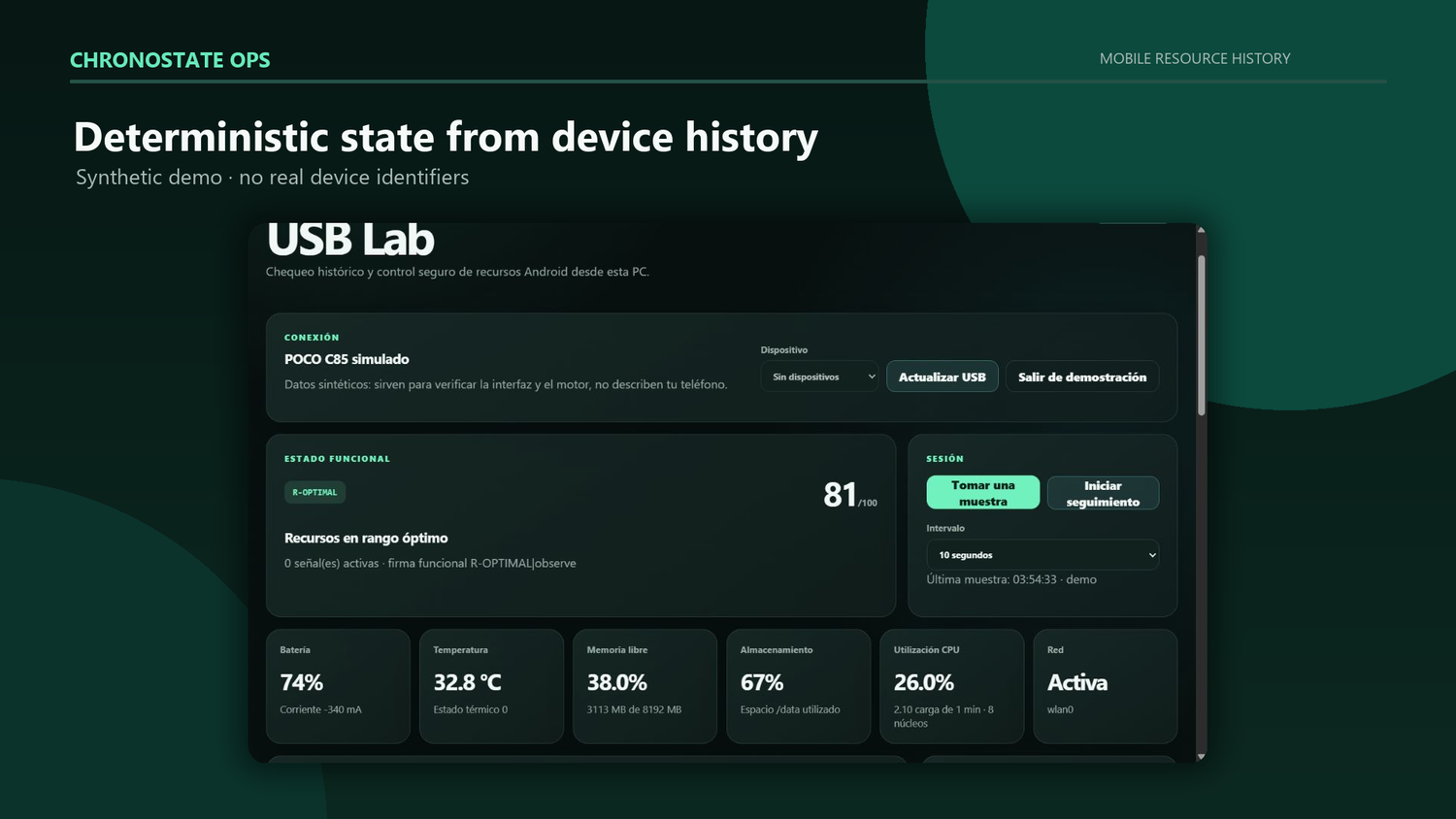
Sanitized USB Lab: read-only Android telemetry becomes deterministic device history and evidence.
Inspiration## Inspiration
Most mobile diagnostic tools show only a snapshot: current battery, CPU, memory, temperature, or network status. But the same measurement can describe very different situations. A device at 72°C may be heating rapidly or recovering from a higher temperature. The correct response depends on its history.
ChronoState Mobile Ops was created to preserve that history while keeping every security claim explainable and conservative.
What it does
ChronoState Mobile Ops is a privacy-first Android operations laboratory.
An authorized phone connects to a computer through USB. The local collector identifies the device, gathers a closed set of read-only telemetry, and sends the observations to a deterministic history engine.
The engine produces:
- a functional resource state;
- an objective score;
- evidence and telemetry coverage;
- an ordered device history;
- recommended actions requiring human review.
Xano authenticates users, isolates workspaces, stores sanitized device passports and observations, and manages the incident workflow.
A guarded Xano AI narrator converts deterministic evidence into a concise support note. It cannot change the mathematical result, diagnose malware from resource usage, or execute actions on the phone. A human decision is required before an incident can be closed.
How we built it
- Node.js and Android Debug Bridge for the read-only USB laboratory.
- TypeScript for the deterministic history and scoring engines.
- Expo and React Native for the mobile-oriented experience.
- Xano for authentication, tenant isolation, APIs, sanitized history, and incident management.
- Xano AI for evidence-grounded incident narration.
- OpenAI Codex for implementation assistance, testing, debugging, architecture, and documentation.
Challenges
Testing with real Android hardware exposed assumptions that simulators did not reveal. HyperOS uses policy routing tables, restricts access to some battery metrics, and reports Linux load differently from CPU utilization.
We adjusted the observation layer so denied measurements remain unknown, network discovery checks the available route tables, and alerts depend on measured evidence.
The central rule is: missing data is never silently converted to zero.
Accomplishments
- 20 automated tests pass with zero failures.
- A real read-only USB baseline was completed on Android hardware.
- Raw USB serial numbers are not persisted.
- Analyzed message content is not collected or stored.
- Xano stores sanitized observations and an ordered device timeline.
- A live synthetic acceptance test produced the trajectory
R-RECOVERING -> R-OPTIMAL -> R-OPTIMAL. - The AI narrator generated separate Observation, Inference, Unknowns, and Human Verification sections.
- The incident could be closed only after an explicit human decision.
What we learned
Device health cannot be understood reliably from a single measurement. The trajectory, evidence quality, and missing information must remain visible.
We also learned that AI is most useful here when it explains deterministic evidence without replacing the underlying engine or the human operator.
What's next
- Validate the engine on more Android manufacturers.
- Collect longer controlled baselines.
- Measure false-positive and false-negative rates.
- Package a signed internal Android build.
- Extend sensor and battery coverage.
- Integrate the original particle-counting mathematical model only after its domain mapping is explicitly reviewed and approved.
Responsible scope
ChronoState Mobile Ops is not a certified antivirus. Resource anomalies are operational signals and are not proof of malware.
What it does
How we built it
Challenges we ran into
Accomplishments that we're proud of
What we learned
What's next for ChronoState Mobile Ops
Built With
- adb
- ai
- android
- api
- bridge
- codex
- debug
- expo.io
- github
- javascript
- native
- node.js
- openai
- react
- rest
- typescript
- xano

Log in or sign up for Devpost to join the conversation.