-
-

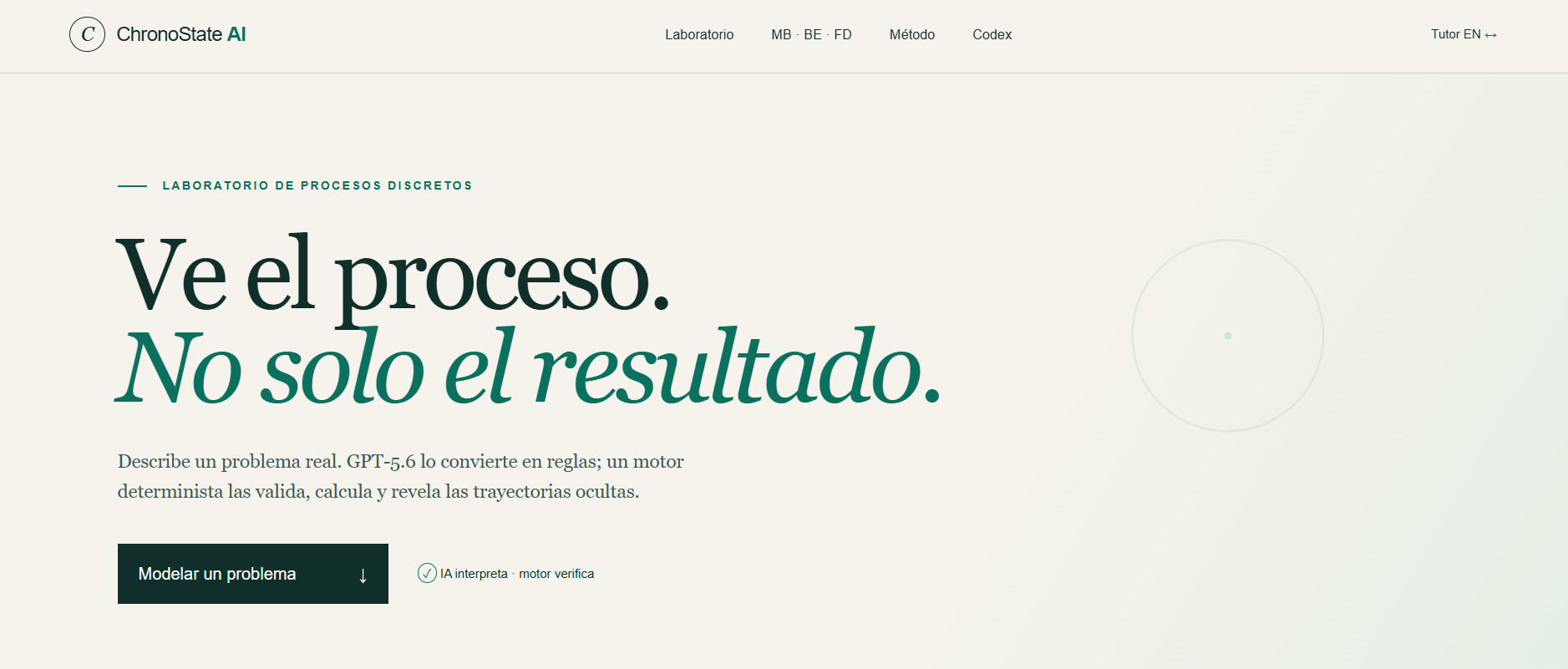
ChronoState AI — See the process, not only the result.
Inspiration
As a Physics and Mathematics teacher in Argentina, I have worked for years on a mathematical model based on the iteration of events in particle counting. The model studies not only how many final configurations are possible, but also the ordered sequences of events that produce them.
Traditional combinatorics and statistical mechanics often present the final count without making the underlying process visible. I wanted students to observe the trajectory: which state was selected, which internal position was occupied, and in what order each event occurred.
ChronoState AI was created to transform this mathematical idea into an interactive educational laboratory. It also explores a hybrid modeling approach that connects ordered-event counting with comparative representations of Maxwell–Boltzmann, Bose–Einstein, and Fermi–Dirac statistics.
What it does
ChronoState AI converts a problem written in natural language into a structured occupation model based on external states, internal positions, ordered events, repetition rules, and global or local scope.
GPT-5.6 interprets the description and proposes the model structure. A deterministic engine then validates the rules and performs the exact calculation. GPT-5.6 does not replace or modify the verified result: it explains the process as an adaptive tutor.
The laboratory reveals:
- ordered histories;
- final configurations;
- the number of distinct histories leading to the same final state;
- the difference between global and local occupation processes;
- comparative occupation behavior under Maxwell–Boltzmann, Bose–Einstein, and Fermi–Dirac statistics.
The statistical panel is an educational comparison, not a claim that the three statistics are mathematically identical. Its purpose is to show how different assumptions about distinguishability and occupation restrictions change the resulting distributions.
Built With
- api
- chatgpt
- codex
- gpt-5.6
- next.js
- openai
- react
- typescript

Log in or sign up for Devpost to join the conversation.