-
-
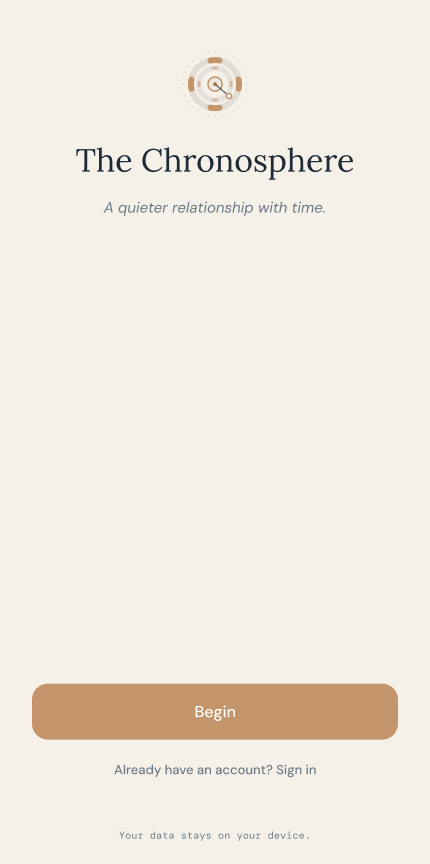
Cover/welcome screen
-
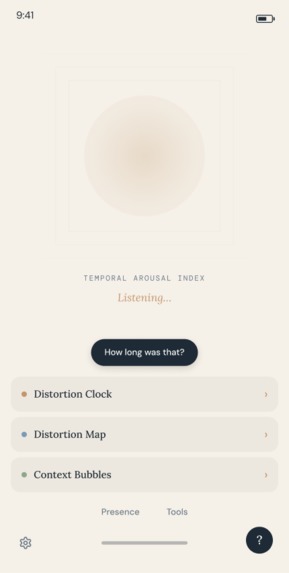
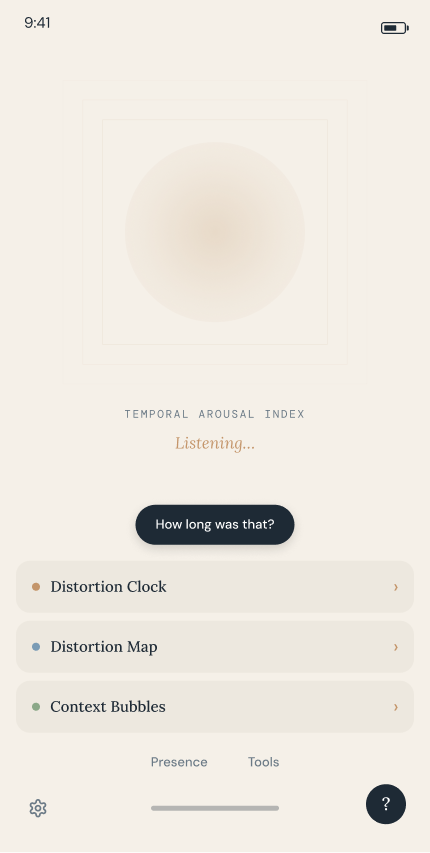
Home screen / orb showing elevated TPI state
-
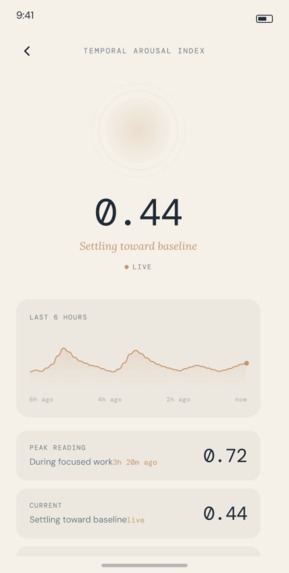
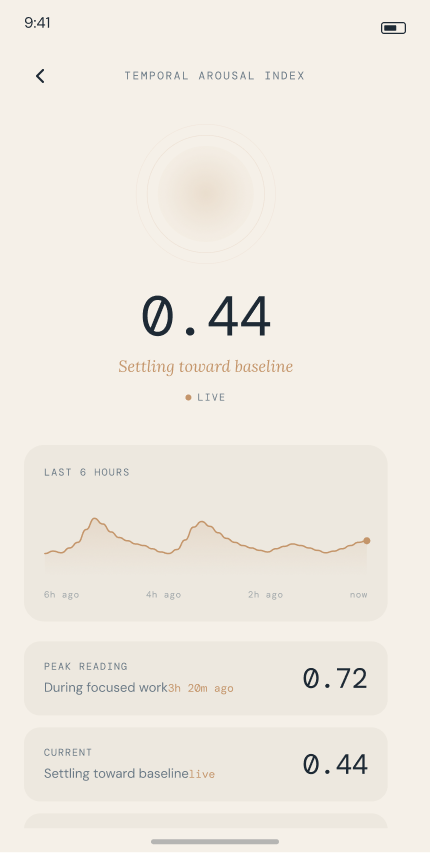
Elevated TPI state
-
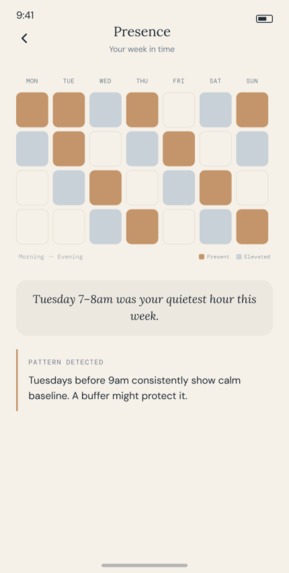
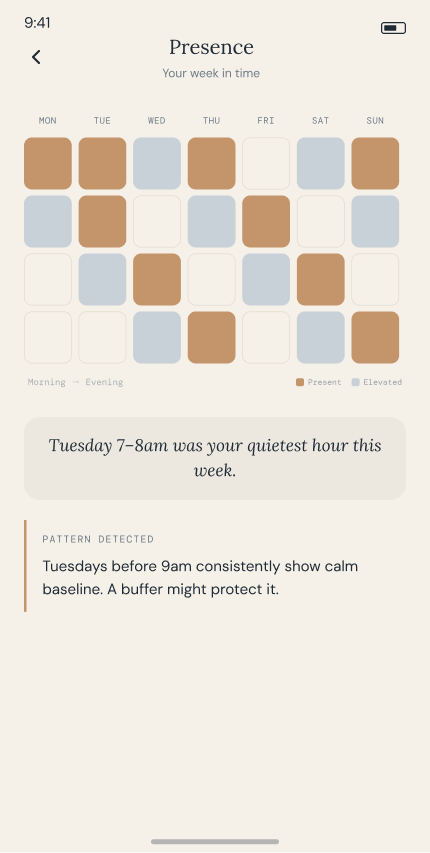
Presence report / weekly view
-
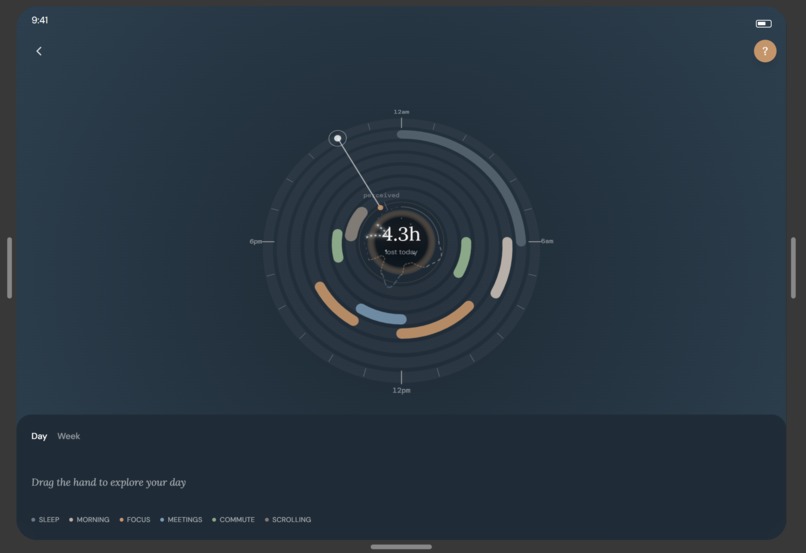
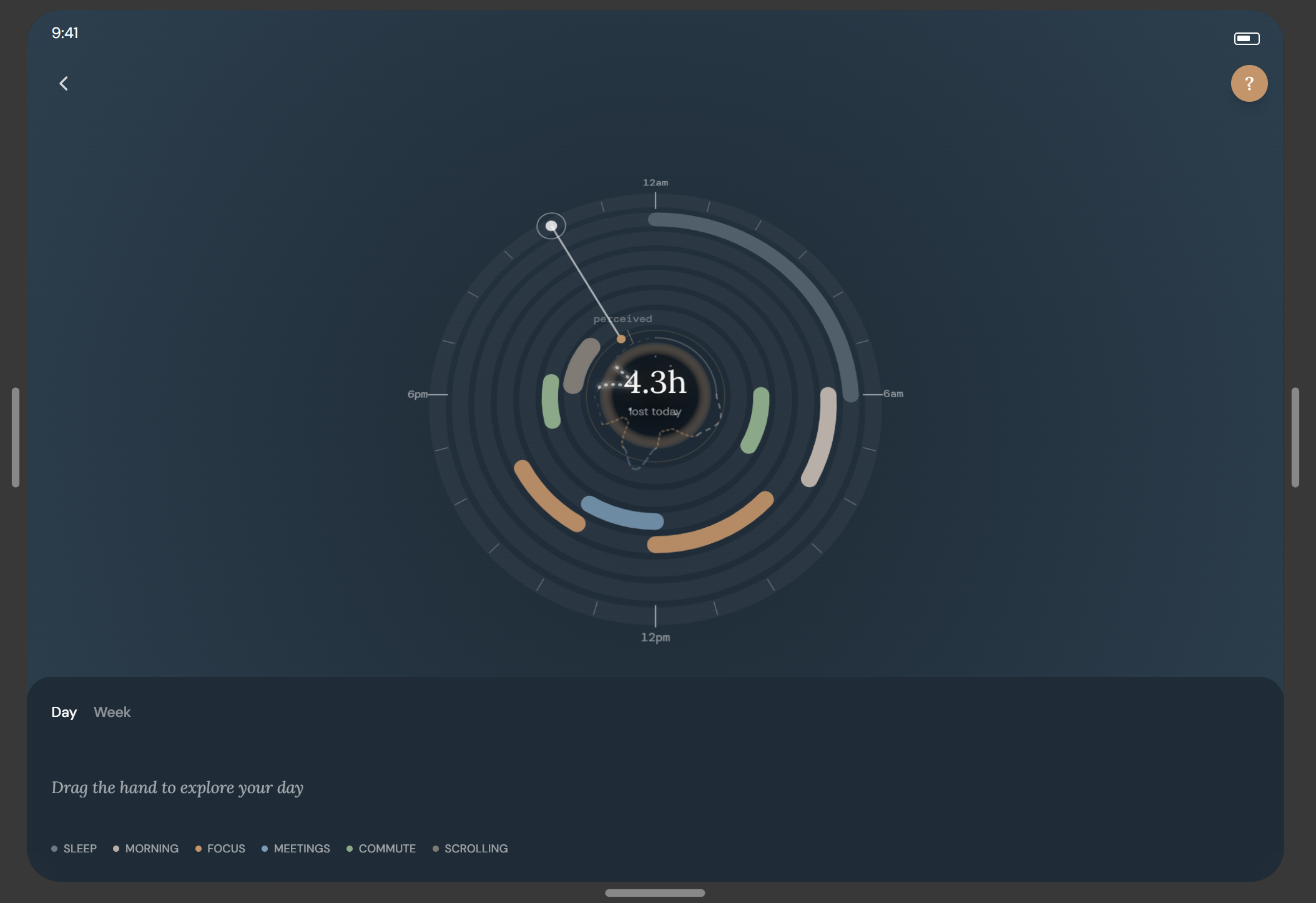
Distortion clock
-
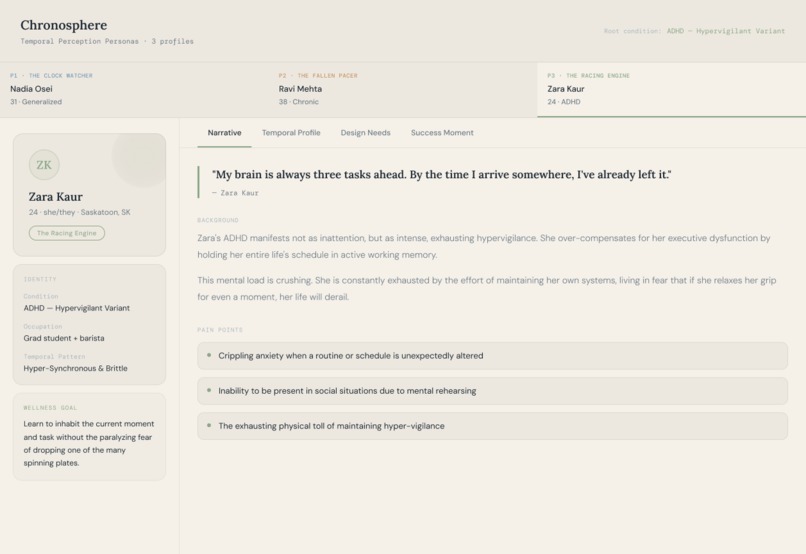
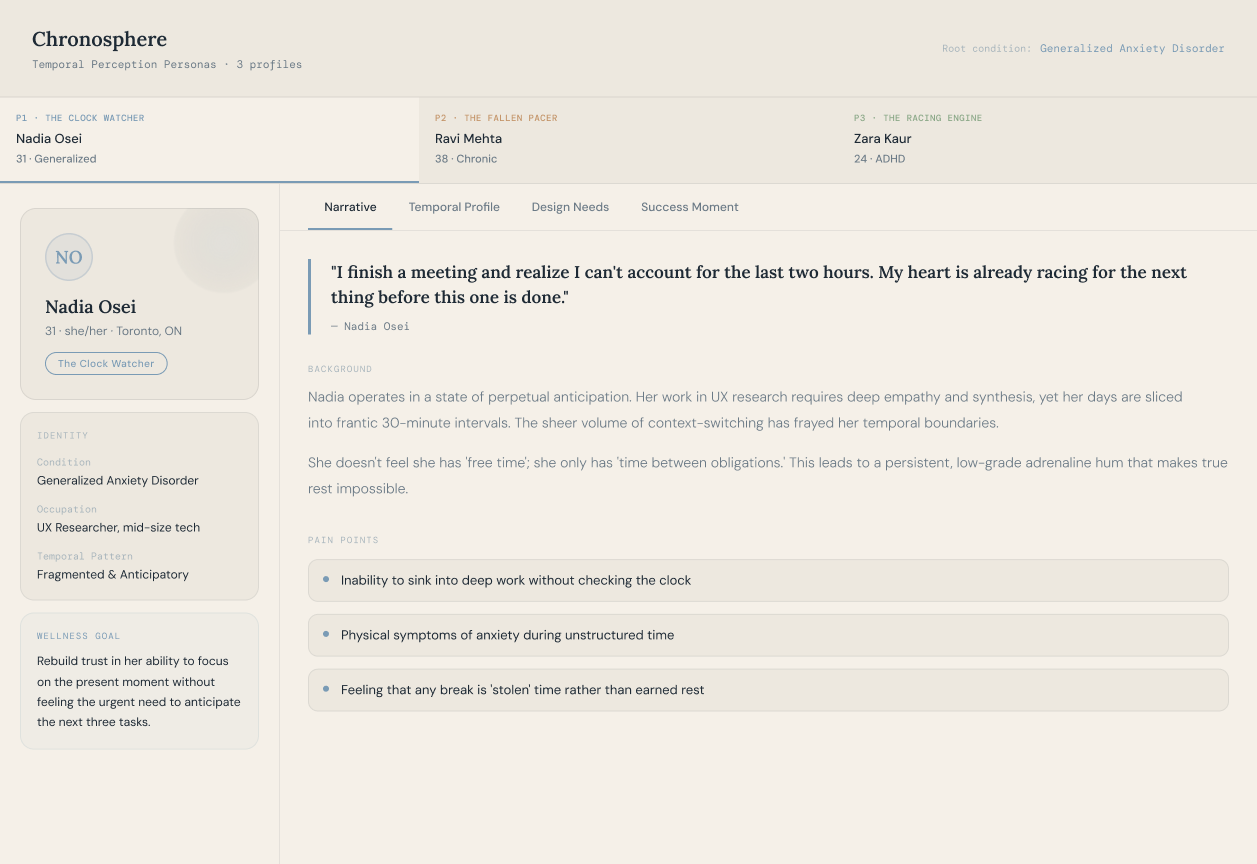
Persona
-
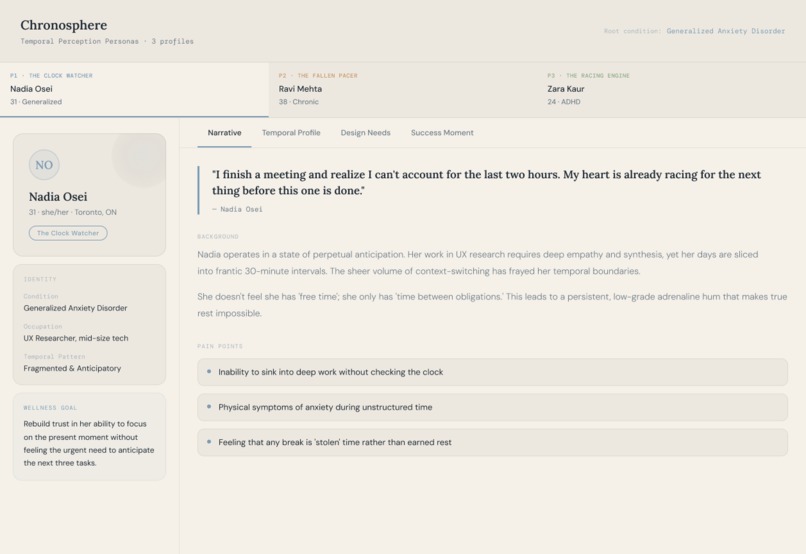
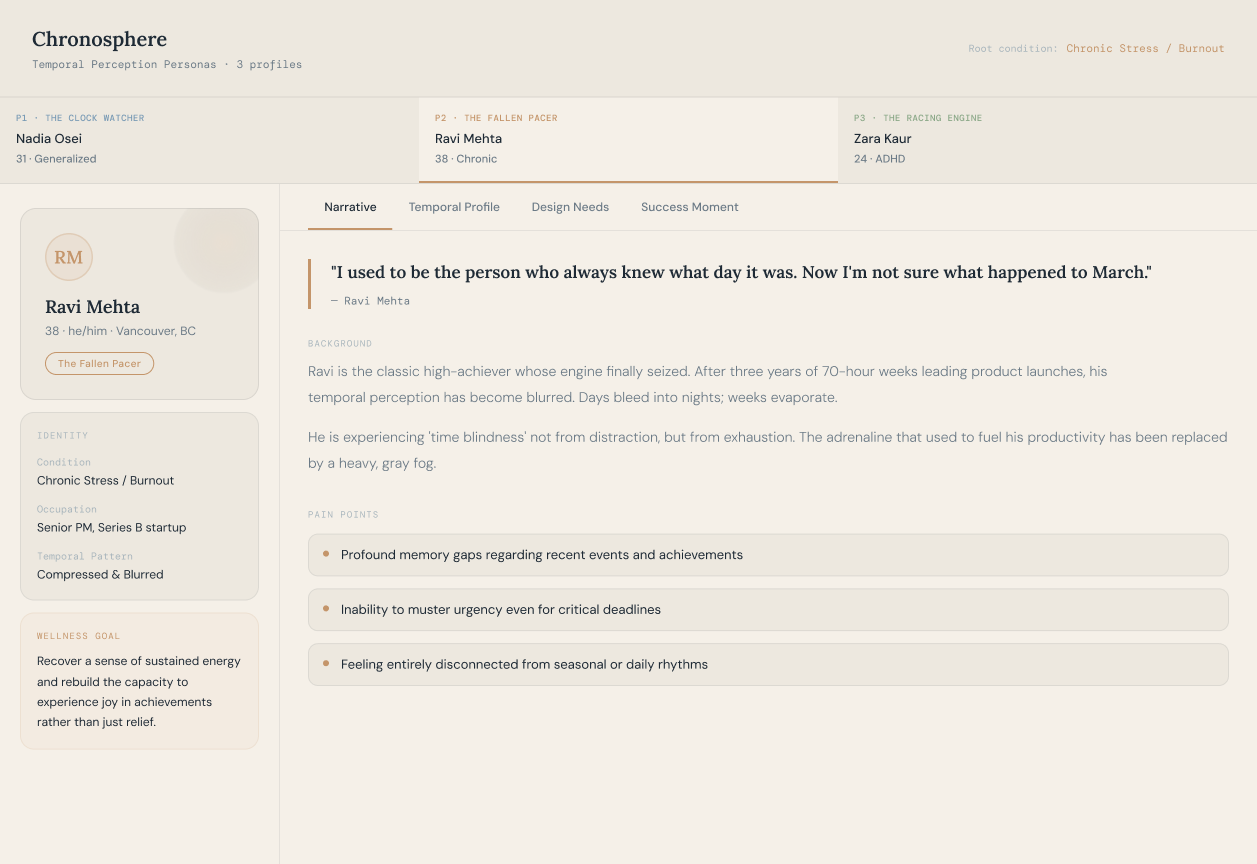
Persona
-
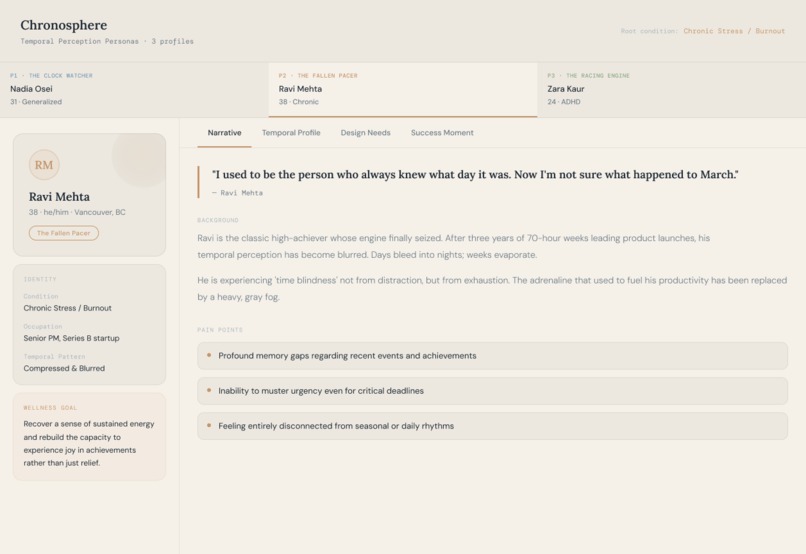
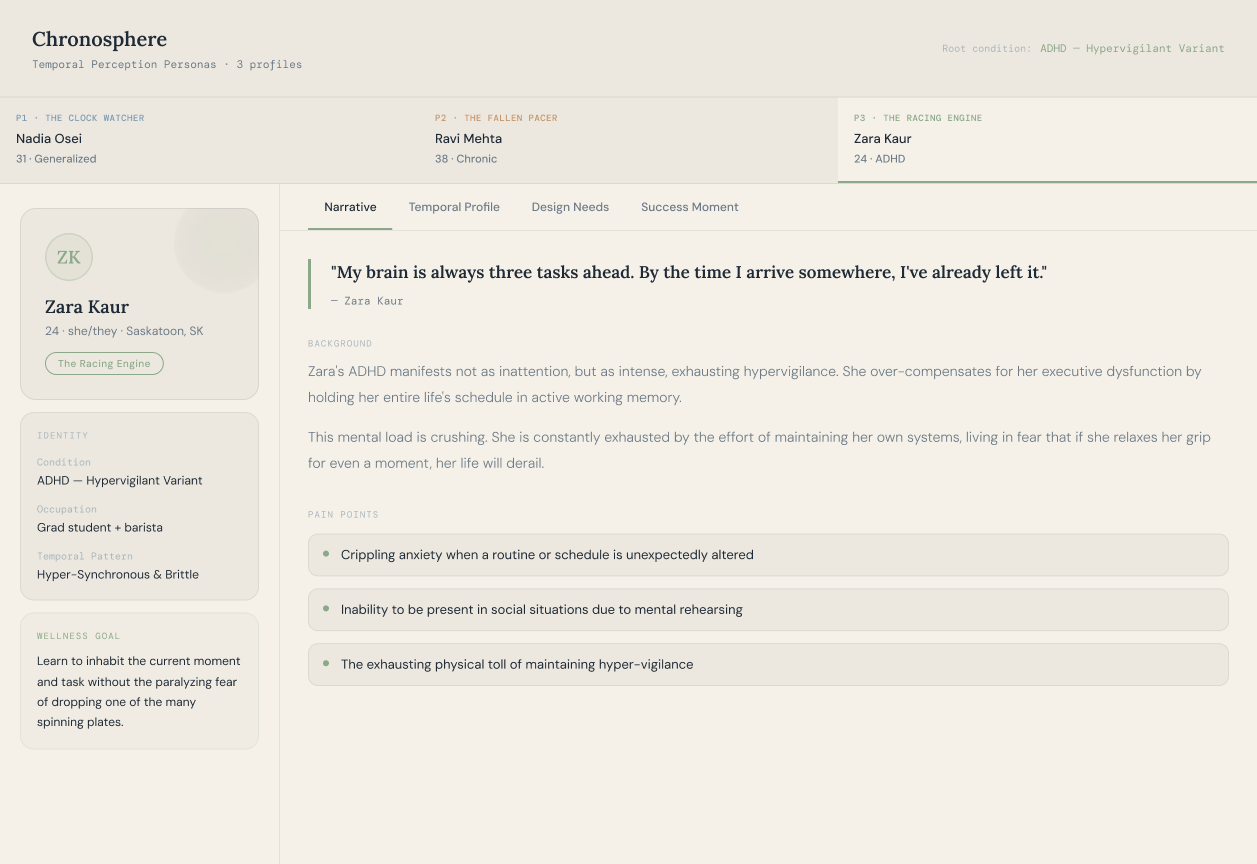
Persona
Inspiration
Time anxiety isn't about having too little time. It's about how threatening time feels — the chest-tightening, clock-watching, always-behind sensation that hits before the day even starts.
We kept coming back to one question: why does every tool designed for this problem make it worse? Calendars add countdowns. Productivity apps add streaks. Wellness apps add one more thing to check. None of them target the actual problem — the nervous system's relationship with time.
The science gave us our answer. Research from Sarigiannidis et al. (2020) showed anxiety causes significant temporal underestimation — not because time speeds up, but because anxiety fragments attention and pulses are literally lost in the brain's internal clock. 359 million people live with this. No tool has ever targeted it directly.
What it does
Chronosphere measures the Temporal Pressure Index (TPI) — a composite signal fusing heart rate variability, micro-behavioral patterns (scroll velocity, typing speed, app-switching), and brief self-report anchors to quantify how threatening time feels in real time.
When TPI is elevated, Chronosphere doesn't send a notification. It doesn't add urgency. It shifts the environment — subtly, ambiently — through a wearable haptic pulse, a desk display, or a screen tone shift. The user doesn't have to act. The tool already did.
The active layer — opened by choice, never pushed — shows a distortion clock: a double-ring instrument visualizing where time actually went vs. where it felt like it went. Not a productivity report. Evidence that your life is still happening, even when it doesn't feel that way.
How we built it
Designed entirely in Figma with a custom design system built around calm, non-urgent interaction principles. Every component decision was filtered through one constraint: does this add to the noise, or reduce it?
The research layer grounded every feature in peer-reviewed science — the attentional gate model (Zakay & Block, 1996), Craig's interoceptive theory of time perception (2009), and Rudd et al.'s awe research (2012) on present-moment anchoring as a pathway to felt temporal abundance.
Challenges we ran into
The hardest design problem was the passive layer. An ambient signal that shifts when TPI is elevated risks becoming a new thing for an anxious person to monitor. We solved this by making the sensitivity threshold user-controlled and the first two weeks observation-only — the tool learns before it nudges.
The second challenge was the data visualization. We didn't want a dashboard. We wanted an instrument. The distortion clock — a double-ring orrery showing actual vs. perceived time — went through many iterations before it felt like something you'd trust rather than something you'd dread opening.
Accomplishments that we're proud of
The TPI concept itself — a named, measurable proxy for temporal threat perception — doesn't exist anywhere as a product. We defined the signal, designed the sensor, and built the interface from scratch in one weekend.
We're also proud of what we removed. No countdowns. No streaks. No completion pressure. The intentional constraints are the design.
What we learned
Designing for anxiety means designing against your instincts. Every "helpful" feature we considered — reminders, progress tracking, goal setting — would have made the product worse for its actual users. The research forced us to be honest about that repeatedly.
What's next for Chronosphere — A Quieter Relationship With Time
Validating TPI as a signal distinct from general stress, through partnership with researchers working on ecological momentary assessment in anxious populations. The intervention gap is real — no clinical trial has ever targeted temporal perception in anxiety as a primary outcome. Chronosphere wants to be the tool that changes that.
Built With
- figma
- figma-make


Log in or sign up for Devpost to join the conversation.