-
-
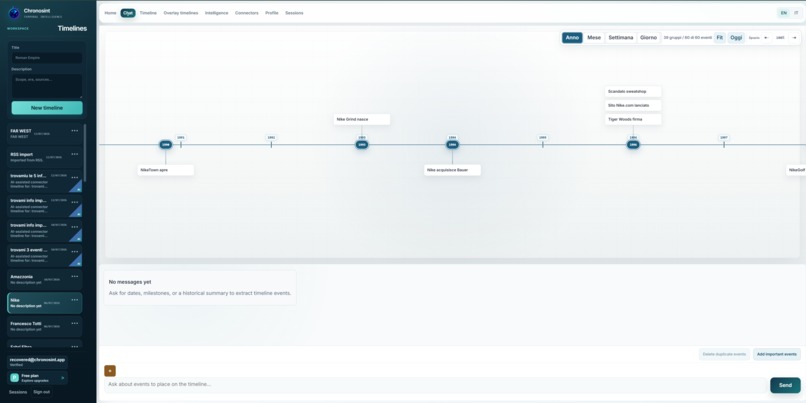
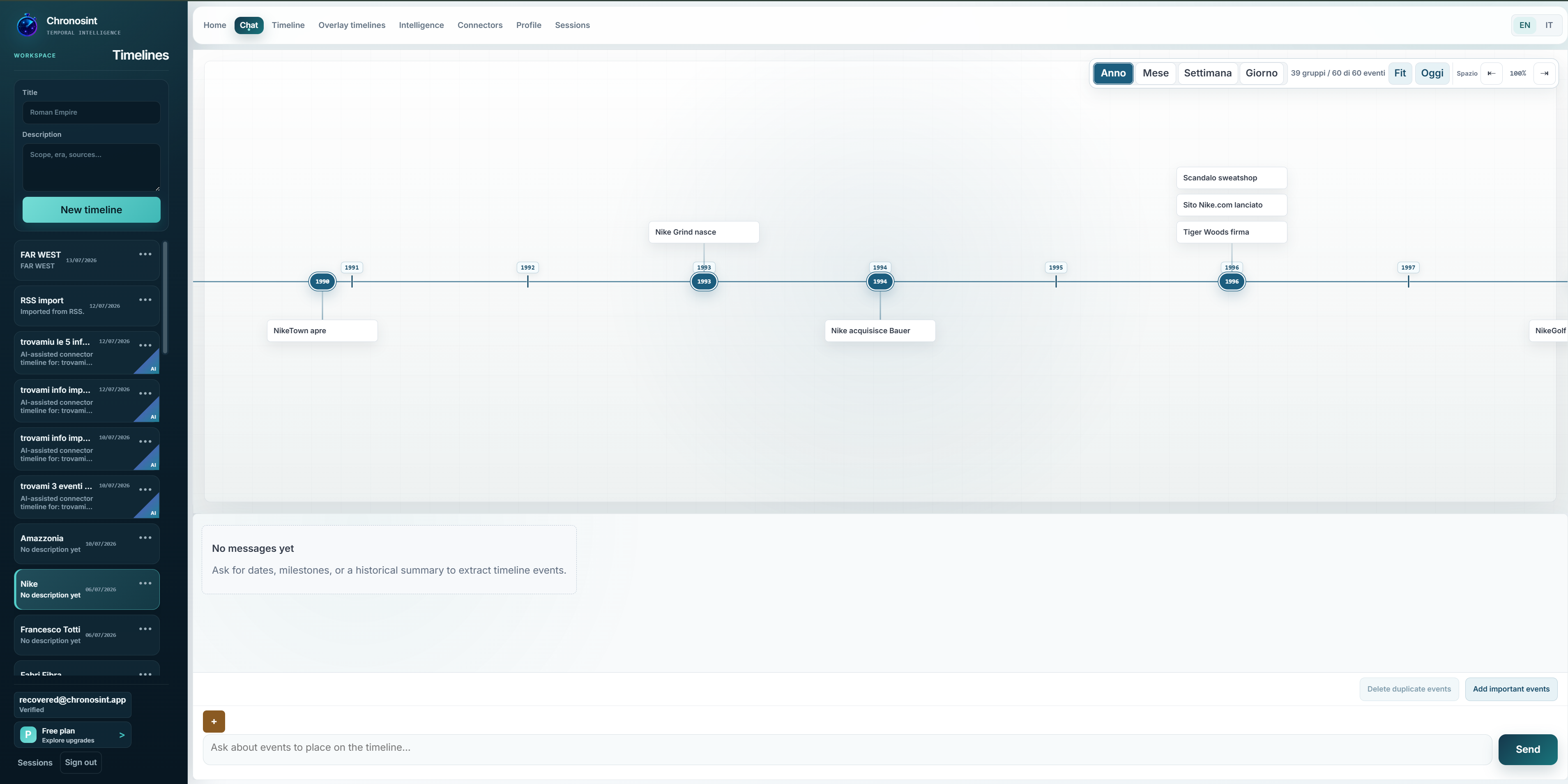
Chat
-
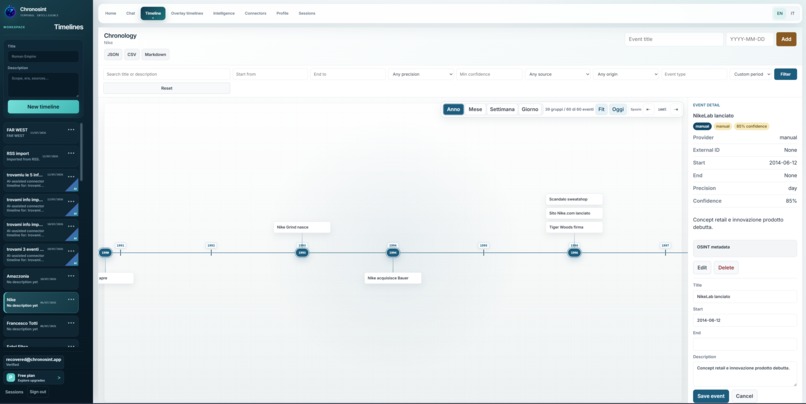
Timeline
-
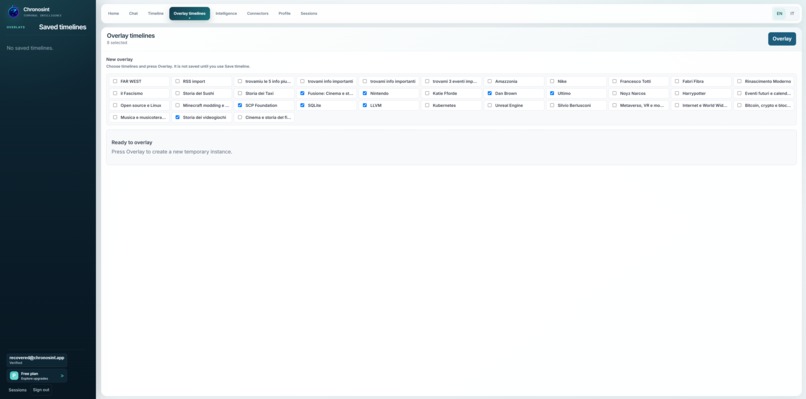
Select
-
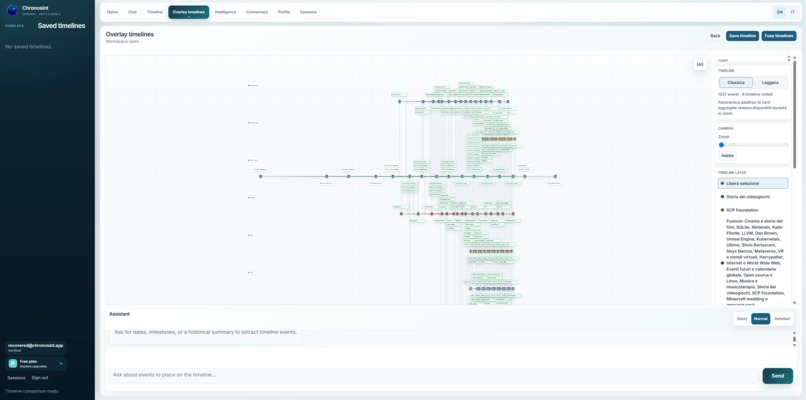
Overlay
-
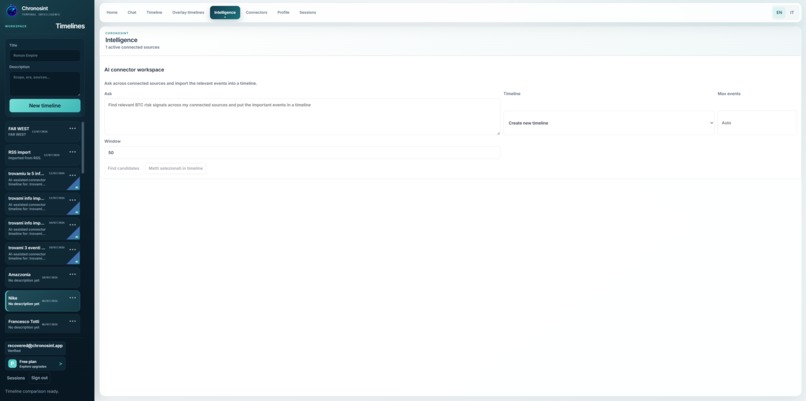
Intelligence
-
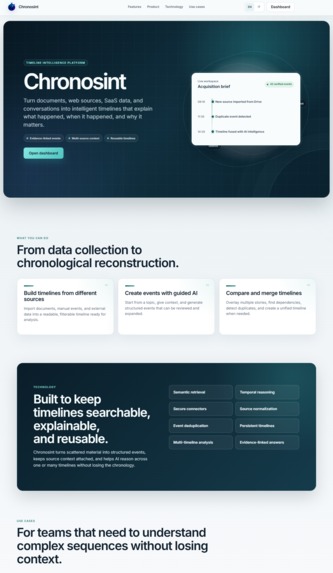
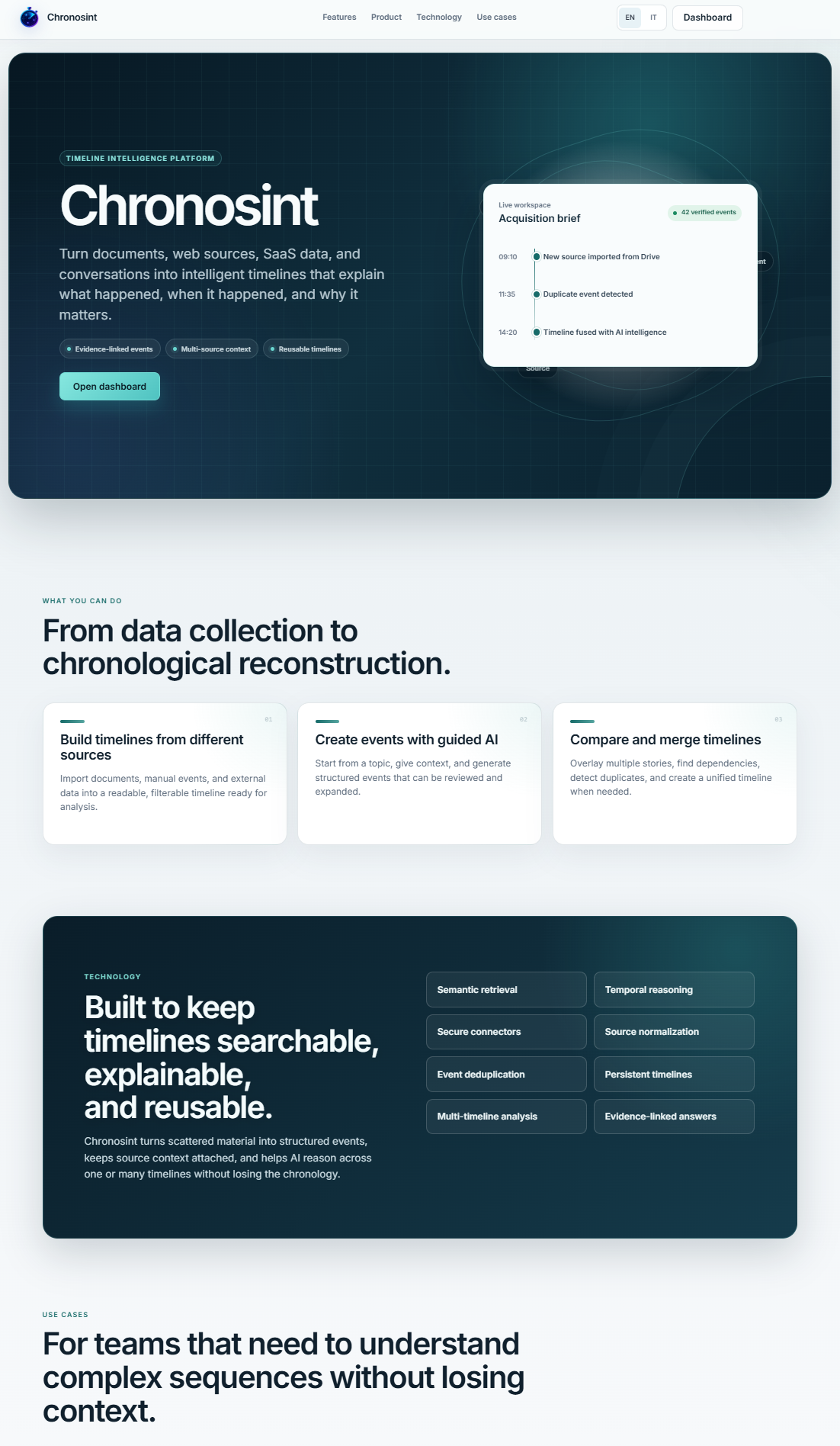
Landing page
-
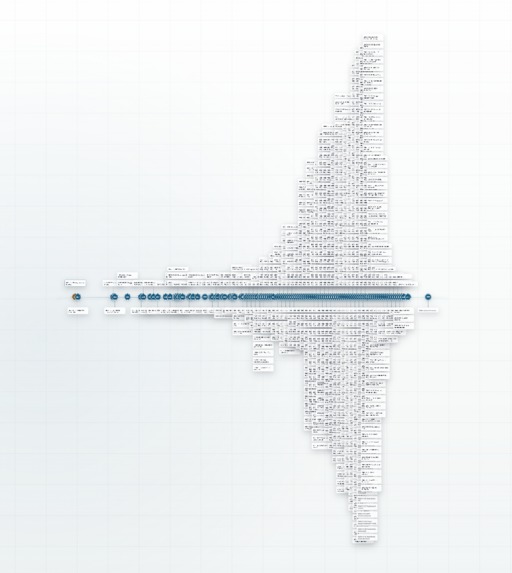
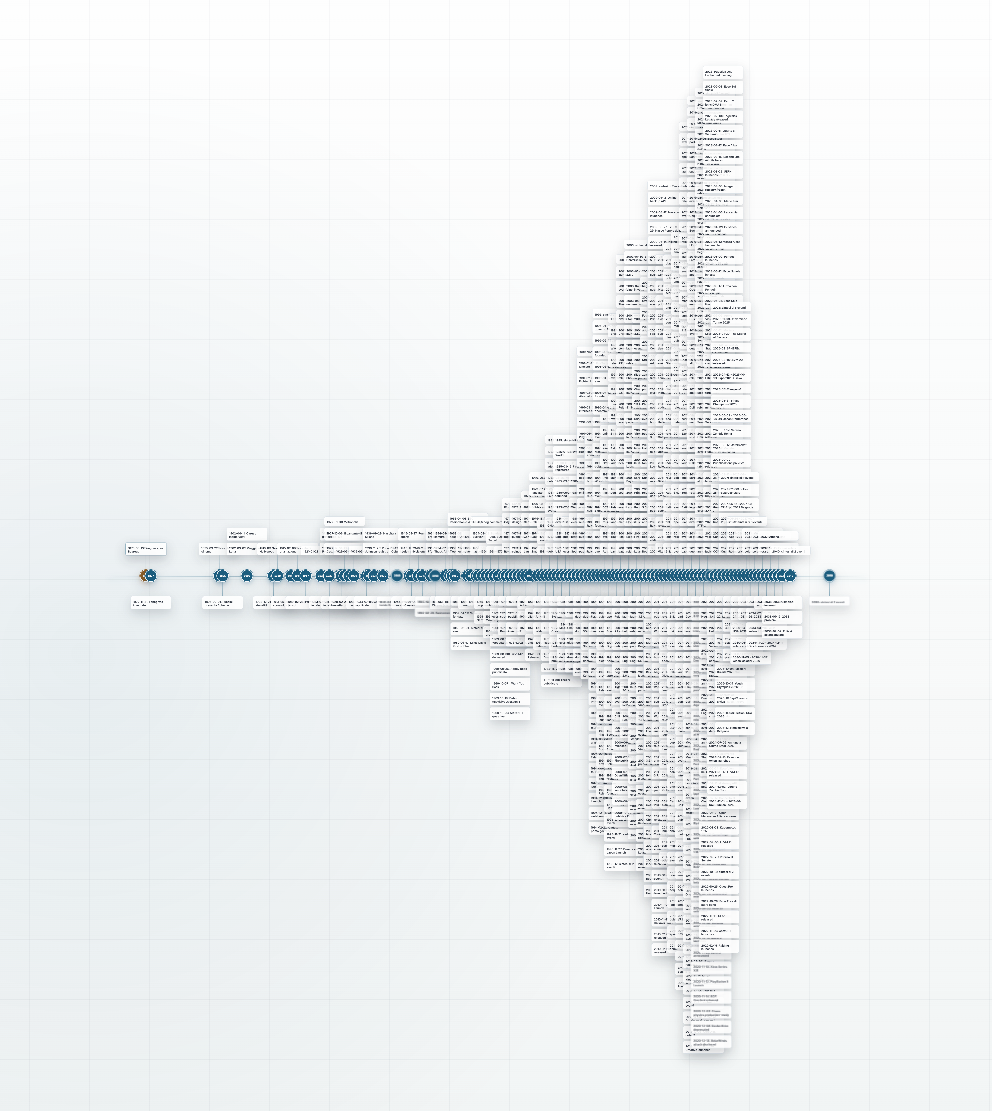
Gauss curve
Inspiration
Complex events are rarely explained in one place. The information is usually scattered across articles, reports, databases, documents, and disconnected sources. Even when the evidence exists, reconstructing what happened, when it happened, and how separate developments relate to each other can require hours of manual research.
Most existing timelines are static lists. They show events in chronological order, but they do not preserve uncertainty, connect every claim to evidence, or make it easy to compare several histories at once.
Chronosint started from a simple idea: use time itself as an intelligence interface.
What it does
Chronosint is a temporal intelligence engine that transforms scattered information into structured, interactive, and evidence-backed timelines.
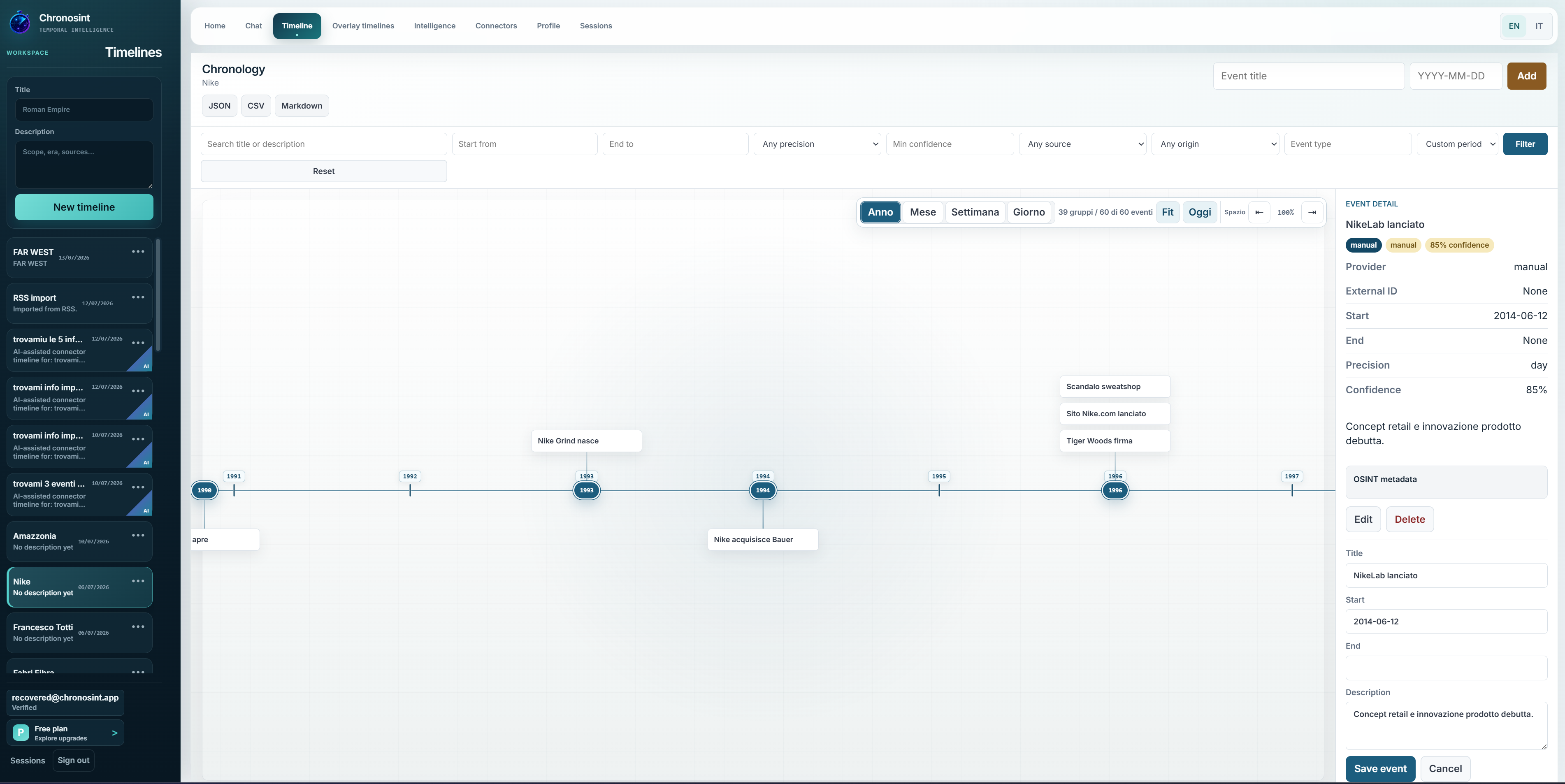
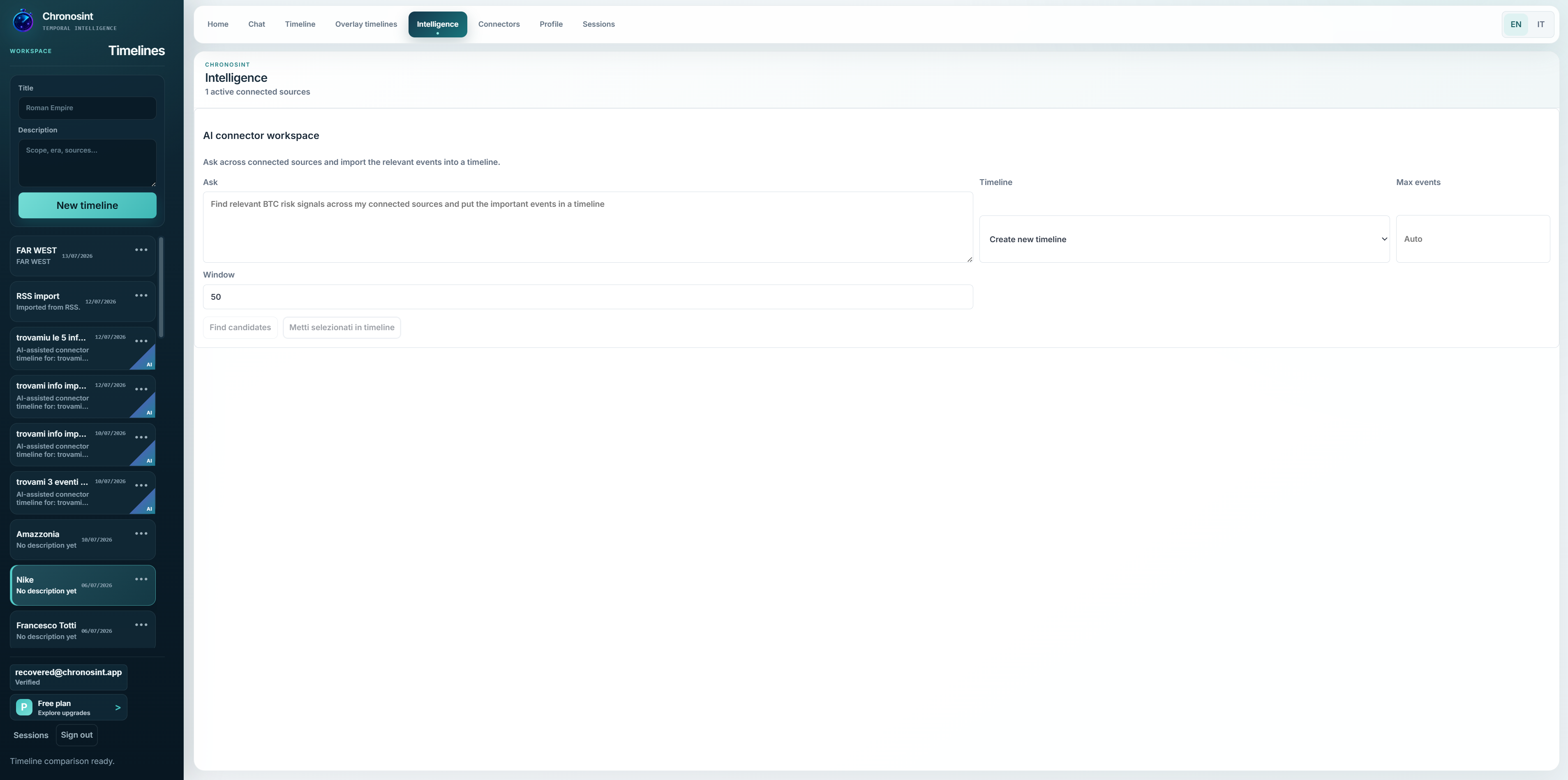
A user can begin with a topic or research question. Chronosint organizes the available information into events, assigns dates, temporal precision, confidence levels, sources, and supporting evidence, and then builds an explorable timeline.
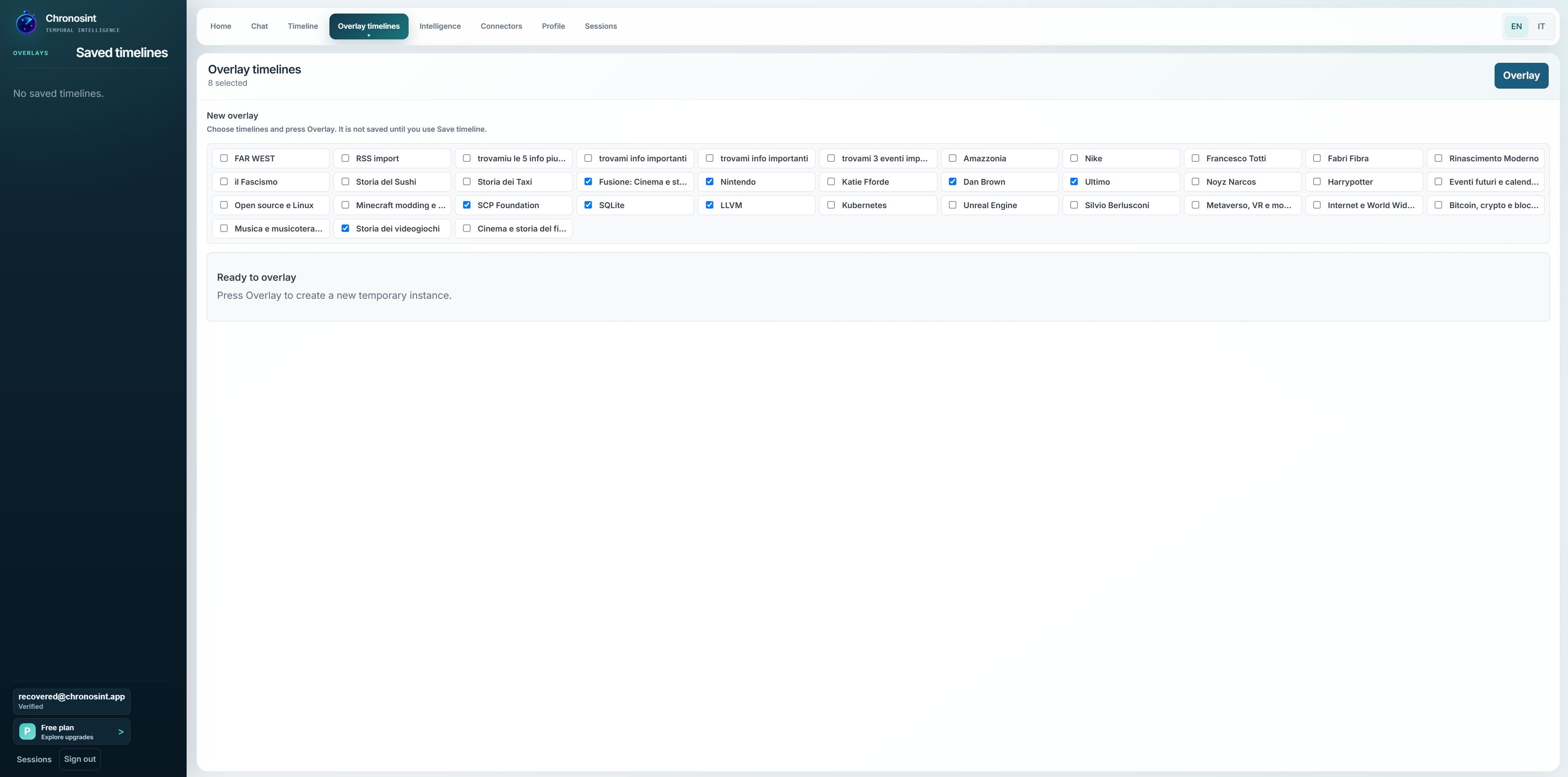
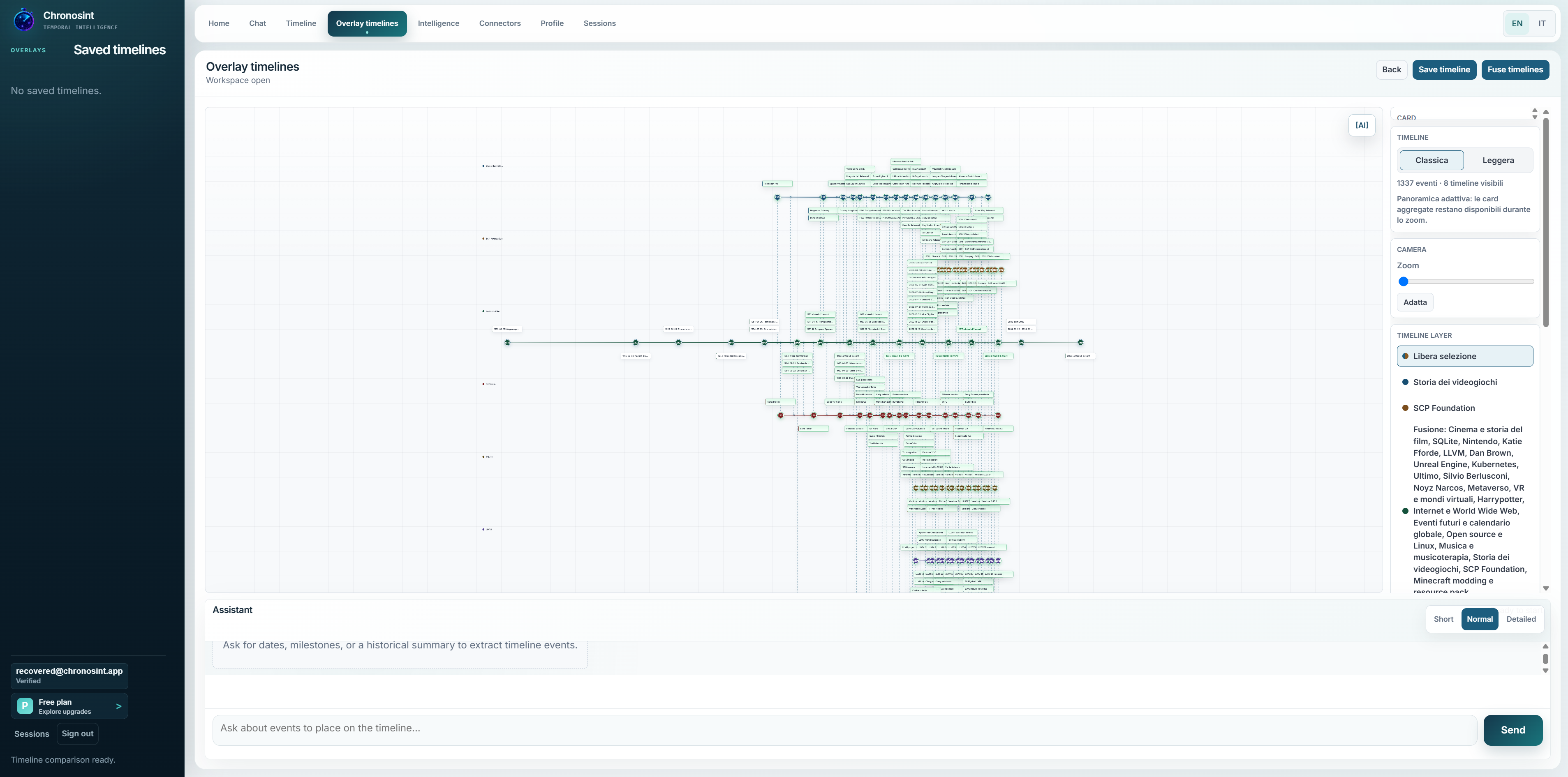
Its central feature is the ability to compare and overlay multiple timelines. This makes it possible to identify:
- events that happened in parallel;
- recurring temporal patterns;
- possible relationships between separate developments;
- gaps or contradictions in the evidence;
- sequences that are difficult to notice through ordinary search.
Users can move from a broad chronological view to individual events, sources, evidence, connections, and cited AI analysis.
The core workflow is:
Question → Sources → Events → Timeline → Analysis
How we built it
Chronosint was built by one person, with Codex and other AI tools used as engineering accelerators.
The platform uses a React and Next.js interface, TypeScript, a Python and FastAPI backend, PostgreSQL, retrieval pipelines, embeddings, RAG, and OpenAI models for evidence-grounded analysis.
The system separates the research process into multiple stages:
- collecting and processing sources;
- extracting and normalizing events;
- assigning temporal precision and confidence;
- connecting each event to supporting evidence;
- generating and indexing timelines;
- comparing multiple timelines through overlays and relationship views;
- answering questions using retrieved evidence and citations.
Chronosint also includes tenant isolation, authentication, access controls, audit logging, connector safeguards, recovery mechanisms, soft deletion, rate limiting, and fail-closed behavior for sensitive operations.
During the Build Week, I used Codex extensively for implementation, testing, refactoring, benchmarking, documentation, and technical hardening. The product concept, architecture, constraints, priorities, and final decisions were defined and reviewed by me.
Challenges we ran into
The first major challenge was temporal uncertainty. Real-world events do not always have exact dates. Some sources describe a specific day, while others only provide a month, year, period, or approximate sequence. Chronosint therefore had to represent precision and confidence instead of treating every date as equally certain.
The second challenge was traceability. Generating a timeline is easy compared with ensuring that every important event remains connected to its original evidence. The retrieval and citation system had to preserve the path from analysis back to sources.
Scale was another major challenge. A timeline containing a few events behaves very differently from a system comparing thousands of timelines and potentially millions of events. This required dedicated work on indexing, caching, retrieval, hierarchical replay, rendering, worker isolation, and large synthetic benchmark workloads.
The final challenge was responsible use. A temporal intelligence platform could become invasive if applied to private individuals or real-time tracking. Development and testing were therefore restricted to safe, non-personal, public-interest domains, with safeguards around connectors, permissions, tenant boundaries, and sensitive capabilities.
Accomplishments that we're proud of
During the Build Week, Chronosint evolved from a timeline concept into a substantial temporal research platform.
The system now includes:
- evidence-backed event generation;
- interactive and filterable timelines;
- multi-timeline overlays;
- temporal precision and confidence controls;
- cited AI analysis;
- source and evidence inspection;
- relationship and connection views;
- scalable retrieval and replay architecture;
- tenant isolation and security hardening;
- connector governance and fail-closed protections;
- large-scale synthetic and replay-based benchmarks.
I am especially proud that Chronosint does not treat AI output as the final authority. The platform is designed to keep analysis connected to inspectable evidence.
I am also proud that the project was built independently by one person while maintaining a clear product vision across a large and technically complex codebase.
What we learned
The main lesson was that temporal intelligence is fundamentally different from ordinary search.
Search retrieves documents. Chronosint must reconstruct sequences, preserve uncertainty, compare parallel histories, identify patterns, and keep every conclusion connected to evidence.
I also learned that scalability cannot simply be added at the end. A system that works with twelve events does not automatically work with one million. The data model, retrieval architecture, rendering system, and testing strategy must all be designed with scale in mind.
Another lesson was that AI is most useful when it helps people navigate evidence rather than replacing it. The strongest output is not an unsupported answer, but an analysis that a user can inspect, challenge, and verify.
What's next for Chronosint
The next step is a controlled private beta for researchers, analysts, journalists, legal professionals, investigators, and organizations that work with complex chronological information.
Future development will focus on:
- stronger source governance;
- improved document understanding;
- more advanced visual relationship discovery;
- collaborative research workspaces;
- better large-scale timeline comparison;
- additional evidence and citation controls;
- simplified deployment and onboarding;
- further privacy and security hardening.
The long-term goal is to make Chronosint a new layer for investigating information: not organized only by keywords or documents, but by time, evidence, uncertainty, and connections.
Built With
- ai
- codex
- data-visualization
- embeddings
- fastapi
- full-stack
- git
- github
- gpt-5
- gpt5.6sol
- machine-learning
- next.js
- openai-api
- postgresql
- python
- rag
- react
- rest-api
- retrieval
- temporal-data
- typescript
- vector-search

Log in or sign up for Devpost to join the conversation.