-
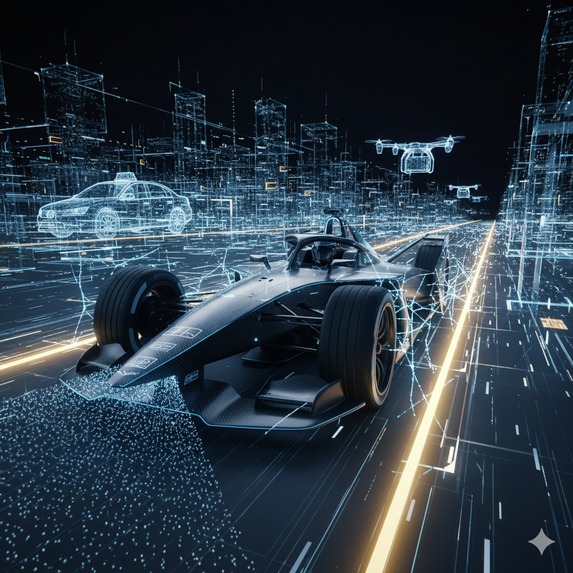
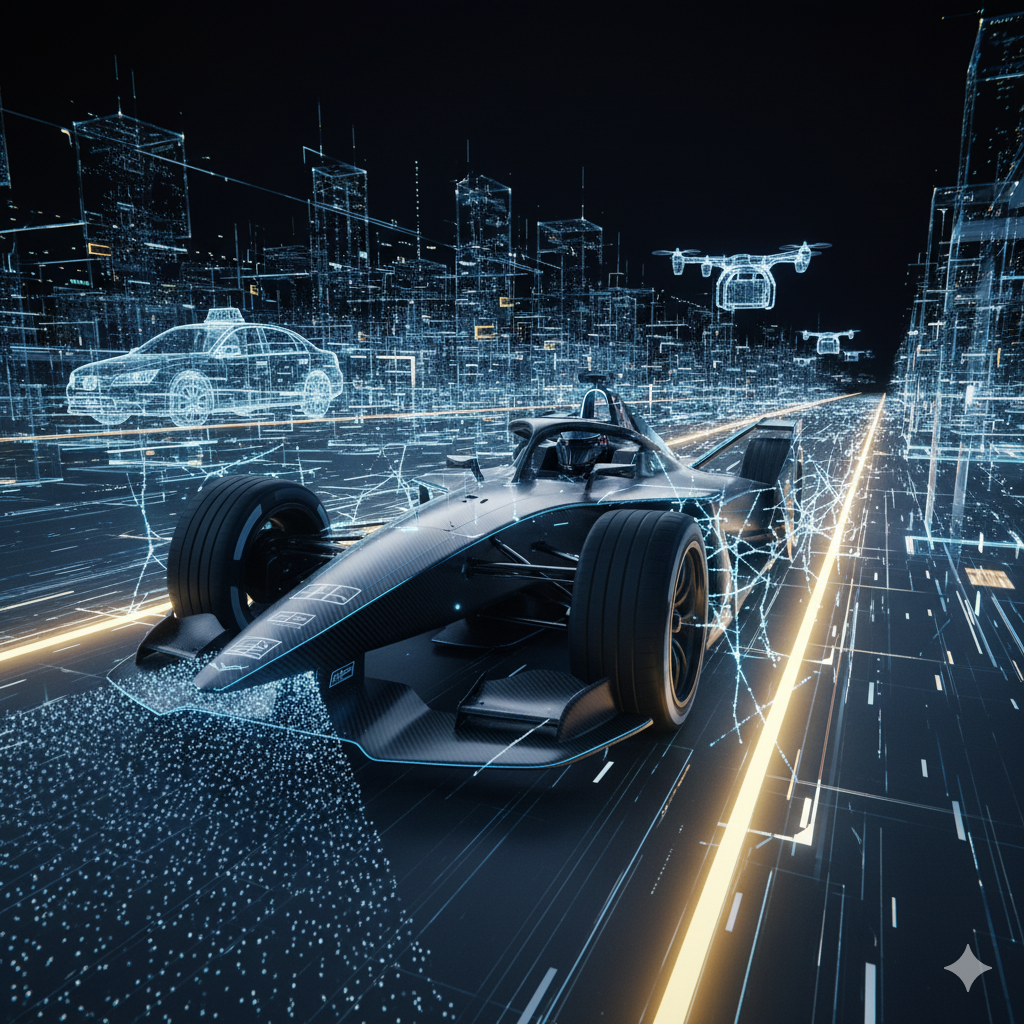
Axon Race Intelligence: Our AI finds the optimal path (gold line) on a scalable platform for race cars, AVs, and drones.
Inspiration Our inspiration came from the precise intersection of the sponsors' goals and the challenge itself. We saw the "Mobility Simulator" track not just as a coding problem, but as a direct response to a real-world strategic need.
On one hand, Mphasis is redefining enterprise solutions with its "Driver in the Driverless Car" philosophy, using AI to steer complex systems. On the other, the MoneyGram Haas F1 Team, as the grid's smallest team, faces a documented competitive gap due to limited access to state-of-the-art simulation technology.
This created our mission: to build a simulator that embodies Mphasis's AI-first approach to solve a critical, real-world performance problem for the Haas F1 Team. We chose to model Formula E, as its intense focus on energy management presents a far more complex and interesting AI challenge than pure lap time optimization.
What It Does Axon Race Intelligence is a modular, agent-based simulation platform designed to model diverse and complex mobility systems. At its core, it's a flexible engine that can simulate various "agents"—from race cars to drones—each with their own unique physics and behaviors.
For this challenge, we built a high-fidelity Formula E simulation as our primary showcase. The platform accurately models the key constraints of electric racing:
Limited Battery Energy (SoC): A finite 52 kWh of usable energy that must last the entire race.
Regenerative Braking: Recapturing energy to extend range and performance.
Battery Thermal Dynamics: The battery heats up under load and its power is automatically reduced if it overheats, adding a critical strategic layer.
The true innovation, however, is our AI Race Strategist. Instead of being programmed with a fixed strategy, our FormulaECar agent uses a genetic algorithm to autonomously learn and evolve the optimal energy deployment profile. It discovers the perfect balance of full-power acceleration and energy-saving "lift and coast" maneuvers for every corner of the track, finding the fastest possible race time without running out of energy.
How We Built It We engineered Axon Race Intelligence from the ground up within the 24-hour timeframe, prioritizing a robust architecture and a powerful AI core.
Core Engine & Physics: The simulation is built in C++ for maximum performance. We leveraged the powerful, open-source Project Chrono multi-physics engine, specifically its Chrono::Vehicle module, to create a realistic, template-based model of our open-wheel race car.
Modular Architecture: We designed a flexible, agent-based system. A central SimulationEngine manages the main loop and a list of abstract Agent objects. This allowed us to easily create our primary FormulaECar agent and later add a DroneAgent to prove the platform's scalability.
AI Race Strategist: We implemented a genetic algorithm from scratch. Each "chromosome" represents a full race strategy. The algorithm runs hundreds of race simulations, scoring each strategy based on its finish time and penalizing those that deplete their battery. Through selection, crossover, and mutation, the AI evolves a near-optimal strategy over multiple generations.
Challenges We Ran Into The 24-hour time limit was our greatest adversary. Our biggest technical hurdle was integrating the AI's evolutionary process with the real-time physics simulation. Running a full race simulation for every single member of the AI's population, for every generation, was computationally expensive. We had to carefully balance the fidelity of our physics models against the need for a fast simulation loop that would allow the AI to learn effectively within the hackathon's timeframe.
Accomplishments That We're Proud Of We are incredibly proud of building a system that doesn't just simulate, but thinks. Our greatest accomplishment is the working AI Race Strategist. It's not just following a pre-programmed path; it's actively discovering a complex, non-intuitive strategy to solve the core energy management puzzle of Formula E.
We are also proud of our modular architecture. By successfully running a high-fidelity car simulation alongside a simple drone simulation in the same environment, we proved that Axon Race Intelligence is not just a one-trick pony, but a truly scalable platform that directly addresses the full breadth of the challenge brief and the "scalability of impact" judging criterion.
What We Learned This project was a deep dive into the real-world application of AI in high-performance engineering. We learned that the most elegant solution isn't always the most complex; by simplifying our physics models to focus on the core strategic problem, we were able to build a much more intelligent system.
What's Next for Axon Race Intelligence Axon Race Intelligence is a powerful foundation. Our roadmap is focused on expanding its fidelity and scope:
Higher Fidelity Physics: Integrate more advanced tire models (like Pacejka's Magic Formula) and a more granular battery thermal model.
Expand the Agent Library: Build out high-fidelity agents for other challenge domains, particularly an autonomous vehicle with a full suite of simulated sensors (LiDAR, camera, radar).
Advanced AI: Explore Reinforcement Learning (RL) as an alternative to the genetic algorithm, allowing the agent to learn from direct interaction with the simulation in real-time.
Cloud-Scale Simulation: Re-architect the platform to run on the cloud, enabling massive parallelization to run thousands of Monte Carlo simulations simultaneously, providing the kind of deep, probabilistic strategic insights used by top F1 teams.
Built With
- amazon-web-services-(aws)
- apache-kafka
- c++
- carla-simulator
- cmake
- docker
- grpc
- kubernetes
- opencv
- opendrive
- postgresql
- project-chrono
- python
- pytorch
- reinforcement-learning
- rest-api
- ros
- scikit-learn
- tensorflow
- unreal-engine

Log in or sign up for Devpost to join the conversation.