-
-
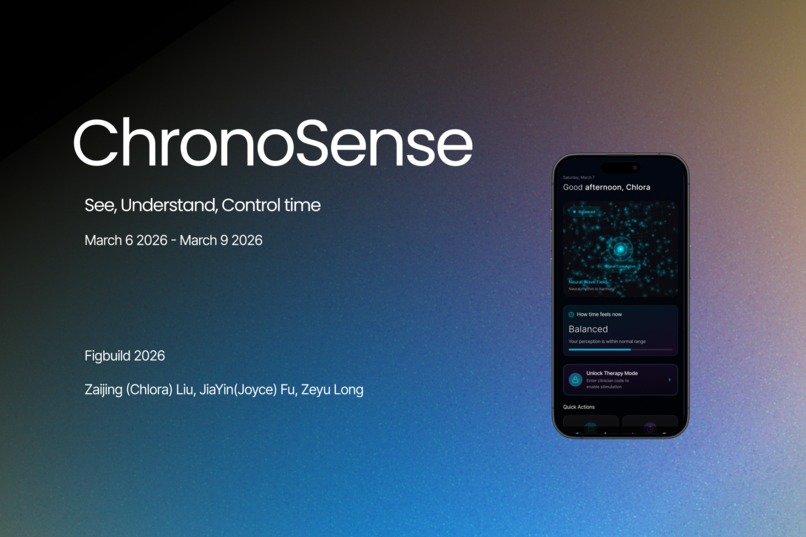
Project Cover
-
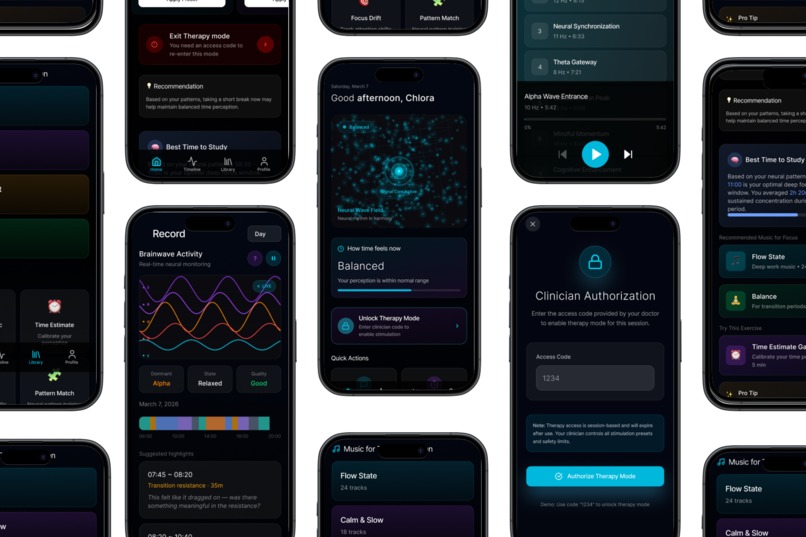
Multi-screen app Mockup Layout
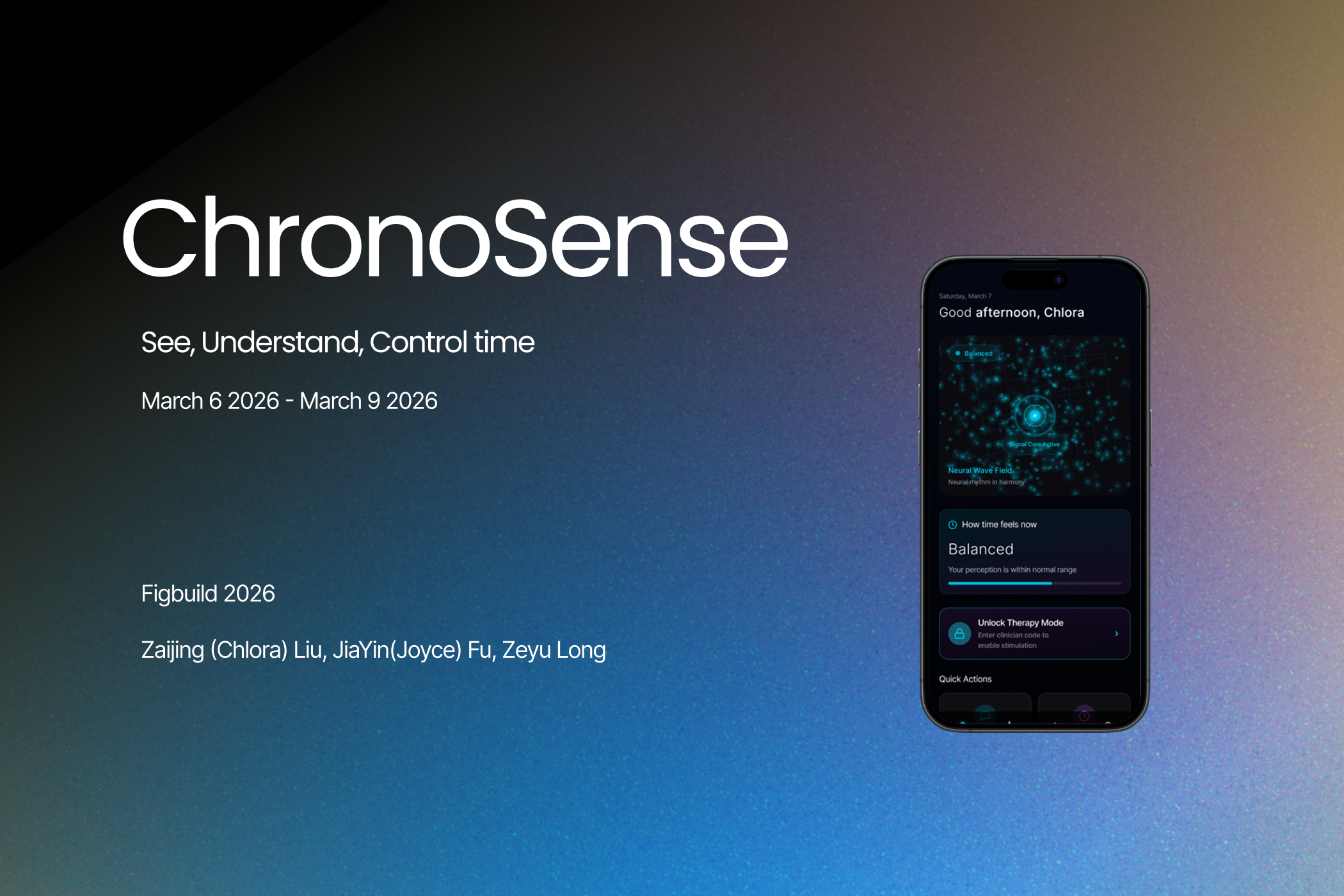
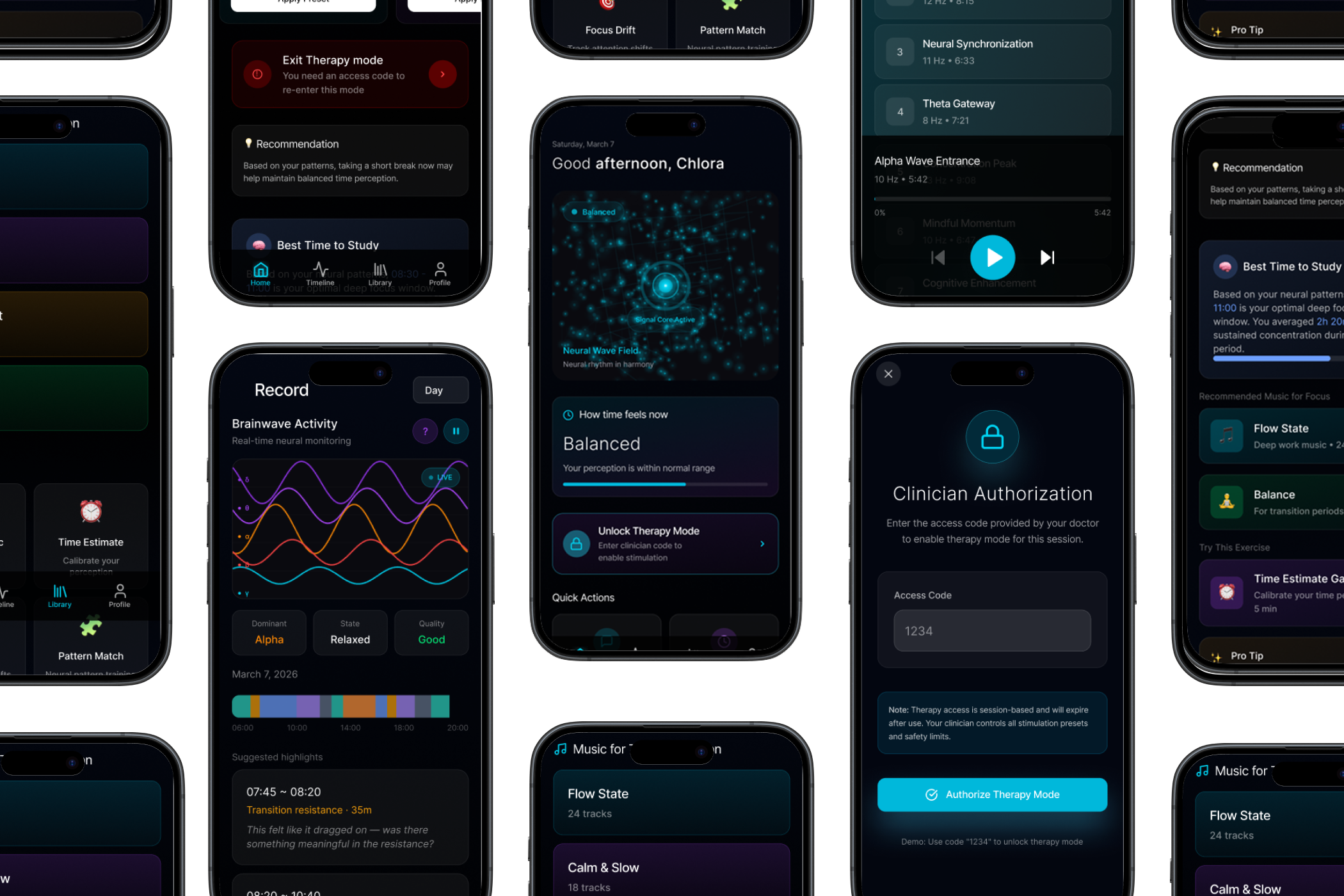
Inspiration
Time doesn’t always feel the same.
Sometimes it disappears. You open your phone for five minutes, and suddenly an hour is gone. Endless feeds, recommendations, and notifications quietly capture our attention.
Other times, time moves painfully slowly. Elderly individuals living alone, or people experiencing loneliness or depression, often describe days that seem to stretch endlessly.
These opposite experiences reveal the same problem. We measure time constantly, but we rarely understand how we actually experience it.
Most tools today focus on managing time through schedules, reminders, and productivity systems. But they don’t explain why time feels the way it does or why our attention slips away so easily. For some people, especially those with ADHD who experience time blindness, this disconnect can be even more frustrating.
That led us to a simple question: what if technology could help people understand their own experience of time?
Recent advances in neural interfaces suggest that brain signals may soon be readable in real time. Inspired by this possibility, we began exploring what it would mean if time perception itself could become visible.
ChronoSense is our exploration of that idea.
What it does
ChronoSense is a concept app designed to help people understand how they experience time.
Instead of tracking schedules or productivity, the system analyzes neural signals to estimate how time is being perceived in the moment. Those signals are translated into visual patterns that show when attention drifts, when focus deepens, and when a person feels mentally stuck.
For most users, the app works as a self-awareness tool, helping them recognize their own time rhythms. When attention begins to slip into patterns like endless scrolling or anxious paralysis, the system can gently guide users back through small interventions such as music or light interactive prompts.
In more serious situations, the same signals could support doctor-guided therapeutic sessions using brainwave feedback.
The goal is not simply to manage time.
It is to help people understand their relationship with it.
How we built it
To explore this idea, we created a prototype that simulates a pipeline connecting neural signals, attention states, and perceived time. The project imagines a near-future scenario where neural chips allow brain activity to be accessed in real time.
Our process started with a shared discussion about the core idea and the problem we wanted to address. From there, each team member independently explored the concept using Figma Make, producing three different versions of the app.
Seeing those prototypes side by side helped us identify what worked and what didn’t. We combined the strongest ideas, divided the interface into sections, and refined them individually before bringing everything back together into a single prototype.
From that point on, the project evolved through continuous iteration as we refined the interaction, visuals, and overall experience.
Challenges we ran into
One of the biggest challenges was working with something as abstract as time perception. Unlike metrics such as heart rate or screen time, subjective time is difficult to measure directly. Research suggests that perceived time is linked to patterns of brain activity, which made neural sensing a natural starting point.
Another challenge was designing feedback that wouldn’t become another distraction. Instead of constant notifications, we focused on creating a system that mostly stays in the background and only intervenes when necessary.
This raised a bigger question for us: what might neural technology mean for how humans experience time in the future? It might make time feel more fragmented, or perhaps more intentional. Either way, people will always experience time differently. Understanding that experience may be the first step toward regaining control over it.
Accomplishments that we're proud of
One thing we are particularly proud of is turning a psychological idea about time perception into a tangible product concept.
Rather than building another productivity tool, ChronoSense explores how technology could help people become more aware of their subjective experience of time. We also developed a working prototype that demonstrates how neural signals and behavioral patterns could be translated into meaningful visual feedback.
What we learned
Working independently in the early stage gave us a surprisingly rich set of ideas. Each person interpreted the same concept slightly differently, which made our later discussions much more productive.
Tools like Figma Make also changed the way we approach early design. Instead of debating ideas abstractly, we could generate something visible almost immediately and react to it together. This shifted our process from describing ideas to seeing them.
More broadly, the project showed us how technologies like neural sensing could enable a new kind of tool—one that adapts to how people actually think and feel.
What's next for ChronoSense
Next, we want to explore more accurate ways of estimating time perception by combining neural signals with behavioral and physiological data.
We are also interested in designing more personalized experiences for groups who struggle with time perception, including people with ADHD and elderly individuals who often experience time very differently.
Ultimately, we hope to continue exploring how technology might help people better understand their relationship with time.
Built With
- figma
- figmamake


Log in or sign up for Devpost to join the conversation.