-
-
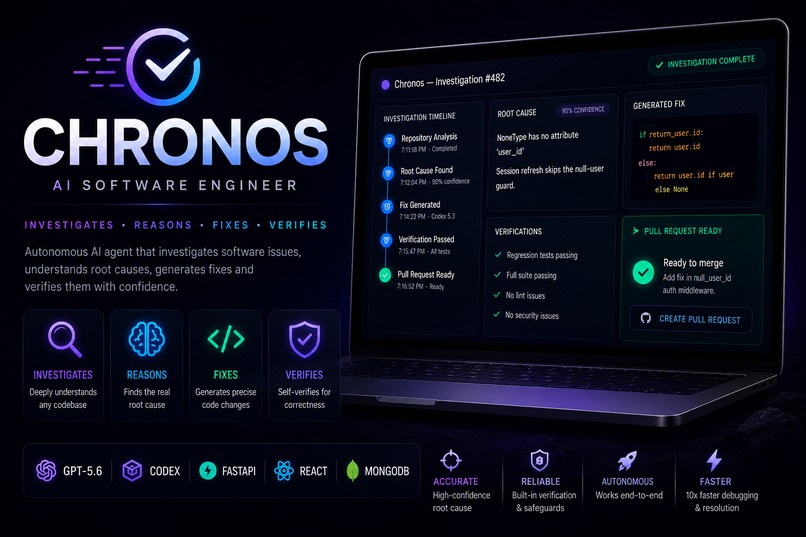
Project Overview
-
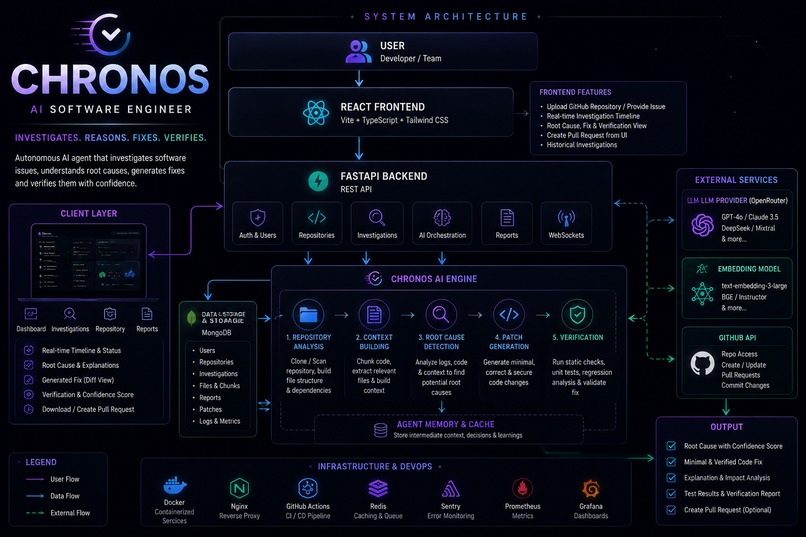
System Architecture
-
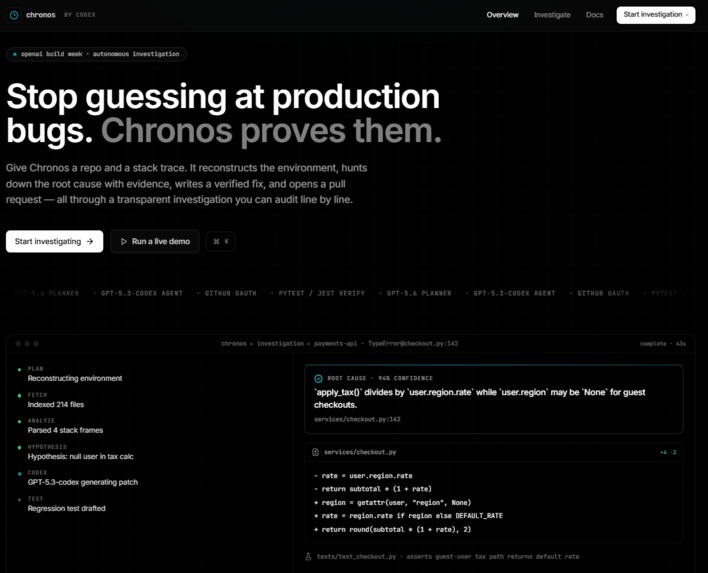
Landing Page
-
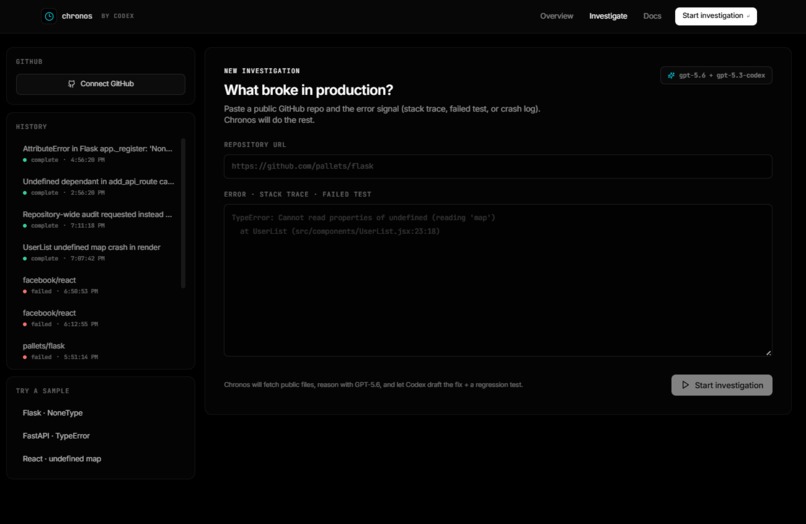
About/Documentation
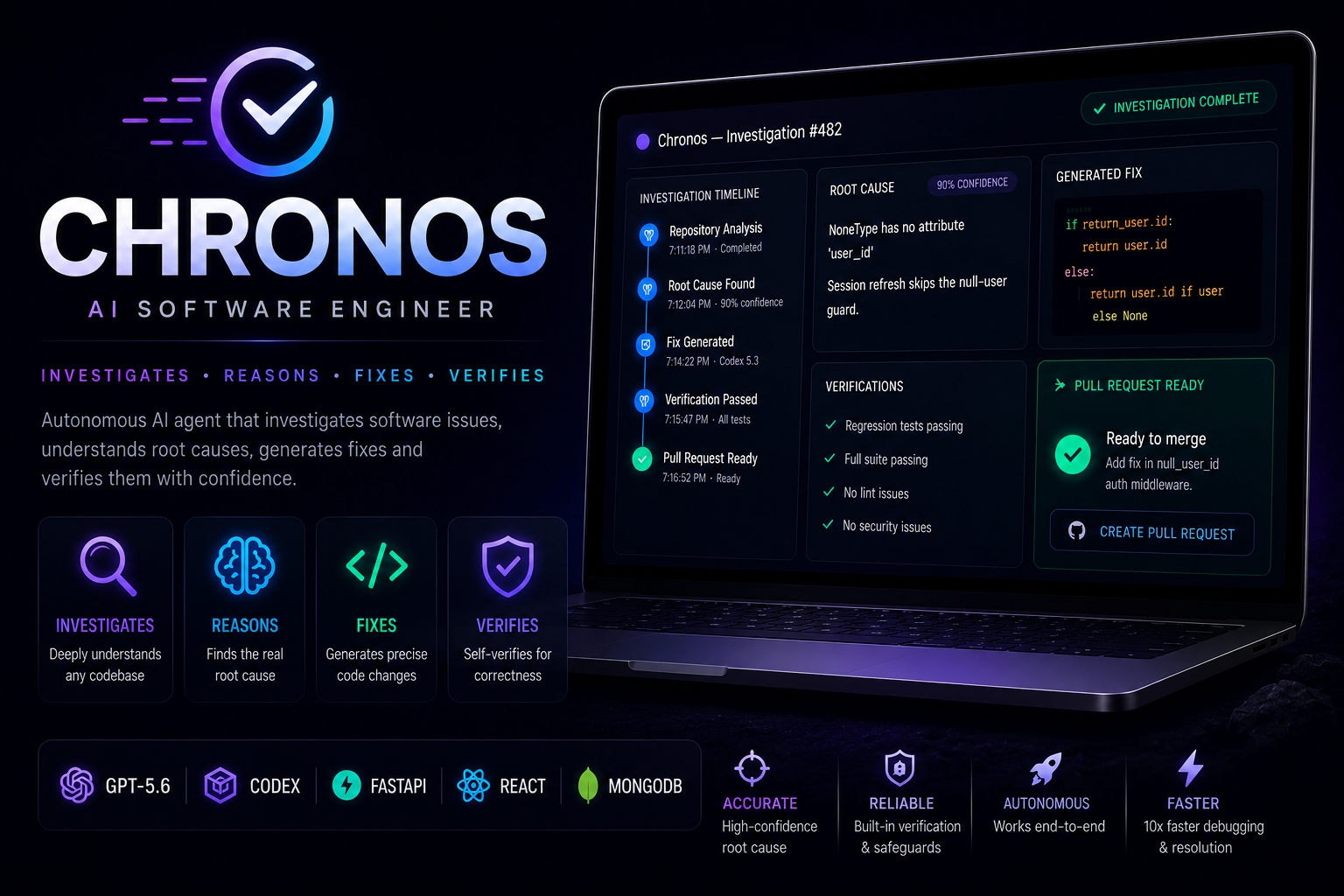
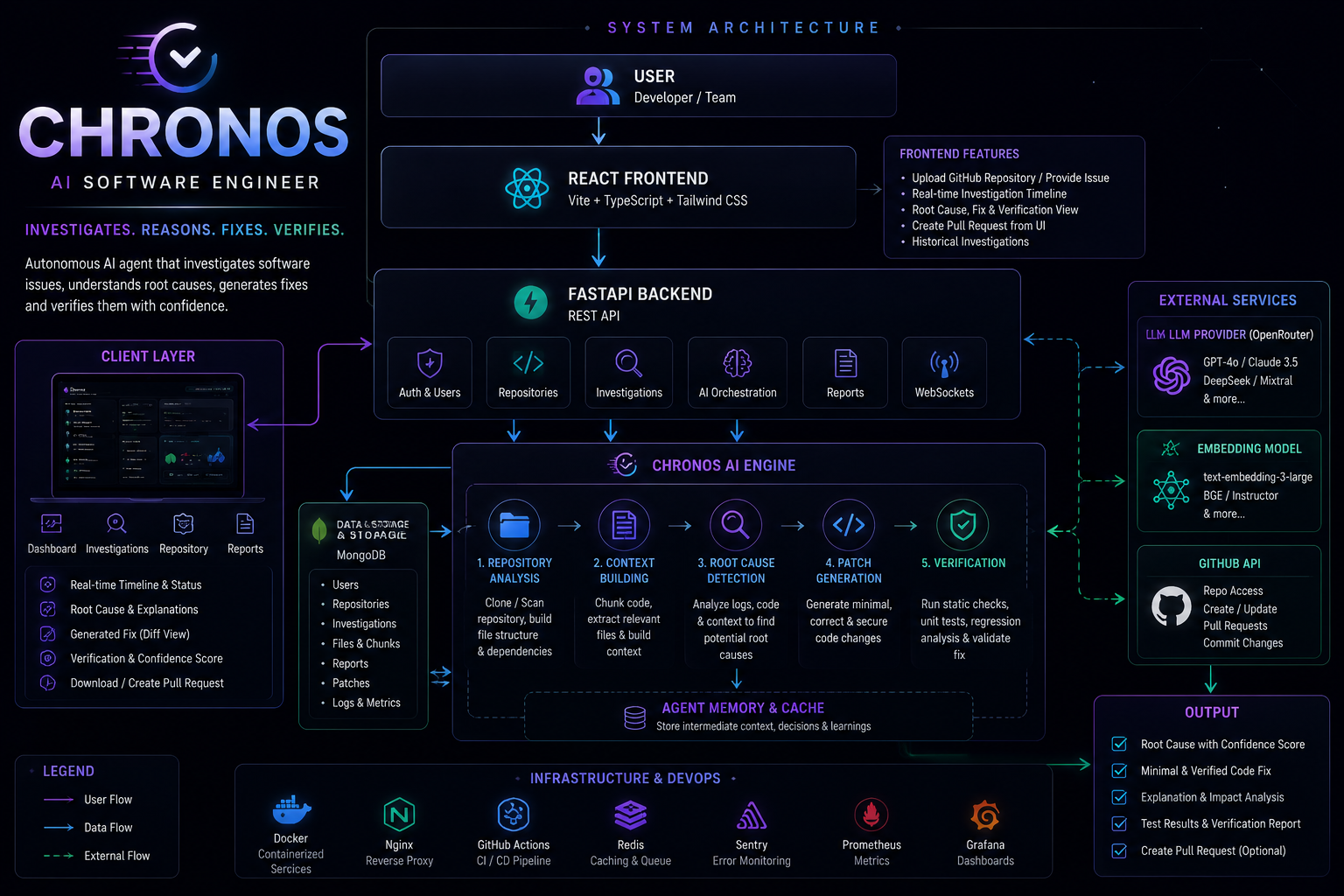
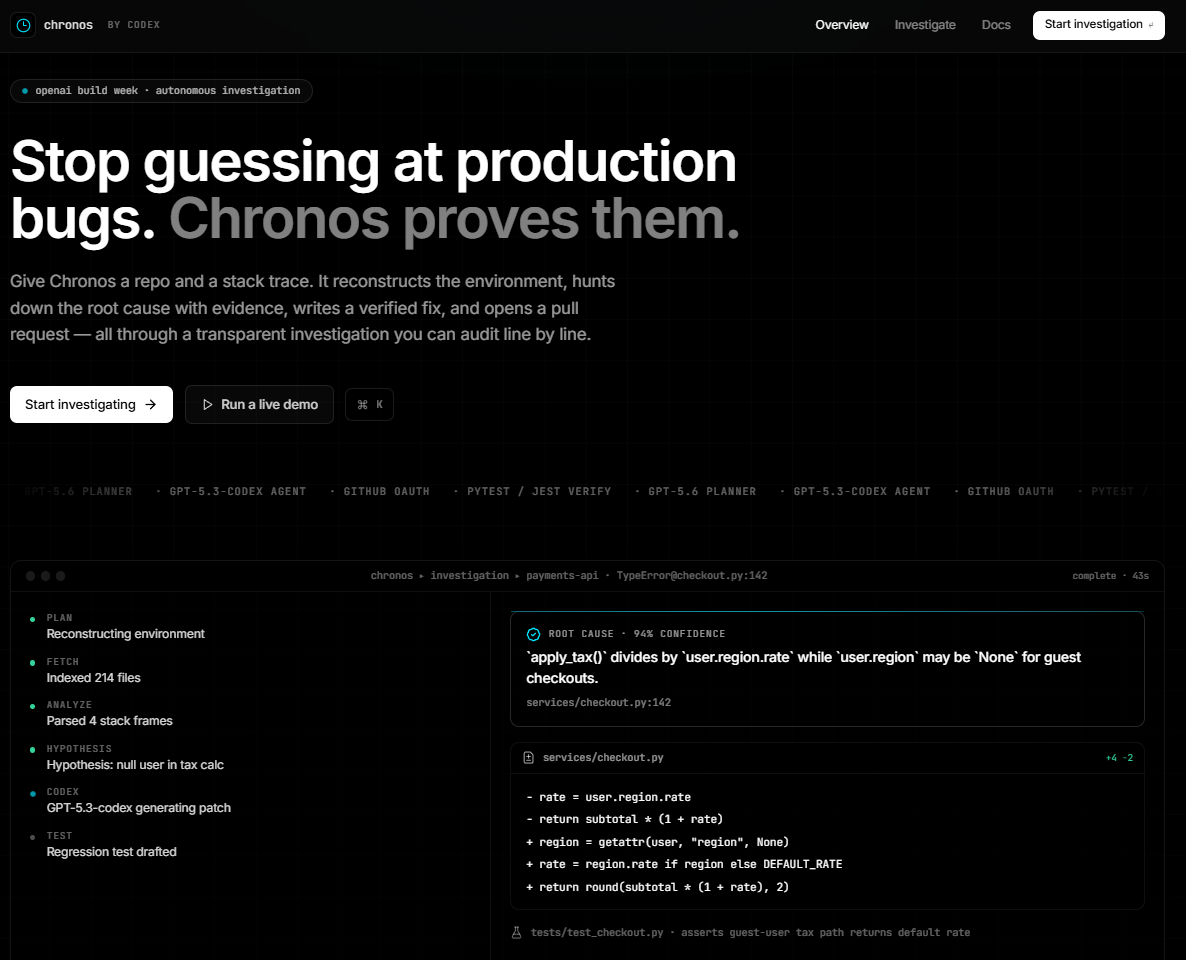
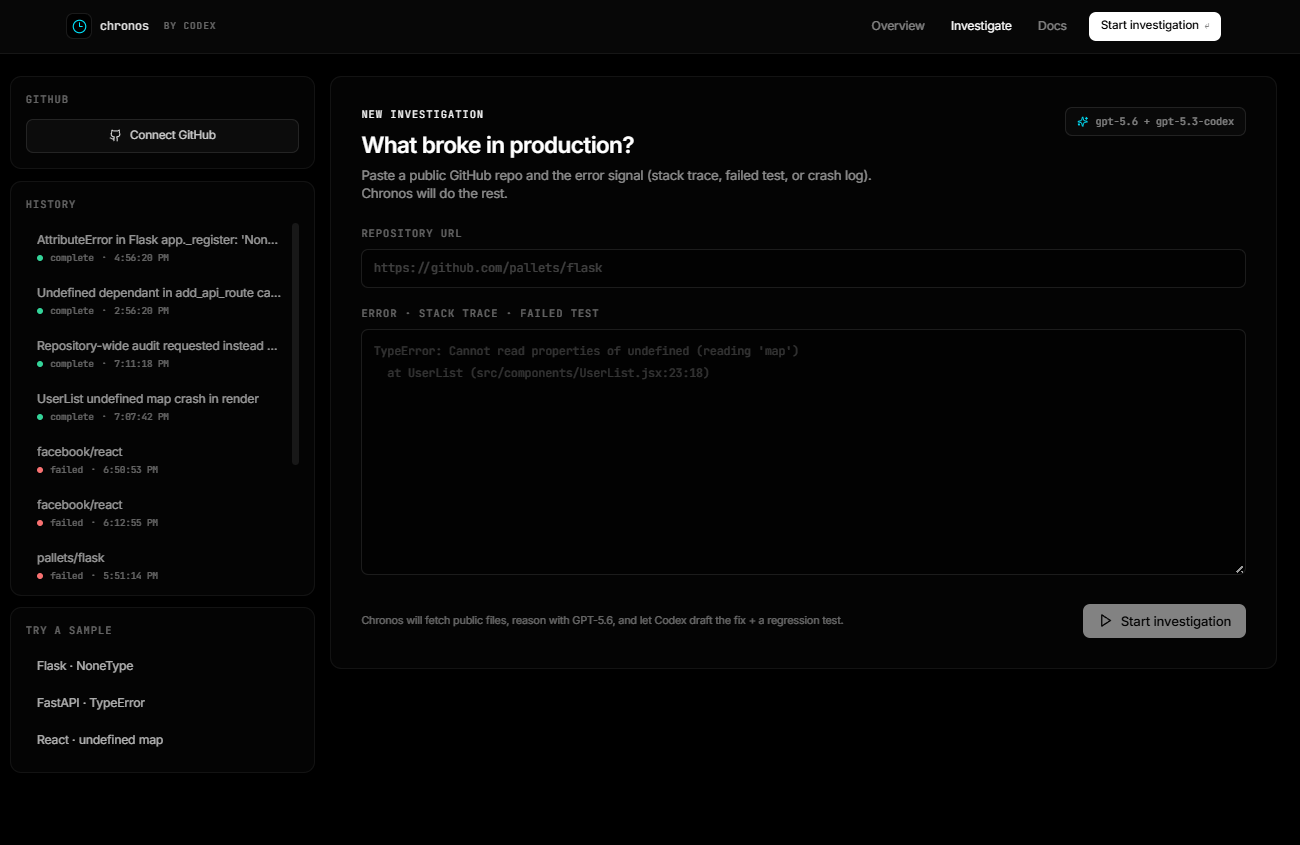
Inspiration
Modern software teams spend hours investigating production incidents before they can even begin fixing them. Developers jump between logs, stack traces, repositories, pull requests, and documentation just to identify the root cause.
We asked a simple question:
What if an AI could perform the entire investigation like an experienced software engineer?
Chronos was built to automate software incident investigation—from understanding a repository to identifying root causes, generating fixes, drafting regression tests, and validating the proposed solution.
What it does
Chronos is an autonomous AI software engineering agent that performs end-to-end code investigations.
Given a GitHub repository and an issue, Chronos:
- Clones and indexes the repository
- Understands the project architecture
- Analyzes stack traces and execution flow
- Forms investigation hypotheses
- Identifies the most likely root cause
- Generates code fixes
- Creates regression tests
- Verifies the generated solution
- Produces a complete investigation timeline
Instead of simply answering questions, Chronos performs a structured engineering investigation.
How we built it
Frontend
- React
- TypeScript
- Tailwind CSS
Backend
- FastAPI
- Python
- Async architecture
AI
- GPT-5.6
- GPT-5.3 Codex
- OpenRouter/OpenAI-compatible APIs
Infrastructure
- MongoDB
- GitHub API
- Docker
- Git
Challenges we ran into
Building an autonomous investigation pipeline required solving several engineering challenges:
- Repository indexing and file selection
- Coordinating multiple AI agents
- Maintaining investigation state
- Designing structured reasoning workflows
- Reliable root-cause verification
- Generating meaningful regression tests
- Handling API failures and model fallbacks
Ensuring that generated fixes were internally consistent proved to be one of the most challenging aspects of the project.
Accomplishments that we're proud of
- Built an end-to-end autonomous investigation workflow.
- Designed a multi-stage reasoning pipeline.
- Generated automated fixes and regression tests.
- Created an investigation timeline similar to what senior engineers follow during incident response.
- Developed a clean developer-focused interface.
What we learned
This project reinforced that successful AI software engineering is not only about selecting a powerful language model.
Reliable autonomous systems require:
- structured reasoning
- verification
- orchestration
- robust error handling
- developer-centric workflows
Verification is just as important as generation.
What's next for Chronos
Future improvements include:
- Automatic Pull Request creation
- CI/CD integration
- GitHub Actions support
- Multi-agent collaboration
- Containerized sandbox execution
- Live code execution for validation
- Support for larger monorepositories
- IDE integrations (VS Code, JetBrains)
- Slack and Microsoft Teams incident assistants

Log in or sign up for Devpost to join the conversation.