-
-
-
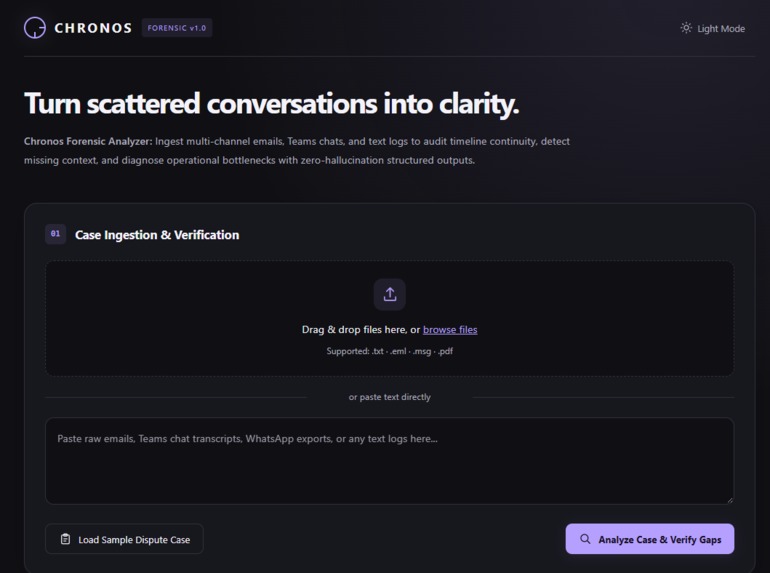
Chronos home page
Inspiration
In commercial, operational, and legal work, the facts behind a blocked project or dispute are rarely in one place. They are spread across email threads, Teams conversations, informal messages, and documents. Reconstructing the story often takes longer than solving the actual problem.
I wanted to build something practical: a small tool that helps a user move from “we have too much scattered information” to “this is what happened, this is what may be missing, and this is the next action to take.” Chronos comes from that everyday need to turn fragmented communication into a usable operational view.
What it does
Chronos follows a two-phase workflow.
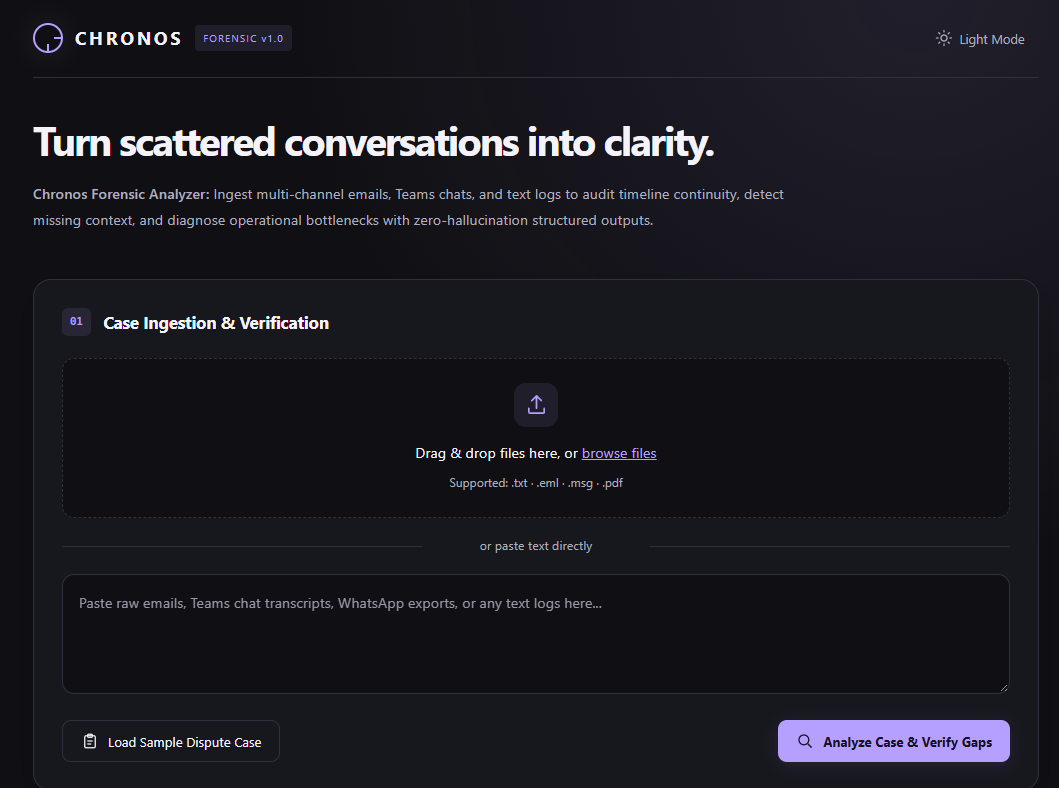
First, the user pastes or loads communication material. Chronos reviews it for possible context gaps, such as references to a document, meeting, or earlier message that may not be included.
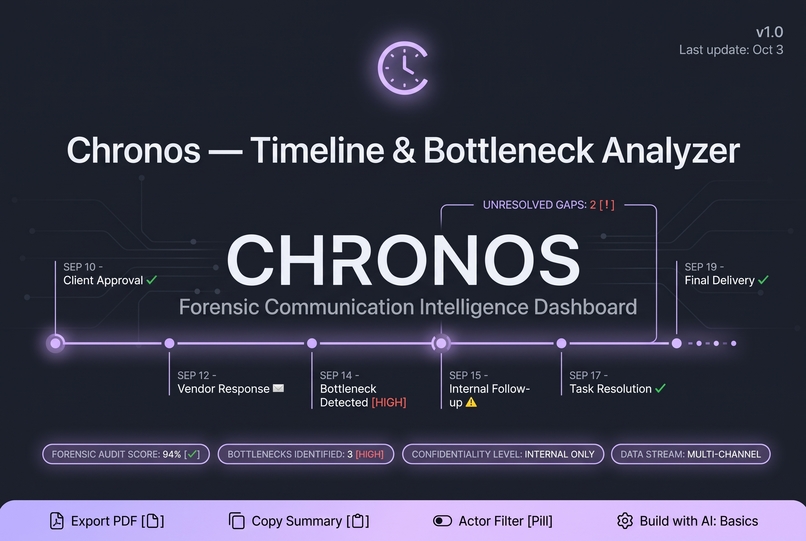
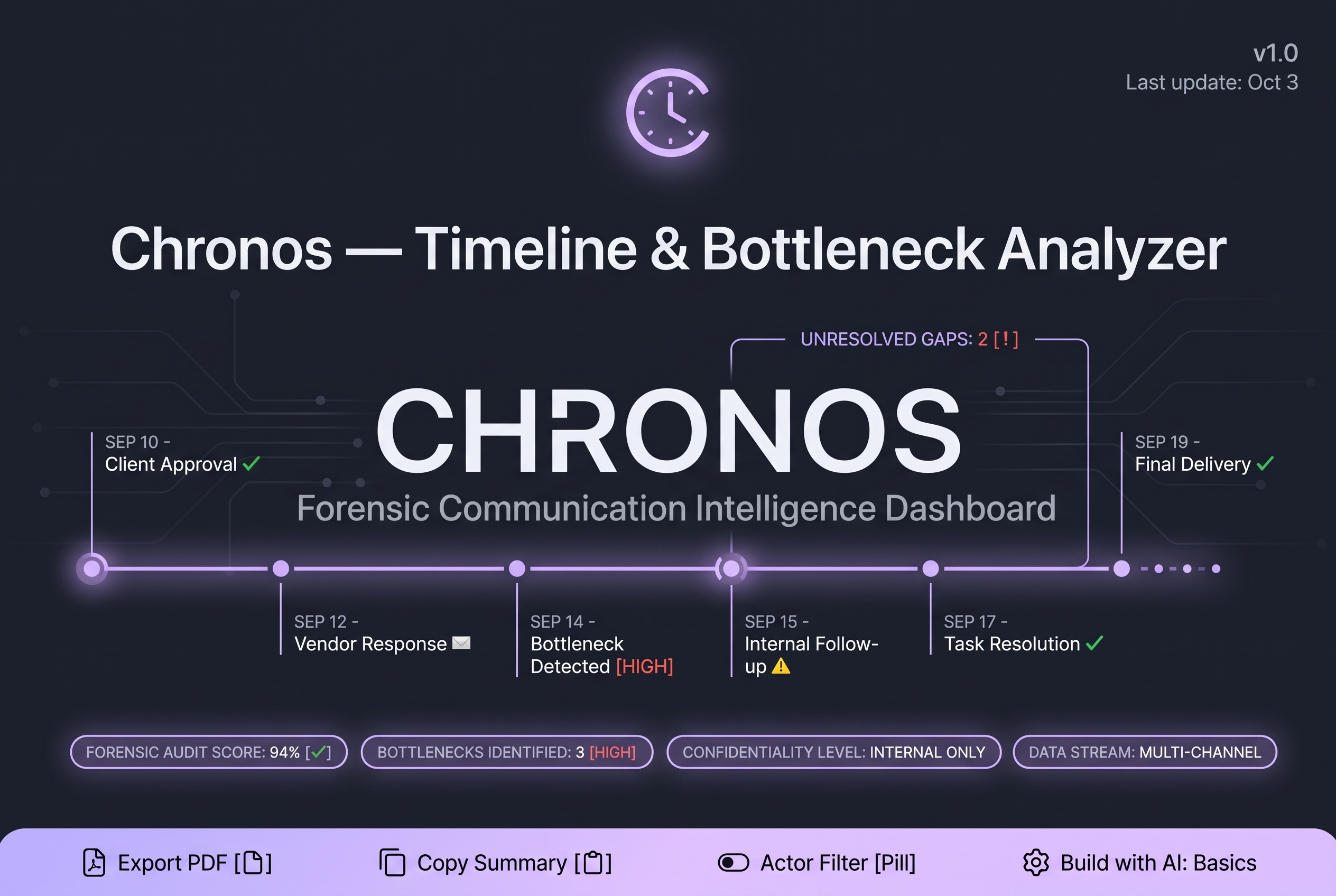
Then it creates a forensic-style dashboard with a chronological timeline, source excerpts, filters by participant, possible bottlenecks ranked by severity, and recommended next actions. Users can copy an executive summary or export selected sections of the report as a printable PDF.
The included sample case shows a supplier delivery block caused by an unpaid invoice and a missing Legal approval.
How we built it
I built Chronos with a plan-first workflow using the Build with AI skills: Scope → PRD → Technical Specification → small verified build steps.
The app is a Vite single-page application built with Vanilla JavaScript, HTML, and CSS. Gemini 2.5 Flash is used for the context check and the structured timeline/bottleneck analysis. The UI renders the returned JSON into an interactive dashboard with a custom responsive light/dark visual system, local SVG icons, actor filters, copy-to-clipboard support, and browser-native PDF printing.
Challenges we ran into
One challenge was handling large, noisy communication logs. In a long WhatsApp export, a straightforward prompt can spend its output on greetings, repetitions, and low-value messages. I refined the analysis prompt to focus on 10–25 meaningful milestones: decisions, requests, delays, commitments, and escalation points.
Another challenge was keeping the prototype honest and usable. The app distinguishes a live Gemini analysis from its demo fallback, while the README documents the current limits of file parsing and model-based outputs. I also had to tune the Gemini model configuration and output length so that the timeline remained useful without becoming too slow or too verbose.
Accomplishments that we're proud of
I am proud that Chronos delivers a complete end-to-end proof of concept rather than just a text summary. The core idea works as a visible user journey: collect material, check for missing context, explore the timeline, inspect source excerpts, identify bottlenecks, and export the relevant findings.
I am also proud of the interface. The actor filters update the timeline immediately, the report export allows users to choose which sections to print, and the visual design makes a dense case easier to scan without overwhelming the user.
What we learned
This project taught me how much better AI-assisted building becomes when the work starts with scope, requirements, and a technical plan. The planning process kept the prototype focused on one useful workflow instead of trying to build a full document-management platform.
I also learned that large communication logs need careful prompt design and that structured outputs make the interface much easier to build and reason about.
What's next for Chronos
The next steps would be dedicated PDF and Outlook MSG extraction, a clearer evidence-review step, and the ability to add missing material and rerun the analysis.
For a production version, privacy would be a central design requirement: local redaction or tokenisation of personal data, access controls, audit logs, approved data processing arrangements, and a GDPR-appropriate deployment model. Chronos is currently a client-side proof of concept, but it points toward a practical, privacy-conscious tool for teams dealing with complex operational cases.

Log in or sign up for Devpost to join the conversation.