-
-
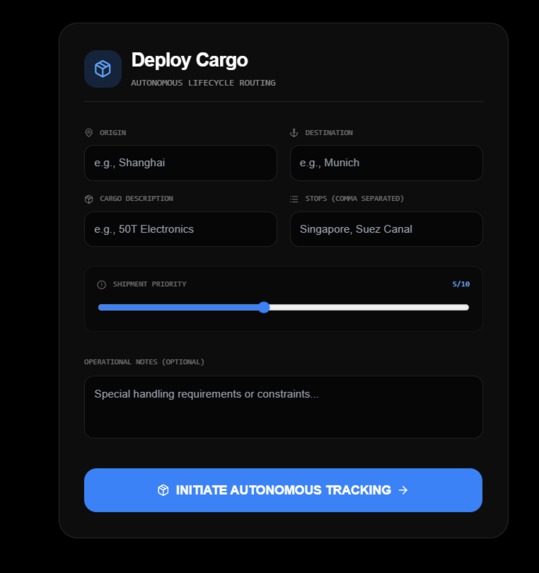
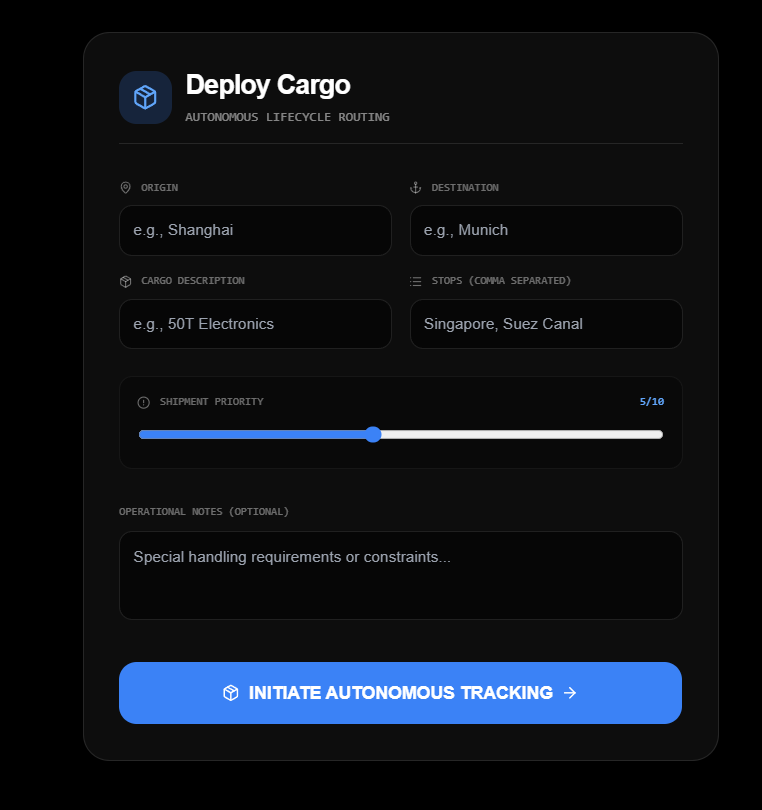
deploy cargo
-
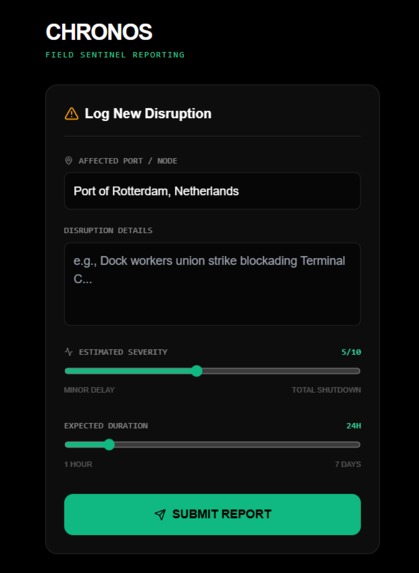
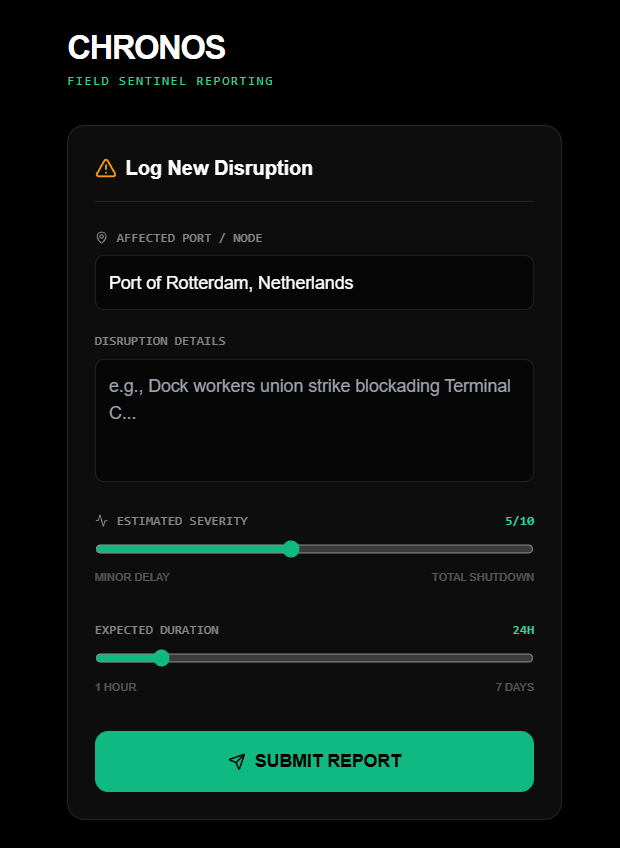
sentinel report
-
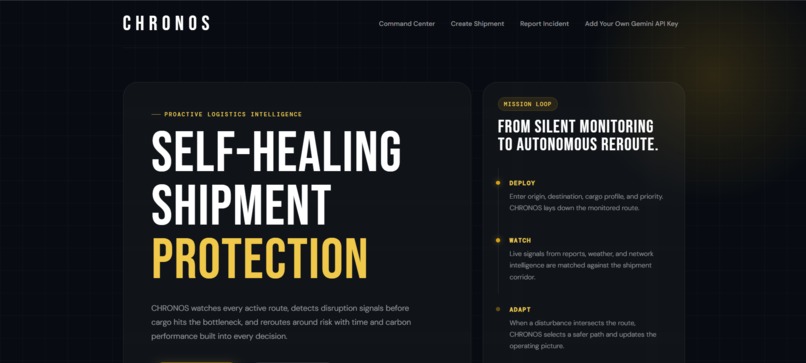
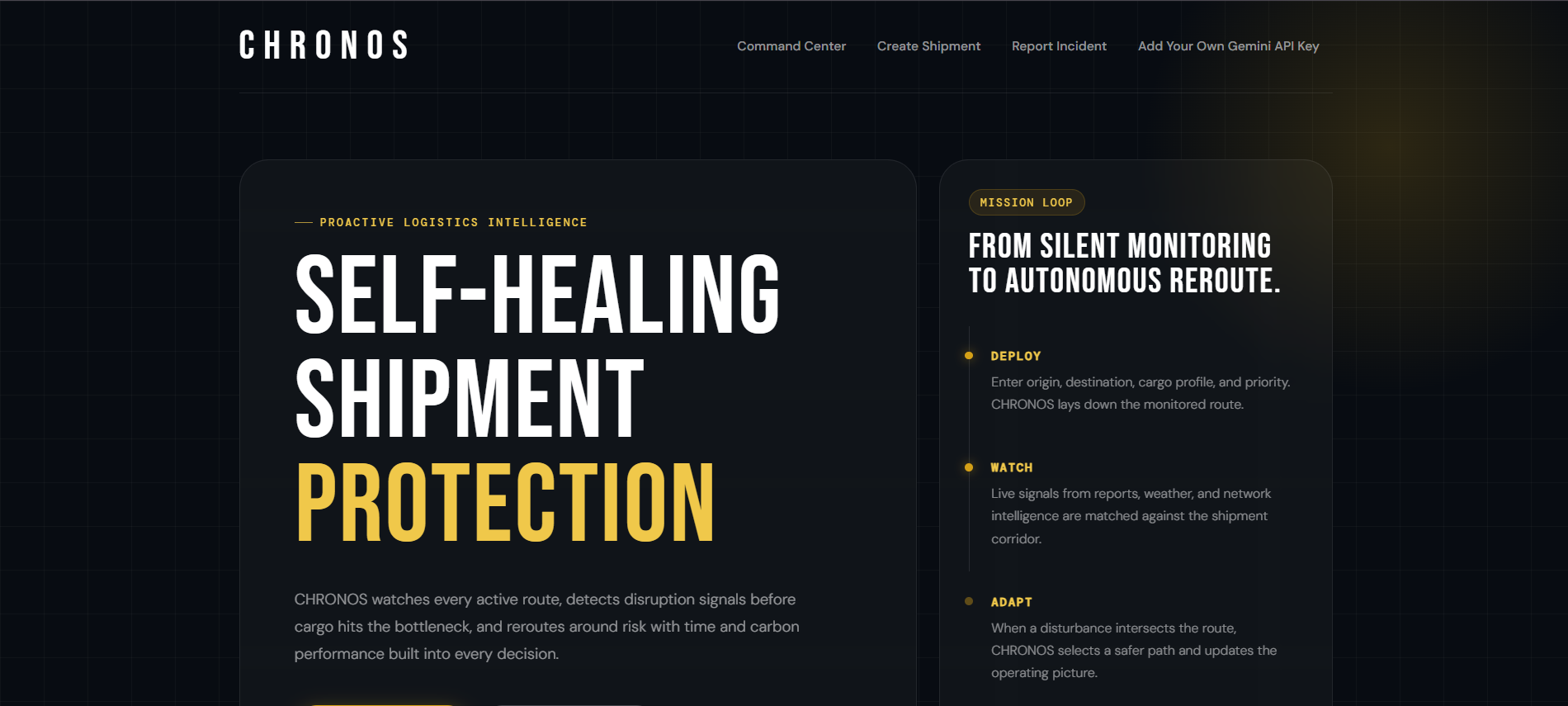
landing page
-
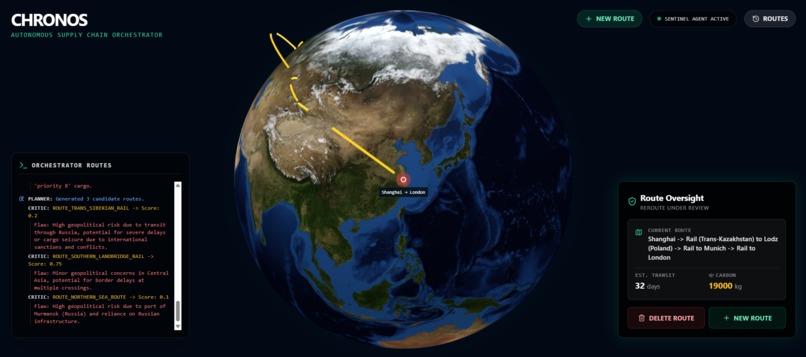
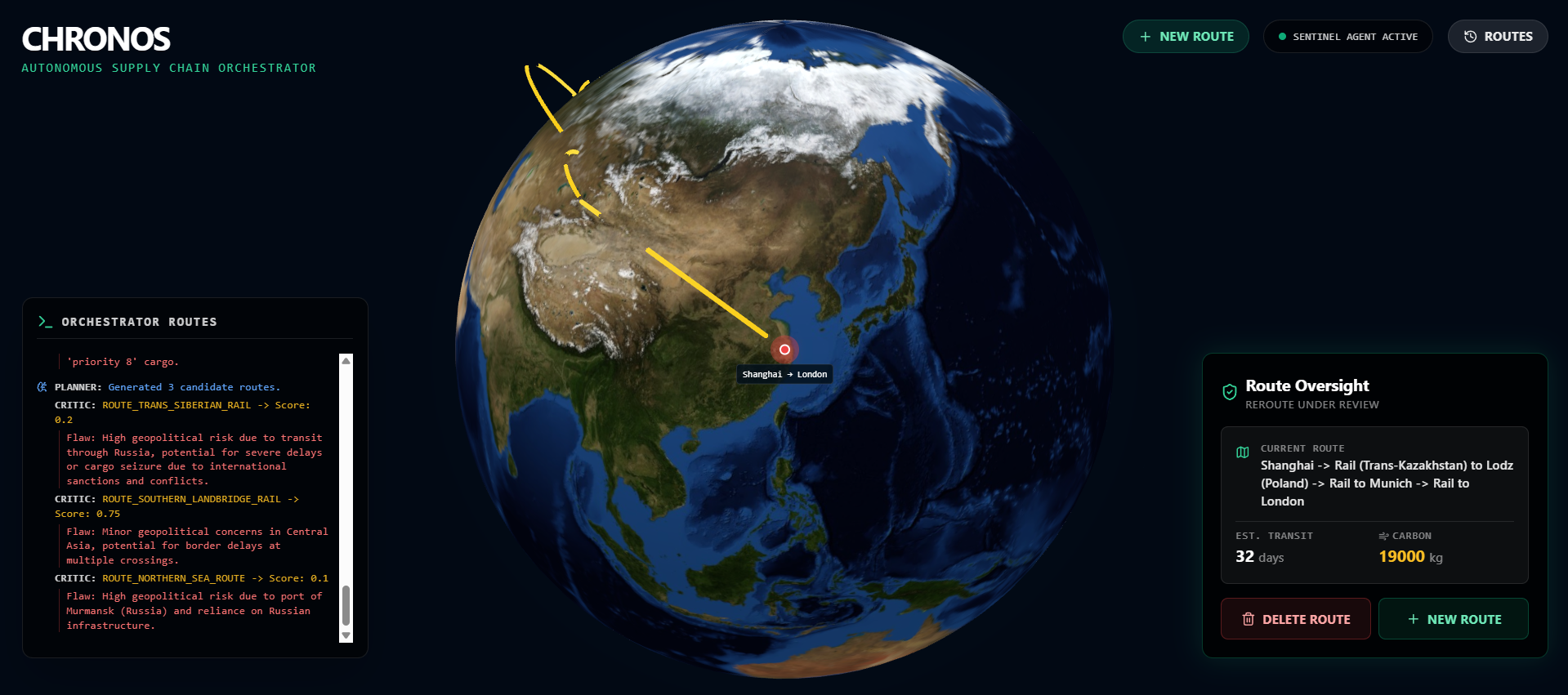
dashboard
The Story of CHRONOS
Inspiration
The inspiration for CHRONOS came from witnessing the fragility of global trade during recent geopolitical and climate-driven disruptions. We realized that while we live in an era of "big data," logistics managers are still stuck in a reactive loop—identifying problems only after they have caused significant delays. We wanted to build a system that doesn't just watch the world happen, but actively thinks ahead to solve problems before they manifest.
How We Built It
CHRONOS was architected as an AI-native "digital twin" of the global supply chain.
- The Brain: We utilized Google Gemini 2.5 to power a multi-agent framework.
- The Logic: We implemented a recursive Reflexion Loop where a Planner Agent and a Critic Agent debate routing options.
- The Math: The Critic Agent audits routes using a weighted efficiency score $S$, calculated as:
$$S = w_1(T_{delta}) + w_2(C_{cost}) + w_3(CO_2)$$
where the system optimizes for minimal time delay, cost increase, and carbon footprint.
- The Visualization: The frontend was built using React, Vite, and Three.js to create a real-time 3D globe.
- The Infrastructure: We deployed the backend on Google Cloud Run and used Firebase Firestore for real-time data synchronization between the AI agents and the user dashboard.
Challenges We Faced
- The "Hallucination" Barrier: In early iterations, the LLM would occasionally suggest routes that were geographically impossible. We solved this by implementing Gemini Tool Calling, forcing the agent to verify every waypoint through real-world Geocoding APIs.
- Data Latency: Relying on official news feeds meant the AI was sometimes hours behind real-world events. This led us to develop the Public Sentinel PWA, allowing crowdsourced "ground truth" data to be ingested directly into the reasoning engine.
- State Management: Syncing the internal "thoughts" of multiple agents with a 3D frontend in real-time required a robust NoSQL architecture using Firestore listeners.
What We Learned
Building CHRONOS taught us that the future of software isn't just about better interfaces, but about autonomous agency. We learned how to move beyond simple prompt-engineering into complex agentic workflows where AI models critique their own logic to ensure operational safety. Most importantly, we saw how AI can be a direct tool for sustainability by making carbon-aware routing a mathematical necessity rather than an afterthought.

Log in or sign up for Devpost to join the conversation.