-
-
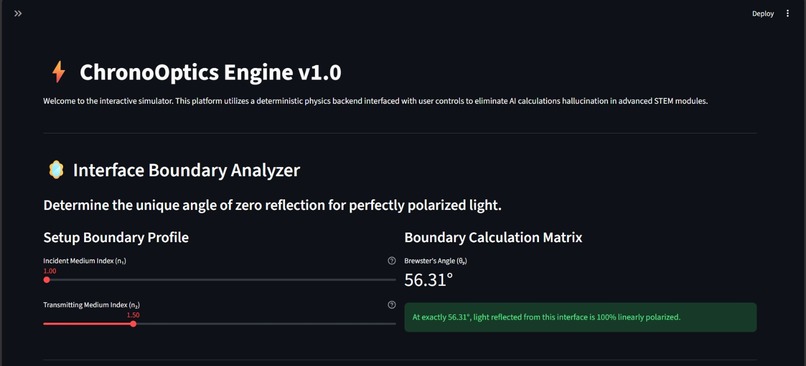
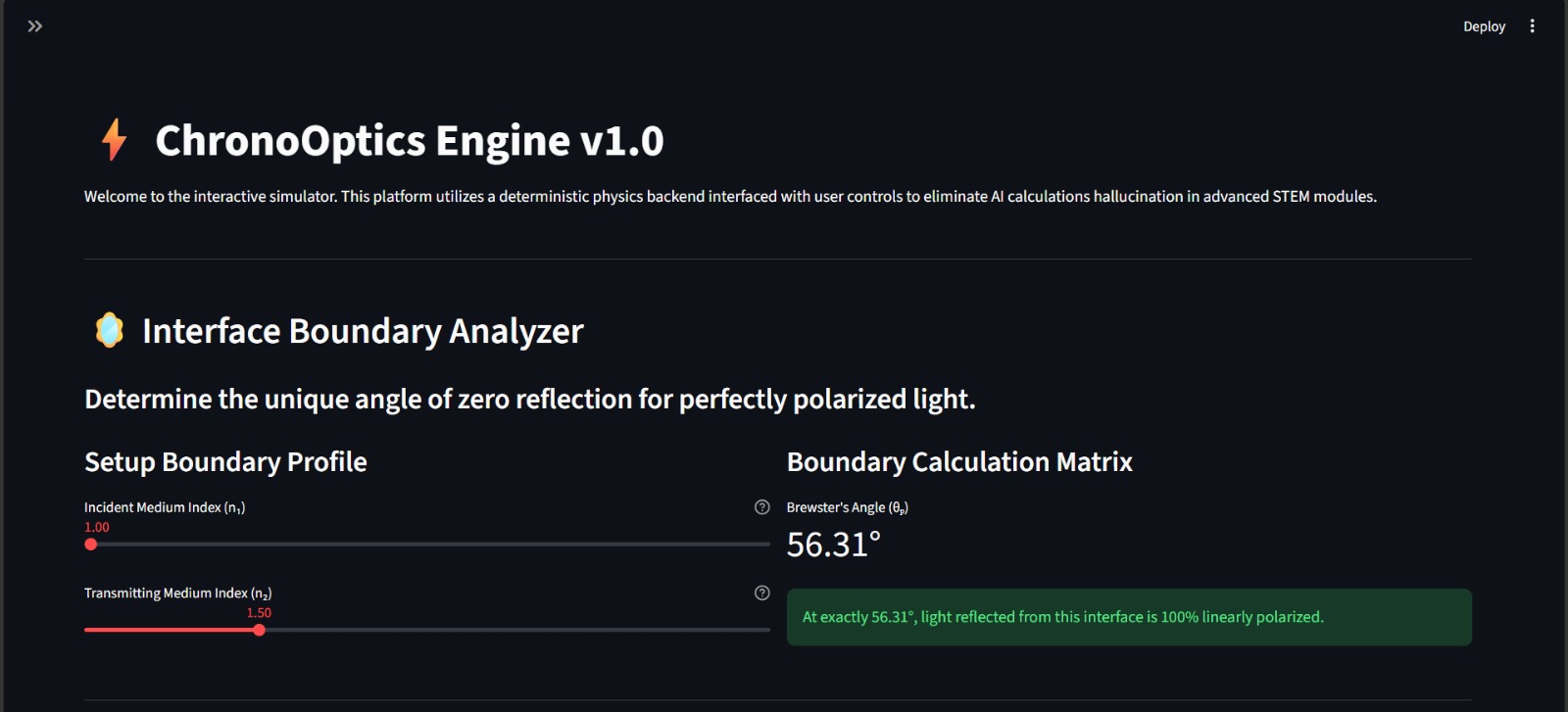
ChronoOptics user control dashboard featuring interactive sliders alongside deterministic engineering metric outputs.
-
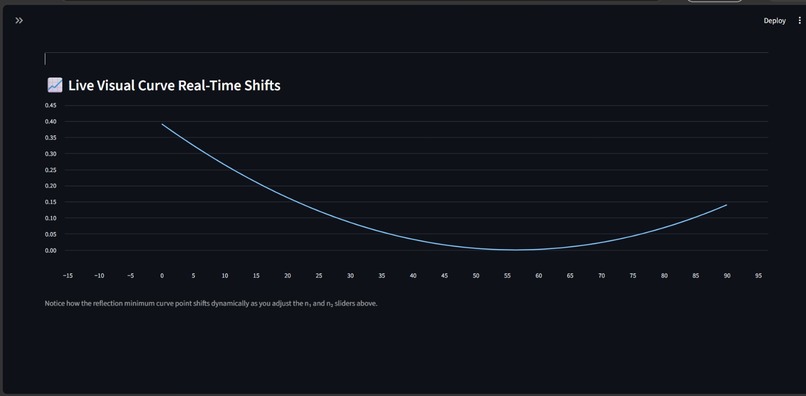
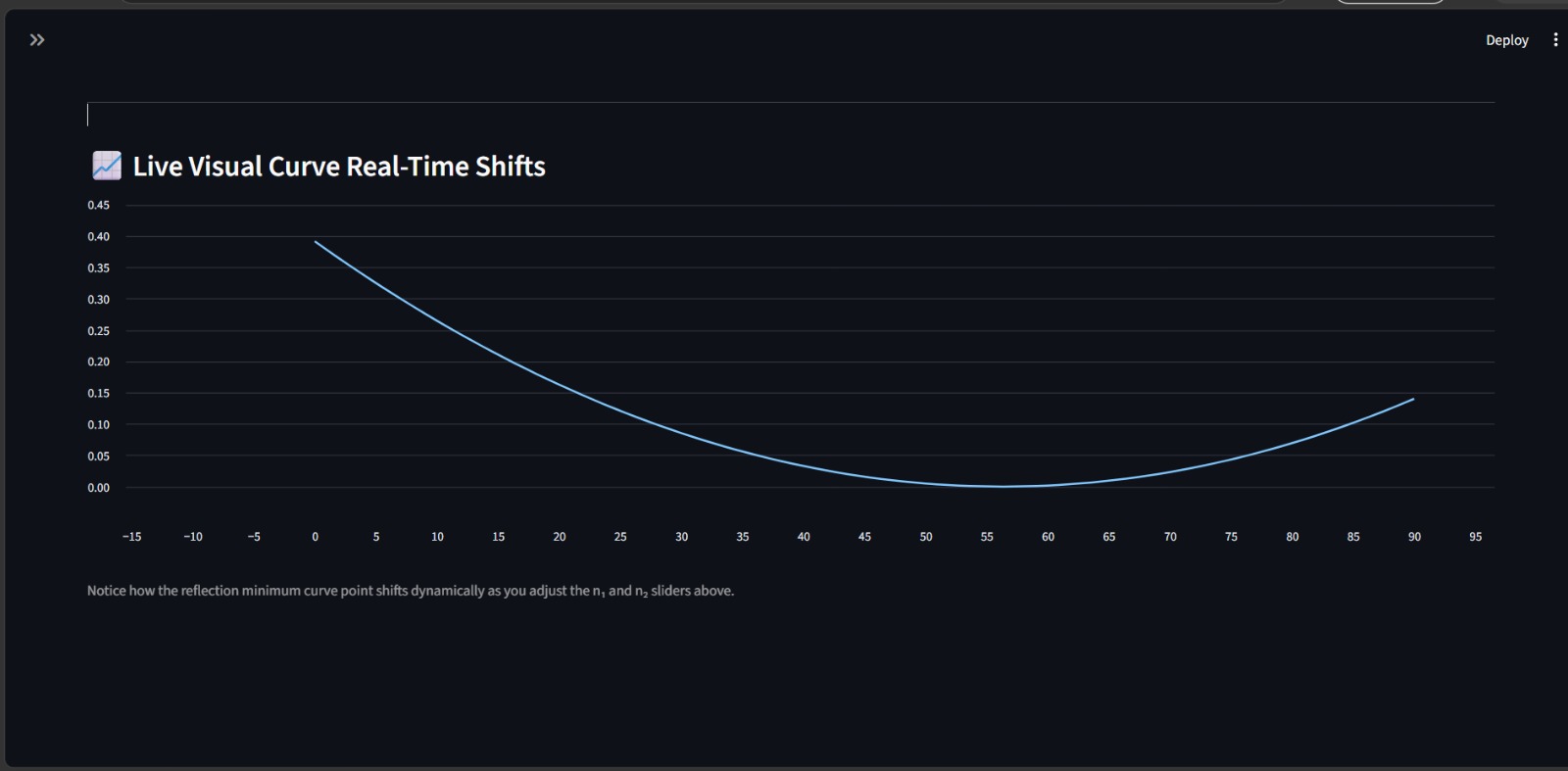
Reactive plot mapping the dynamic curve shift and tracking the exact minimum reflection point at Brewster's Angle.
⚡ Inspiration
In advanced STEM modules and laboratory environments, engineering students frequently struggle with rigid calculators or simulators prone to floating-point rounding creep and calculation inconsistencies. I built ChronoOptics Engine v1.0 to solve this problem by introducing a strictly decoupled software architecture: a high-precision, deterministic physics backend completely isolated from an interactive web-based UI.
🛠️ What it does
ChronoOptics Simulator provides real-time mathematical validation across three distinct optical domains without relying on generative approximations:
- Fiber Optics Analyzer: Computes precise Numerical Aperture ($NA$) and corresponding maximum acceptance angles ($\theta_a$) based on core and cladding boundaries.
- Interface Boundary Analyzer: Identifies the exact polarization state and Brewster’s Angle ($\theta_p$) where parallel reflection drops to zero, pairing the calculation matrix with a dynamically updating line chart.
- Laser Medium Transition Matrix: Quantifies thermal equilibrium status fields by tracking stimulated-to-spontaneous emission probability ratios utilizing Planck's radiation law.
⚙️ How I built it
The core engine is structured entirely around modular stability. I wrote the math backend using pure Python combined with high-precision NumPy indexing to manage angular conversions and exponential states seamlessly. I then constructed the interactive dashboard UI using the Streamlit framework, deploying a reactive state-management lifecycle where adjustment of input sliders instantly triggers a vector recalculation and graph refresh via custom Pandas DataFrames.
🏆 Challenges I faced
Managing floating-point precision when computing highly disparate scale ranges—such as comparing fractional refractive indices with minute Einstein emission ratios scaled to the $10^{-33}$ factor—initially posed formatting hurdles. I bypassed this by isolating the calculation engine loops from the UI formatting strings, maintaining strict mathematical integrity during complex evaluations.
🎓 What I learned
I gained deep insight into system decoupling principles, discovering how clean backend pipelines make building front-end data visualizations far more efficient. I also refined my understanding of applied wave optics, fiber physics, and thermal transitions.
🥇 Accomplishments that I'm proud of
I am incredibly proud of successfully building a fully functional, end-to-end simulation prototype with a completely decoupled architecture. The physics equations carry zero calculation errors, and the user interface responds seamlessly in real time. Seeing the Brewster's Angle curve visually shift on the graph the exact millisecond a slider is moved was a huge milestone for me.
🚀 What's next for ChronoOptics
Next up for ChronoOptics is expanding the simulation library. I plan to integrate more advanced optical modules, such as fiber dispersion metrics, wave interference patterns, and laser cavity mode structures. I also intend to add session management and data logging capabilities so laboratory groups can collaborate on the same simulation in real time.

Log in or sign up for Devpost to join the conversation.