Inspiration
Most VR games want you standing in an empty room. A lot of the time you are not: you are in an airplane seat with your forearms on the armrests, or on a bench at a bus stop, with not much space in front of you. We wanted something you could play right there.
A pocket watch felt right. It is small, it sits on your lap, and fixing one is all fingertips and wrists. So ChronoGrip is a pocket-sized clockwork repair: a walnut tray stands on your table or tray table in passthrough, and you fix it with your bare hands. No controllers, no standing, no turning around.
What it does
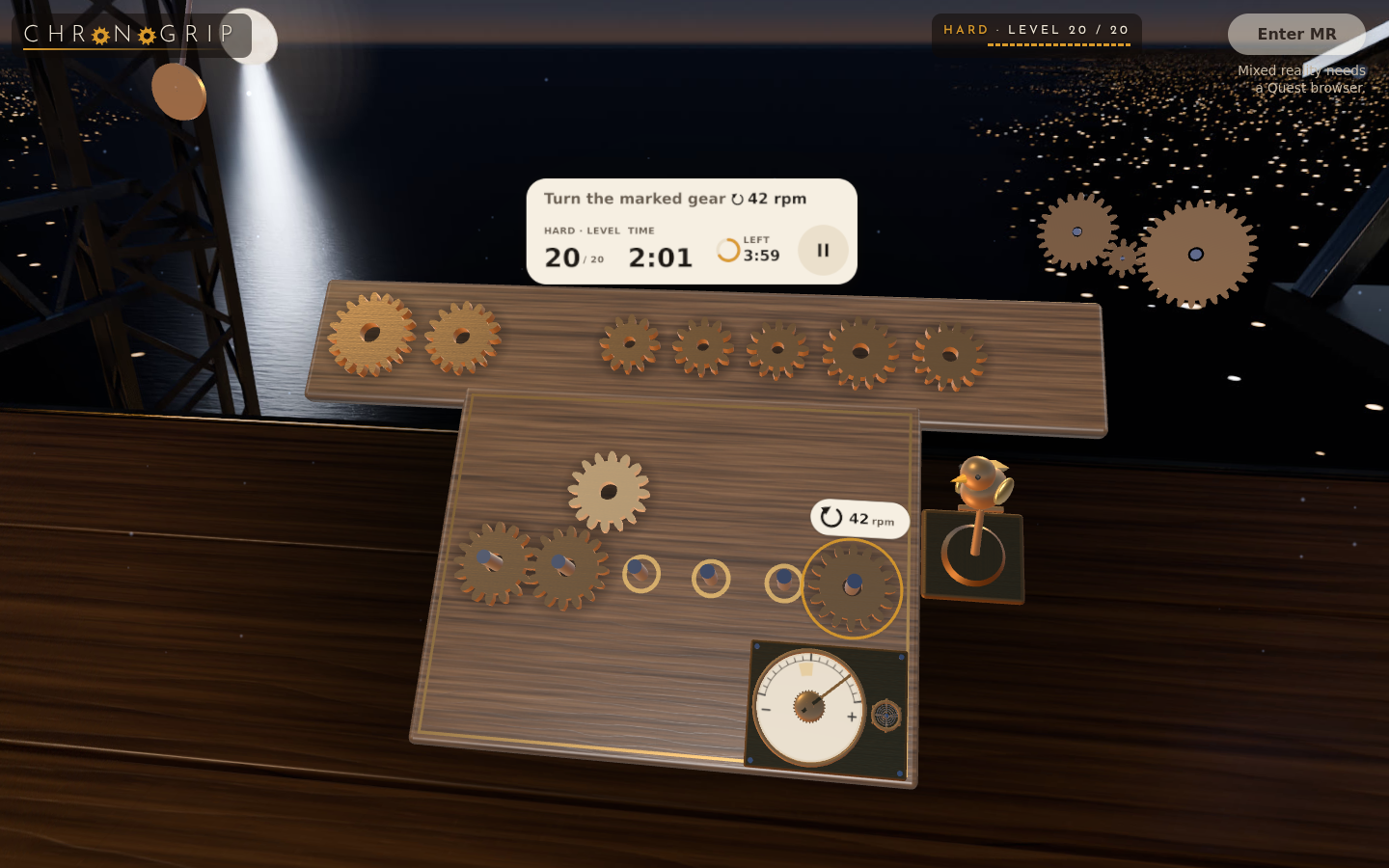
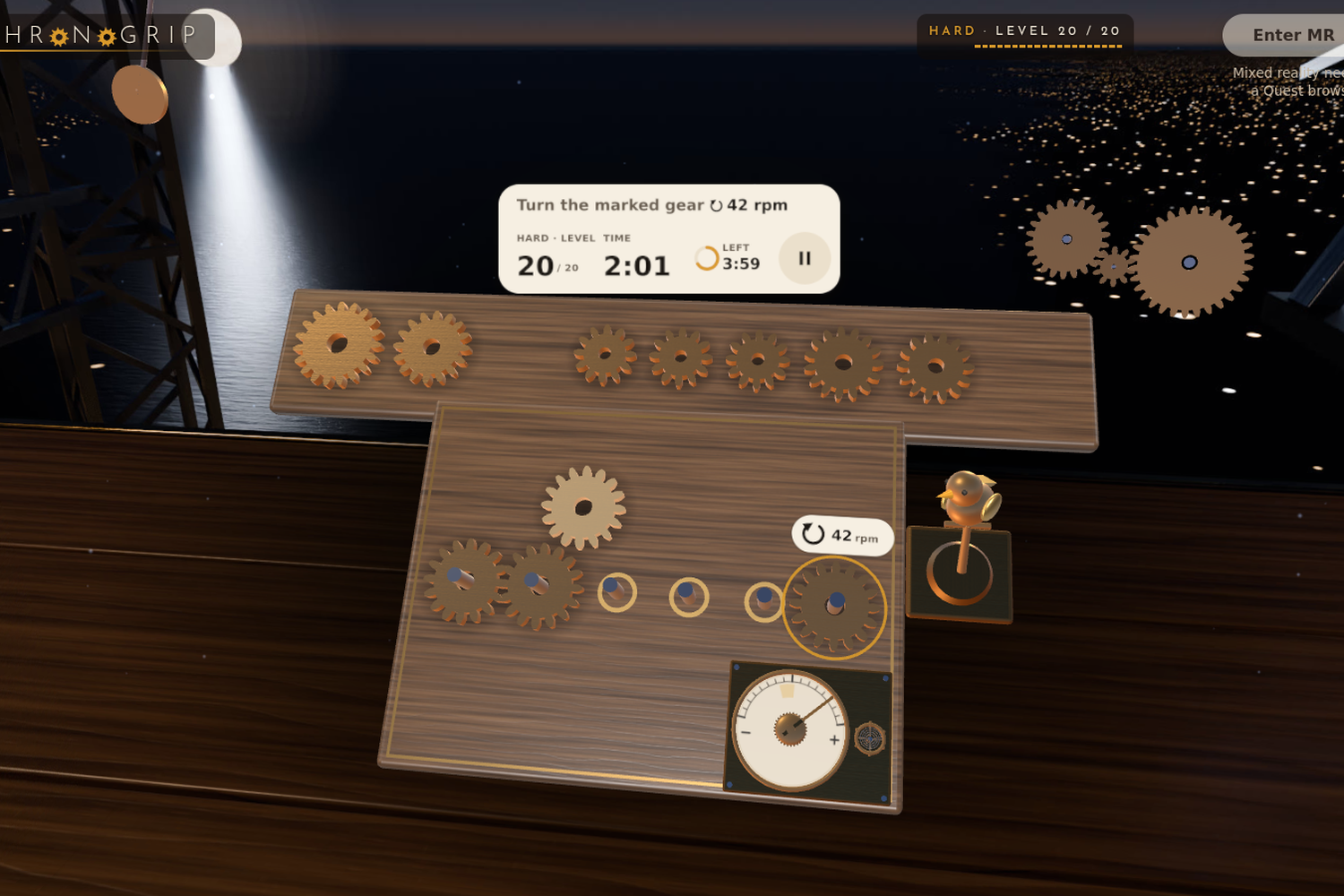
ChronoGrip is a seated mixed-reality clockwork puzzle for Meta Quest. You pinch brass gears onto axles on a tray, connect a gear train so the marked gear turns the right way at the right speed, then roll your wrist on a regulator dial until the escapement ticks in band and a little brass bird comes to life.
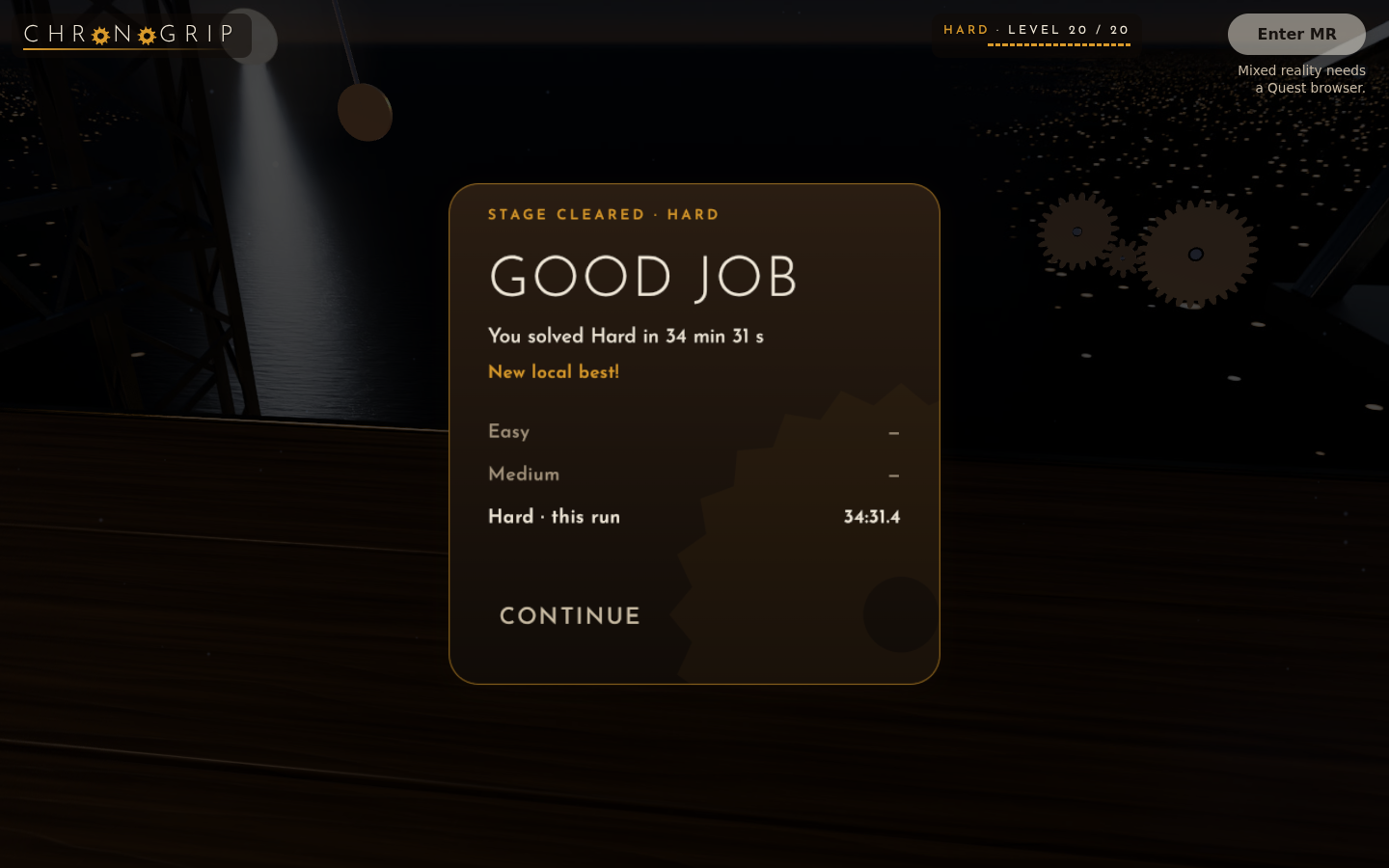
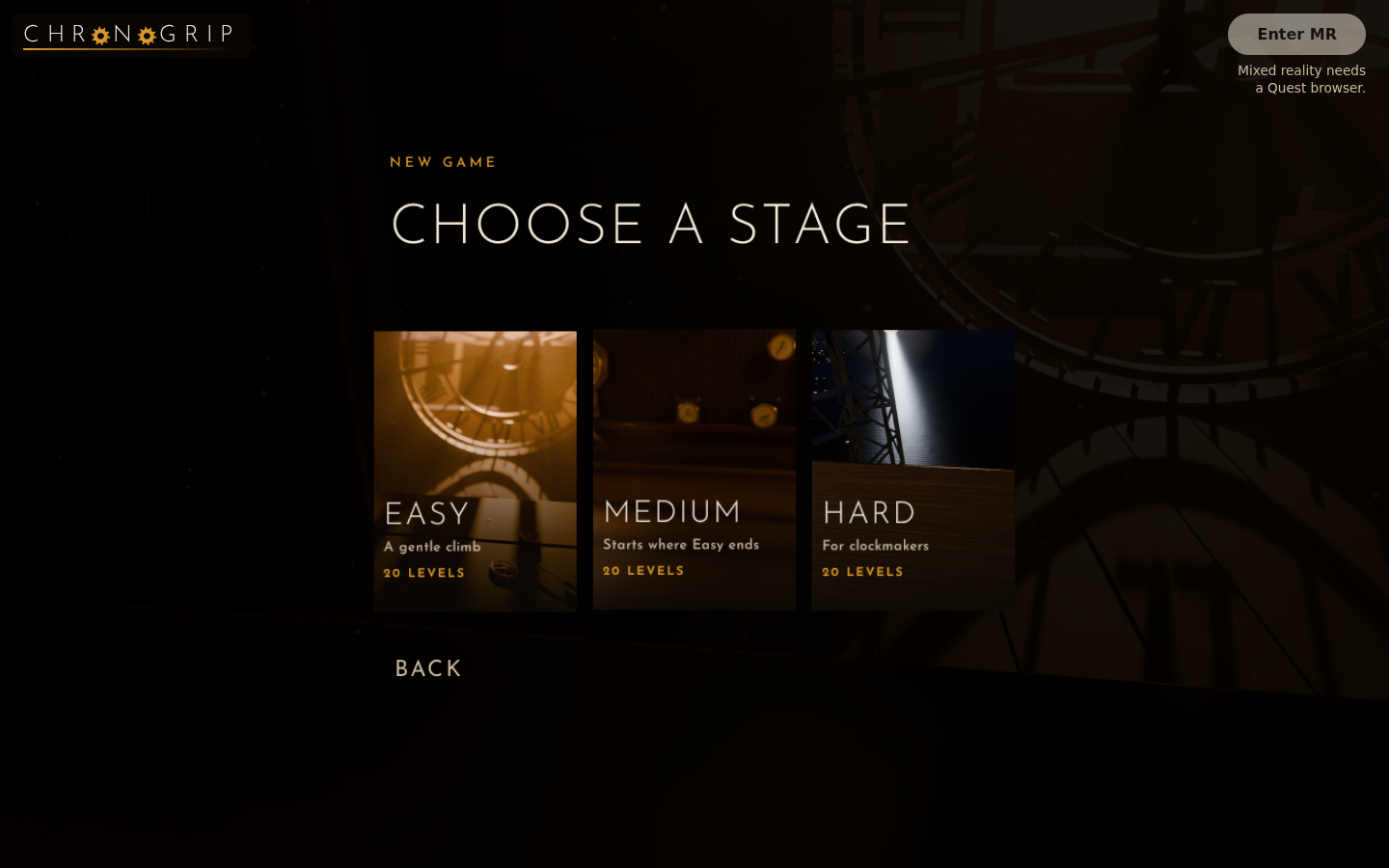
There are three stages (Easy, Medium, Hard) of 20 generated levels each. Every level is built fresh, so you cannot memorise a stage. Each level has a time limit; clearing a stage puts your run on local and global high scores.
In a Quest you play hands-first in passthrough: the tray snaps to a detected table edge, your real hands occlude the board, and the tray pose is remembered between sessions. Any desktop browser gets a mouse-driven preview of the same game.
How we built it
ChronoGrip is a WebXR immersive-ar app: TypeScript, IWSDK (@iwsdk/core) for the session, three.js for rendering, Vite for the build. It runs in the Quest browser with nothing to install.
Hands use IWSDK's GrabSystem for gears, plus joint reads every frame for pinch, poke, wrist roll on the regulator, and two-hand recenter. Gears are procedural involute meshes; a solver walks the train and reports jams and wrong-way spins. Levels are generate-and-score. Rooms are Blender cubemaps with music-synced moving parts; music and SFX are synthesised in WebAudio.
Live build: https://chrisbuildsonline.github.io/chronogrip-mr/play/
Repo: https://github.com/chrisbuildsonline/chronogrip-mr
Challenges we ran into
- IWSDK grab does not expose pinch point, index tip, or wrist roll, so we read joints ourselves.
- Random puzzles can be trivial or unsolvable; the generator rejects bad candidates and scores the rest.
- Testing hands without a headset: IWER + Playwright drive the full story headless.
- Software GL stalled first frames until a quality tier cut materials and map sizes.
- Seated comfort: every grab point and menu stays inside a comfort cone and arm's reach.
Accomplishments that we're proud of
A complete hands-only seated MR puzzle with purposeful passthrough (plane-anchored tray), three stages of 20 generated levels, global high scores, three rendered rooms with music-synced ambient motion, and a green Docker + Playwright suite judges can run.
What we learned
WebXR on Quest can ship a polished seated experience without a native build if you design for hands, FoV comfort, and plane detection from day one.
What's next for ChronoGrip MR
Target launch date: January 2027, free in the Quest browser at the live URL. Next: test hand occlusion, remembered tray pose, and IWSDK grab on a real Quest 3; profile for 60 fps on-device. Demo video will be added to this submission once recorded.
Track: Gaming. Division: New Experience.
Built With
- bun
- iwsdk
- mixed-reality
- three.js
- typescript
- vite
- webxr
