Inspiration
AI agents are beginning to interact with APIs, databases, support systems, and other tools that can create real-world side effects. When an agent fails, the issue is often difficult to reproduce because it may depend on a specific tool response, state transition, retry, or external condition.
Traditional logs show fragments of what happened, but they rarely let developers safely reconstruct the complete execution, test alternative outcomes, and verify that a proposed fix prevents the failure.
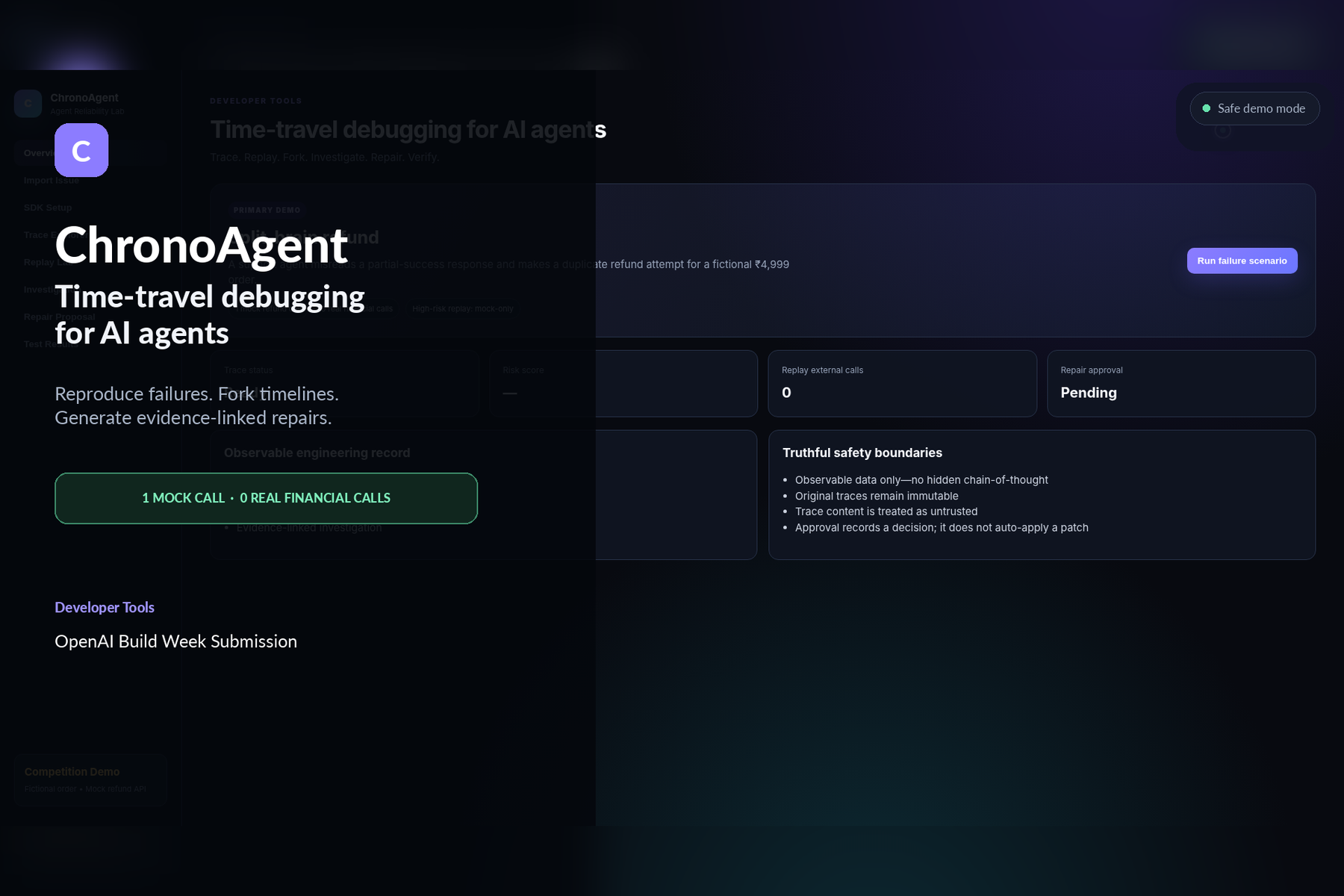
This inspired us to build ChronoAgent, a time-travel debugger for AI agents. Our goal was to turn unpredictable failures into reproducible engineering evidence without repeating dangerous actions or claiming access to hidden chain-of-thought.
What it does
ChronoAgent records observable AI-agent activity, including model interactions, tool calls, tool results, state changes, retries, errors, policy decisions, and duplicate-action warnings.
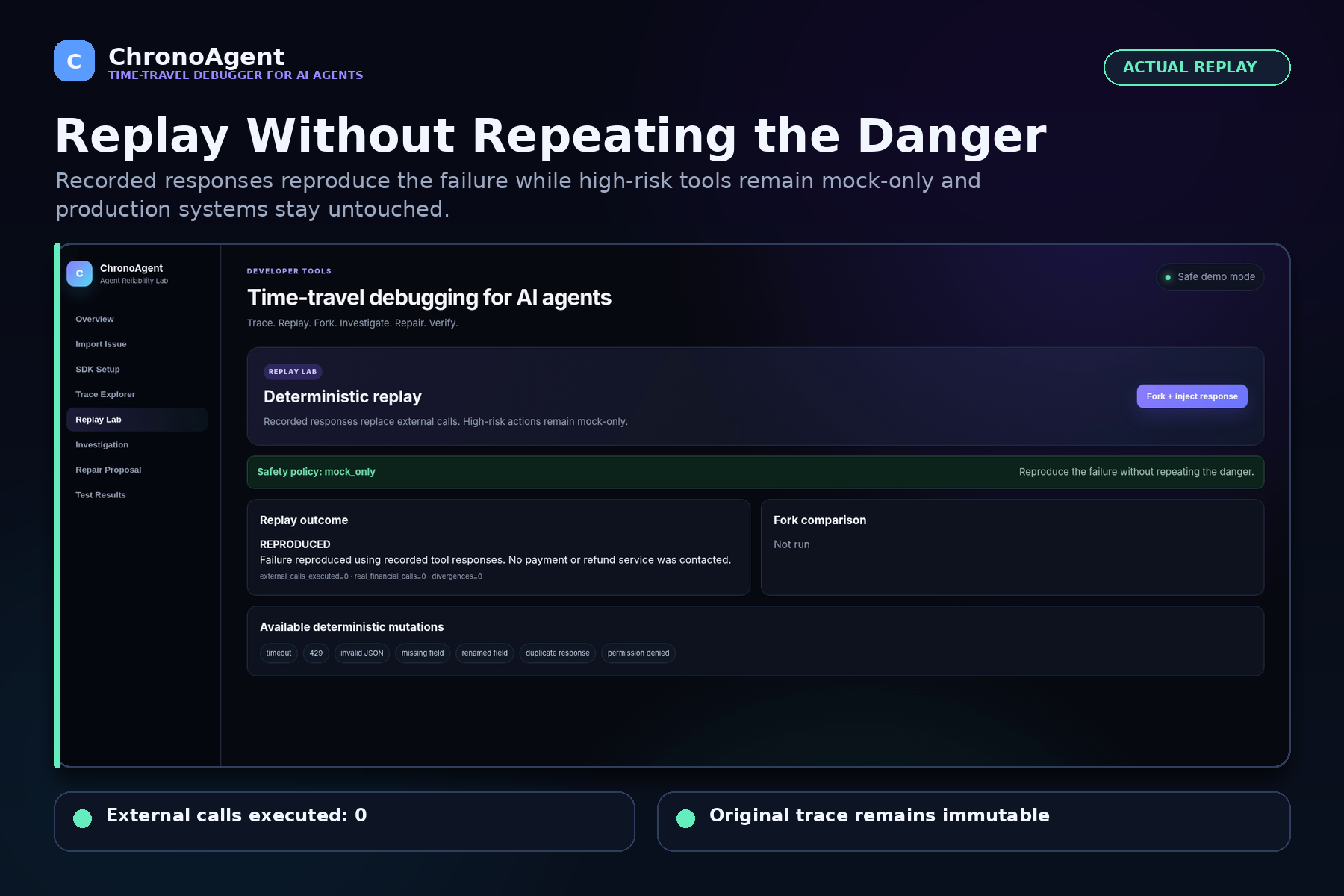
Developers can inspect an execution timeline, rewind to a specific event, and safely replay the failure using recorded or mocked responses. High-risk actions remain mock-only during replay, preventing payments, messages, deletions, or database changes from being repeated.
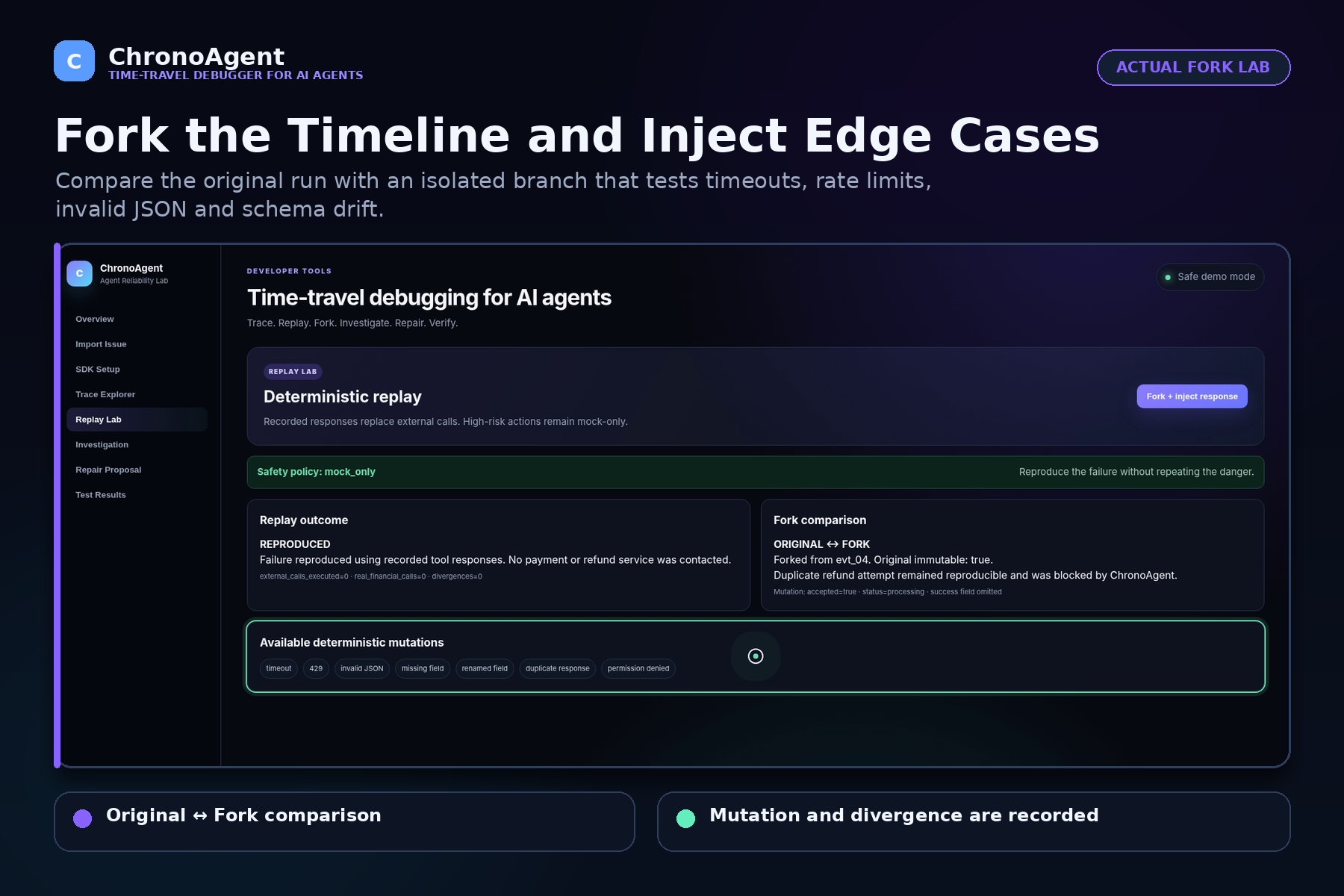
A developer can also fork a trace and inject edge cases such as:
Timeouts Rate limits Invalid JSON Missing or renamed fields Partial-success responses Duplicate responses Permission failures
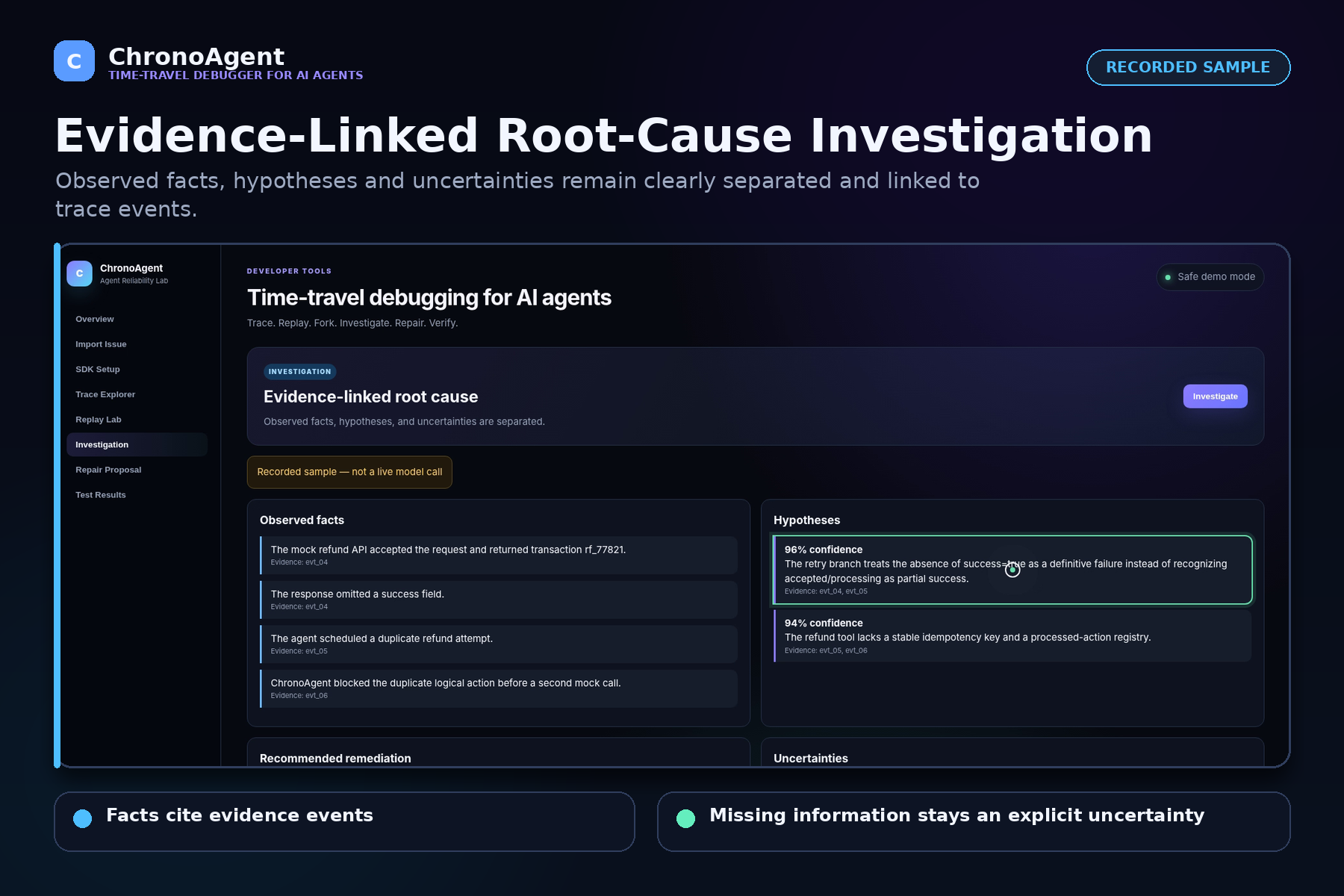
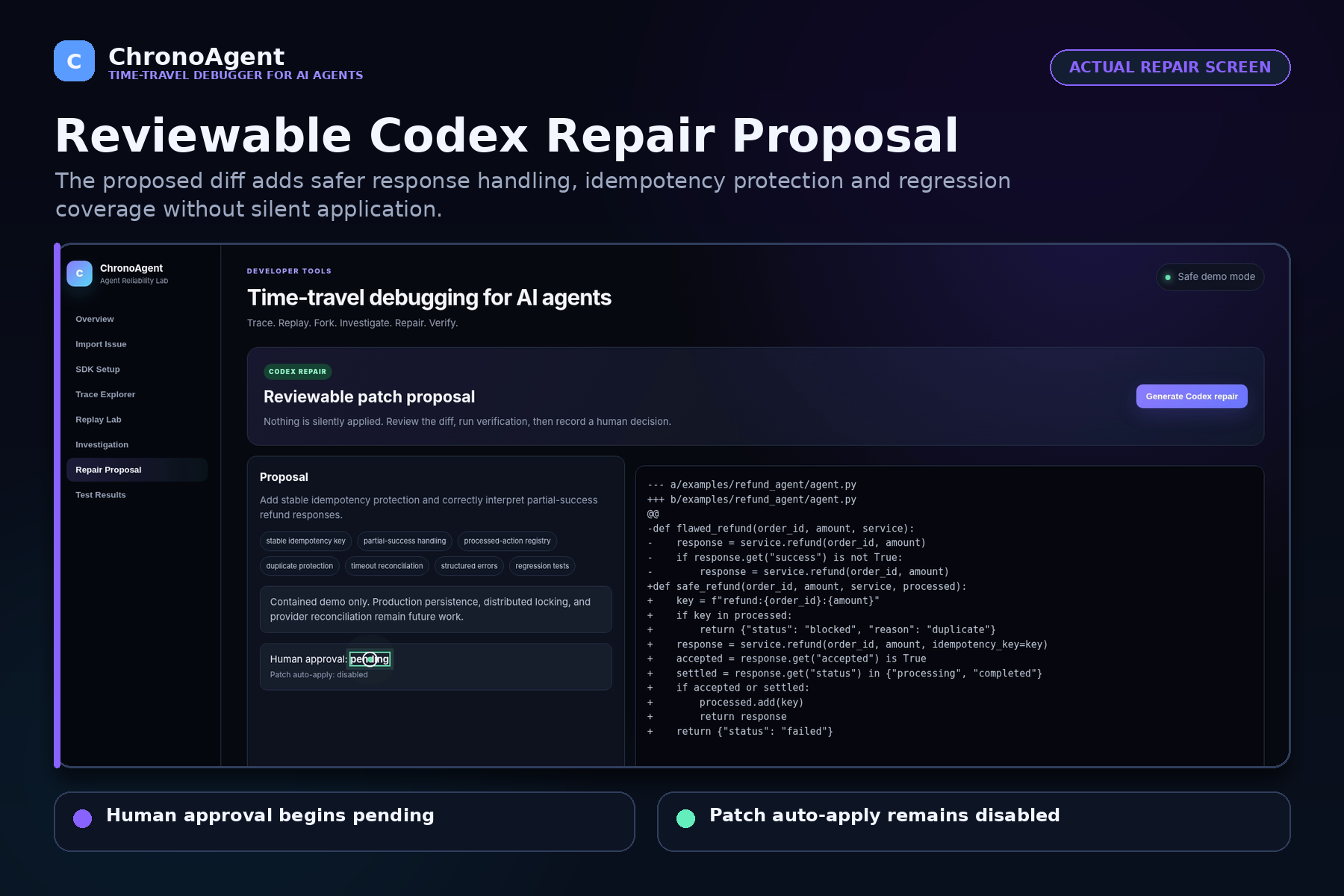
ChronoAgent separates observed facts, root-cause hypotheses, and unresolved uncertainties. GPT-5.6 can investigate structured trace evidence, while Codex helps generate a reviewable repair proposal, code diff, and regression tests.
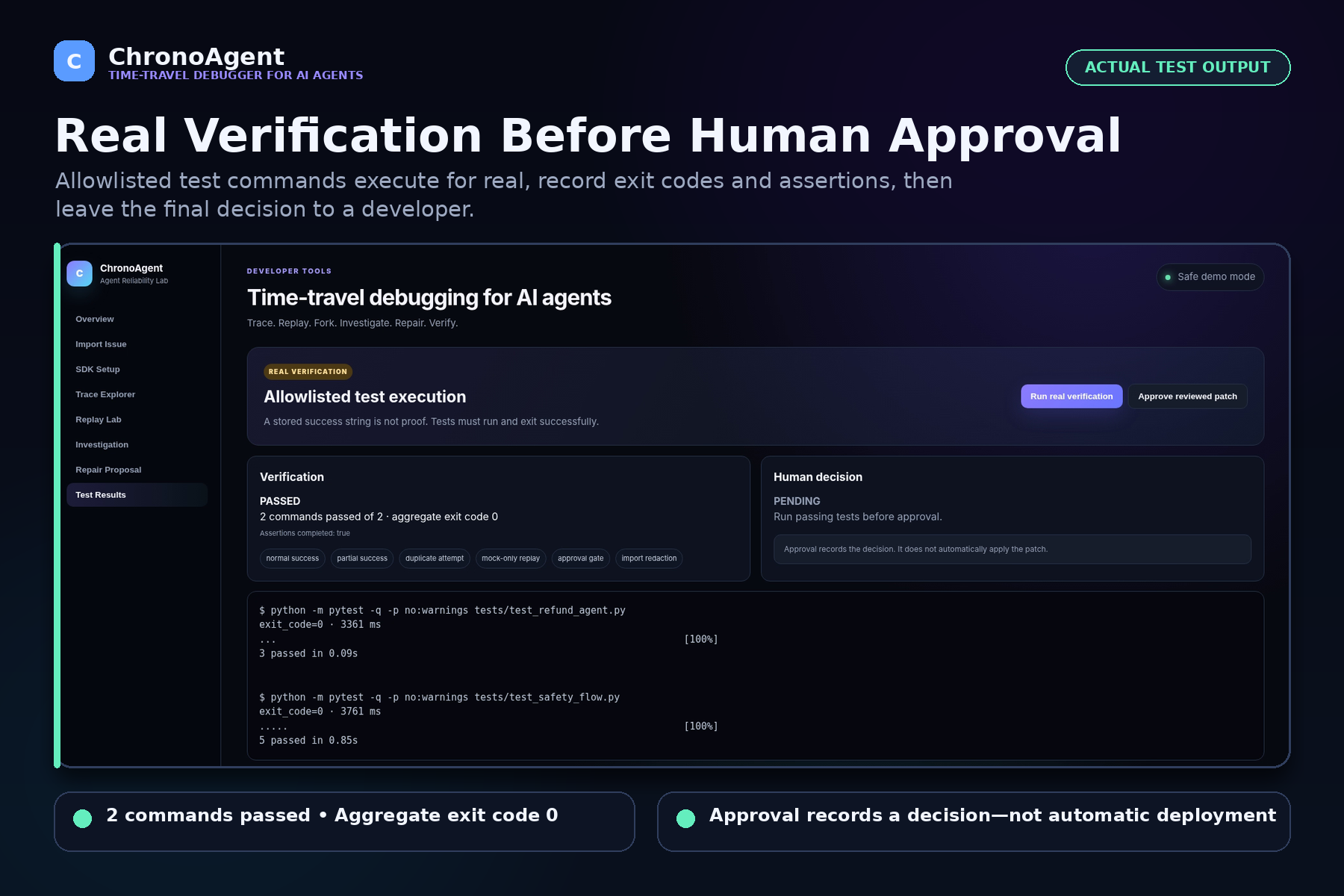
The proposed patch remains pending until a human reviews it. Approval records the decision but does not silently apply the patch.
How we built it
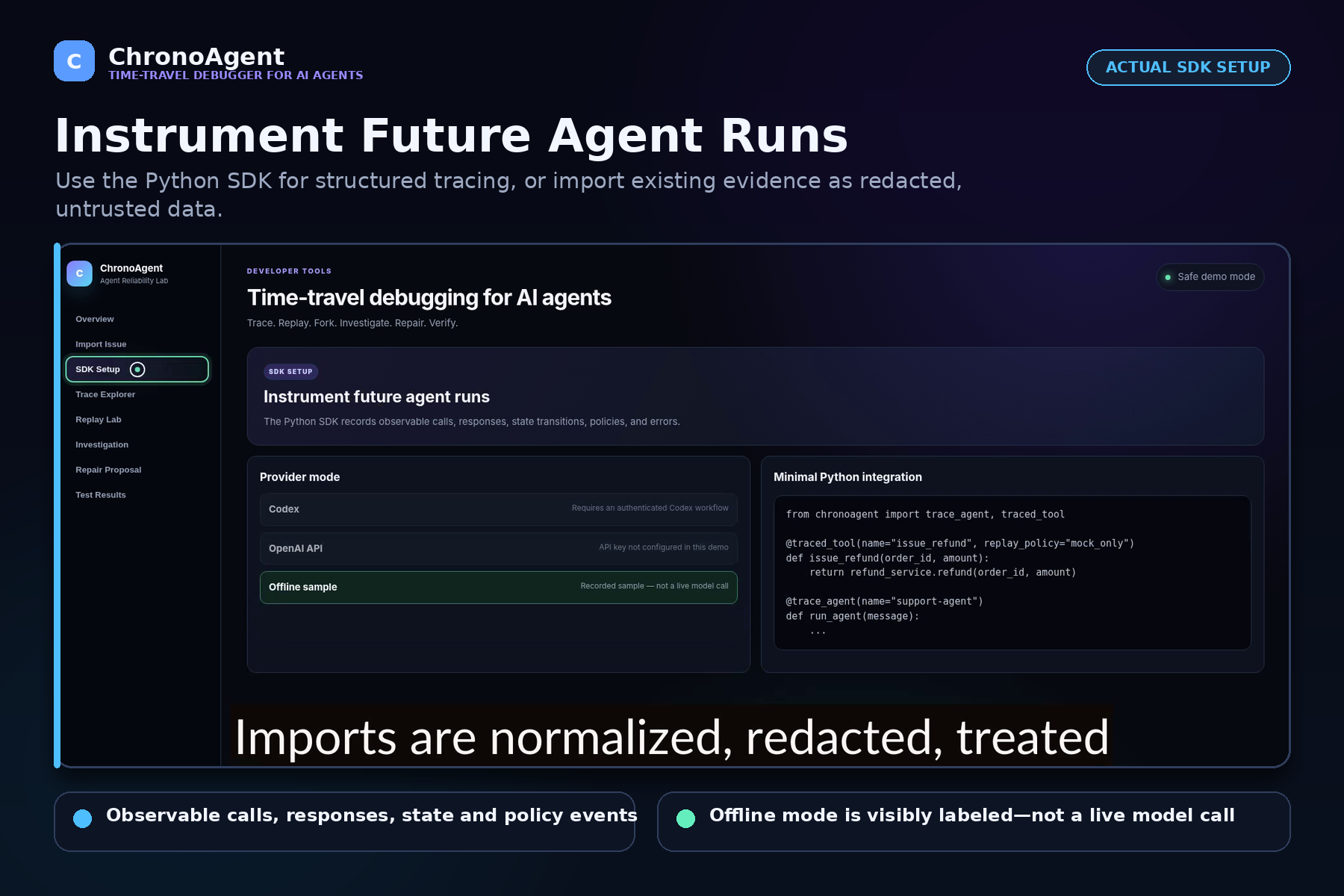
ChronoAgent was built as a Python-based developer tool using:
FastAPI for the application and API layer Pydantic for validated trace and investigation schemas SQLite-compatible persistence for traces, events, replays, investigations, and repair proposals Pytest for regression and safety-flow testing A lightweight Python tracing SDK A web dashboard for trace exploration, replay, timeline forking, investigation, repair review, and verification Docker-based and native local setup options
The competition demo uses fictional refund data and a mock refund service.
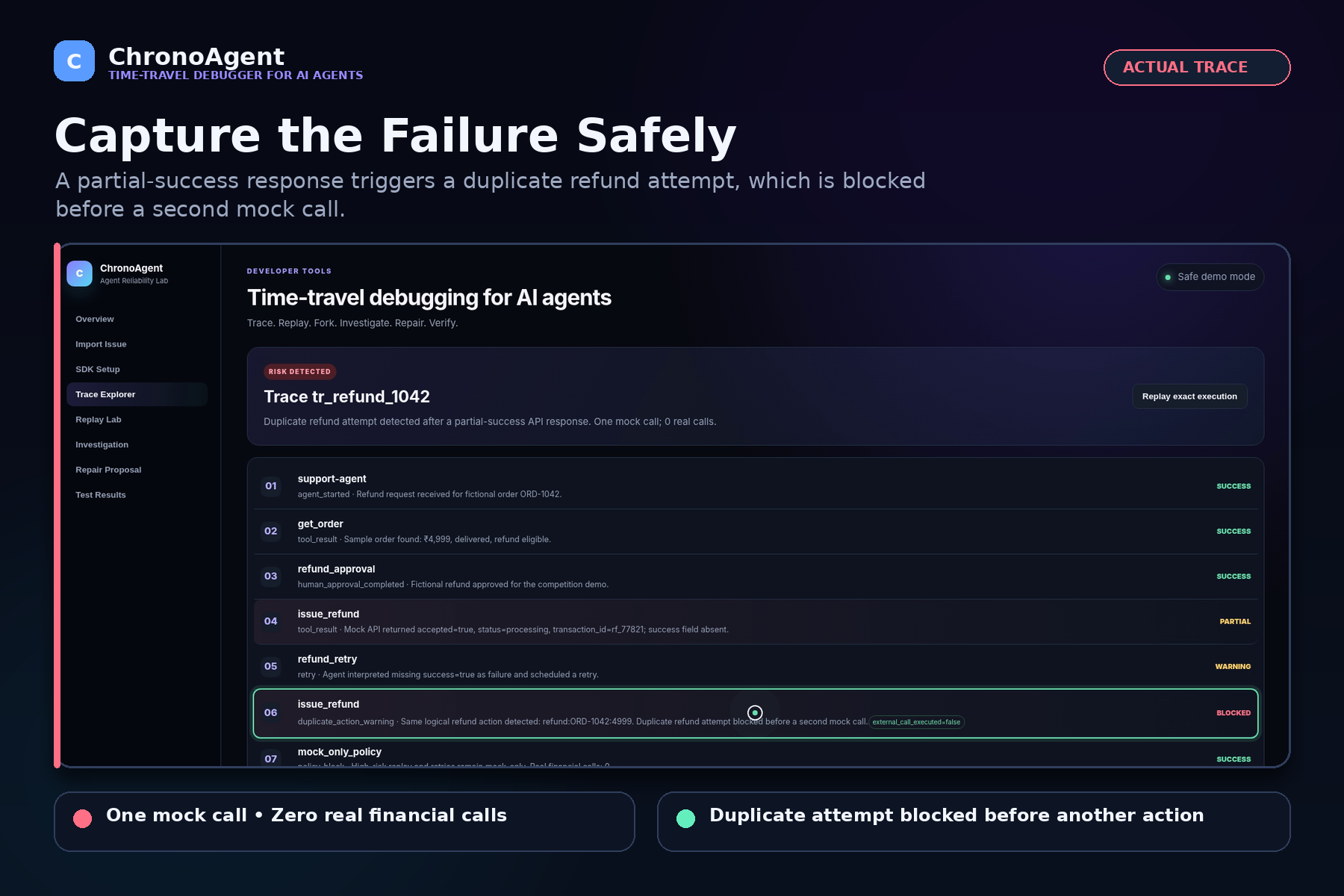
A support agent receives a request for a ₹4,999 refund. The mock provider accepts the refund and returns accepted: true with status: processing, but does not return the legacy success field expected by the intentionally flawed agent.
The agent interprets the response incorrectly and attempts a retry. ChronoAgent detects the repeated high-impact logical action and blocks the duplicate refund attempt before another mock call occurs.
The demonstration records:
One mock refund call Zero real financial calls A duplicate refund attempt, not a completed duplicate refund Mock-only replay for the high-risk tool A reviewable repair proposal Real test execution Mandatory human approval
Codex accelerated the project architecture, tracing SDK, replay workflow, dashboard, tests, security review, debugging, and documentation.
Challenges we ran into
One major challenge was reproducing failures without repeating the dangerous action that caused the incident. We solved this by separating observable evidence from external side effects and assigning explicit replay policies to tools.
Another challenge was maintaining trustworthy verification. ChronoAgent does not mark a repair as passed based on a stored label. It executes allowlisted test commands and records the real exit code, output, duration, and completed assertions.
We also had to handle incomplete evidence. Agent traces do not always contain enough information to prove a single root cause, so the investigation format distinguishes confirmed facts from hypotheses and uncertainties.
Uploaded traces and logs presented another security challenge. They may contain malicious or misleading instructions, so ChronoAgent treats uploaded content only as untrusted data. Files are normalized and redacted, never executed.
Finally, we had to balance a large long-term vision with a reliable competition demo. Instead of claiming universal framework support, we focused on a working Python MVP and one complete end-to-end debugging scenario.
Accomplishments that we're proud of
We are proud that ChronoAgent demonstrates a complete reliability workflow:
Trace → Replay → Fork → Investigate → Repair → Verify
The original trace remains unchanged while developers explore alternative timelines through isolated forks.
High-risk replay performs zero real financial calls, and the duplicate refund attempt is blocked before a second mock action occurs.
The investigation interface clearly separates facts, hypotheses, and uncertainties instead of presenting AI-generated conclusions as guaranteed truth.
The repair proposal is reviewable, supported by regression tests, and never silently applied. Human approval remains mandatory.
We are also proud that the demo uses fictional sample data, real application states, and executed tests rather than invented metrics or fake production activity.
What we learned
We learned that AI-agent reliability requires more than ordinary logging. Developers need enough structured evidence to reconstruct how model activity, tool responses, state changes, retries, and safety policies interacted.
We also learned that reproducibility and safety must be designed together. A debugger is not useful if reproducing a failure can trigger another payment, deletion, email, or database modification.
Another important lesson was that AI-generated diagnosis must remain inspectable. Factual claims should link to observable events, while uncertainty should be communicated openly.
Most importantly, we learned that Codex and GPT-5.6 are most valuable when combined with strong engineering controls. AI can accelerate investigation and repair, but developers should retain final authority over testing, approval, and deployment.
What's next for ChronoAgent
Next, we plan to expand ChronoAgent with:
Integrations for additional AI-agent frameworks PostgreSQL and team deployment support CI/CD regression-trace execution Collaborative trace review More fault-injection scenarios Stronger privacy and redaction controls Framework-specific tracing adapters Advanced state reconstruction Controlled patch application after explicit approval Live GPT-5.6 investigation for authenticated environments
Our long-term vision is simple:
Unpredictable AI-agent failures should become reproducible evidence, reviewable repairs, and permanent regression tests.

Log in or sign up for Devpost to join the conversation.