-
-
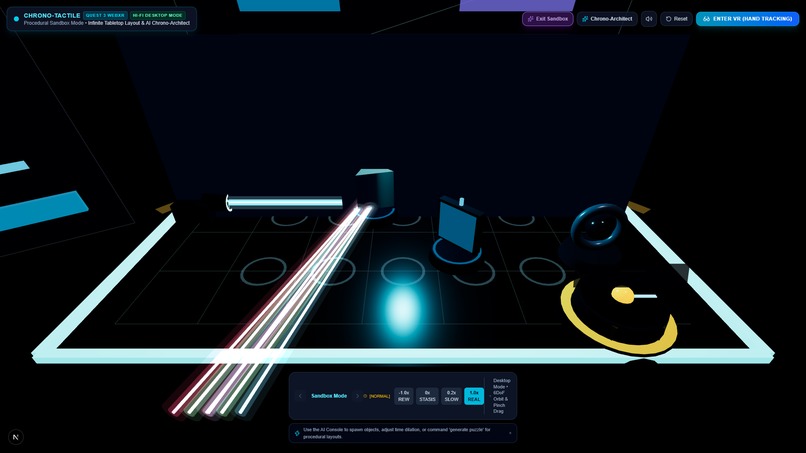
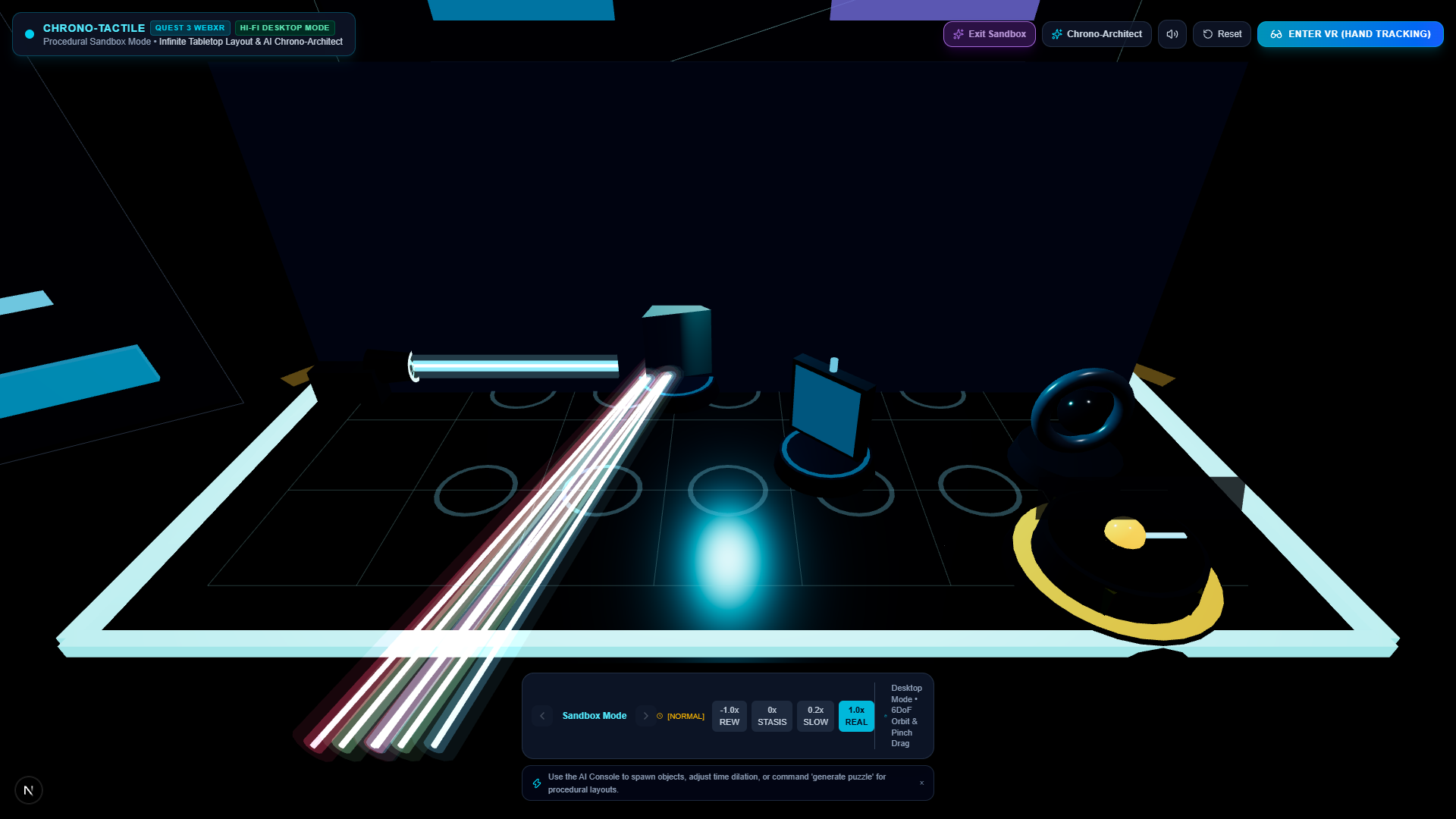
Cauchy chromatic dispersion splitting white laser light into discrete RGB vectors through diamond prisms.
-
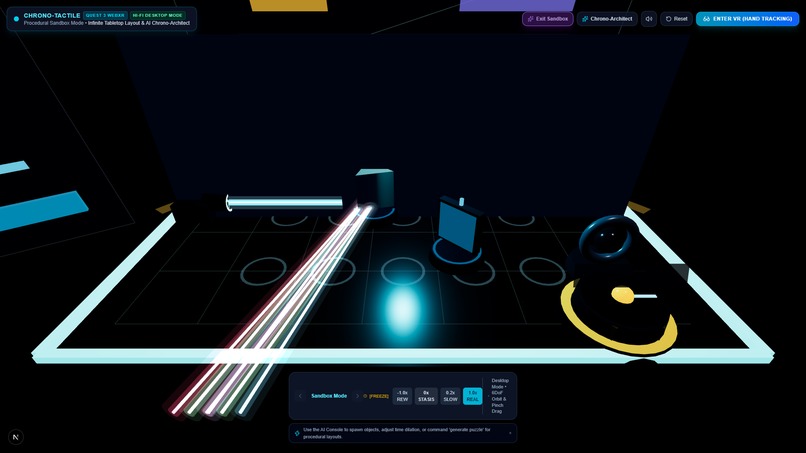
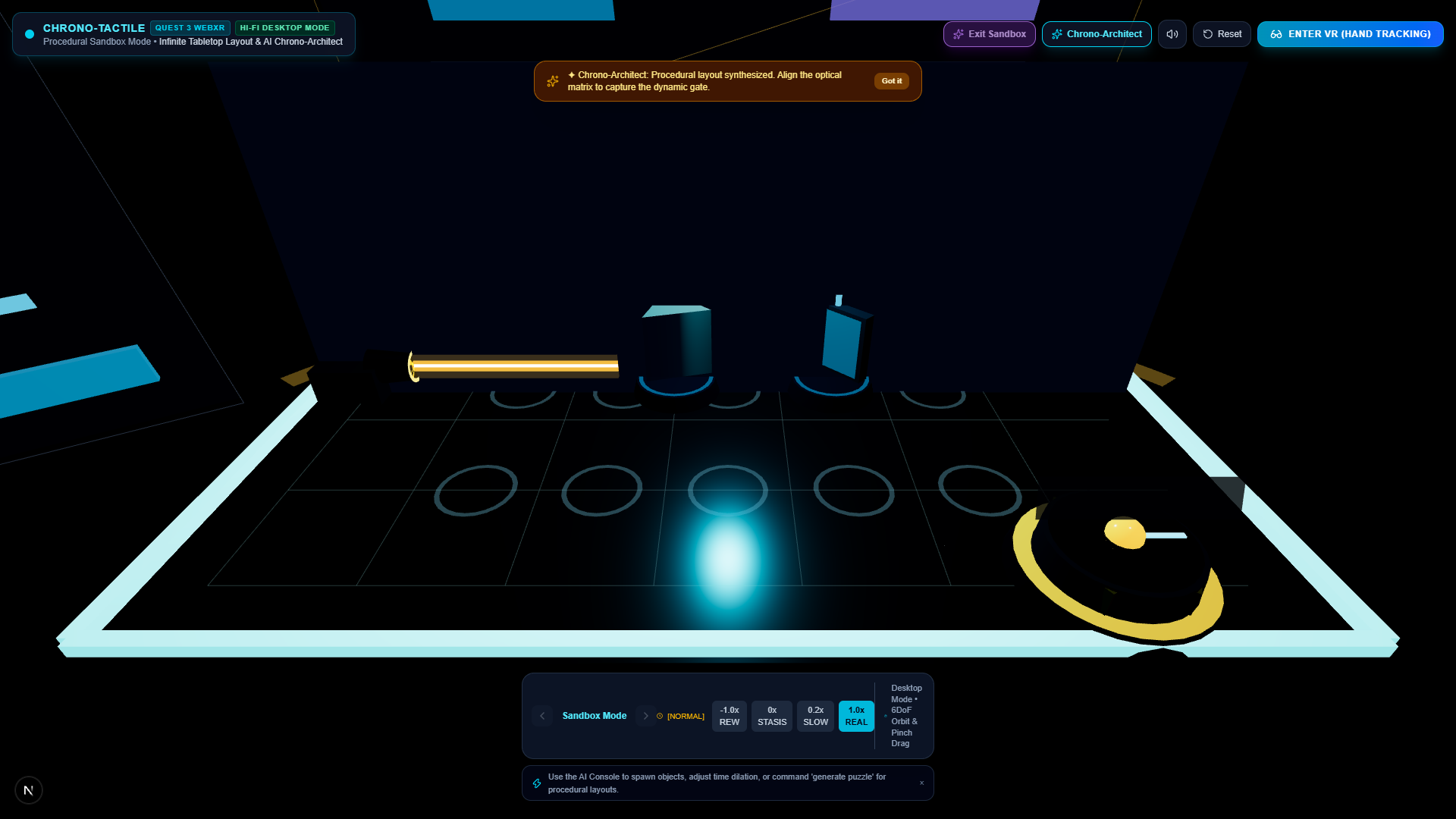
Contactless hands-first magnetic snapping reticle and 0.6m ergonomic tabletop envelope on Quest 3.
-
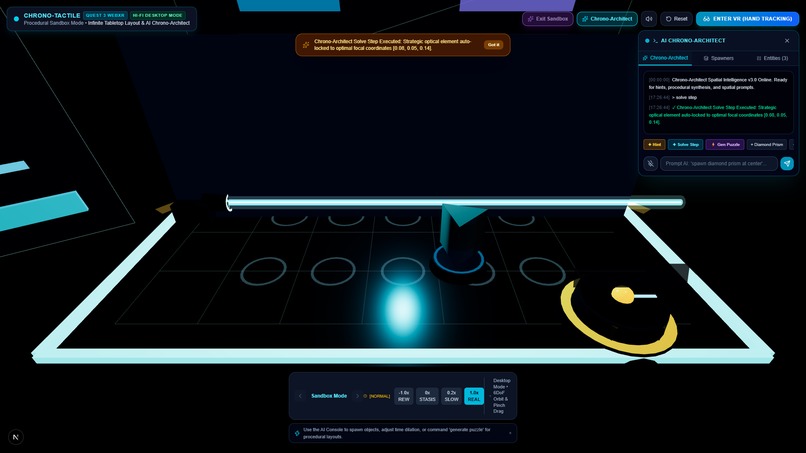
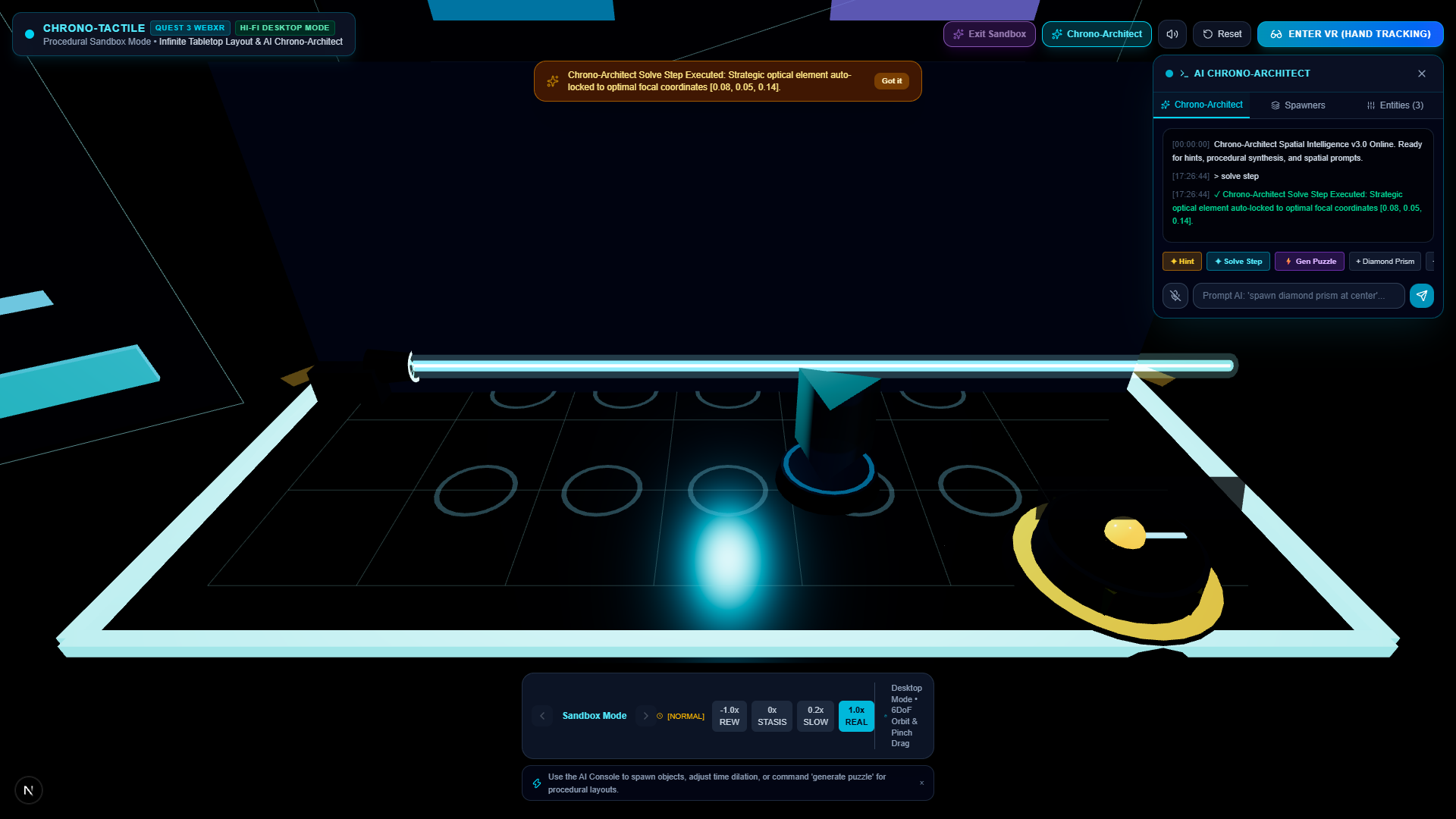
Autonomous 3-tier AI Chrono-Architect console executing dynamic multi-step spatial solve recommendations.
-
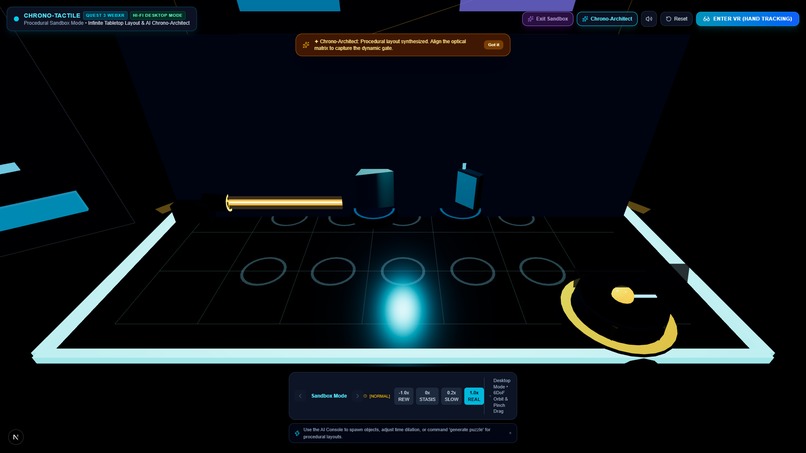
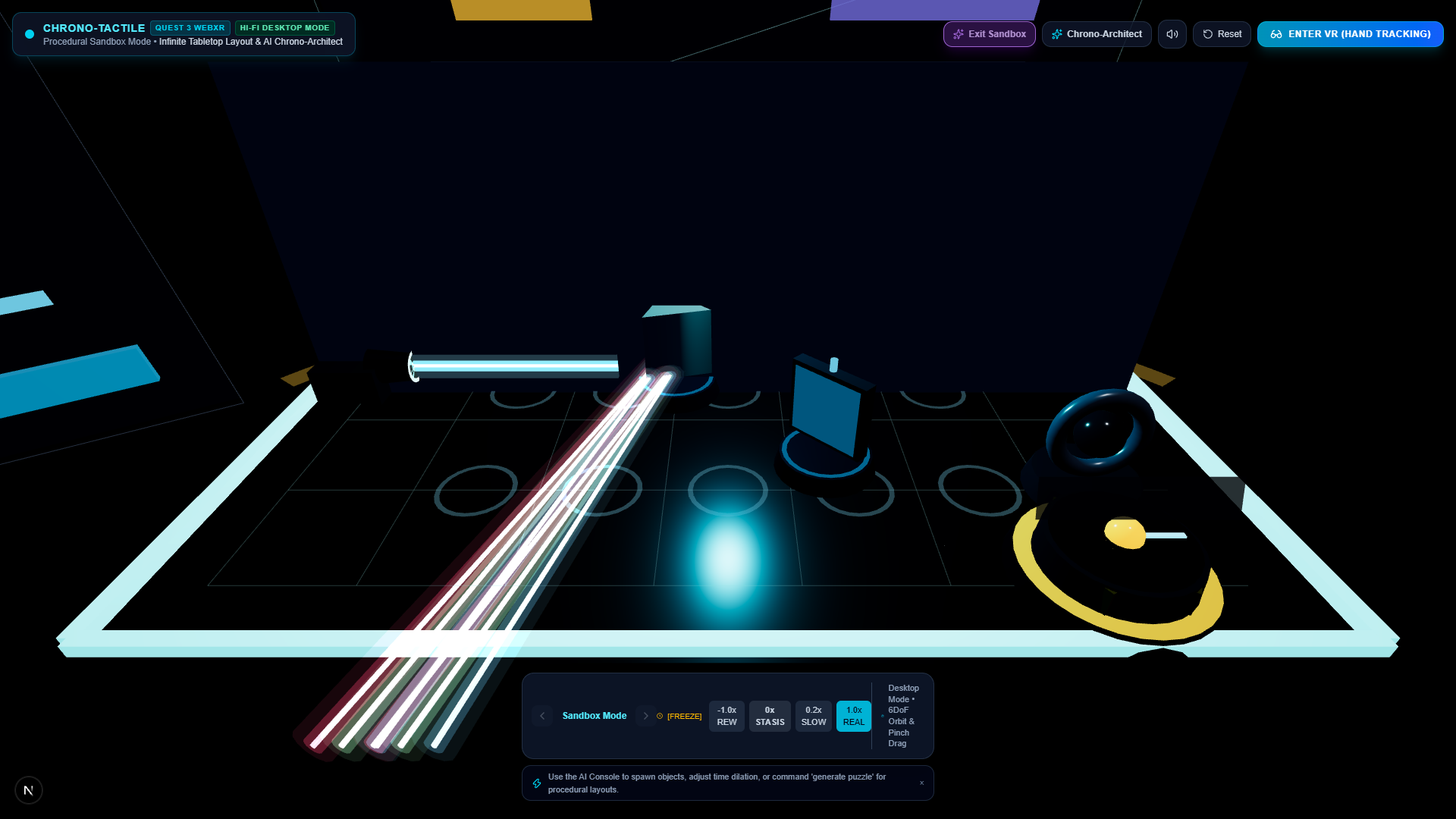
4D Chrono-Dial time dilation: freezing photon flight in 0x STASIS and rewinding beam paths in -1.0x REW.
-
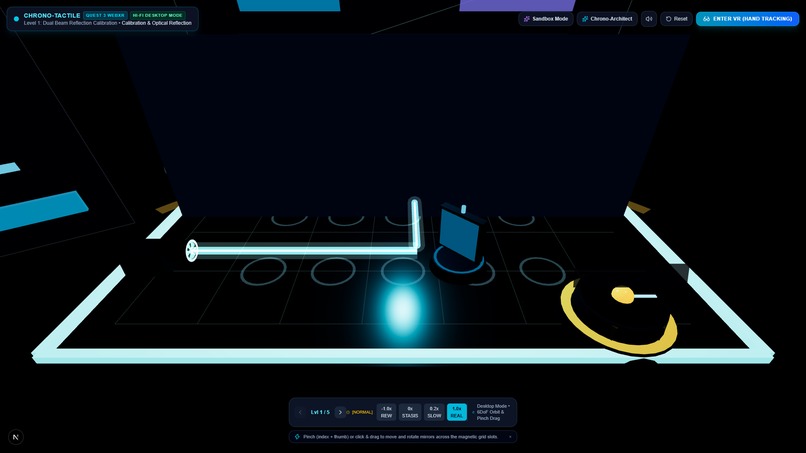
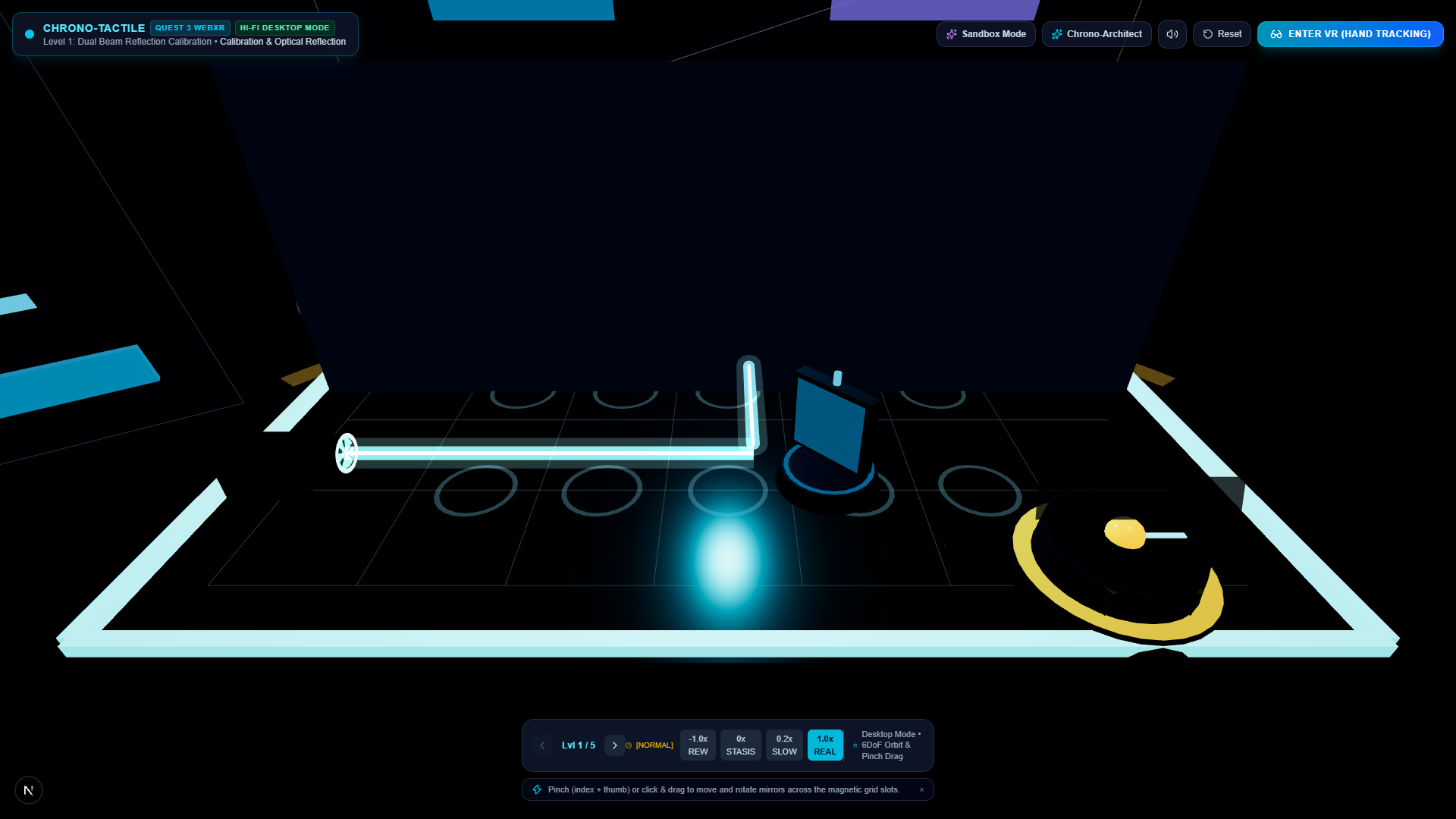
Level 1 Dual Beam Reflection calibration with sub-bass procedural acoustic resonance at 90 FPS.
Inspiration
What it does
How we built it
Challenges we ran into
💡 Inspiration
Most VR puzzle games still treat hand tracking as an afterthought—merely emulating physical controller grips or laser pointers. We asked a foundational question: What if spatial interaction felt completely natural without physical hardware, relying purely on optical physics, pseudo-haptic audio-visual resonance, and temporal manipulation?
Chrono-Tactile was engineered from the ground up for the Meta VR Start Developer Competition 2026 to push the boundaries of pure WebXR and contactless spatial immersion on Meta Quest 3.
✨ What It Does
Chrono-Tactile places the player before an interactive holographic tabletop where photons, crystals, and time converge:
- Cauchy Chromatic Dispersion: Monochromatic white laser beams split into precise RGB vectors (#ff3366, #00ff88, #33aaff) upon entering Crown (IOR 1.54) and Diamond (IOR 2.42) optical prisms.
- 4D Chrono-Dial (Time Dilation): Players scrub reality between
-1.0x REW(rewinding past beam paths),0x STASIS(freezing photons mid-flight), and1.0x REAL, allowing players to reposition optical apertures through frozen light corridors. - Autonomous AI Chrono-Architect: Powered by a 3-tier cascade (Nebius Nemotron-4 340B, Google Gemini 1.5 Flash fallback, and local deterministic regex), the AI provides real-time spatial hint vectors, executes multi-step optical alignments, and generates procedural sandbox puzzles on demand.
- Seated-First Ergonomic Horizon: Designed within a comfortable 0.6m reach envelope with magnetic snapping (0.14m proximity lerp) and acoustic micro-haptics (65Hz sub-bass thump on pinch, 1200Hz chime on snap).
- 5 Progressive Stages + Infinite Sandbox: From simple dual-beam reflections to complex chromatic multi-receiver routing, plus an unrestricted sandbox to build custom optical experiments.
🛠️ How We Built It
- Frontend & WebXR Core: Next.js 15 (App Router), Three.js, React Three Fiber, and WebXR Device API using native hand-joint meshes.
- Optics & Dispersion Engine: Custom WebGL raycasters simulating Snell's law of refraction, total internal reflection (TIR), and Cauchy wavelength equations.
- 3-Tier AI Spatial Cascade: Serverless Next.js edge route orchestrating Nebius Nemotron-4 340B for complex spatial reasoning, failing over seamlessly to Gemini 1.5 Flash, with an air-gapped local parser ensuring zero downtime.
- Audio Synthesis: Web Audio API procedural oscillator engine synthesizing acoustic feedback dynamically without heavy audio asset loads.
🛡️ The "Take It Away" Test Compliance
- Take away controllers: Chrono-Tactile is strictly controller-free, built 100% for index-and-thumb optical pinch mechanics.
- Take away API connectivity: If offline or token-limited, Tier 3 rule-based parser immediately handles hint generation and physics verification.
- Take away physical space: Fully playable seated on a sofa within a compact 0.6m desk radius without boundary recalibration.
⚡ Challenges We Ran Into
Balancing dynamic multi-bounce laser raycasting with additive bloom passes on Meta Quest’s mobile Snapdragon chipset while holding a rigid 90 FPS was challenging. We solved this by lowering cylinder radial segments on mobile XR, culling unnecessary overdraw passes, and optimizing collision spatial hashes.
🏆 Accomplishments That We're Proud Of
- Achieved zero-latency, rock-solid 90 FPS performance on the Meta Quest 3 browser.
- Built a complete, self-healing 3-tier AI pipeline that guarantees sub-second spatial suggestions.
- Crafted a rich 5-stage progression complemented by an Infinite Procedural Sandbox Mode.
🔮 What's Next for Chrono-Tactile
- WebXR Colocation Multiplayer: Real-time multi-user optical puzzle solving over WebRTC.
- Mixed Reality (MR) Passthrough Anchoring: Projecting the chronotable directly onto real-world desks using WebXR Plane Detection. ## Accomplishments that we're proud of
What we learned
What's next for Chrono-Tactile: Hands-First 4D WebXR Spatial Optics Engine
Built With
- gemini-1.5-flash
- meta-quest-3
- nebius-ai
- nemotron-4-340b
- next.js-15
- react-three-fiber
- three.js
- typescript
- web-audio-api
- webxr

Log in or sign up for Devpost to join the conversation.