-
-
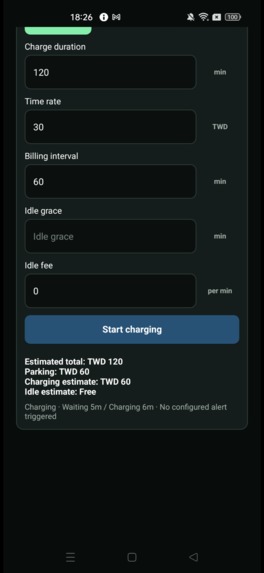
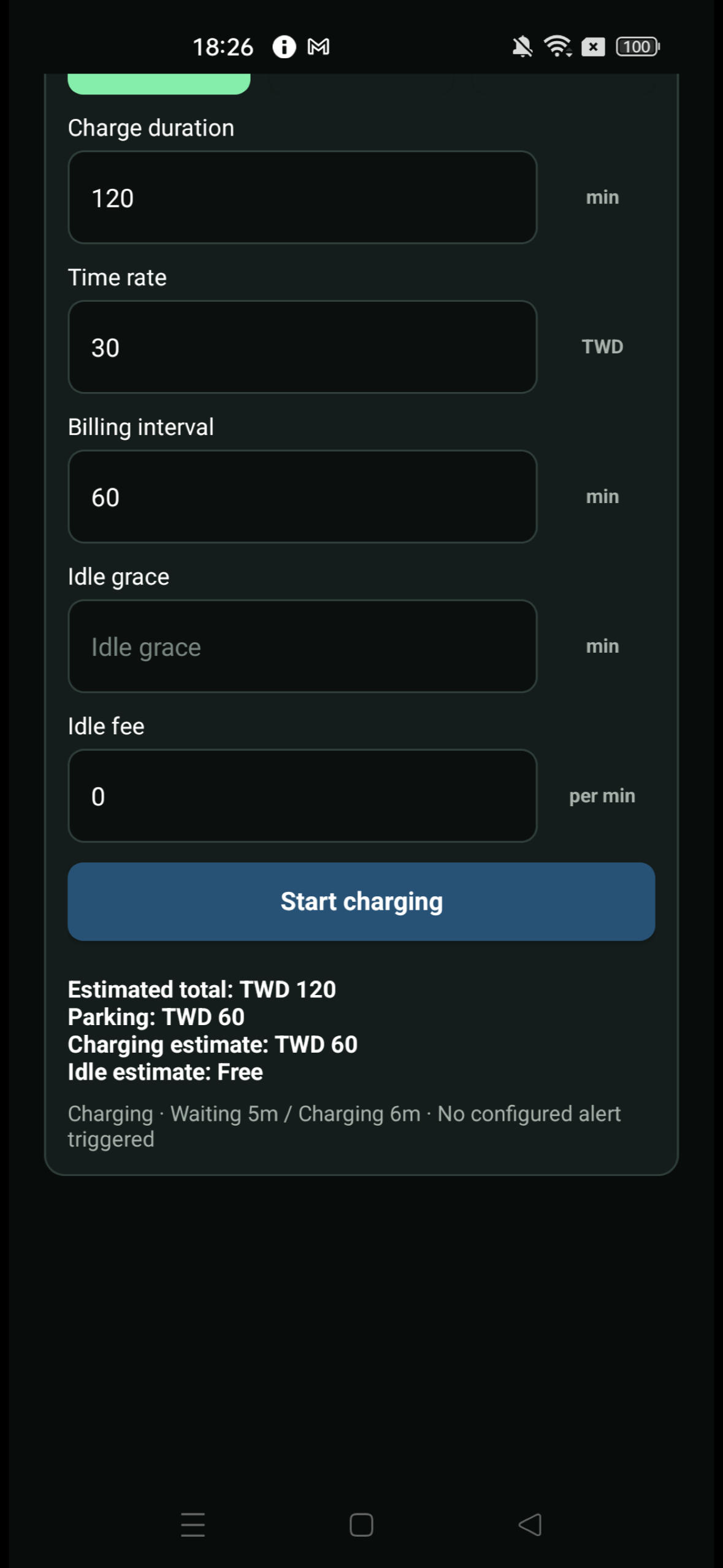
EV cost evidence: parking TWD 60 + charging TWD 60 = estimated total TWD 120.
-

Chrono.P app icon (1024 × 1024)

Inspiration
EV drivers often compare charging prices but overlook the cost of staying: parking fees continue while a car charges, and idle fees may begin after charging ends. This is especially painful at malls, hotels, offices, public parking facilities, and third-party charging stations. Chrono.P was built to show that complete cost in one place without requiring a vehicle account or sending parking data to a private server.
Evidence behind the problem
This cost stack appears across multiple EV markets, not only Taiwan:
- United States: The U.S. Department of Energy's Alternative Fuels Data Center says public charging is commonly located at shopping centers, parking lots, garages, airports, hotels, and offices, while operators may charge per session, per hour, or by energy used.
- United States, site-host pricing: ChargePoint's station payment guide explicitly supports a parking fee while a vehicle is charging, a grace period, and a separate overstay rate after charging stops.
- United States, public fast charging: Electrify America's official FAQ documents a per-minute idle fee after charging is complete.
- Australia: Chargefox's official idle-fee guide explains that some stations add a per-minute fee after a location-specific grace period, and that both the amount and conditions vary by station owner.
- Europe: IONITY explains that its ultra-fast network operates across 24 countries and that charging prices vary by country and location, reinforcing the need for local-currency, manually adjustable rates.
These real policies validate Chrono.P's core model: true stop cost = parking cost + charging cost + optional idle cost.
What it does
Chrono.P combines parking time, parking fees, EV charging fees, and optional idle fees in one focused workflow. Drivers can:
- Track parking with a large, one-handed timer.
- Enter the venue's real local rate instead of relying on an incomplete global pricing database.
- Estimate EV charging by time, kWh, or flat fee.
- Mark fast charging, slow charging, or an unspecified charger.
- View parking, charging, and idle costs together before leaving.
- Capture a parking space or zone with on-device OCR, then correct the result manually.
- Use Traditional Chinese or English independently from the selected ISO 4217 currency.
Chrono.P estimates costs only. It does not process parking payments, start a charger, read vehicle battery data, or claim live charger availability.
How we built it
Chrono.P is a native Android app written in Kotlin. Session and EV metadata are stored locally behind separate persistence boundaries. Cost calculations support time-based, energy-based, and flat charging models, while localized amount parsing handles decimal conventions across markets. OCR runs on the device so parking images and recognized text are not uploaded to a Chrono.P server.
RevenueCat powers the one-time ad-free entitlement and purchase restoration. RevenueCat Ads tracks rewarded-ad monetization. Google Mobile Ads serves opt-in rewarded ads, and Google UMP manages regional privacy consent.
Monetization without interruption
Every installation starts with three completed uses. After finishing a parking record, a user may voluntarily watch one rewarded-ad experience to add 10 uses, or purchase a one-time permanent ad-free unlock at the localized Google Play price. Ads never interrupt launch, active timing, data entry, or the exit countdown.
Challenges
The hardest part was treating monetization as a state-management problem rather than a pop-up. A reward must be granted exactly once, only after the ad network confirms completion, and never after a failed load or early dismissal. We also had to preserve active timers across background transitions, separate language from currency, validate localized numeric input, and keep the interface usable across large fonts and wider Android layouts.
Accomplishments
Chrono.P is publicly available on Google Play with a working RevenueCat purchase path, purchase restoration, rewarded ads, regional privacy handling, bilingual UI, and an EV cost model that remains independent of any automaker ecosystem.
What we learned
A small utility becomes more trustworthy when it states its boundaries clearly. Manual rate entry is not merely a fallback: it makes the app usable at fragmented charging networks worldwide without collecting vehicle credentials or pretending that every operator follows the same pricing rules.
What's next
Next steps include evidence-led localization, additional real-device accessibility testing, clearer cost comparisons between charging choices, and more user validation in crowded destination-charging scenarios.
Built With
- android
- google-admob
- google-play-billing
- google-ump
- kotlin
- ml-kit-ocr
- revenuecat
- revenuecat-ads

Log in or sign up for Devpost to join the conversation.