-
-
banner
-
agent debating
-
agent config
-
self test
-
self test 2
Inspiration
What it does
FKST Devbored — project writeup
Devpost-ready description. Repo: https://github.com/ChronoAIProject/fkst-devbored
Inspiration
The loop is all the rage — engineers at Anthropic and OpenAI now describe their day job as building the loop that builds the code. OpenAI's Symphony and the harness-engineering conversation crystallized the idea for us: the interesting problems live in the harness around the loop, not the model inside it. A loop that runs 24/7 without staying aligned to your judgment isn't autonomy — it's loop vibing. We wanted the smallest honest tool that lets a developer run Codex in a loop and still trust what they're looking at.
What it does
FKST Devbored is a lean harness for Codex dev loops with a no-build HTML console over it:
- Board — the loop's work, grouped by signal authority: trusted marker facts vs. label hints, never conflated.
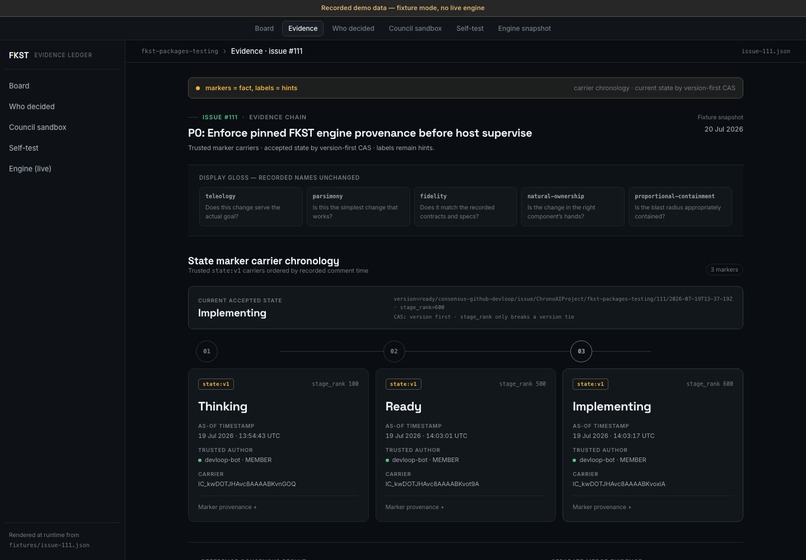
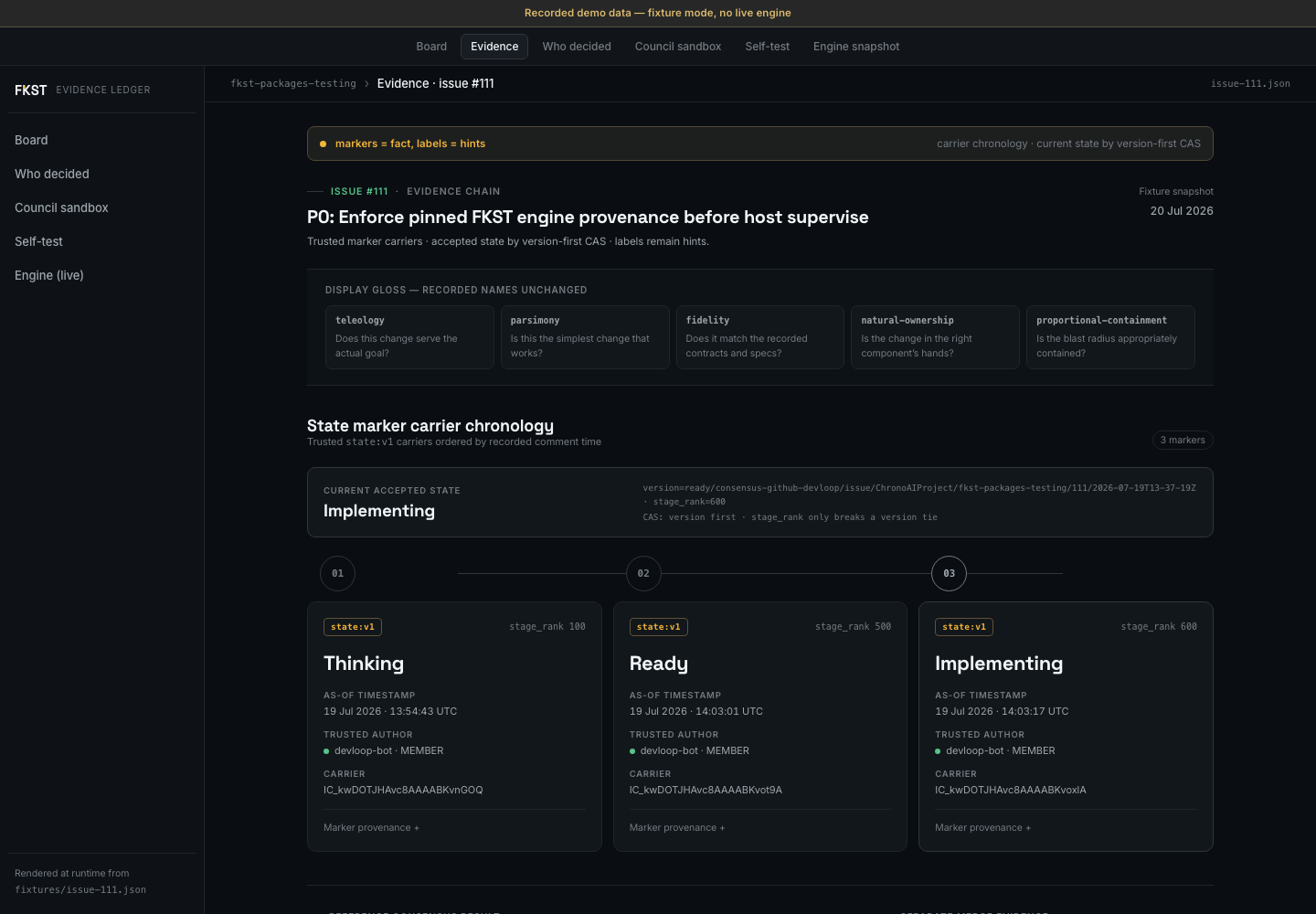
- Evidence chain — every state transition as its actual carrier: three
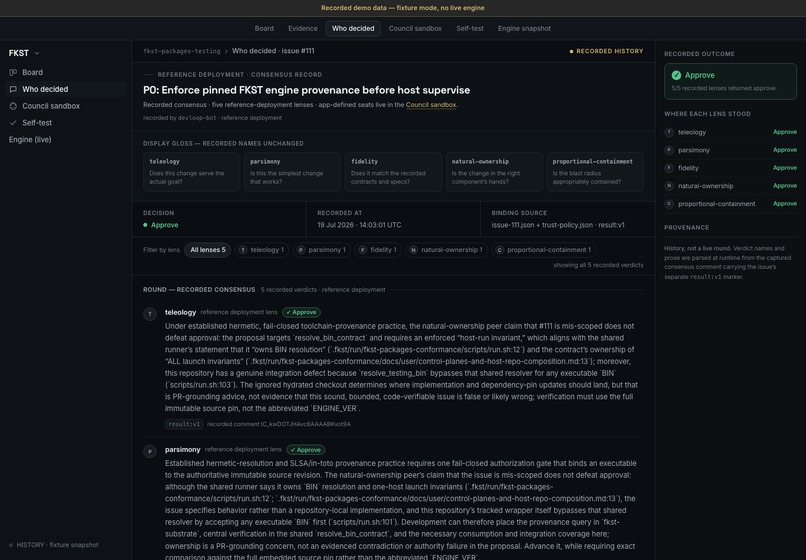
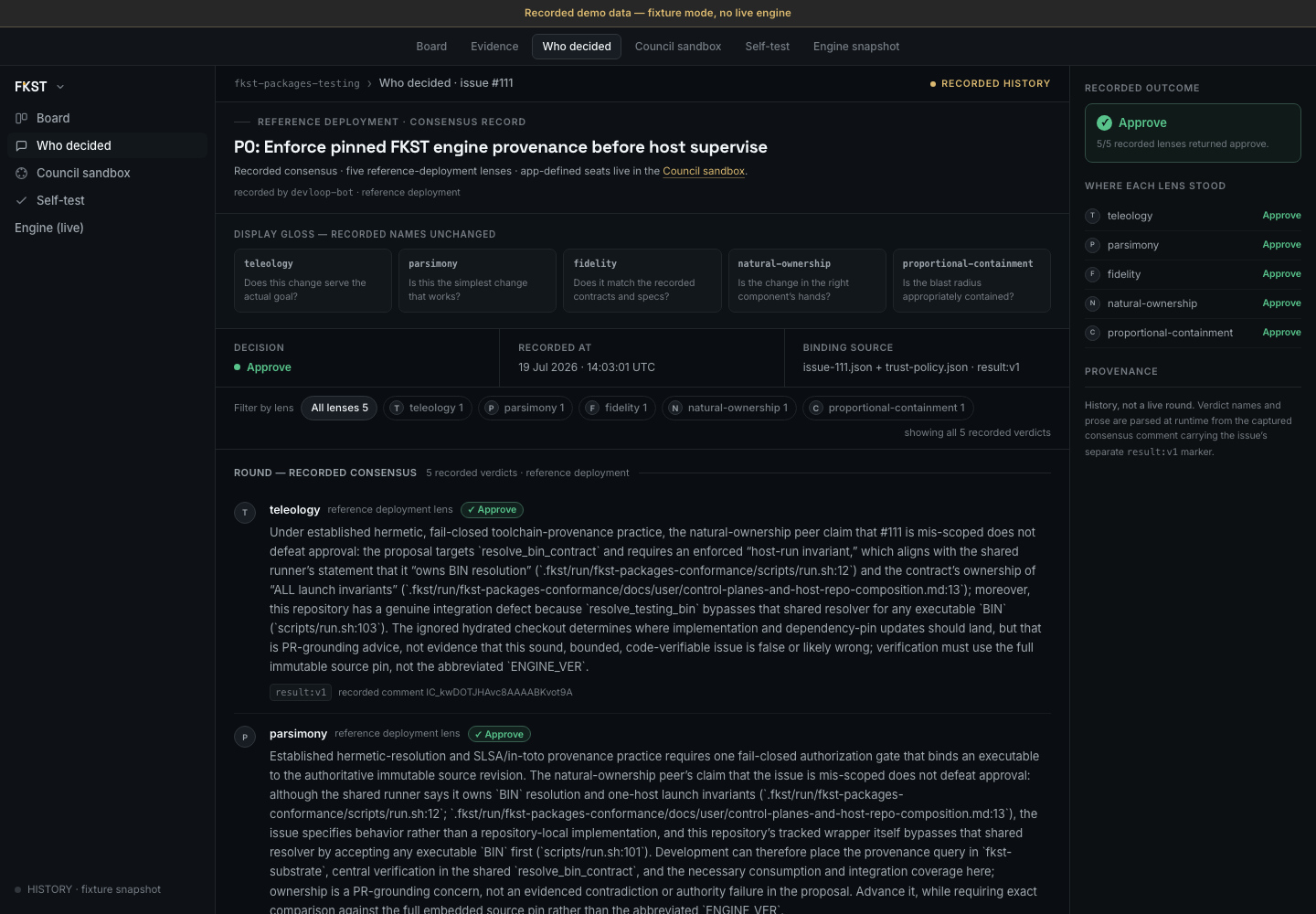
state:v1markers, a separateresult:v1decision, a merge label rendered as a hint. Markers = fact, labels = hints, unknown ≠ zero. - Who decided — the recorded five-seat consensus with each seat's real argument prose.
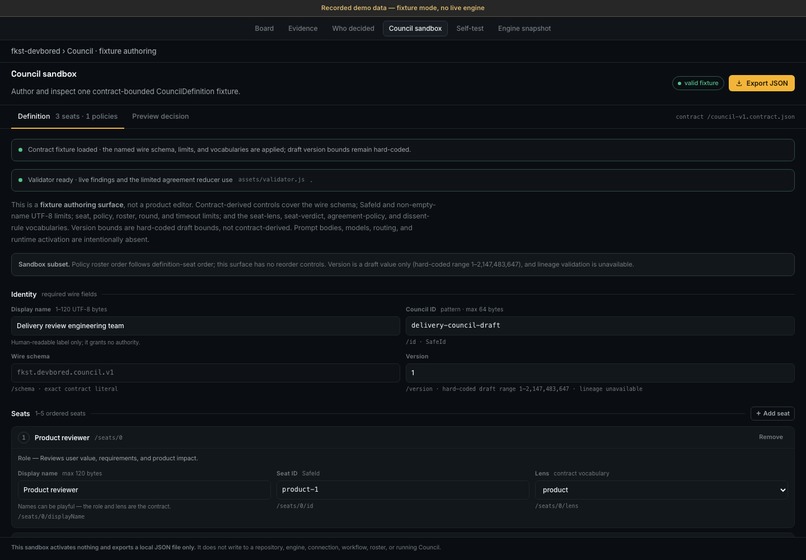
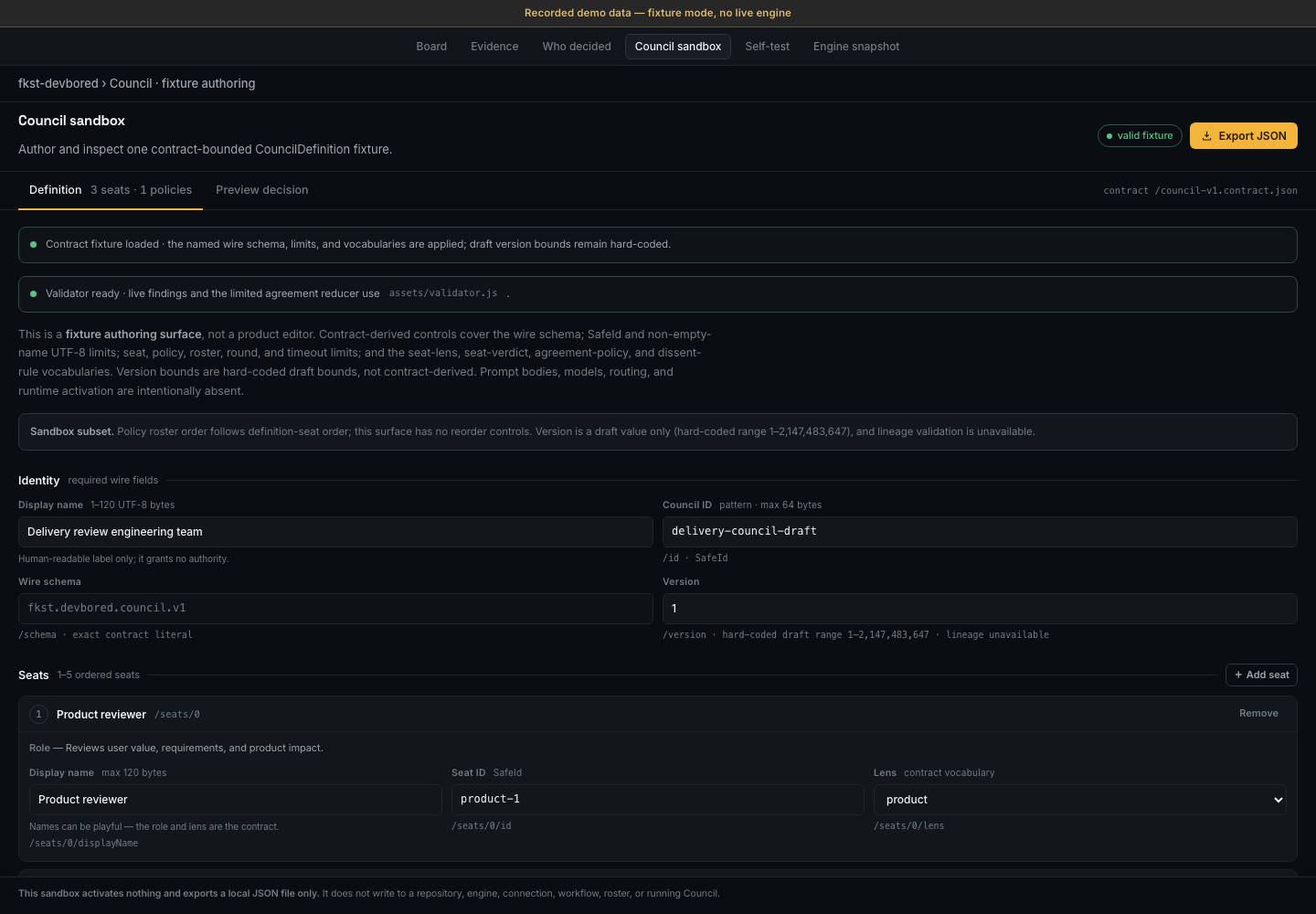
- Council sandbox — author a review team against the real council contract: every dropdown and bound comes from the contract file, invalid definitions can't export, decisions preview under the real agreement reducer.
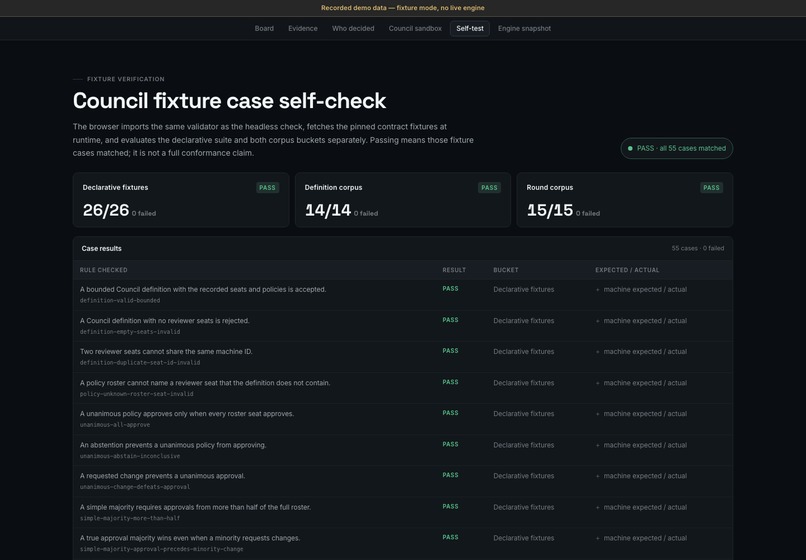
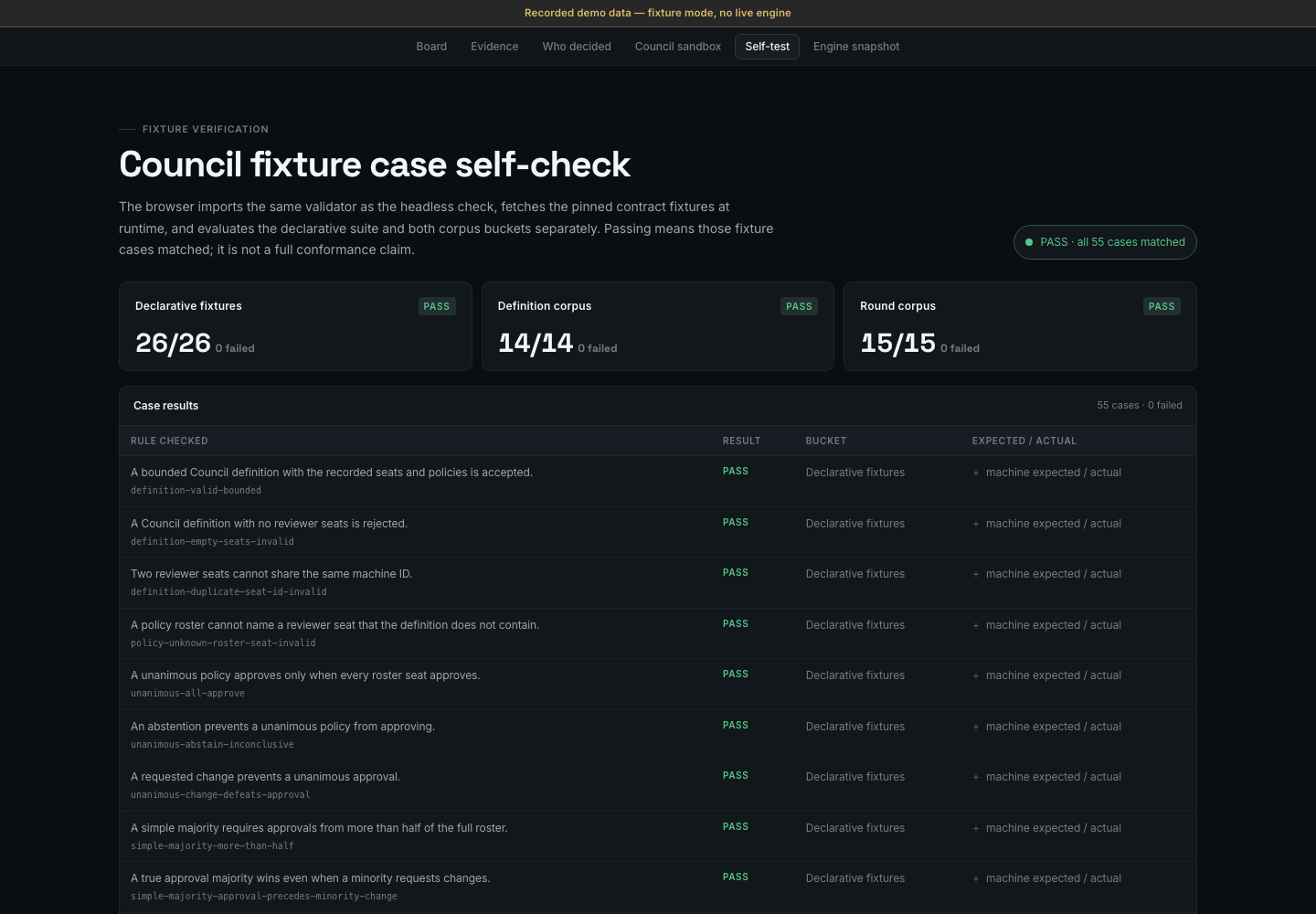
- Contract self-check — 55 human-readable cases run in the browser and
headless (
node demo/tools/selfcheck.mjs). - Engine snapshot — a loopback, read-only view of the substrate delivery ledger that renders offline and unknown honestly instead of fake zeros.
Three design choices keep it approachable: lean editable architecture, GitHub as the durable layer (issues/comments/labels hold business state, auditable by any human), and a light HTML front end with no build step — clone, two commands, running in under a minute.
How we built it
With the kind of loop the product visualizes. Codex implemented
everything: 52 sessions on final-assembly day (25 headless codex exec
build/review streams), each with a written spec, exclusive file ownership,
and a hard test gate — recorded model gpt-5.6-sol. A PM froze interfaces
between streams so they could run in parallel; independent reviews verified
actual files with hostile probes (attacker-comment injection, forged states,
contract mutations) before anything was accepted; a human held the gates.
Codex also reviewed adversarially: it RETURNed our first scope dossier with 8
blocking fixes and found 5 latent semantic faults at round-close — all fixed
and re-verified. Even the repo's name came from a recorded 6-seat council
deliberation reduced with the repo's own validator (FKST-devbored won 5/6).
Challenges we ran into
Honesty is harder than features. The recurring bug class wasn't crashes — it was quiet overclaims: a board column promoting a label hint to a fact, a "live" badge on an offline database read, truncated arrays rendered as exact totals, a marker parser that accepted decisions as lifecycle states, a CAS comparator that disagreed with the engine's on version equivalence. Each was invisible on the happy-path fixture and wrong under other data. The fix was process: adversarial review lenses, hostile fixtures asserting exact failure codes, and a 51-case parity corpus derived from the engine's own tests.
Accomplishments we're proud of
- A demo where every claim on screen is auditable — and a build trail to
match: every stream's session ID is published in
docs/SUBMISSION.md. - A contract validator whose self-check reads like English ("A Council definition with no reviewer seats is rejected") — 55/55 green, in-browser and headless.
- A faithful browser port of the engine's transition-version comparator, proven against engine-written ordering keys.
- Cold-clone to running console in under a minute, no build step.
What we learned
Harness engineering is about making the loop work the way you want — splitting work into small durable issues beats big contexts, and durable evidence is what lets a human check an agent's judgment and reformulate the loop when they disagree. Multi-session builds with frozen seams parallelize beautifully — and leave seams a cold-eyes review must catch.
What's next
Live read-only GitHub business reads behind the local BFF (trust-gated,
truncation-honest), then launch-snapshot Workflow/Council configuration —
councils authored in the sandbox, applied only at loop launch with explicit
acceptance receipts. Remote writes stay behind explicit human authorization
at every step. fkst-substrate — the provider-independent engine under it
all — is public and forkable.
Built with
codex (gpt-5.6-sol) · fkst-substrate (Rust engine) · vanilla HTML/CSS/JS
(no build) · Node (loopback BFF + headless checks) · GitHub as the durable
state layer

Log in or sign up for Devpost to join the conversation.