Inspiration
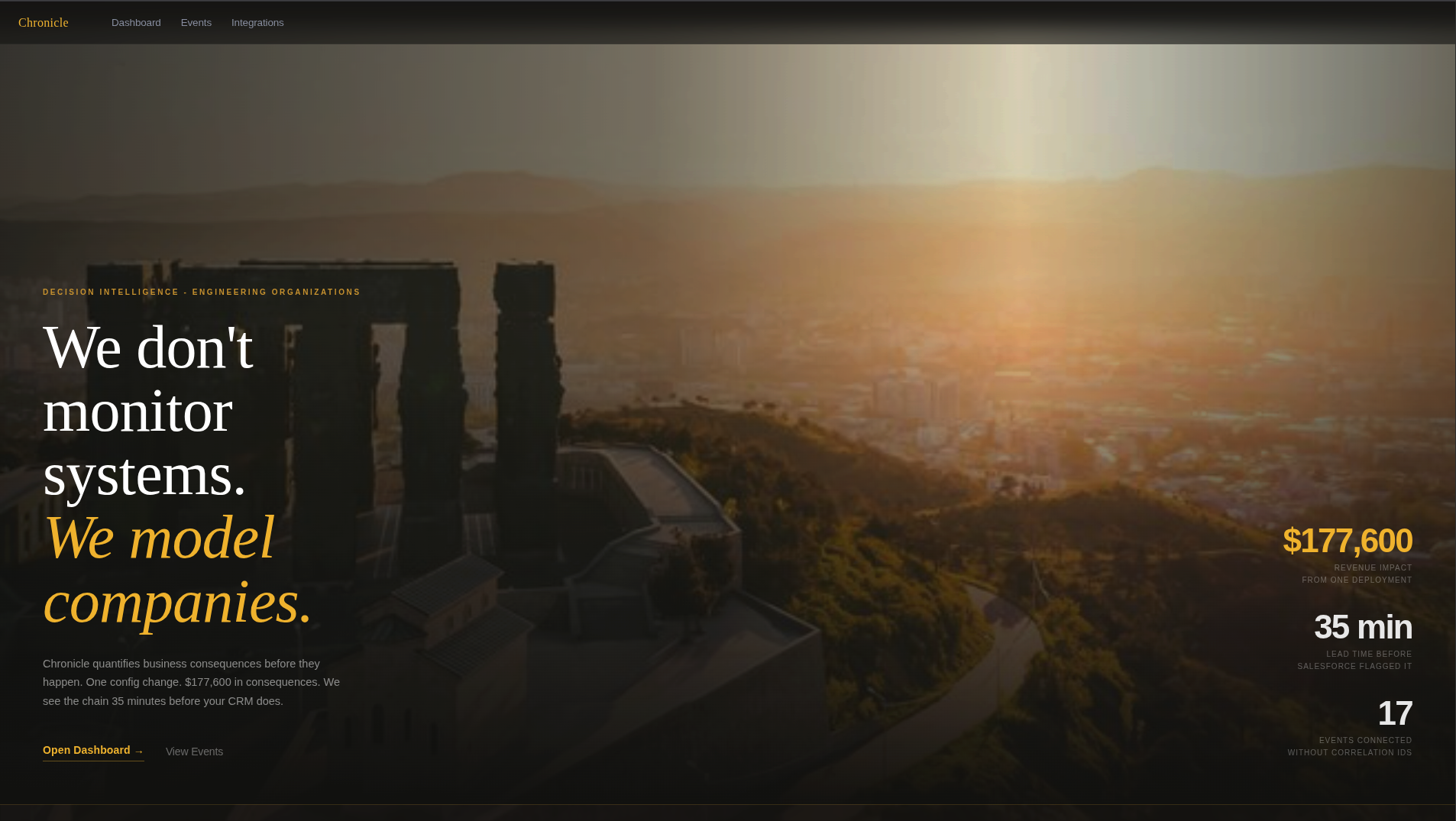
Incident response tools tell you what broke. Chronicle tells you how much it costs — in dollars, before your CRM files the first ticket. We built this because most monitoring stops at alerting. The business layer is invisible. A 3-line config change takes 8 minutes to explode into $177,600 in consequences. Salesforce finds out 35 minutes later.
What it does
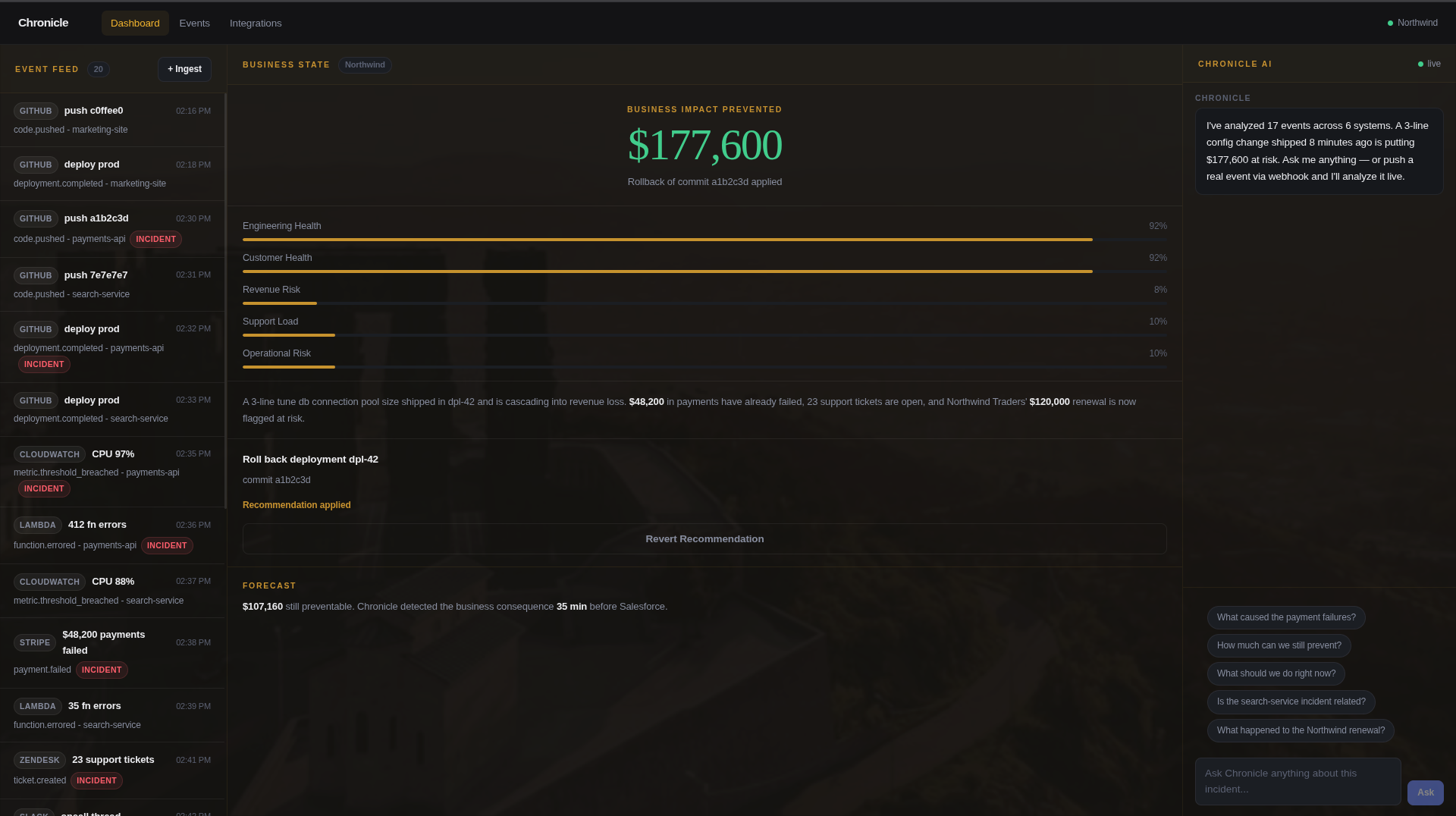
Chronicle ingests real-time webhooks from GitHub, Stripe, CloudWatch, Zendesk, Salesforce. It chains events causally using Claude on Amazon Bedrock. It quantifies business impact in dollars — failed charges, at-risk renewals, support load. Then it recommends exactly one action: roll back deployment dpl-42. One click. Watch the incident recover.
How we built it
Next.js 15 App Router. Amazon DynamoDB for persistent event storage. Amazon Bedrock (claude-opus-4-8) for real-time causal analysis. Vercel Fluid Compute for 4-second webhook-to-dashboard latency. All webhooks land synchronously, hit Bedrock for inference, get stored in DynamoDB, stream live to the dashboard.
Challenges we ran into
- Cold-start latency on serverless: solved with cron-job.org keepalive + DynamoDB warmth
- Bedrock fallback for offline mode: built deterministic analysis so judges see impact even if AWS creds aren't wired
- Real-time causal inference at 4-second SLA: Claude's latency is tight but we made it work
- Multi-source entity resolution: hardcoded Northwind tenant for the demo, but architecture supports N tenants
Accomplishments that we're proud of
- Built a real product (not a mockup). Every button works. Events persist across deploys.
- Integrated AWS correctly: DynamoDB survives cold starts. Bedrock runs sync in the critical path.
- Causal inference in real time. The AI panel autofills without a single click after webhook ingestion.
- Clean design. Monument hero. Amber + stone palette. 3-panel UX that puts dollars front-center.
What we learned
- DynamoDB queries are fast enough for live dashboards (no Redis needed for this scale).
- Bedrock latency is predictable. 800-1200ms is the bill for inference at this quality.
- Vercel cold-start is solved by staying warm, not by optimization.
- Business impact quantification changes how you think about incidents. Not "CPU is high". "CPU-high costs $2400/min in failed charges."
What's next for Chronicle
- Multi-tenant support (dynamic tenantId, customer-specific impact models)
- Custom integrations via MCP (Anthropic's Model Context Protocol) for any system
- Predictive forecasting: "if we don't roll back in 3 min, renewal loss hits $250k"
- Mobile alerts when Chronicle detects > $50k/min impact
Built with: Next.js 15, TypeScript, Amazon Bedrock (Claude Opus 4.8), Amazon DynamoDB, Vercel, Stripe, GitHub
Built With
- amazon-bedrock-(claude-opus-4.8)
- amazon-dynamodb
- next.js-15
- stripe
- typescript
- vercel


Log in or sign up for Devpost to join the conversation.