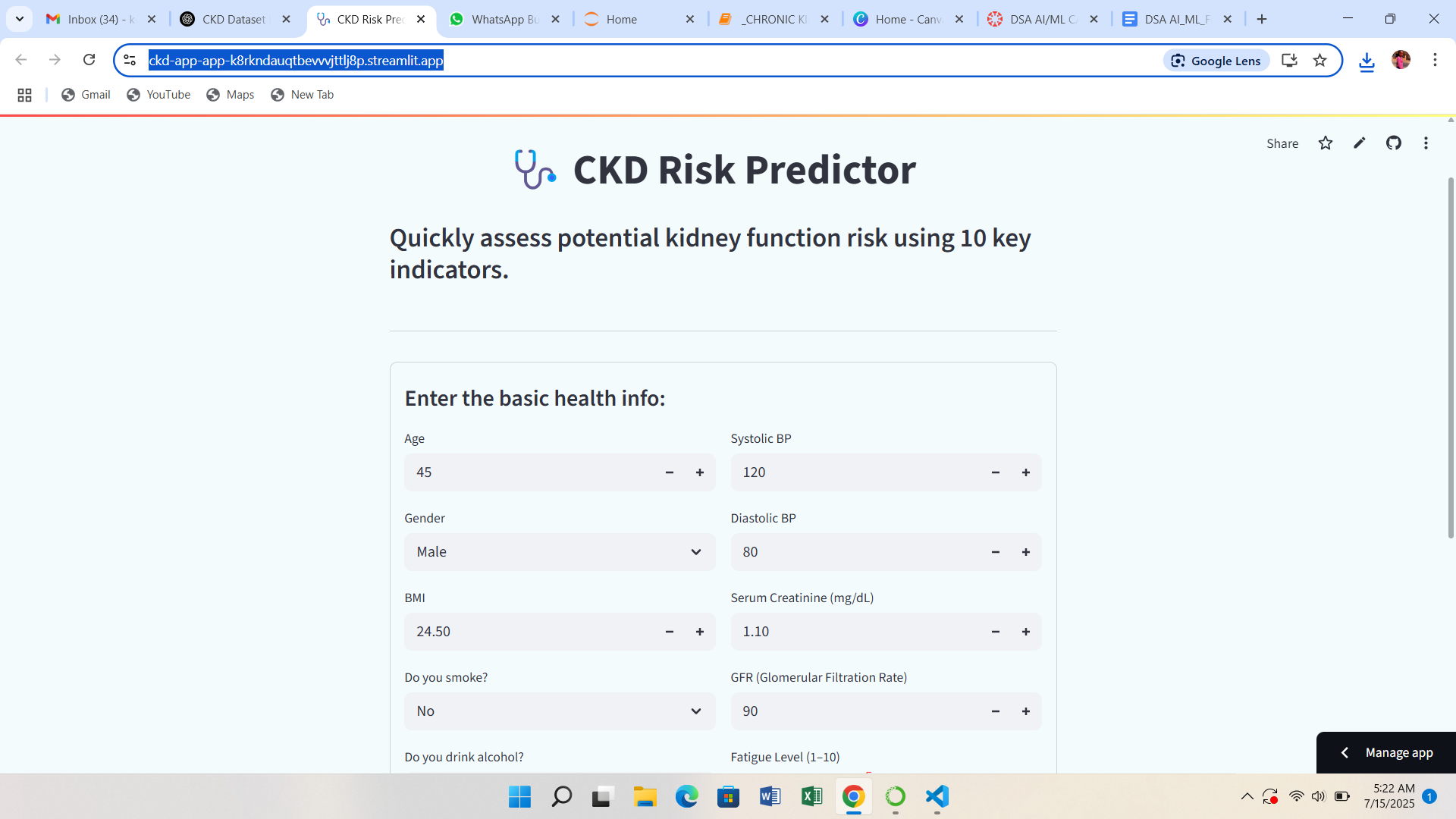
What It Does The Chronic Kidney Prediction App uses machine learning to assess a user’s risk of Chronic Kidney Disease (CKD) based on simple clinical data such as age, blood pressure, creatinine level, GFR, and lifestyle indicators. The app provides an instant prediction and downloadable report to support early medical consultation and intervention.
How We Built It Dataset: Used the UCI CKD dataset with 400 medical records.
Preprocessing: Cleaned data, handled missing values, and encoded categorical inputs.
Model: Tuned a Random Forest Classifier to achieve 89% accuracy.
Deployment: Built the web interface using Streamlit and hosted it online.
Tools: Python, Pandas, Scikit-learn, Streamlit, Joblib, GitHub.
Challenges We Ran Into Inconsistent and missing values in the dataset
Balancing accuracy with interpretability
Mobile responsiveness and design on Streamlit
Styling and color contrast for readability
Accomplishments That We're Proud Of Successfully deployed a working machine learning model online
Achieved strong accuracy (89%) with real-world data
Built a user-friendly app for non-technical users
Applied ethical and sustainable software engineering principles
What We Learned Practical application of machine learning in healthcare
How to structure real-world datasets for model building
Building and deploying a complete ML app from end to end
The value of simplicity and user experience in technical projects
What's Next for the Chronic Kidney Prediction App Expand the dataset with local clinical records for improved accuracy
Add multi-language support to reach a wider audience
Integrate a chatbot for guidance and education
Collaborate with healthcare professionals for clinical validation


Log in or sign up for Devpost to join the conversation.