-
-
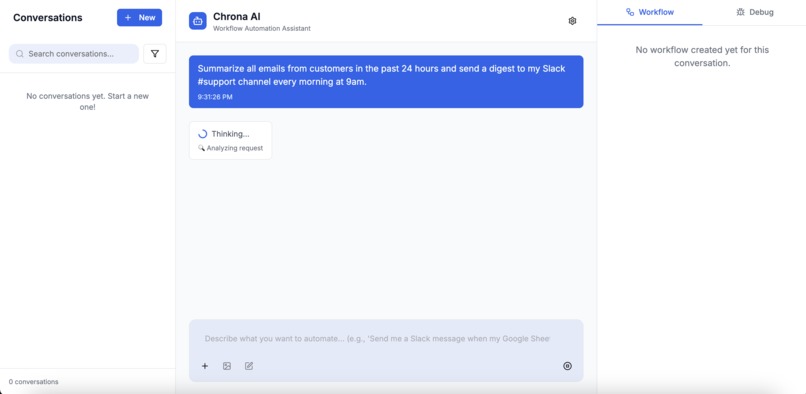
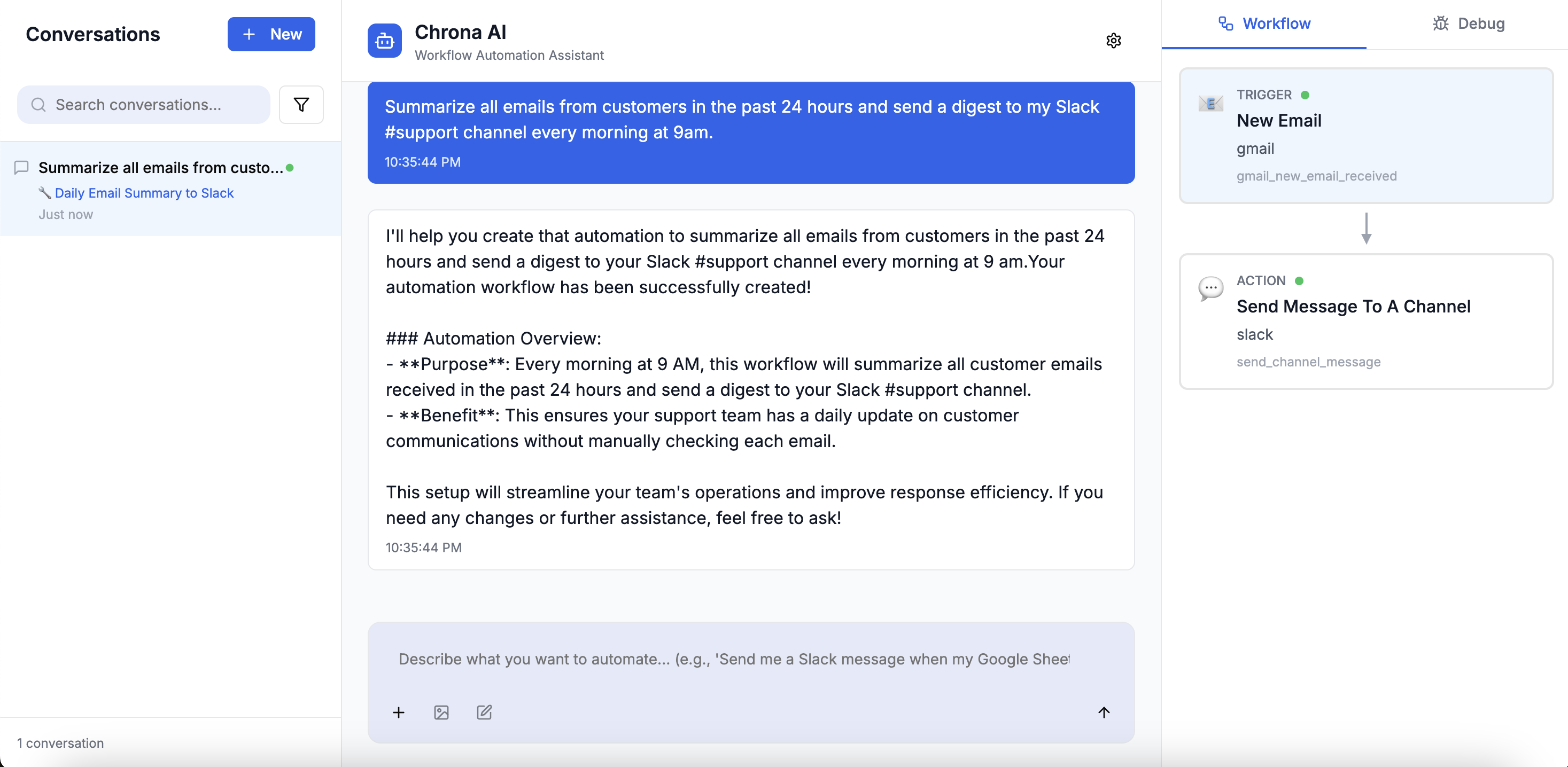
Thinking about a task
-
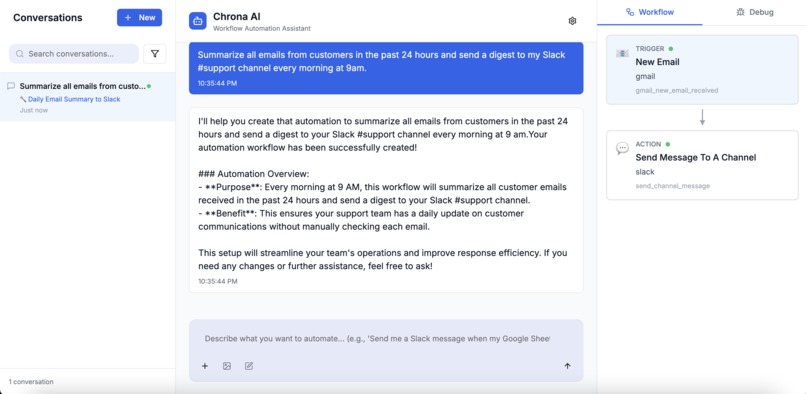
After building a workflow
-
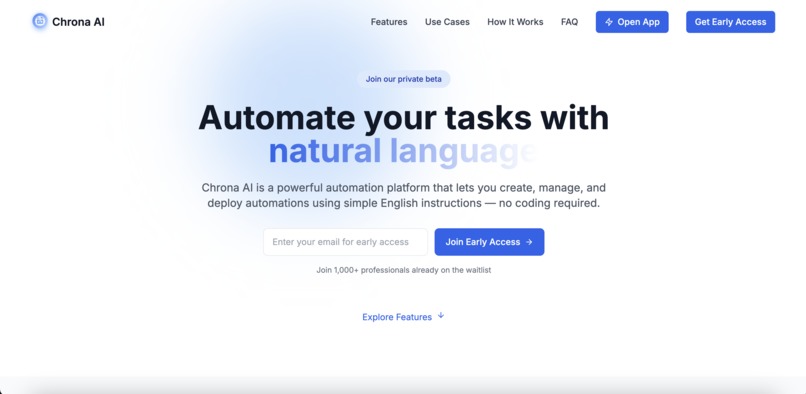
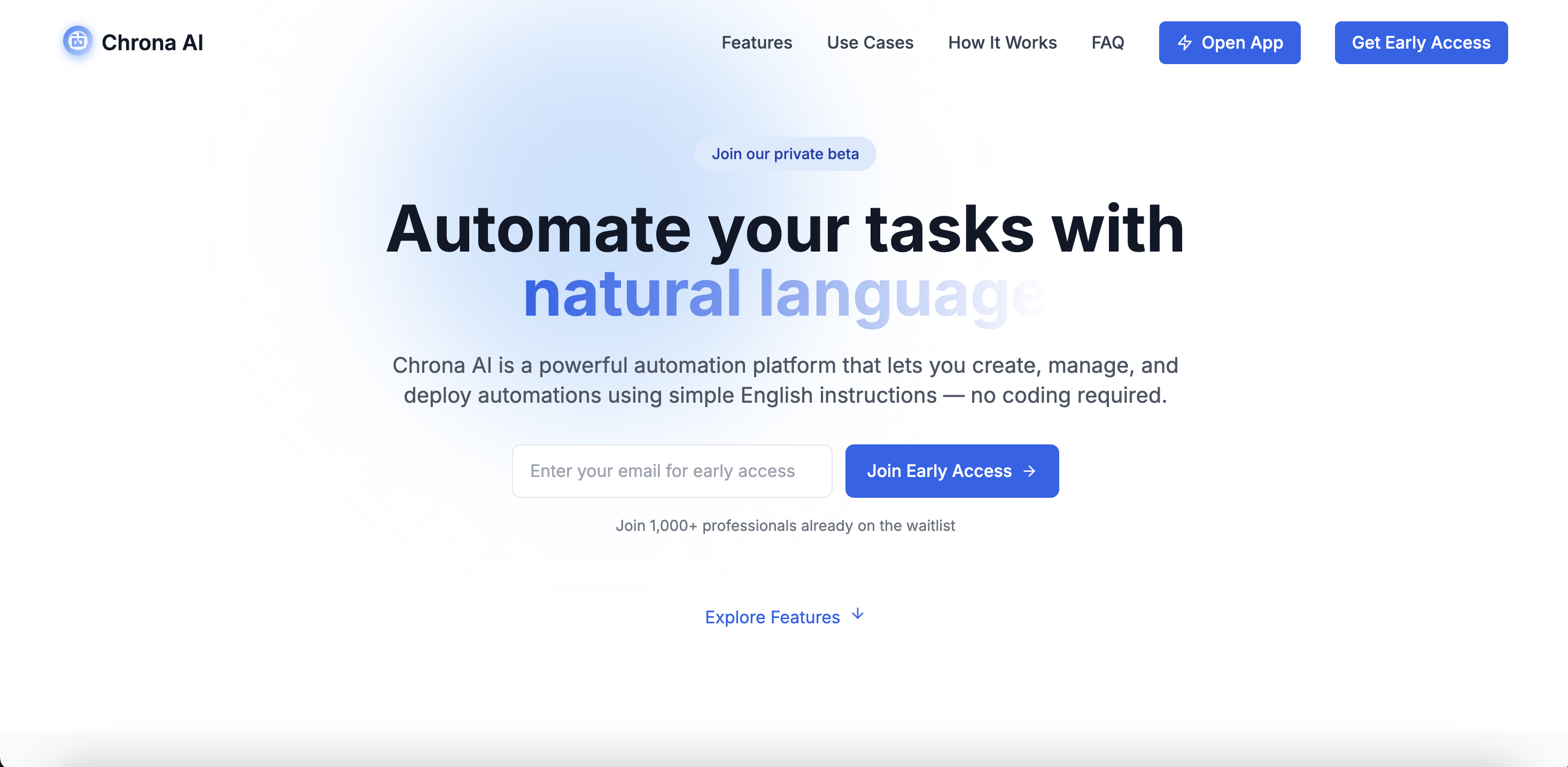
Landing page
-

Logo
Inspiration
Picture this: It's 2 AM, and Sarah, a marketing manager at a growing startup, is manually copying data from Google Sheets to Slack notifications for the third time this week. She's exhausted, but her team needs these updates first thing in the morning.
"There has to be a better way," she mutters, opening yet another automation tool. Forty-five minutes later, she's drowning in dropdown menus, webhook configurations, and error messages she doesn't understand. She gives up and sets her alarm for 6 AM to do it manually again.
We realized the problem wasn't the technology – it was the interface. People don't think in terms of "triggers" and "actions" and "API endpoints." They think in terms of outcomes: "I want this to happen when that happens." What if you could just talk to your automation platform like you would talk to a really smart colleague?
What it does
Chrona AI is an intelligent workflow automation platform that understands natural language and builds real automations through conversation. Instead of navigating complex interfaces, users simply describe what they want to automate.
Here's the magic in action:
You: "I want to get notified in Slack whenever someone fills out our contact form"
Chrona: "I'll create a workflow that monitors your contact form submissions and posts to Slack. Let me set this up for you..."
[You watch as a visual workflow appears on screen, showing the connection being built in real-time]
Chrona: "Done! I've created a workflow that watches your contact form and posts new submissions to your #leads channel. Would you like me to customize the message format?"
You: "Can you make it only notify for leads from companies with more than 100 employees?"
Chrona: "Absolutely! I'm adding a filter to check company size. This will now only trigger for enterprise leads."
That's it. No tutorials, no documentation, no configuration screens. Just a conversation that results in a working automation that connects to real services like Google Sheets, Slack, email systems, and 400+ other platforms.
How we built it
We built Chrona AI as a conversation between humans and specialized AI agents, each with their own expertise:
- Discovery Agent: Explores what services and automations are possible
- Creation Agent: Builds workflows from scratch based on descriptions
- Modification Agent: Updates and refines existing workflows
- Debug Agent: Troubleshoots and fixes issues
- Query Agent: Provides insights and analytics
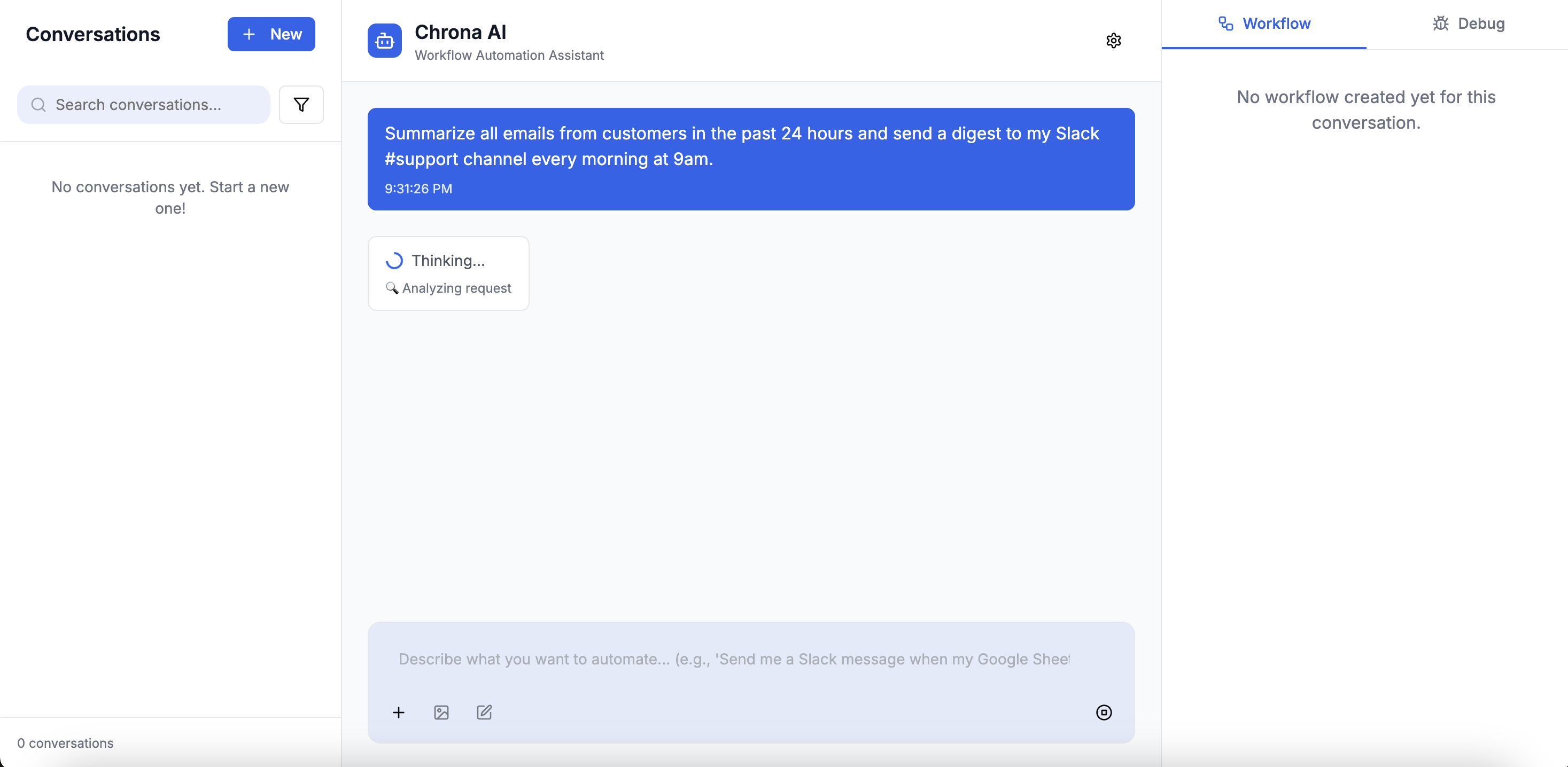
The platform features a clean, conversational interface where users see their workflows being built in real-time.
We focused on making the experience feel like chatting with a knowledgeable colleague who happens to be really good at automation, rather than learning yet another software tool.
Challenges we ran into
The Conversation Challenge: Teaching AI to understand messy, human requests like "Set up something for when customers complain on Twitter" or "I need our sales team to know about hot leads immediately" required building sophisticated intent recognition and context management.
Speed of Agents' Tech Evolving: The OpenAI Agents SDK, which was what we built on, constantly evolved and changed as we were building, which made things a little trickier as we needed to adjust and do workarounds.
The Trust Problem: People are naturally skeptical of AI building automations that affect their real business processes. We had to create visual confirmation, step-by-step explanations, and easy editing capabilities so users could see and understand exactly what was being built.
Real-time Complexity: Users wanted to watch their workflows being built live, but streaming AI responses while coordinating multiple specialized agents and showing visual updates is incredibly complex. We had to solve real-time communication challenges that most chat applications never face.
Accomplishments that we're proud of
We made automation accessible to everyone. Sarah, our marketing manager, went from avoiding automation tools to becoming her team's "automation expert" simply by having conversations with Chrona AI. Third-Party automation companies (who simply use external tools such as Zapier/n8n to build workflows) have less leverage on non-technical SMEs and startups now simply because the learning curve for automation has been cut to almost zero; anyone can vibe-build a simple workflow in less than 5 minutes without learning how to drag nodes across a canvas and figuring out the millions of tools available.
We solved the real-time AI experience. Users can watch their workflows being built live, see which AI agent is working on their request, and get visual confirmation of every step. It feels magical.
We built trust through transparency. Instead of black-box automation, users see exactly what's being created and can refine it through natural conversation.
We proved conversation is the future interface. By eliminating traditional UI complexity, we showed that the best technology is the kind you don't have to think about.
What we learned
The power of specialized AI agents: Instead of building one super-agent with multiple tools, we discovered that specialized agents working together create much better experiences. Each agent became an expert in their domain while collaborating.
Visual feedback is crucial: Even in a conversational interface, people need to see what's happening. The real-time workflow visualization became one of our most important features.
Simplicity requires incredible complexity: Behind every "simple" conversation are sophisticated systems for understanding intent, managing context, coordinating agents, and creating real-world integrations.
People want to collaborate with AI, not be replaced by it: The most successful interactions felt like working with a really smart colleague who happened to be great at automation.
What's next for Chrona AI
Expanding the conversation: We're adding voice interaction so users can literally talk to their automation platform while walking to meetings or driving, checking in on whether runs executed or not.
Building of our own Agent-native Workflow Builder: In the MVP, we are using Activepieces as the workflow builder engine, but the way it is built is not optimised for agentic interfaces - we plan to build our own from scratch and made to work in a secure way with MCPs.
Learning from patterns: Chrona AI will start recognizing common automation patterns in organizations and proactively suggest optimizations.
Collaborative automation: Teams will be able to build and refine automations together through group conversations, making automation a collaborative process - similar to group vibe coding on Bolt.
Industry specialization: We're developing specialized knowledge for different industries - healthcare automations, e-commerce workflows, education processes - so Chrona AI becomes an expert in your specific domain.
Because the future isn't about better interfaces – it's about no interfaces at all. We're building a world where technology adapts to humans instead of the other way around, where powerful capabilities are just a conversation away.
Built With
- activepieces
- docker-compose
- eslint
- express.js
- framer-motion
- jest
- jwt
- node.js
- openai-agents-sdk
- prettier
- radix-ui
- react
- redis
- socket.io
- supabase-(postgresql)
- tailwind-css
- tanstack-react-query
- typescript
- vite

Log in or sign up for Devpost to join the conversation.