-
-
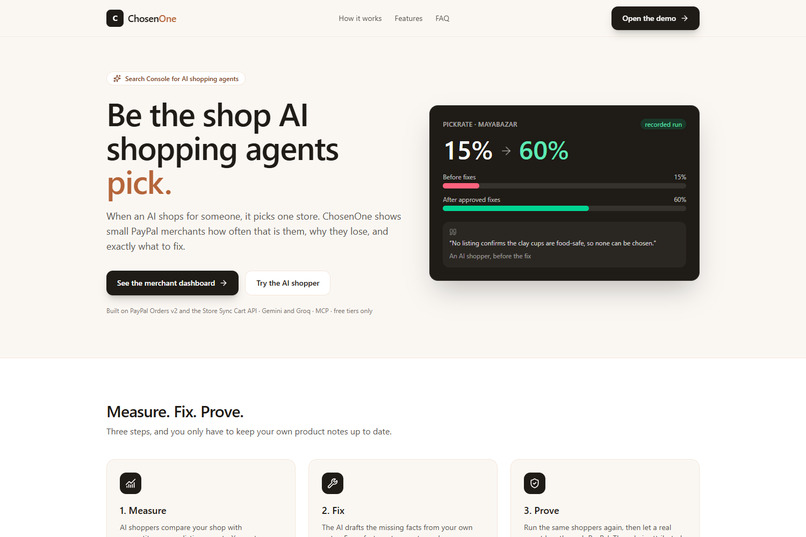
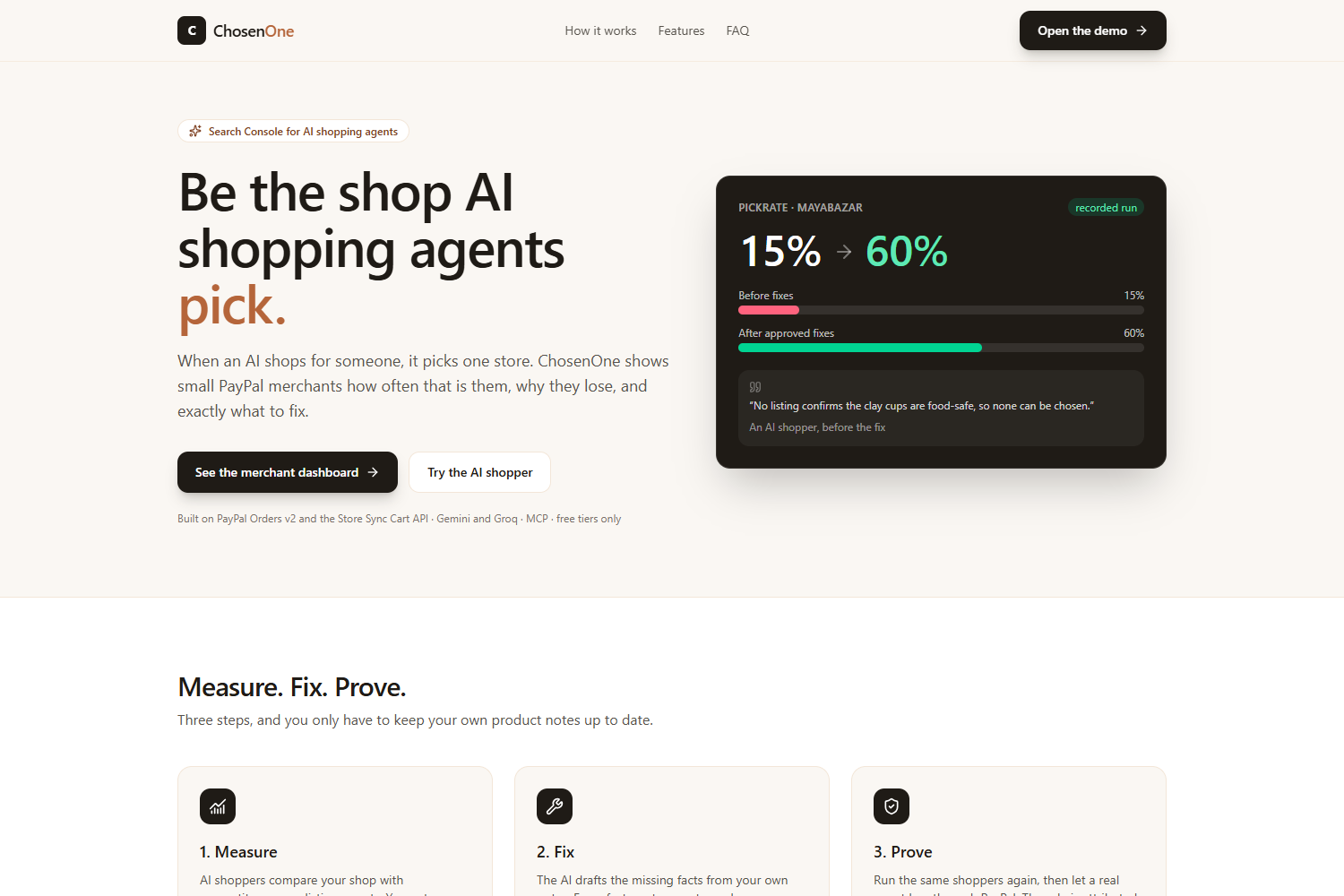
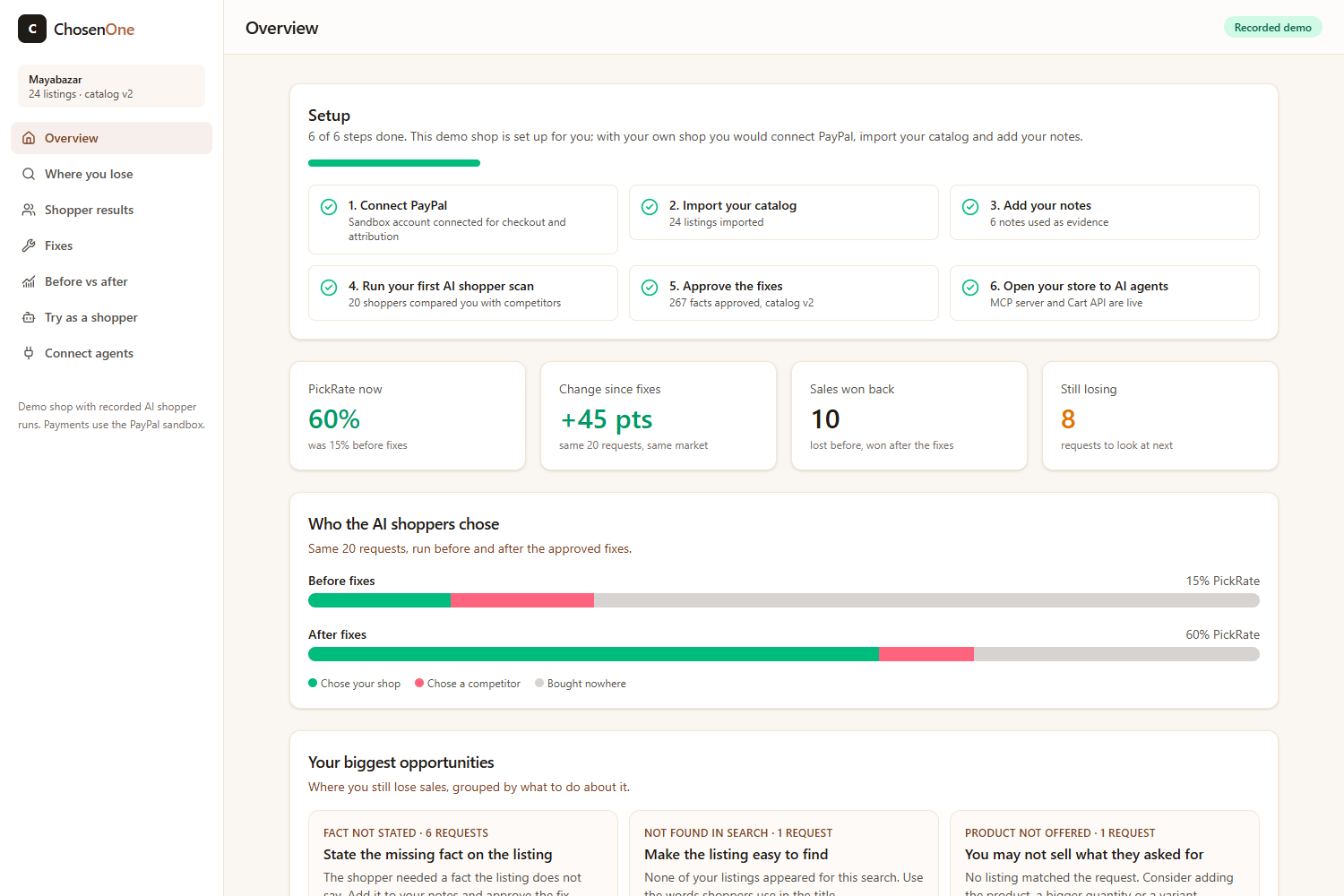
Landing page: ChosenOne shows small PayPal shops how often AI shopping agents pick them. Demo shop PickRate: 15% to 60%.
-
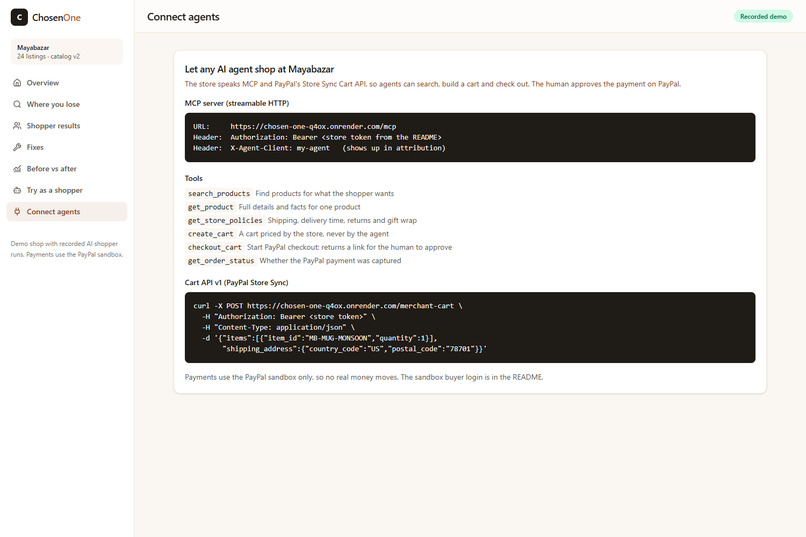
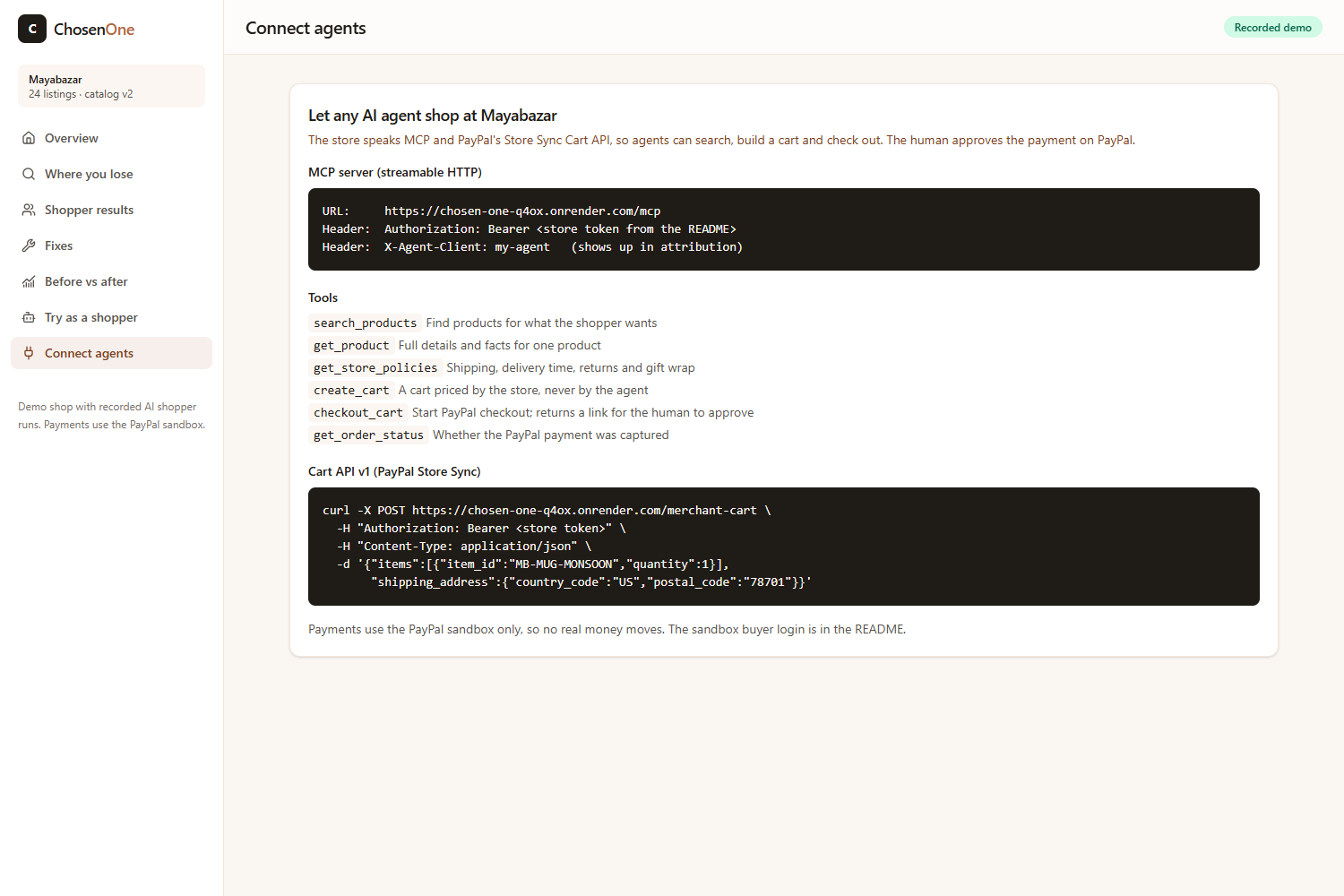
Connect agents: any AI agent can shop through the MCP server or Store Sync Cart API, then pay with PayPal Orders v2.
-
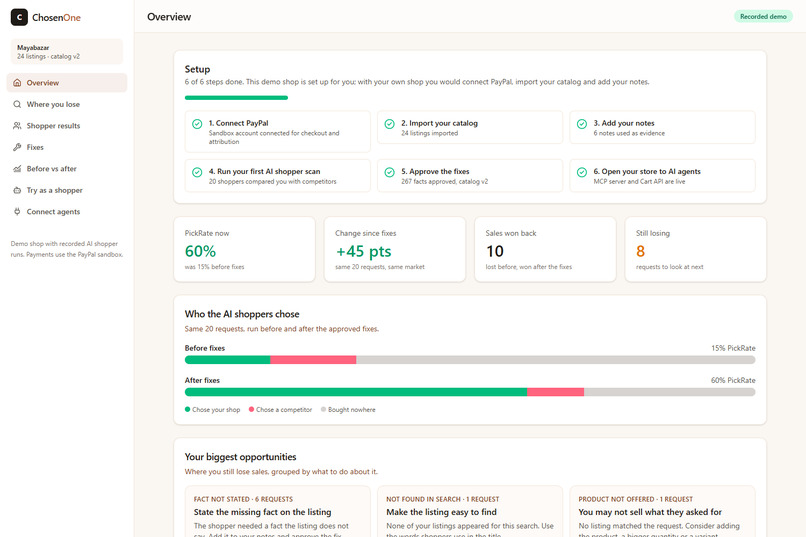
Overview: setup checklist, PickRate 15% to 60%, ten sales won back, and the biggest opportunities grouped by what to fix.
-
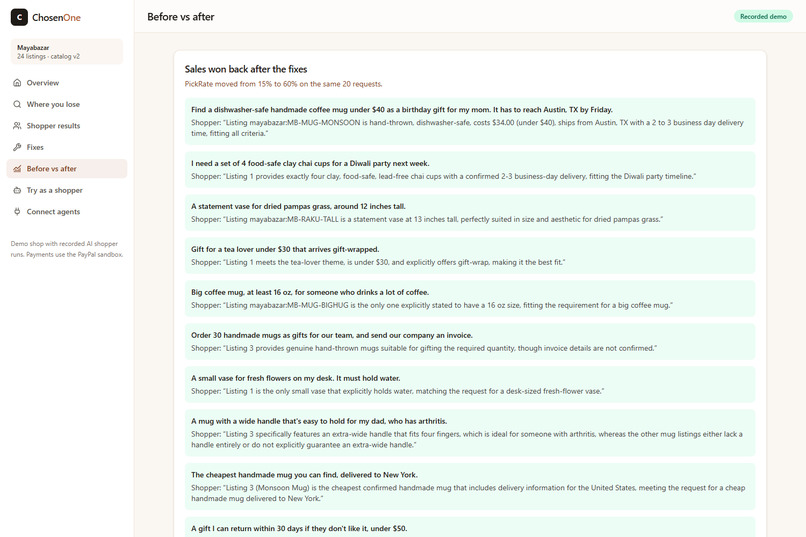
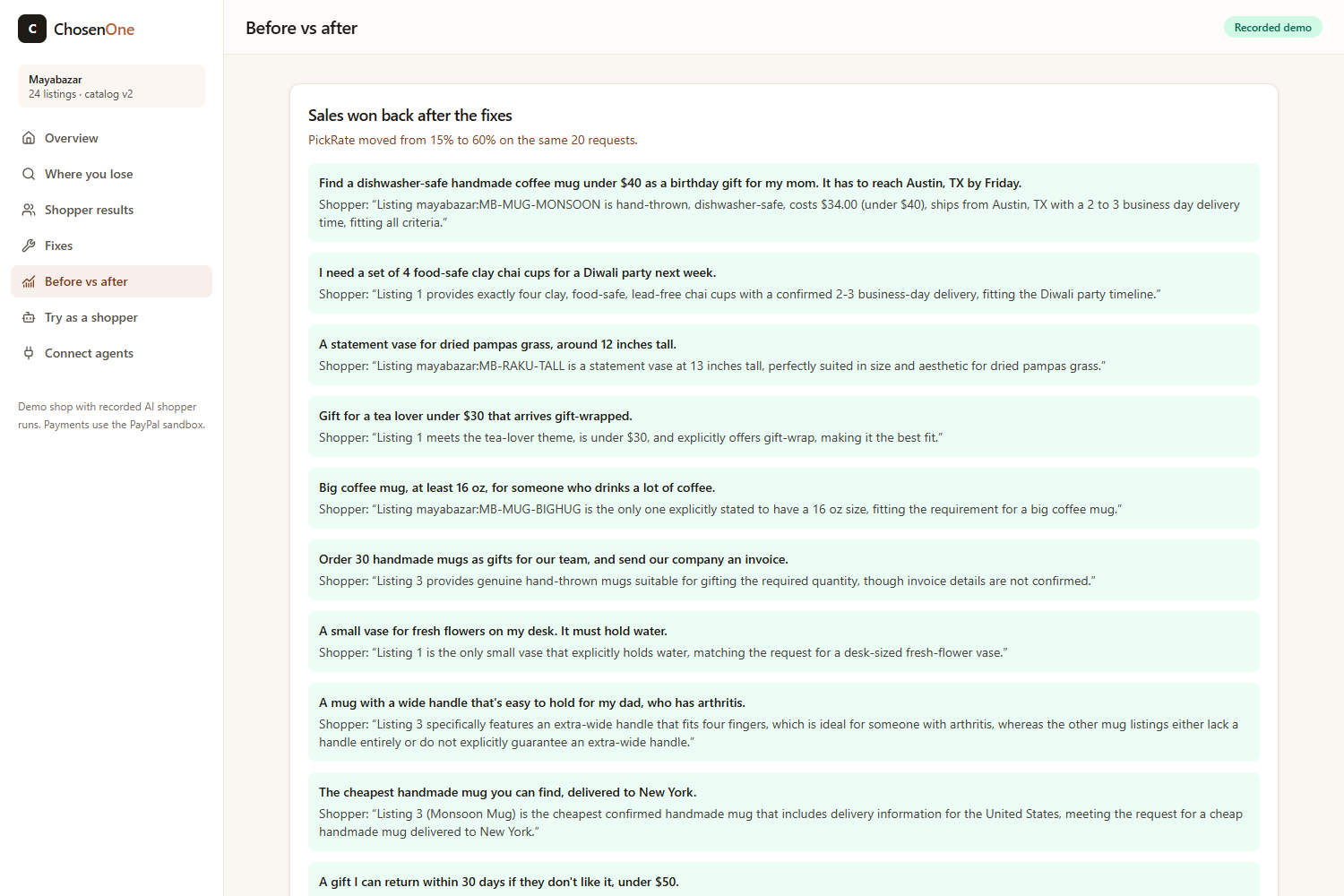
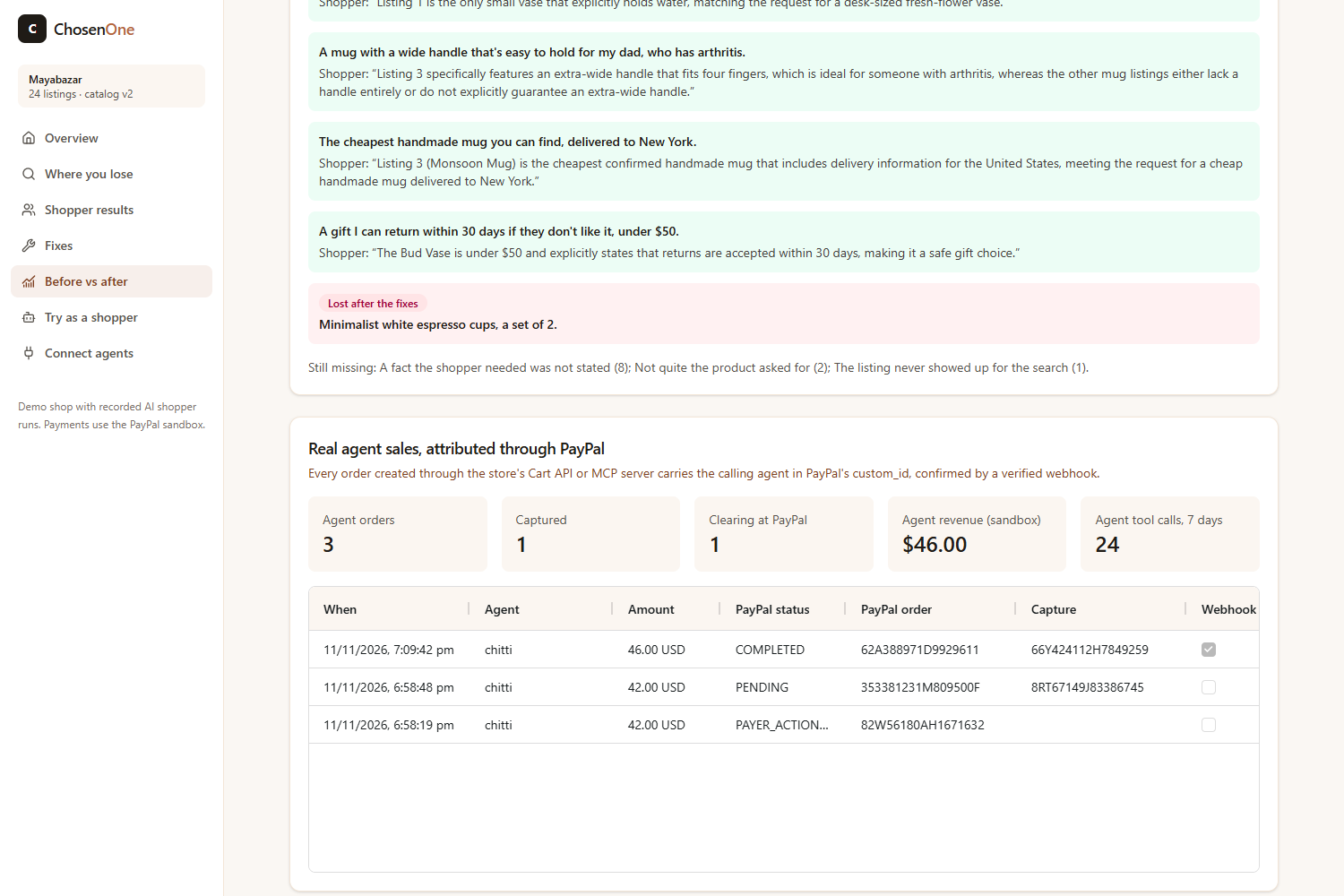
Before vs after: the same 20 AI shoppers, run again. PickRate rises from 15% to 60%; ten sales won back, one lost.
-
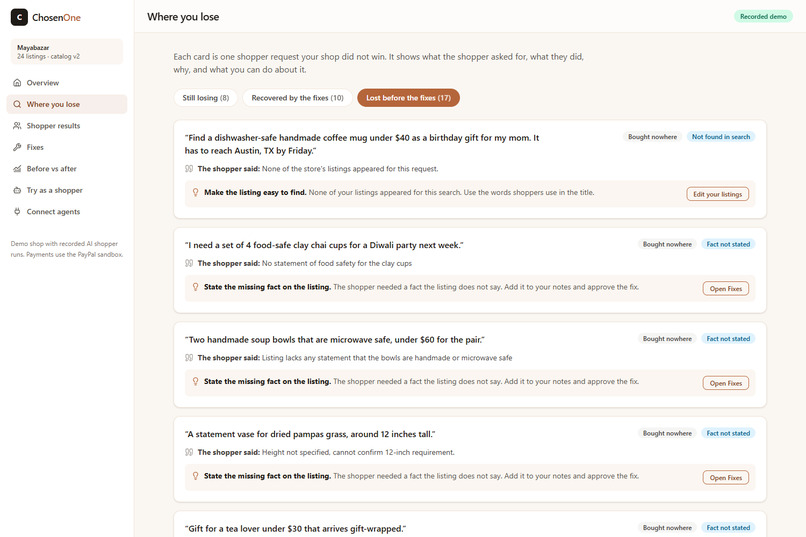
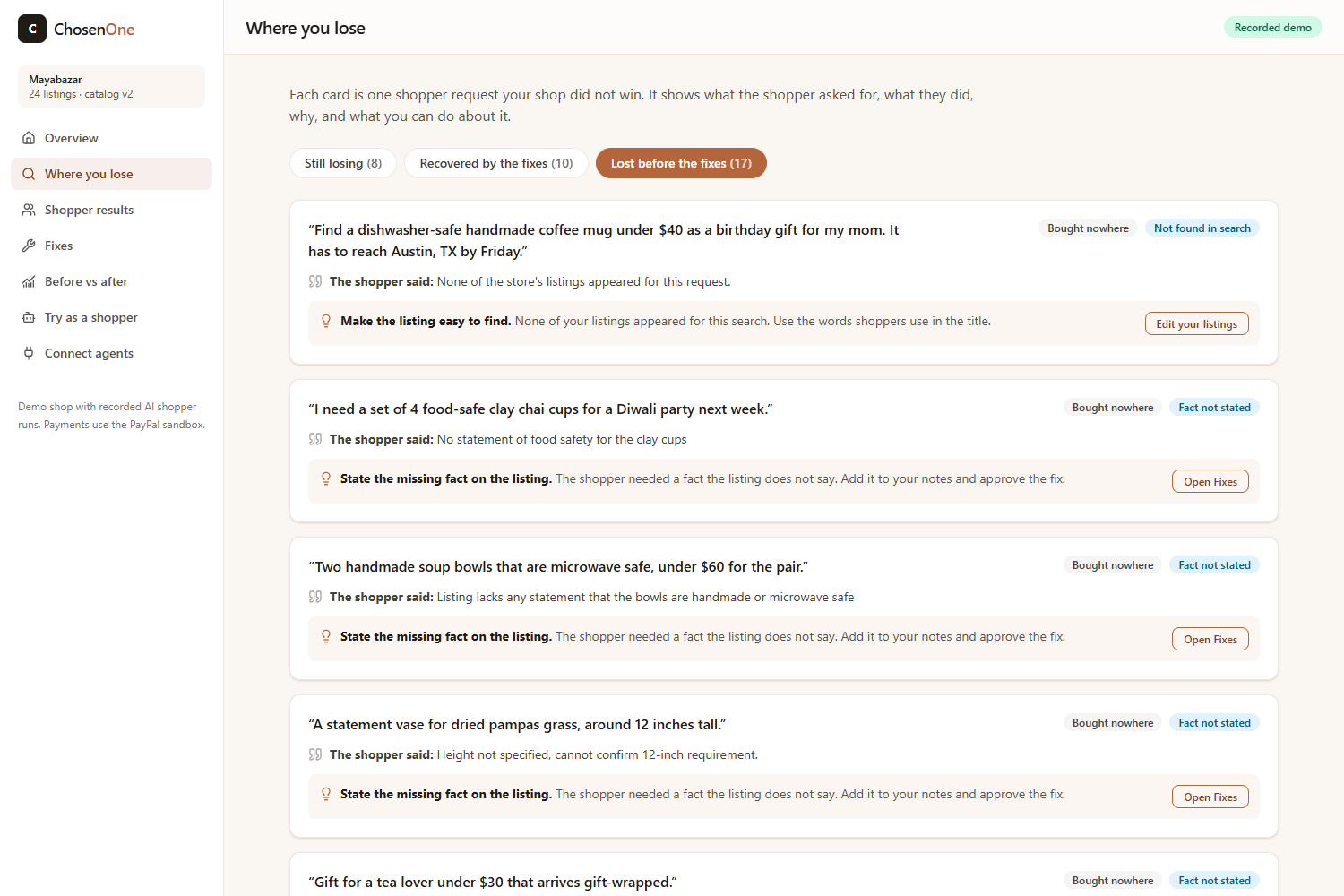
Where you lose: each lost sale shows the shopper's request, their reason in their own words, and a suggested action.
-
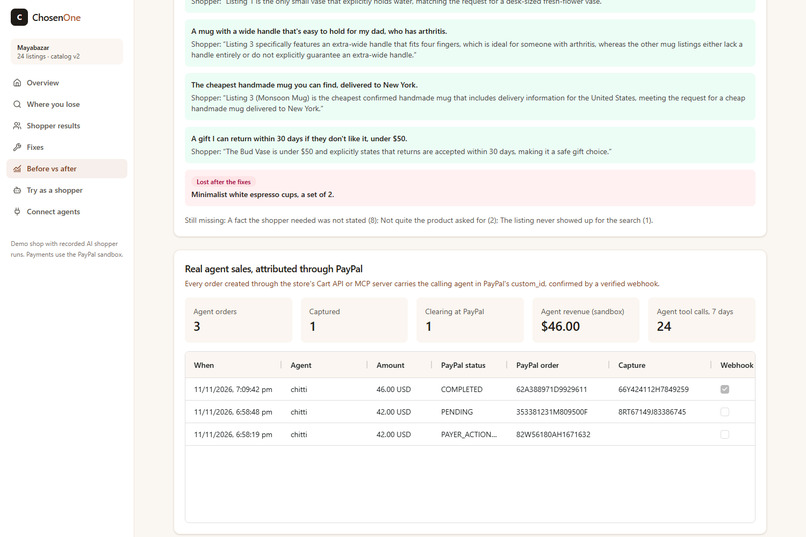
Real agent sales via PayPal: agent name, order and capture IDs, and a verified webhook confirmation (sandbox).
-
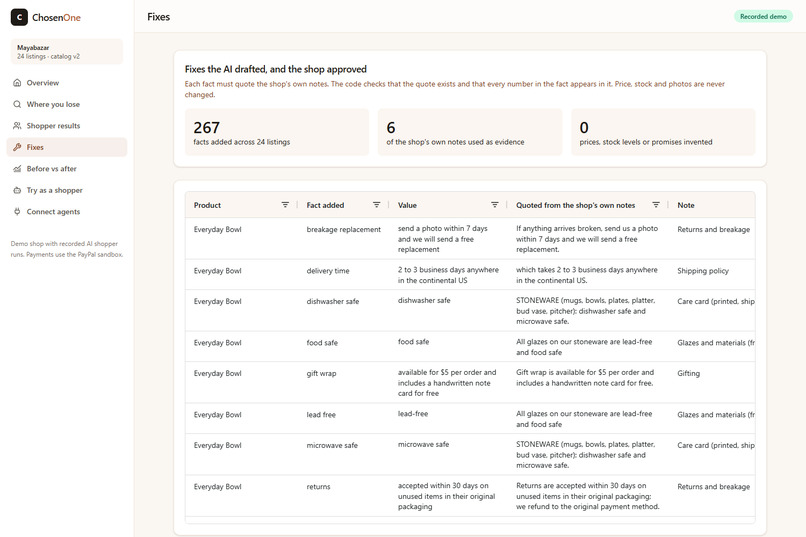
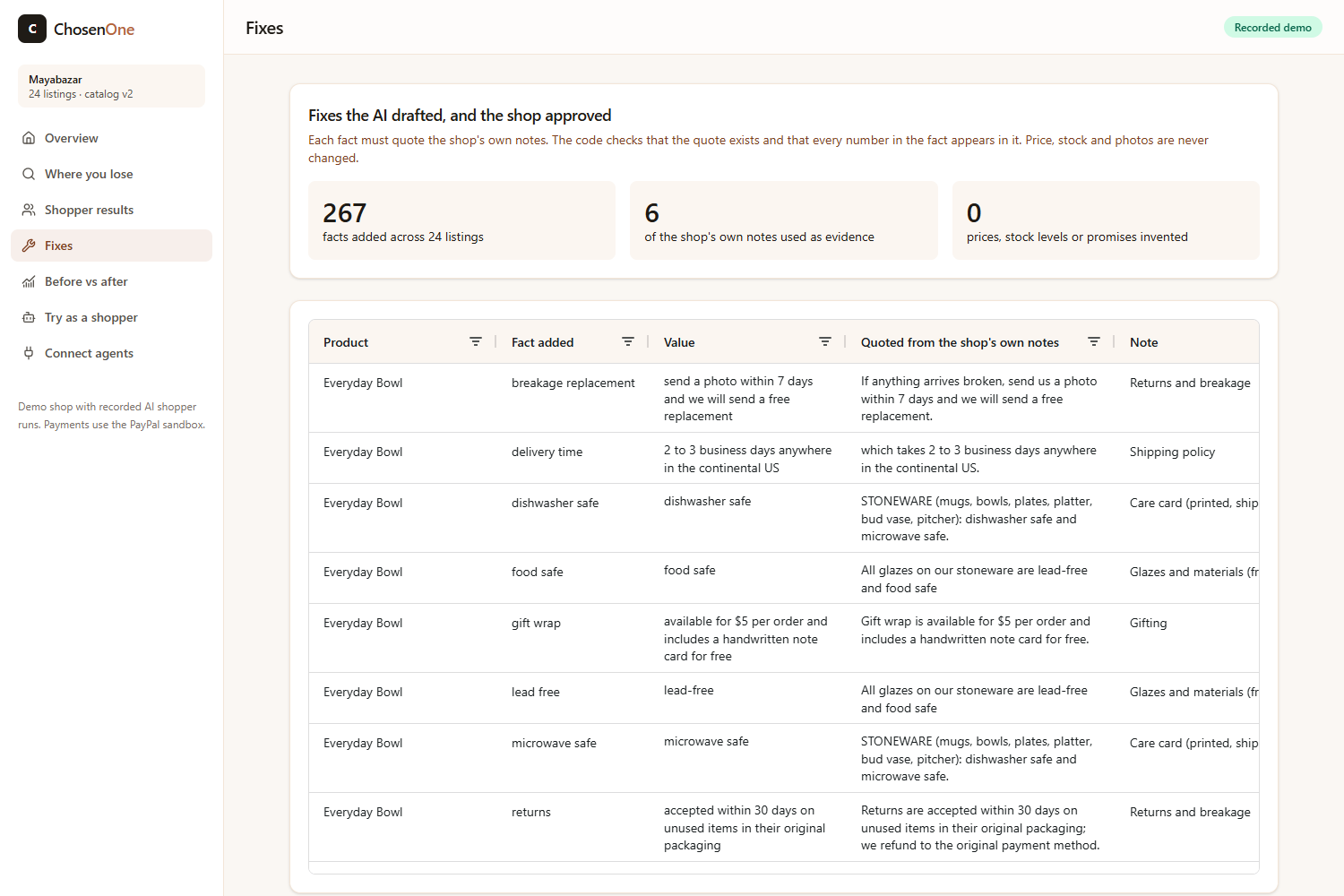
Fixes: 267 AI-drafted facts, each quoting the merchant's own notes. Code checks every quote and number before approval.
Inspiration
AI assistants are starting to shop for people, and they usually pick one store. A small merchant has no way to see whether those agents recommend them, why they lose, or whether a sale came from an AI at all. Big retailers can build teams for this. A small PayPal merchant can't.
We wanted a Search Console for AI shopping agents: a tool that tells a small shop how often AI picks it, why it loses, and exactly what to fix.
What it does
ChosenOne shows a small PayPal merchant their PickRate: how often AI shopping agents choose their store. Then it closes the loop in three steps.
- Measure. A panel of AI shoppers works through 20 realistic requests, comparing the demo shop (Mayabazar, a fictional clay studio) with anonymised competitor listings. It reports PickRate, who won the sales it lost, and the shopper's reason for every lost sale.
- Fix. An LLM drafts the missing facts (care, size, delivery time, returns) from the merchant's own notes. Every fact must quote a note, and the code checks that the quote exists and that every number in the fact appears in it. Prices and stock are never touched. The merchant approves, and a new catalog version is published.
- Prove. The store speaks MCP and PayPal's Store Sync Cart API, so a real agent can search, build a cart and check out. Checkout runs on PayPal Orders v2. The sale is captured, attributed to the agent in the payment's
custom_id, and confirmed by a verified webhook.
On the demo shop, PickRate went from 15% to 60% across the same 20 requests after the approved fixes. The Where you lose page lists every request still lost (8 of 20) with the shopper's own words and a suggested action, such as "state the missing fact", "say where you ship" or "you may not sell this product".
How we built it
- PayPal: Orders v2 through the Server SDK (idempotency keys, retries with backoff, decline and capture handling,
debug_idlogging); the Store Sync Cart API v1 contract via@paypal/agentic-commerce-spec, validated with its own schemas and with all prices computed server-side; webhooks verified with PayPal'sverify-webhook-signatureagainst the exact raw body. - AI: Gemini and Groq free tiers through the Vercel AI SDK, with a quota guard and provider fallback. Structured outputs drive shopper decisions and fix proposals. An MCP server lets any outside agent shop the store, and Chitti, an in-app buyer agent, shops through that same MCP endpoint with an MCP client and tool calling.
- Stack: Node 22 and TypeScript, Express 5, React 19, Tailwind 4, AG Grid Community, Postgres on Neon (PGlite locally and in tests) with Drizzle, Render free hosting, GitHub Actions CI. Everything is free tier or open source.
- Built with an AI coding agent that used the APIMatic Context Plugin for the PayPal Server SDK and PayPal's AI-Toolkit. The plugin surfaced SDK facts that shaped the design. For example, the SDK never retries
POST, so we retry safely ourselves under onePayPal-Request-Id.
Challenges we ran into
- The Server SDK retries nothing by default, so payment retries had to be designed around idempotency.
- PayPal's Cart API spec package can't be loaded by plain Node at runtime. We isolated it behind one adapter, added a lint rule, and made CI boot the production build.
- Free-tier model limits (Groq allows about 8,000 tokens a minute) forced one structured decision per shopper request, paced by a quota guard with fallback between providers.
- Making fixes trustworthy: a model can invent facts, so every fact must quote the merchant's notes and pass a code check.
- A sandbox payment funded from a bank account stays
PENDING(ECHECK). The app says "clearing" instead of "complete".
Accomplishments that we're proud of
- A loop that is real end to end: an AI agent searches, builds a cart and checks out; a human approves on PayPal; the payment is captured, attributed to the agent and confirmed by a verified webhook, all live on the hosted demo.
- Fixes that can't invent facts: each one carries a quote from the merchant's own notes, verified by code.
- Every number in the dashboard comes from a stored run, and the recorded runs ship with the repo.
- All of it runs on free tiers and open source.
What we learned
Agents reject listings that don't state what a shopper needs, even when the shop has those facts in its own notes. That gap is large, measurable and cheap to close. We also learned how much careful payment plumbing (idempotency, retries, webhook verification, honest status handling) matters when an agent, not a person, is the one checking out.
Honest limits
The shopper panel is simulated: 20 requests, one run each, free-tier models. The requests were written to match the demo shop's notes, so 15% → 60% shows the method working end to end, not how any real assistant ranks real stores. Competitor data is a one-time anonymised Channel3 snapshot. The demo is PayPal sandbox only.
What's next
Reconcile agent sales with PayPal Transaction Search, add a merchant copilot over PayPal's MCP server, connect a real merchant catalog, and move from a simulated panel to measuring real assistants as access allows.
Built With
- agentic-commerce
- aggrid
- ai-sdk
- apimatic
- channel3
- drizzle
- express.js
- gemini
- github-actions
- groq
- llm
- mcp
- neon
- node.js
- paypal
- paypal-sandbox
- postgresql
- react
- render
- tailwindcss
- typescript
- vite
- webhooks
- zod
