T-Mobile Customer Happiness Index
Inspiration
While working at T-Mobile as a retail associate, I often experienced firsthand how customer frustration could build up quietly before turning into complaints. These moments inspired me to think — what if store teams could detect dissatisfaction before it escalates?
To solve this, I envisioned a system that uses AI-driven emotion detection and natural language processing to analyze both facial expressions and spoken feedback in real-time. The goal: transform subtle cues into actionable insights so managers can proactively improve service, boost satisfaction, and create a smoother customer experience for everyone.
Overview
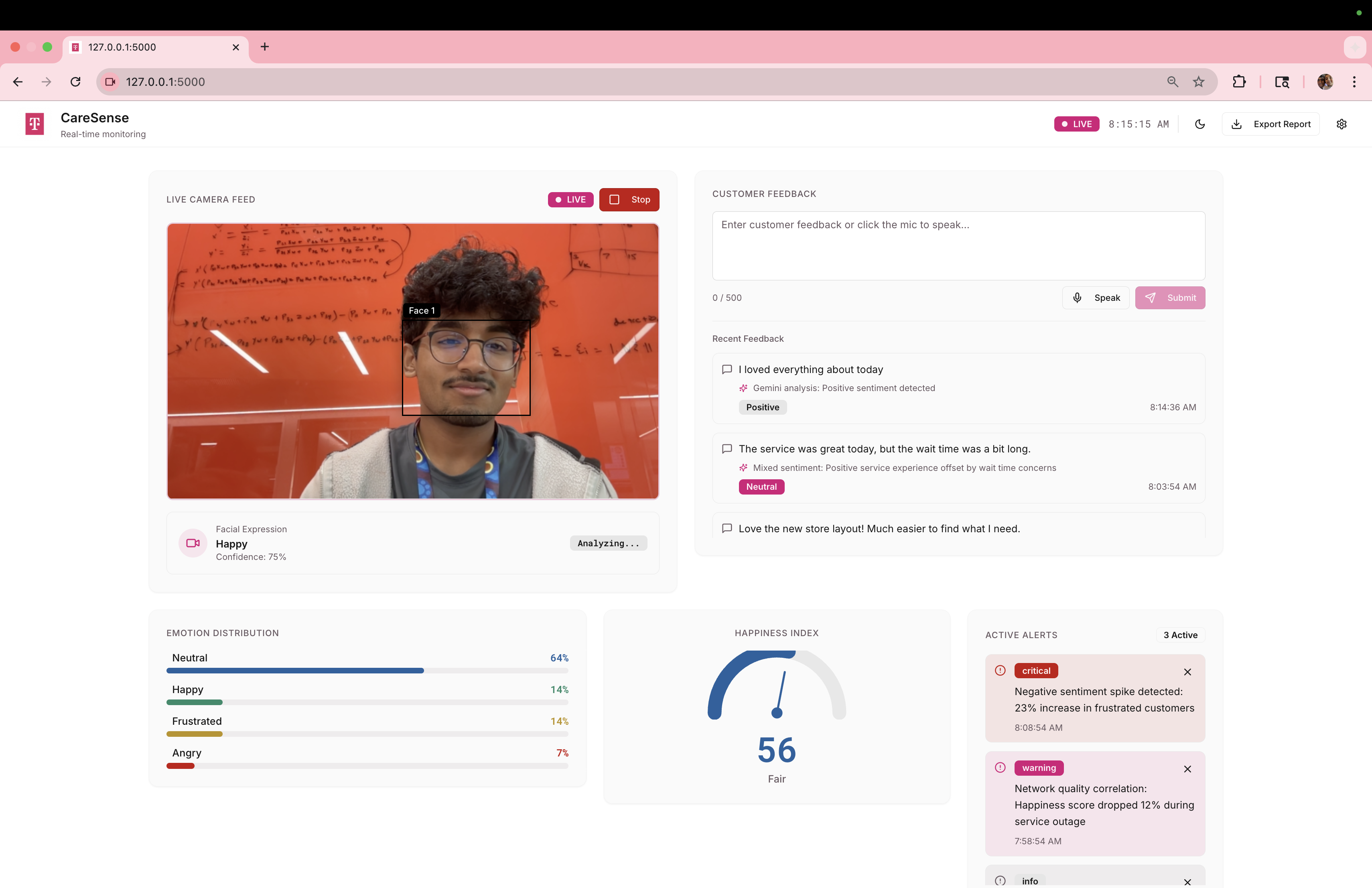
T-Mobile Customer Happiness Index is a real-time sentiment dashboard that:
- Tracks multiple customer faces simultaneously using TensorFlow.js BlazeFace model with individual bounding boxes.
- Analyzes facial expressions every 5 seconds using Google Gemini 2.0 Flash vision API to detect emotions (Happy, Neutral, Frustrated, Angry).
- Transcribes spoken feedback using the browser-based Web Speech API (no external API needed).
- Analyzes text sentiment using Gemini's advanced language understanding.
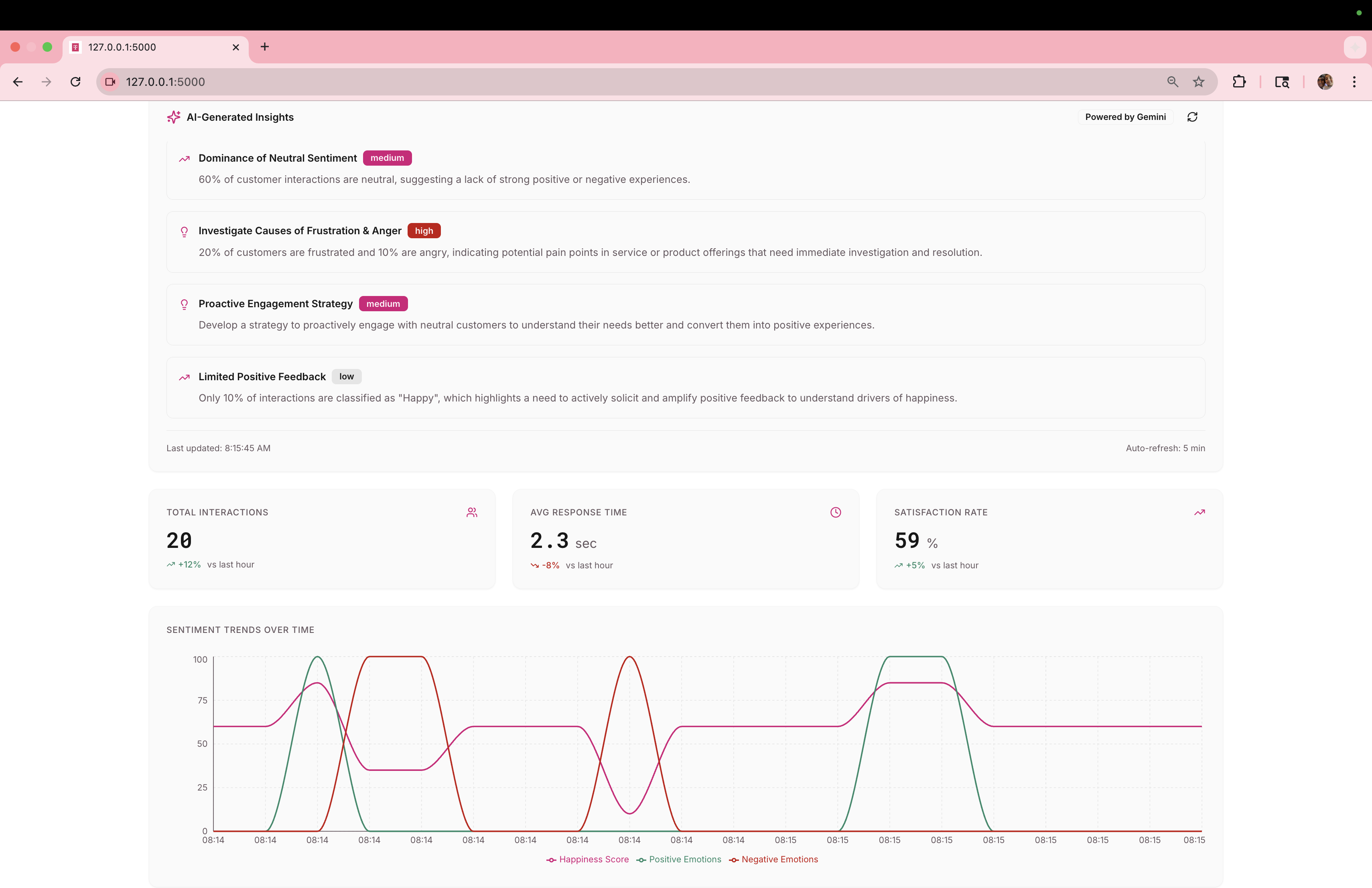
- Visualizes trends with live charts showing happiness score, emotion distribution, and 24-hour sentiment patterns.
- Generates real-time alerts when negative sentiment spikes are detected.
- Provides AI-powered insights with actionable recommendations for store managers.
- Updates live via WebSocket streaming for instant dashboard refreshes.
Store managers get a comprehensive view of customer satisfaction without interrupting service or requiring customer surveys.
Tech Stack
- Frontend: React + TypeScript + Tailwind CSS with shadcn/ui components
- Backend: Express.js + Node.js with WebSocket support
- AI Engine: Google Gemini 2.0 Flash (multi-modal vision + text analysis)
- Computer Vision: TensorFlow.js with BlazeFace model for real-time face detection
- Speech Recognition: Browser Web Speech API for free voice transcription
- Real-time: WebSockets for live emotion updates
- Storage: In-memory
Architecture
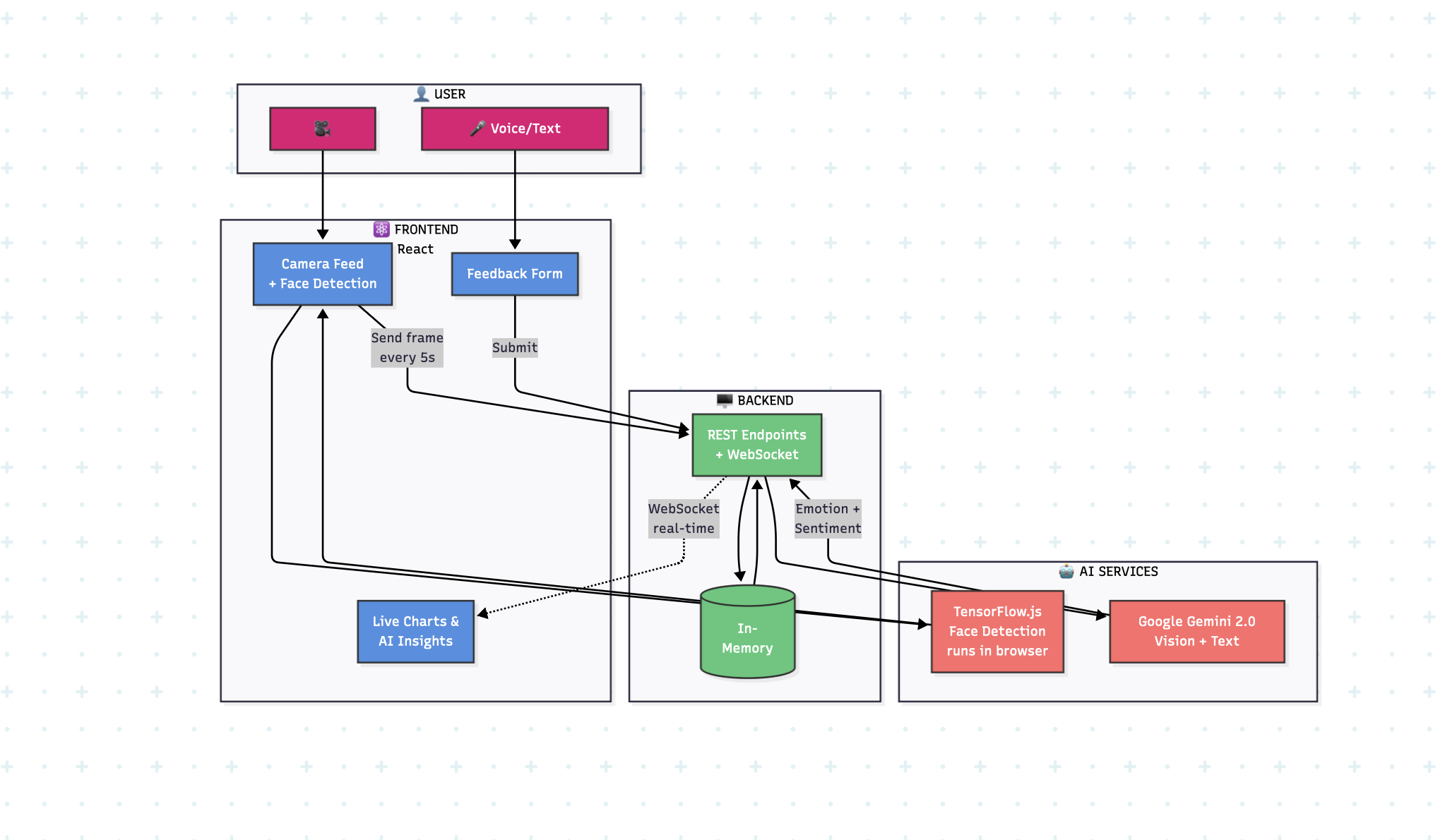
- Webcam captures video frames.
- BlazeFace detects multiple faces and tracks their positions with bounding boxes.
- Gemini Vision analyzes emotions in real-time (Happy, Neutral, Frustrated, Angry).
- Speech-to-text: The Web Speech API converts spoken feedback to text.
- Gemini Text analyzes sentiment from transcribed speech.
- All data streams through WebSocket for live updates.
- The Dashboard refreshes in real-time to display sentiment analysis.
- The AI engine periodically generates actionable insights based on sentiment patterns.
Challenges
Coordinate transformation for face tracking: Getting bounding boxes to accurately overlay on scaled/letterboxed video required complex mathematical transformations to account for different aspect ratios.
Speech-to-text accuracy: The Web Speech API has quirks with interim vs. final transcripts. I had to implement careful state management to prevent duplicate text from appearing.
Real-time performance: Balancing continuous face detection with emotion analysis every 5 seconds required careful optimization to avoid overwhelming the API while maintaining a real-time feel.
Built With
- blazeface
- drizzle-orm
- express.js
- figma
- framer-motion
- google-gemini-ai
- javascript
- node.js
- postgresql
- radix-ui
- react
- tailwind-css
- tanstack-query
- tensorflow.js
- typescript
- vite
- web-speech-api
- websockets
- zod


Log in or sign up for Devpost to join the conversation.