Inspiration
Hard questions do not belong to one domain. A plan to prevent blindness, design clean energy, or deploy AI in public health needs clinical, technical, economic, legal, ethical, and implementation expertise—often in tension. Quorum was built to mirror an expert team: choose the right specialists, let them challenge one another, then reconcile a decision-ready answer.
What it does
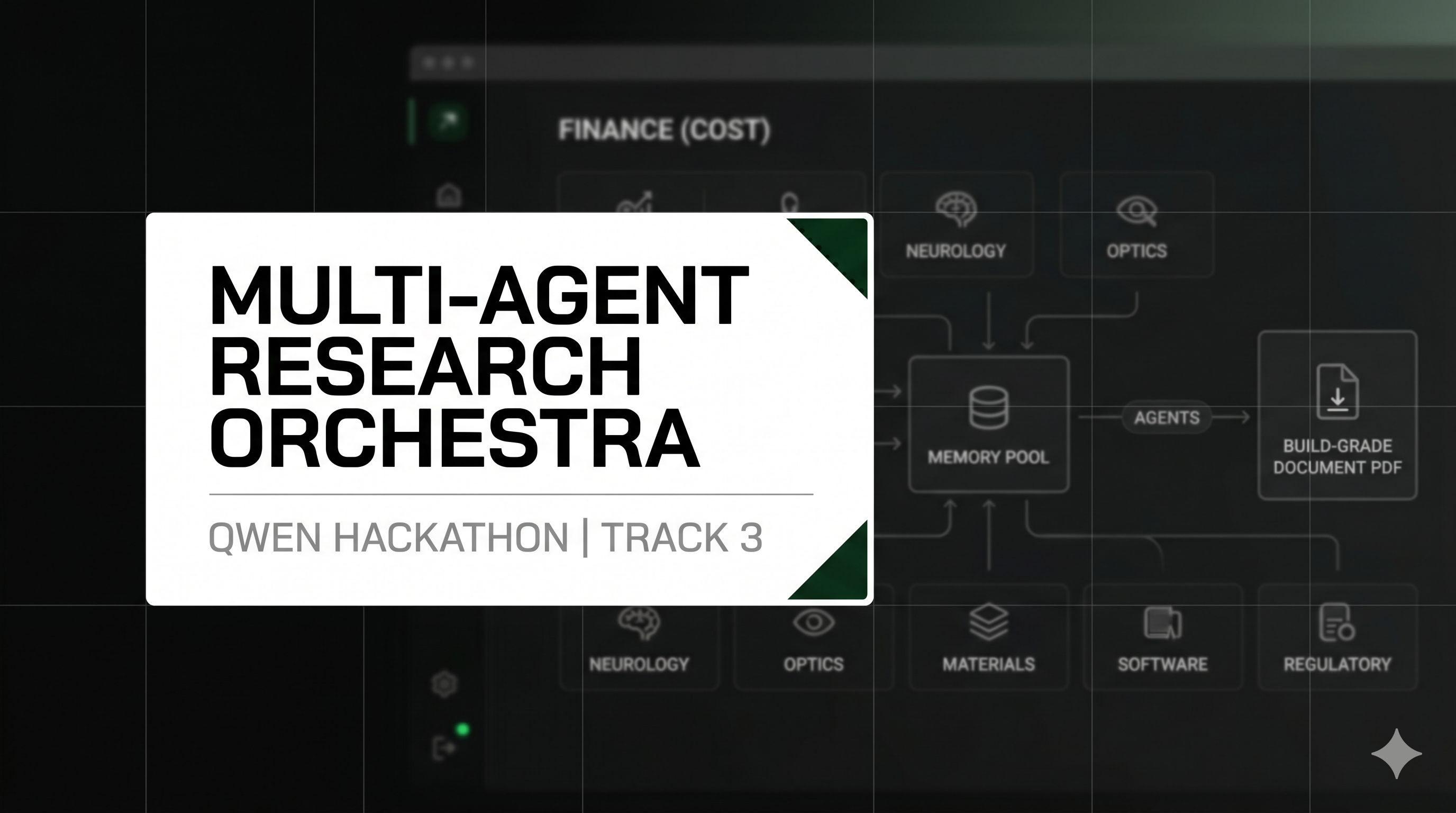
You ask one complex question and optionally add constraints, stakeholders, success criteria, and an evidence standard through a Decision Brief. Quorum selects a cross-domain team of specialists, researches in parallel, and gives each agent a distinct evidence-focused role.
Before synthesis, agents review selected peer claims in a structured dissent round: they can support, dispute, or mark claims uncertain, with reasons and impact. A coordinator then resolves agreements, conflicts, gaps, and needed follow-ups. The result is a unified report, downloadable as a PDF, with pause, resume, stop, and redacted share-link support.
How we built it
Quorum uses Qwen Cloud for analysis, specialist work, structured coordination, synthesis, and embeddings. The orchestrator runs specialist work concurrently with Python asyncio, while FastAPI and Server-Sent Events stream every stage live to the interface.
The pipeline is:
- Decision Brief and scope preparation
- First-pass research and question decomposition
- Adaptive specialist casting and parallel investigation
- Structured peer dissent
- Coordinator reconciliation and follow-up work
- Final synthesis and PDF export
It is deployed on Alibaba Cloud ECS in Singapore at https://quorum.guardianity.space. Visitors use their own Qwen Cloud key in a browser-session field; keys are not stored in reports, share links, or persistent application data.
Challenges we ran into
Reliable multi-agent orchestration requires more than parallel API calls. We had to make structured model output resilient to imperfect JSON, keep shared budgets across stages, stream asynchronous progress without losing events, and ensure pause, resume, and stop actions happen safely at pipeline boundaries.
We also designed the public sharing layer carefully: a shared run must remain useful while excluding private chat history and internal memory.
Accomplishments that we're proud of
Quorum is not just a collection of parallel summaries. Its dissent stage makes agents inspect and challenge one another’s claims before the coordinator produces a recommendation.
We are also proud of:
- Adaptive specialist selection for genuinely cross-domain questions
- A visible, live workflow that judges can inspect stage by stage
- Decision Brief inputs that make research relevant to real constraints
- Durable redacted share links
- A controlled single-agent baseline endpoint for honest Track 3 comparisons
- Browser-session Qwen credentials, with no platform-owned key required
What we learned
Agent diversity matters more than simply increasing agent count. Specialists need genuinely different responsibilities, and disagreement must be mechanically represented—not merely requested in a prompt.
We also learned that visibility matters: showing the cast, evidence, dissent, coordinator decisions, and final report makes multi-agent collaboration inspectable rather than a black box.
What's next for Quorum
- Let users refine the specialist cast before launch
- Add richer structured exports beyond PDF
- Expand challenge mode, where agents actively try to falsify the emerging recommendation
- Build a benchmark set with blinded human evaluation for multi-agent versus single-agent results
- Improve decision modes for policy, product, implementation, and adversarial-review workflows
Built With
- alibabacloud
- css3
- html5
- javascript
- python
- qwencloud
- rust


Log in or sign up for Devpost to join the conversation.