-
-

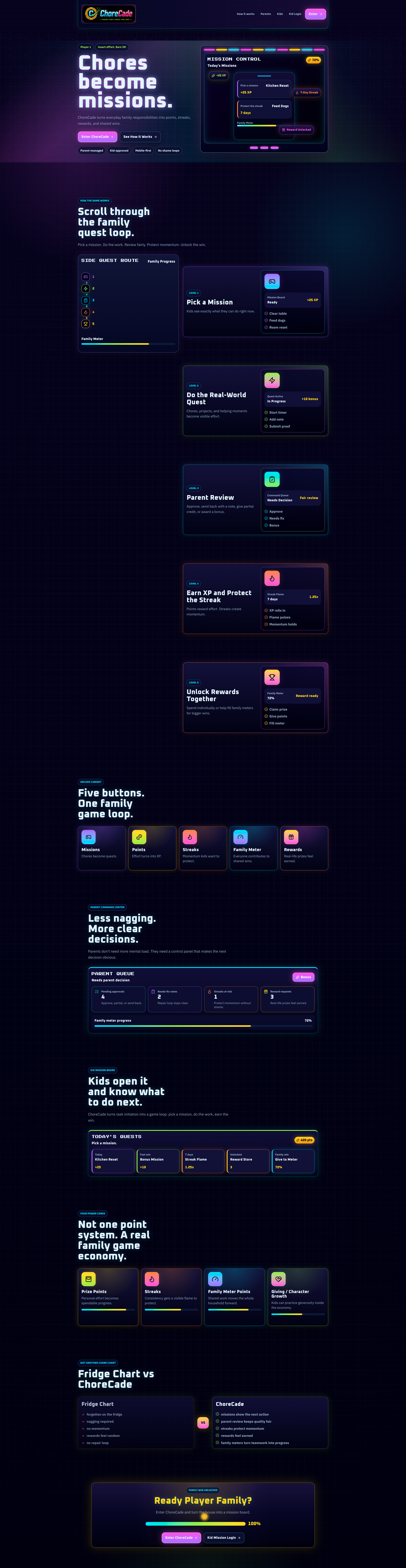
Current homepage/landing page for unregistered accounts
-
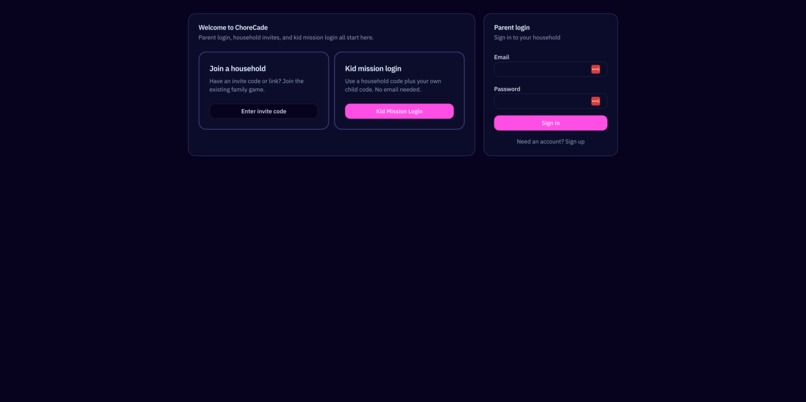
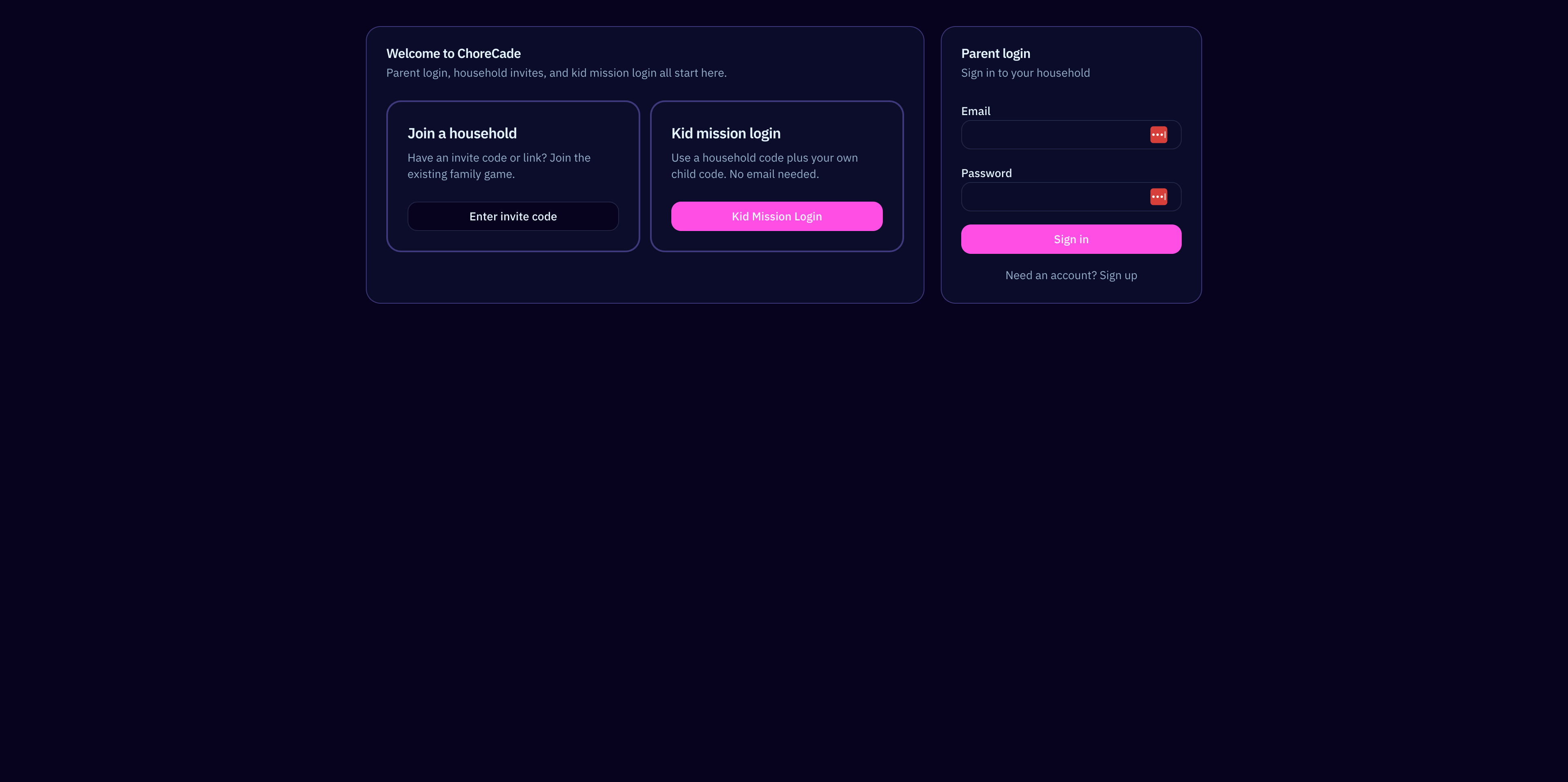
Login Screen
-
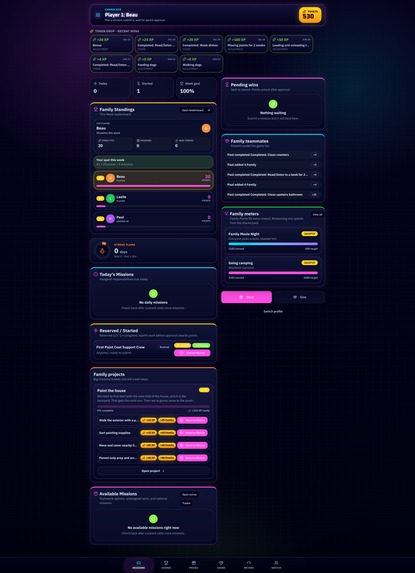
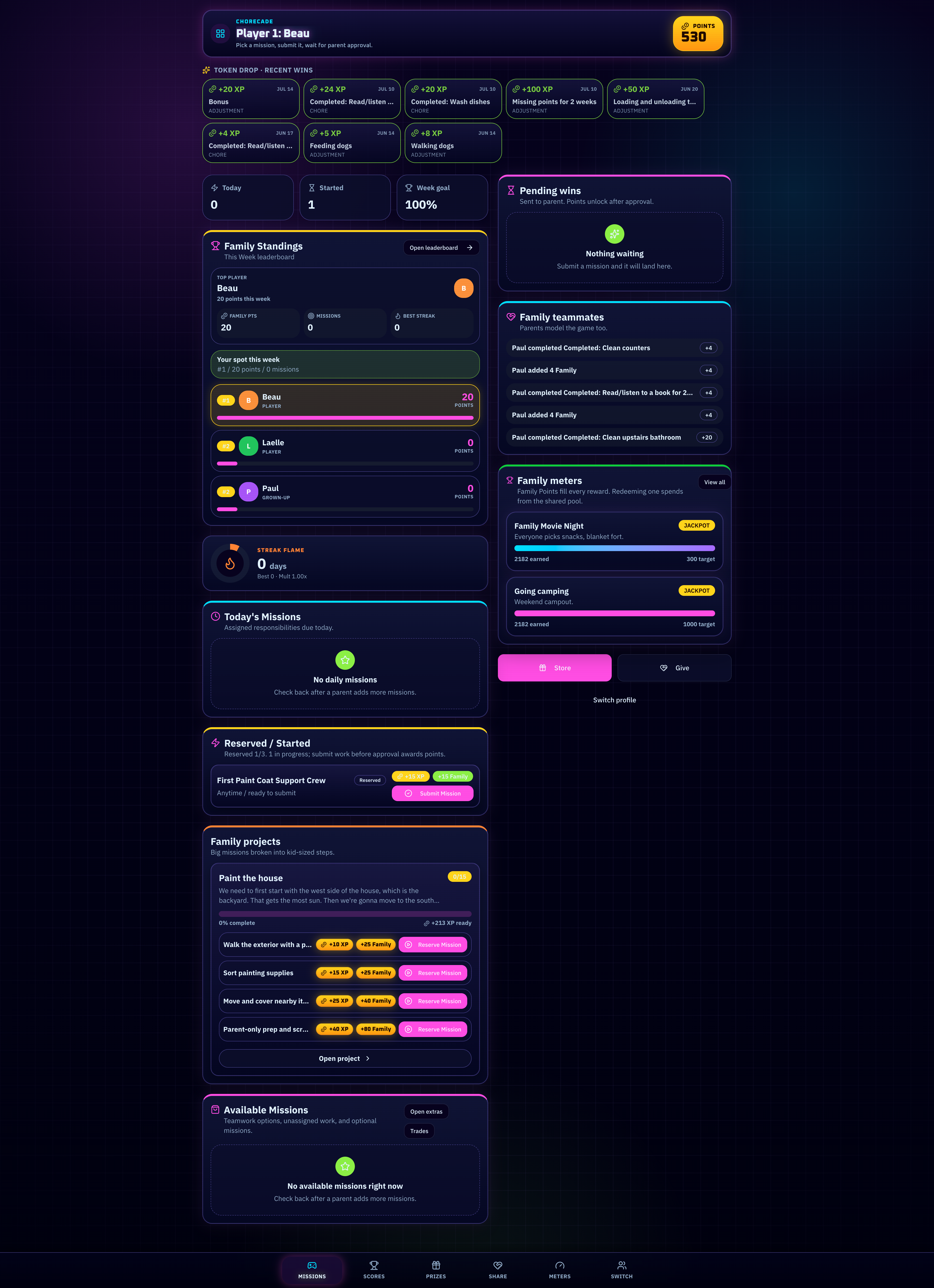
The kid's view command center (their home screen)
-
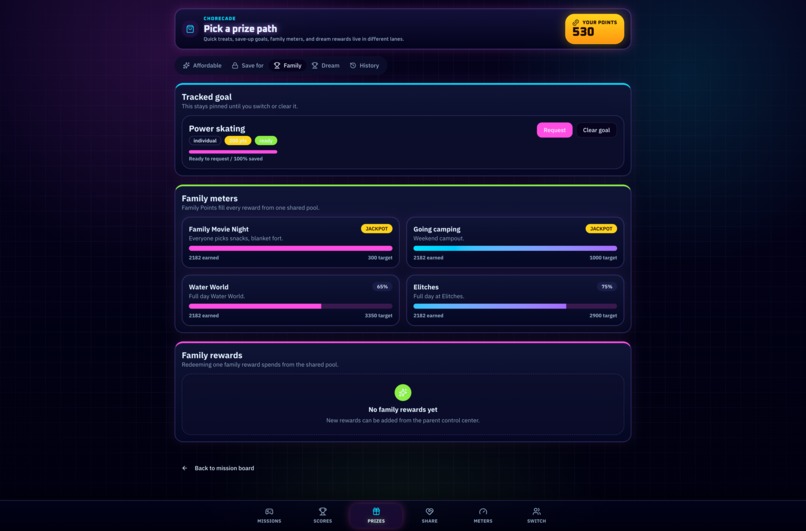
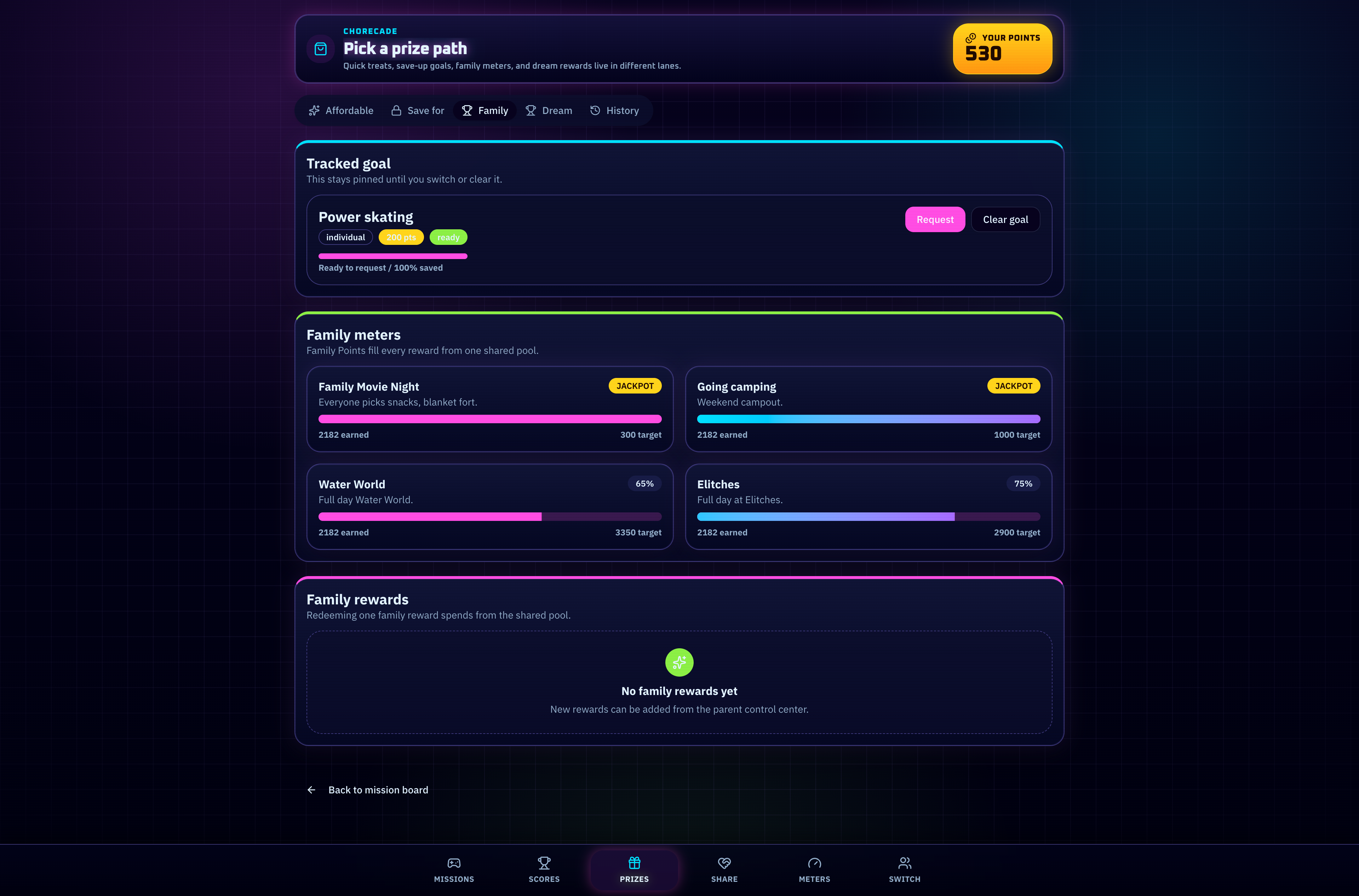
Family prizes that are available
-
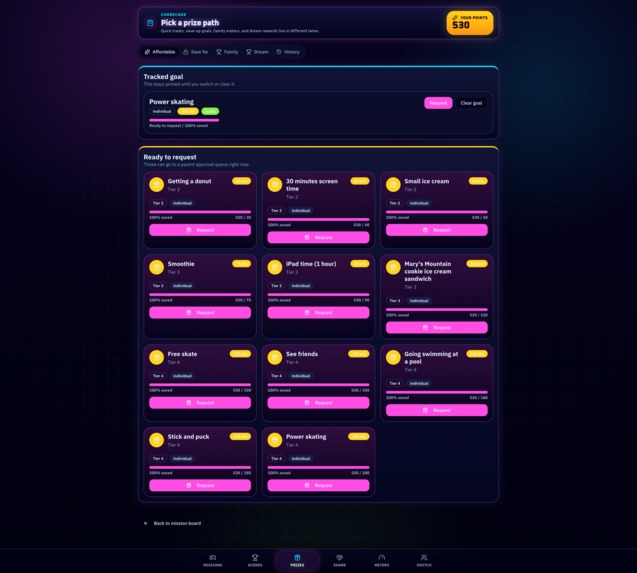
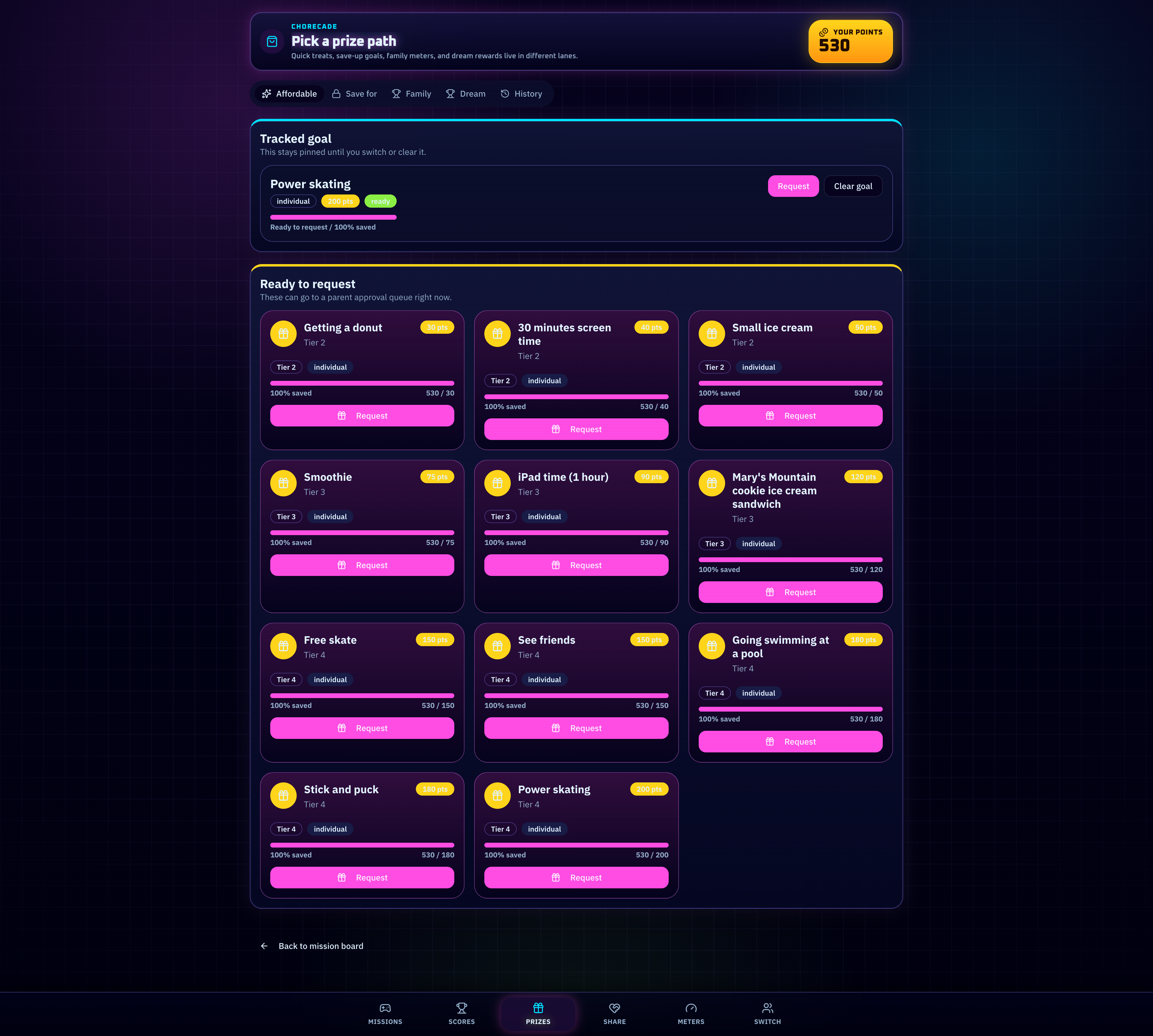
Affordable prizes selection screen
-
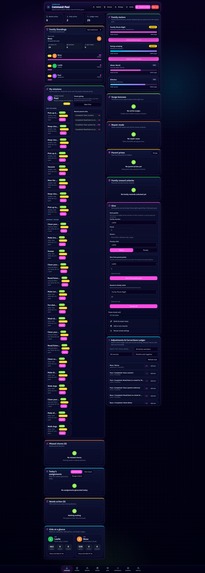
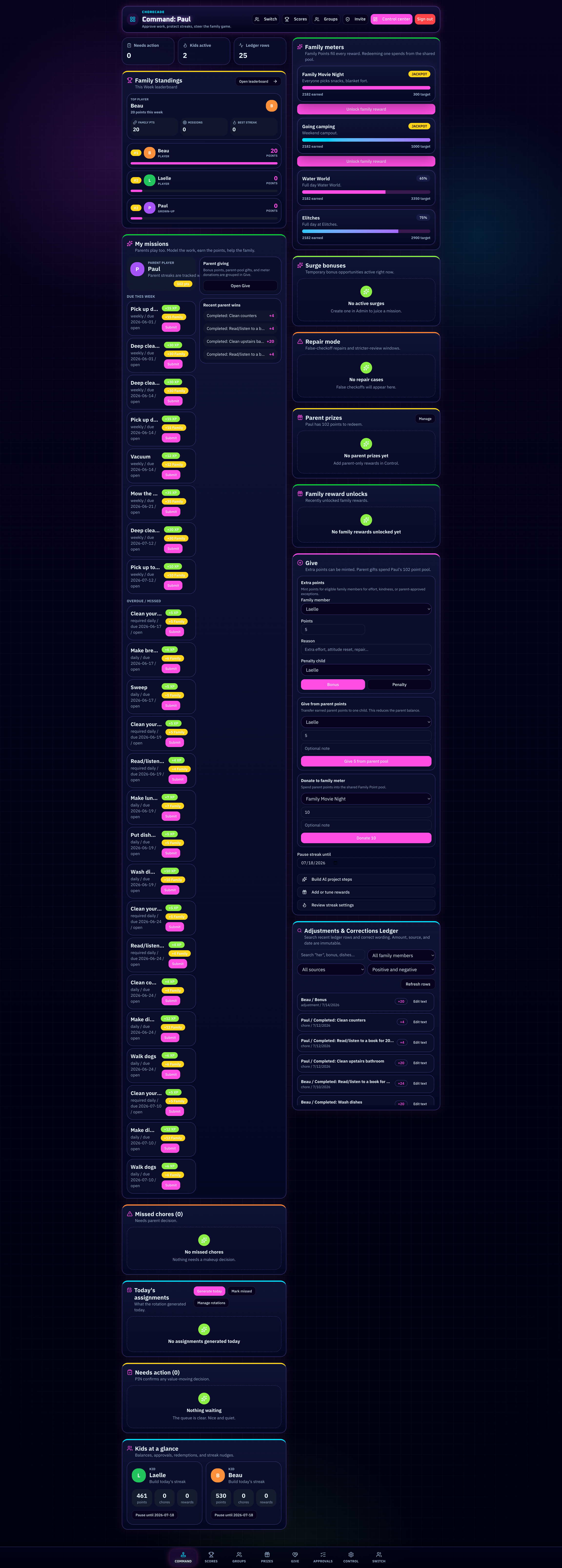
The parent command center/home page
-
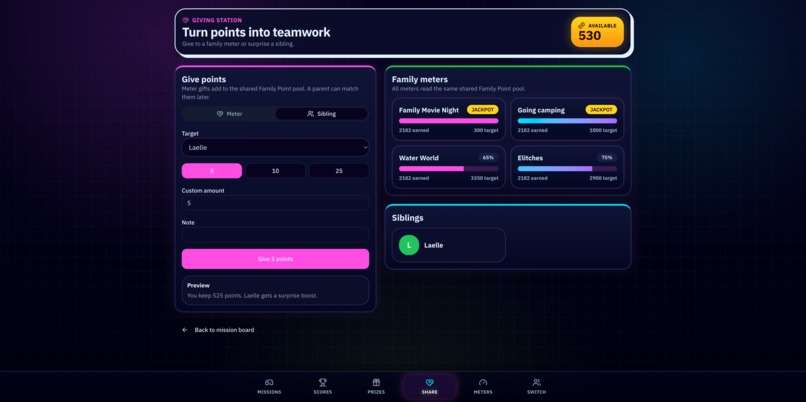
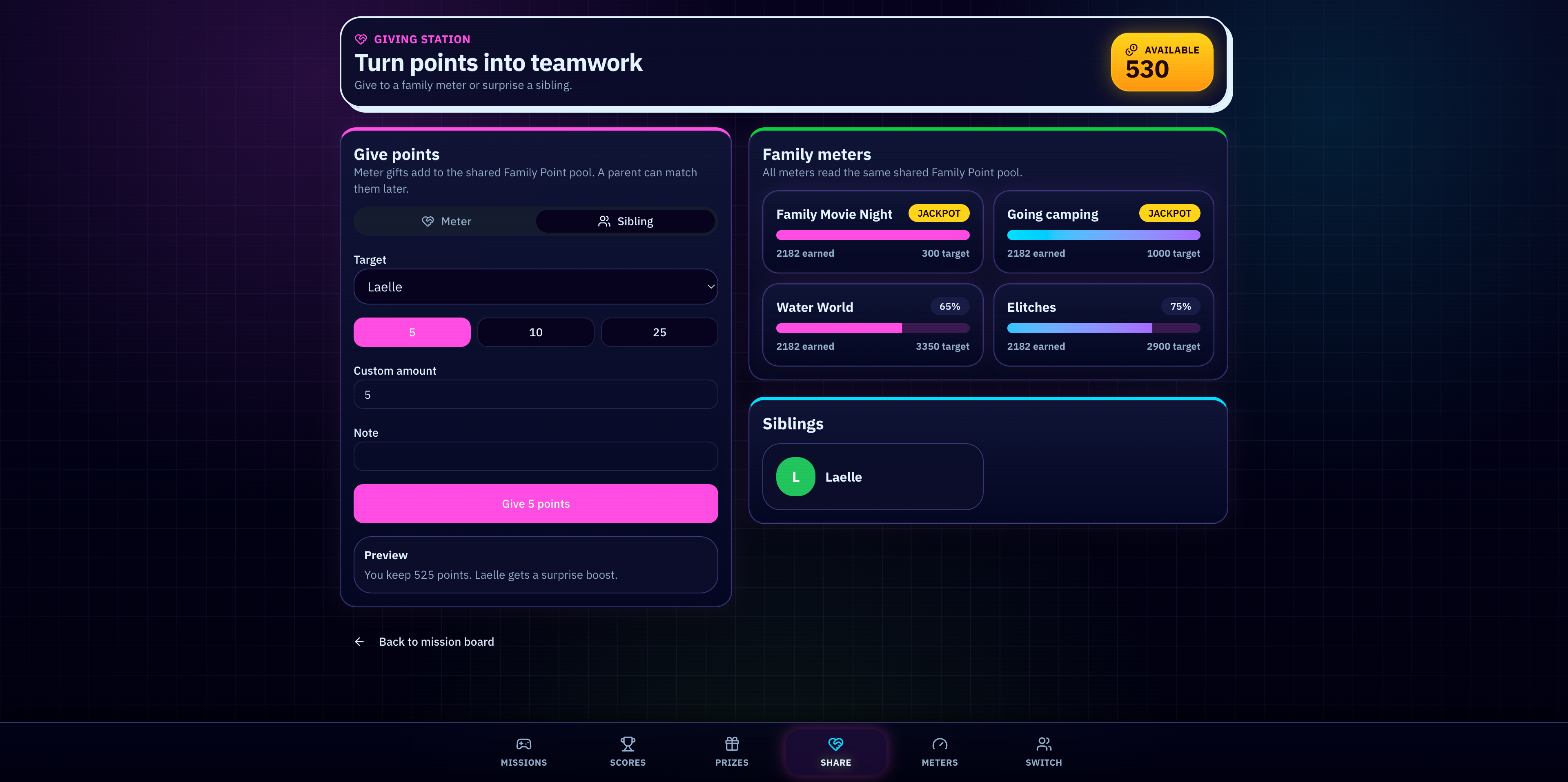
We encourage the kids to give each other points to ear rewards, they can also "donate" to a bigger family prize
-
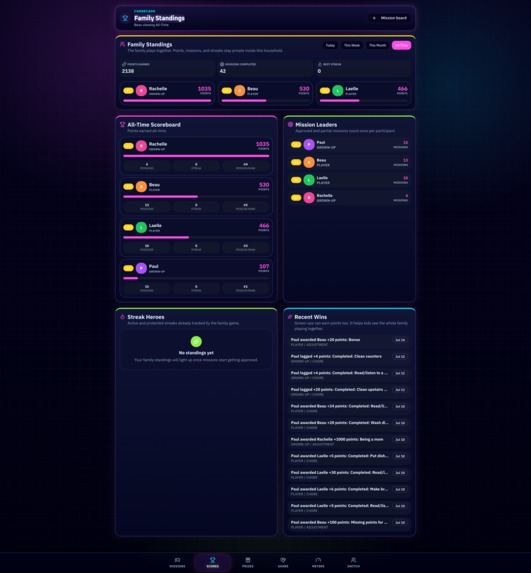
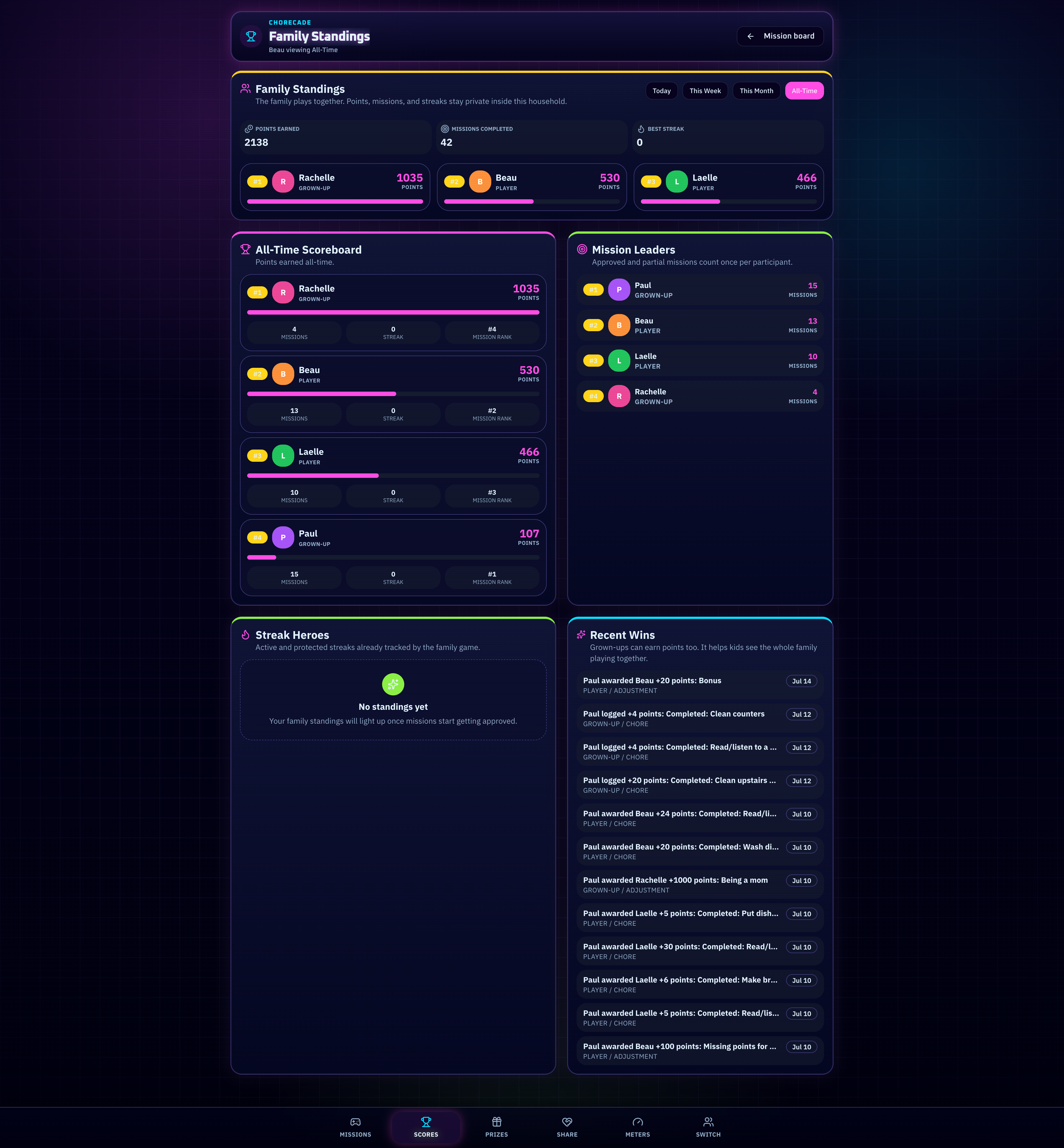
The family standing screen showing all time point earners. Mom is in the lead...
-
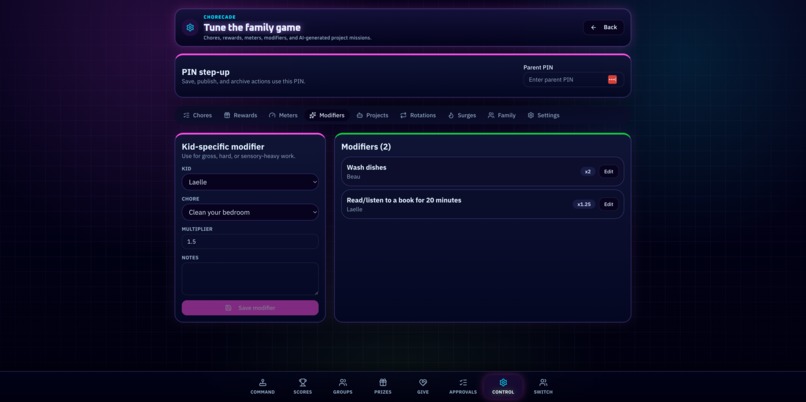
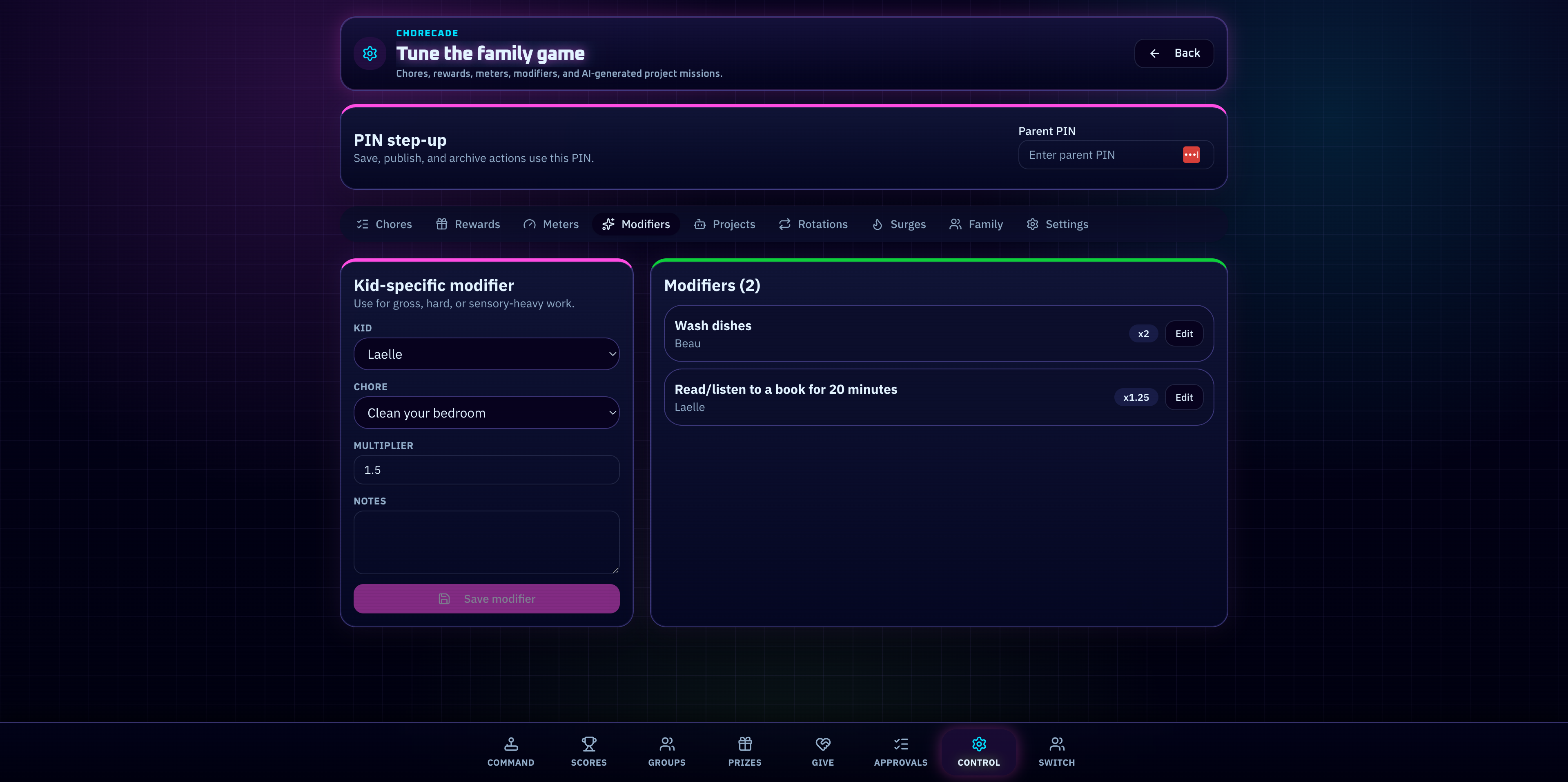
Kid-specific modifiers (our daughter is learning to read, my son hates getting his hands wet)
-
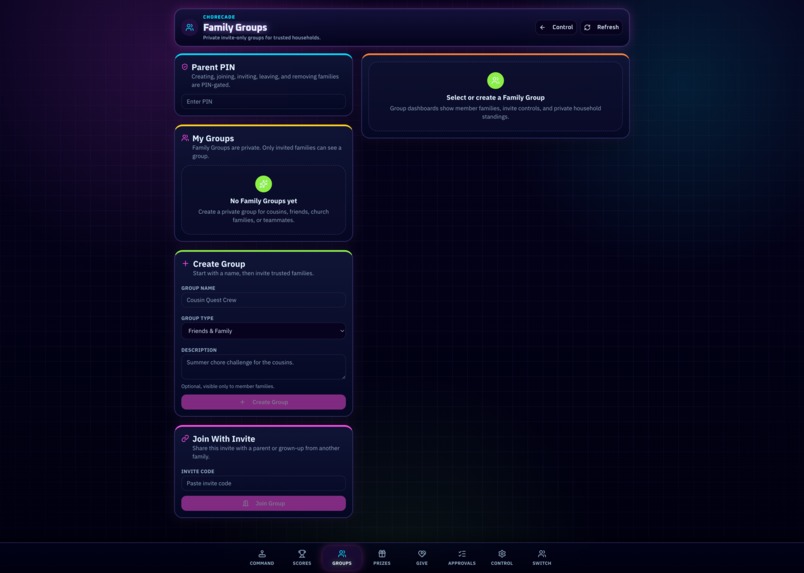
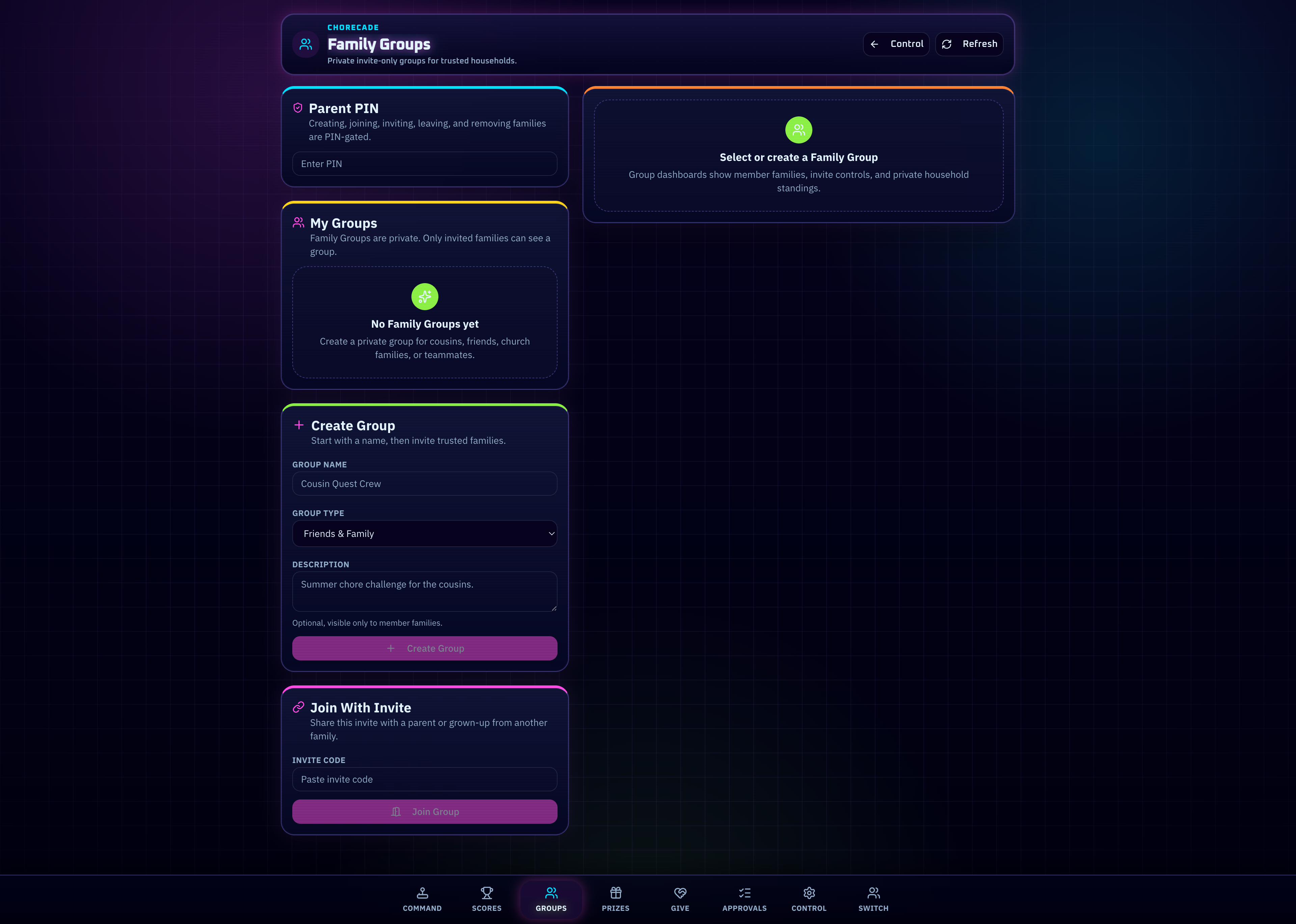
For future family and/or group competition (think school groups, church groups, etc)
-
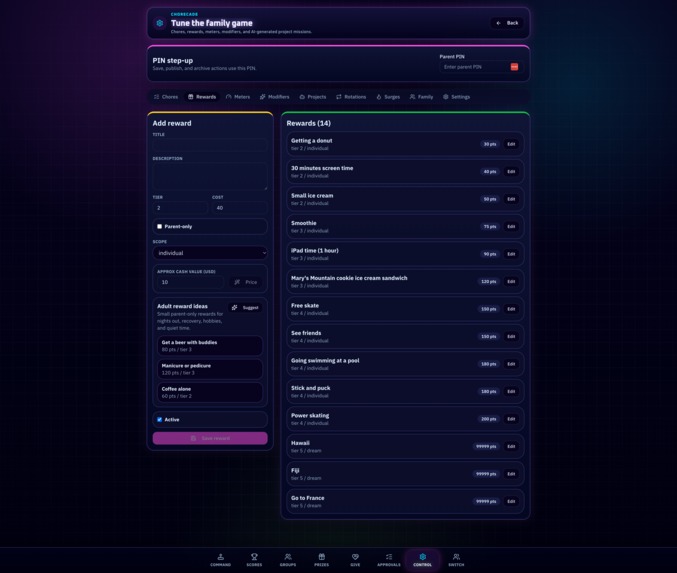
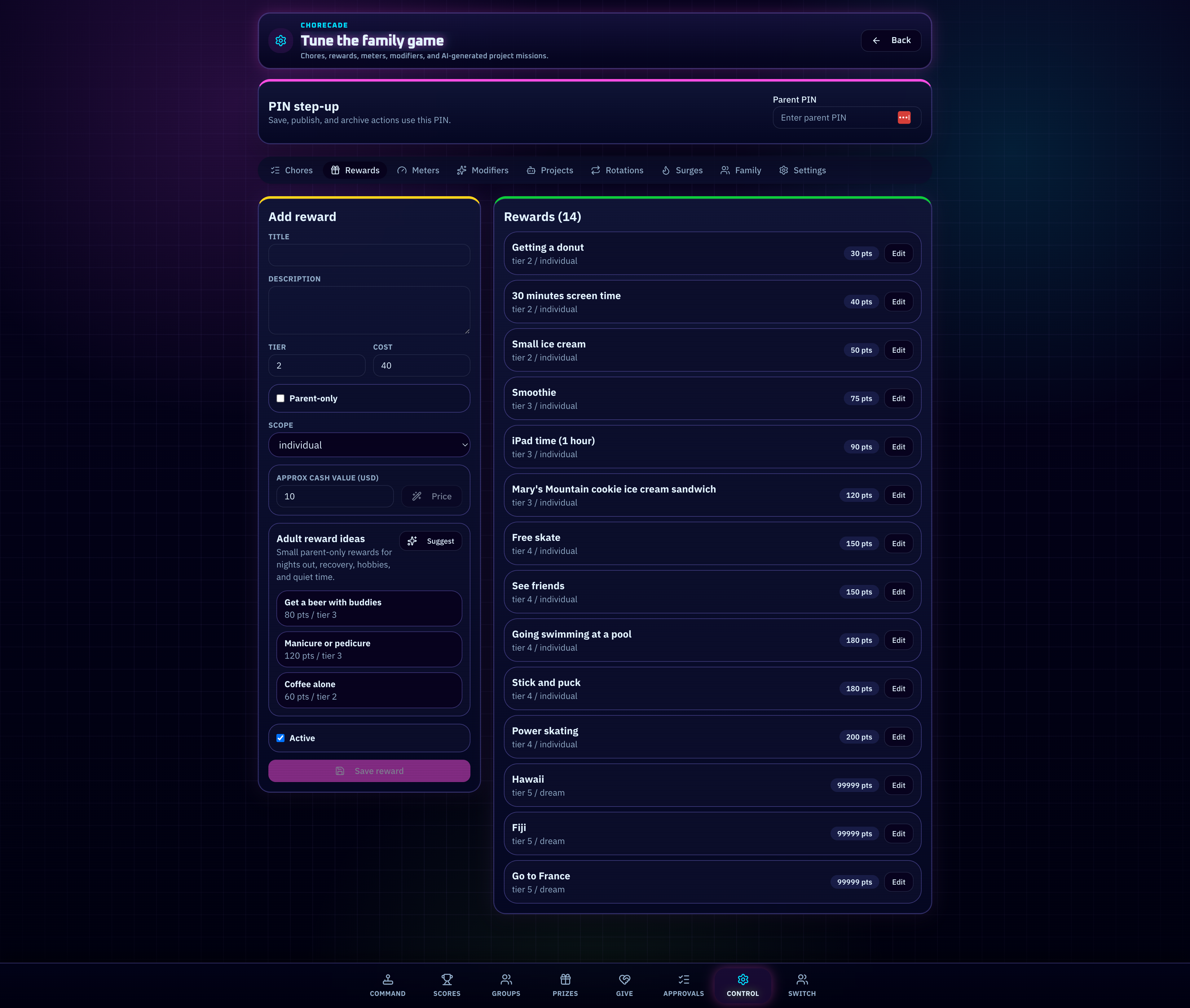
The rewards screen admin area where parents can add awards, assign point values, edit etc.
-
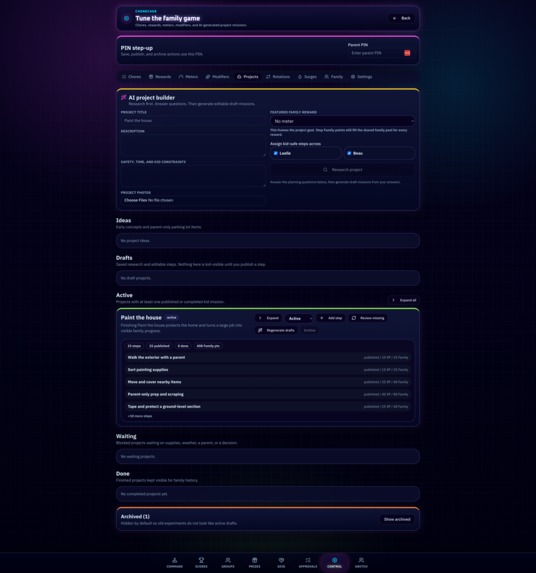
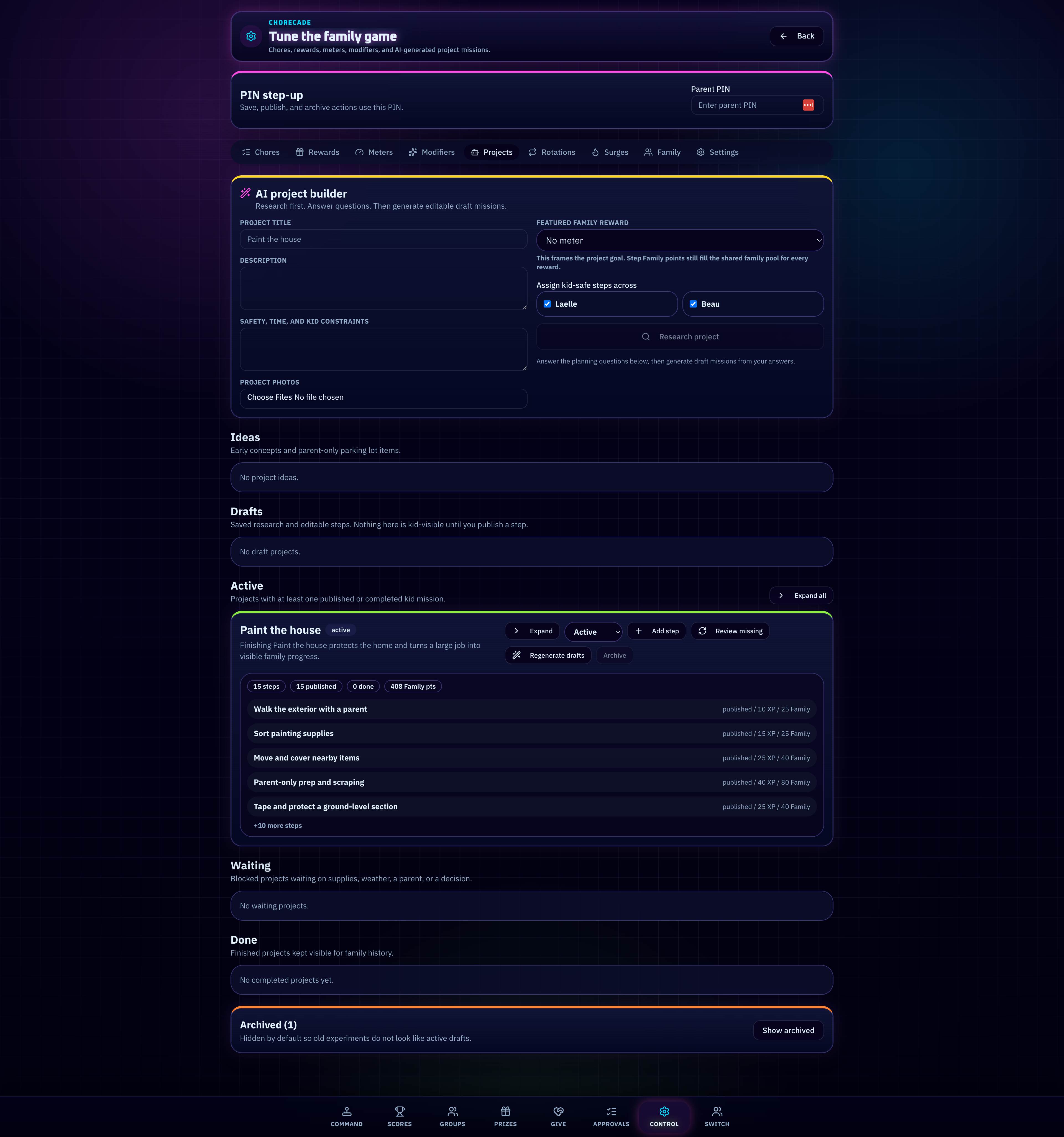
I built an ai-project builder to help break larger projects into parts that are easier to do
-
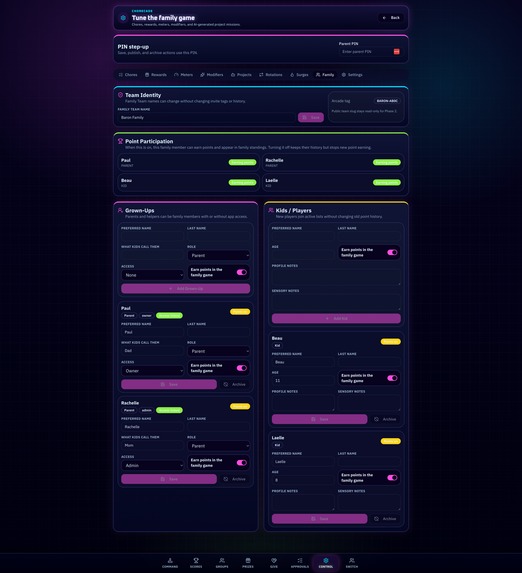
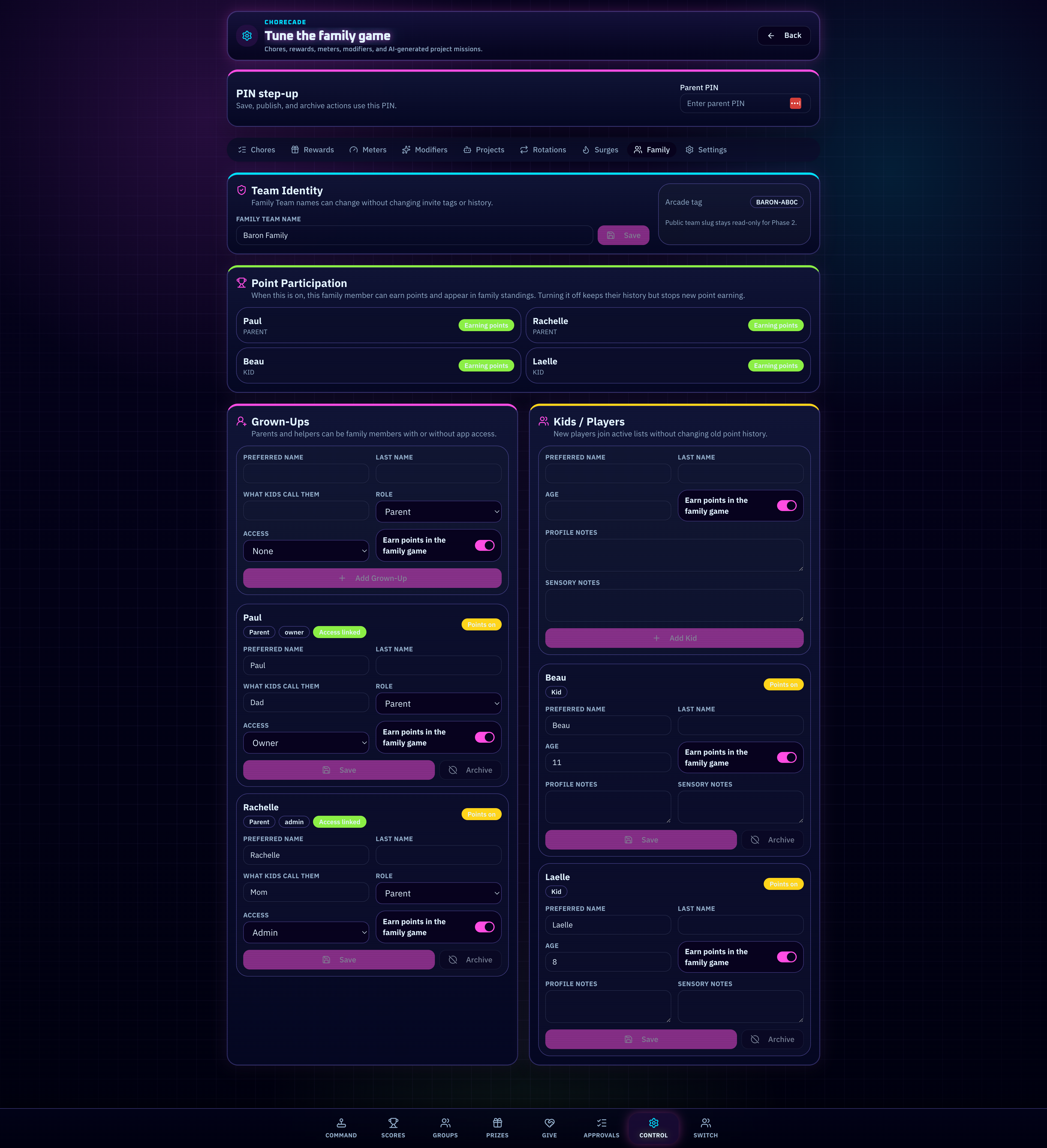
The family edit section where new kids can be added, new grown-ups etc.
-
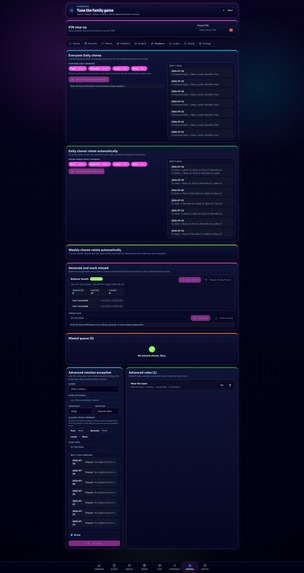
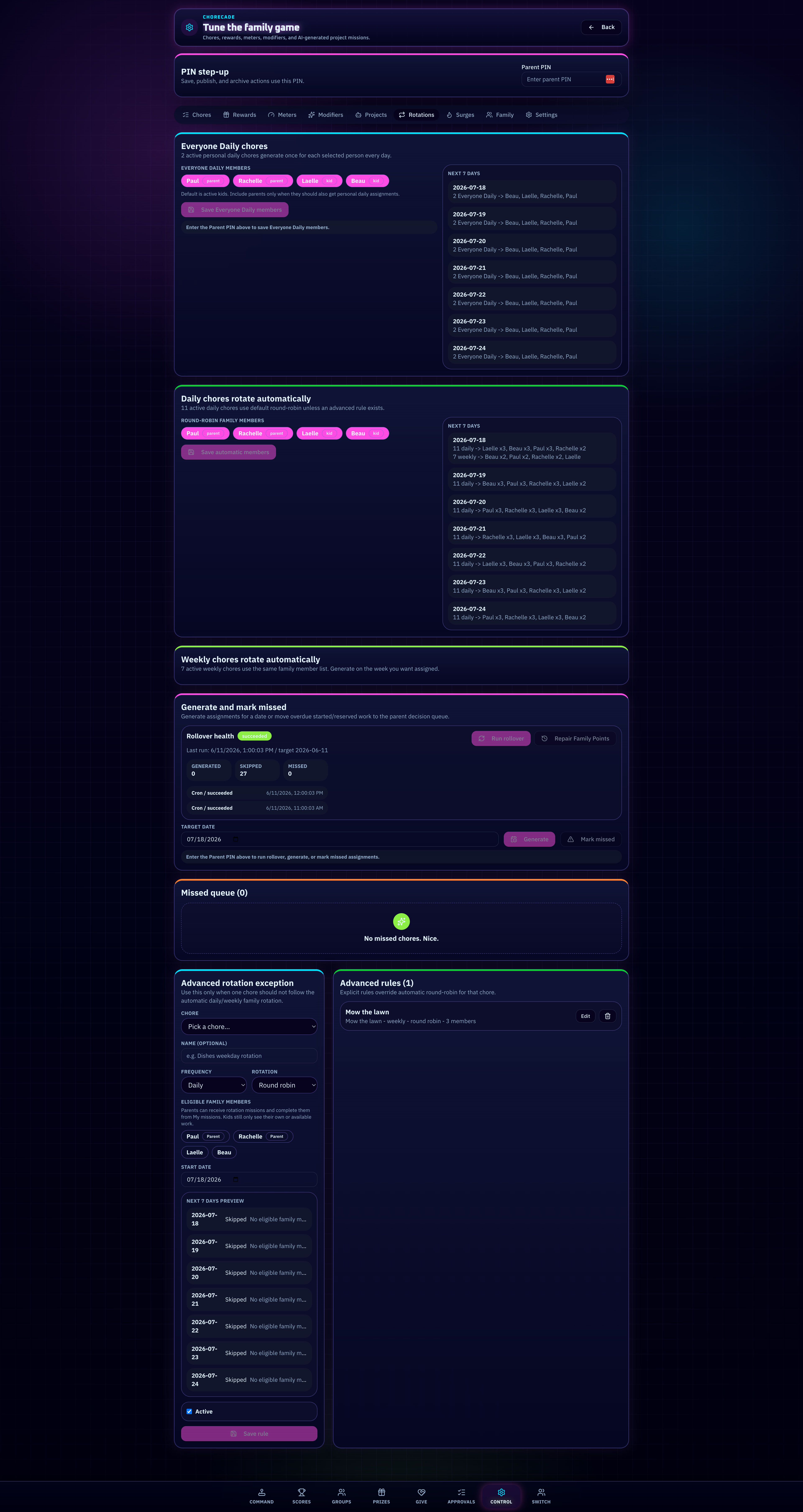
The chore rotation modification page, where you can determine what chores round-robin to what players (my daughter cannot mow for example)
Inspiration
ChoreCade started on our patio, not in a pitch deck.
My wife Rachelle and I were thinking through how we could get the kids to stop complaining about doing chores, so we asked them a simple question: How can we make doing chores more fun?
I pulled out my ipad and together, we made a spreadsheet with four tabs: Projects (like bigger things we need to work on together), daily chores, weekly chores, and rewards. We worked with the kids and listed rewards they would genuinely want to earn. Things like screen time, cookies, donuts, stick and puck, activities, outings, and bigger family experiences-- even dream experiences like going to France, Hawaii, or Fiji..
Once we had the spreadsheet, I went to ChatGPT to brainstorm how a fair point system could work. How many points should reading be worth, or washing dishes? How should scooping dog poop from the back yard be given points vs making your bed? How should saving, streaks, shared family rewards, and missed chores work?
I had already been building some apps using Loveable, and when Codex came out I began using Codex to enhance my workflow with Loveable. I immediately decided to turn this spreadsheet into an app using Codex as the main workhorse.
The core idea became:
Chores become missions. Points become progress. Families win together.
I did not want to build another digital checklist or sticker chart. We tried the magnet chart on the fridge and that didn't work. I wanted something that felt like a video game, or a virtual arcade, something the kids would actually ask about and want to open and "play" every day.
What it does
ChoreCade turns real household responsibilities into missions, points, streaks, rewards, family goals, and friendly competition.
Kids can open the app and see the missions available to them. My kids each have an iPad so they have their own logins. They can start or reserve a mission, submit completed missions, attach a photo as proof it was done, track their points, see who's "winning" that day or week in the leaderboard (they love this... they're super competitive), give points to contribute toward shared family goals, and save for rewards they actually care about.
Parents create and assign missions, manage who gets what recurring chore, approve completed work, give partial credit, ask for repairs, add bonuses, manage rewards, and run the household system from a Parent Command Center.
Points are only awarded after the work is submitted and reviewed/approved by a grown-up. This keeps the game exciting without making the point economy feel random or unfair.
One feature that is already making a real difference in our house is reading. Our kids can earn five points for every 20 minutes they read (my daughter actually has a modifier of 1.25x that because she's learning to love reading; so she gets more points for reading than her brother). Reading is stackable for up to two hours per day, so if they want to make a bunch of points easily, I just tell them to read. That turns reading into an optional mission they can choose when they want to earn more points.
The biggest GPT‑5.6 feature implemented in the app is something I call Chaos-to-Quest.
We don't need AI to tell us a room is a mess. They need help turning “clean the garage,” “organize the livingroom,” or “paint the house” into something the family can actually start.
Grownups can take a photo of a messy room, unfinished project, garage, backyard, etc., or just describe what needs to be done. GPT‑5.6 Terra looks at the photo and description, figures out what it knows and what it does not know, and asks the parent a few practical questions instead of confidently hallucinating an answer.
Once the parent answers, GPT‑5.6 Sol turns the whole thing into a safe, editable family quest. It breaks the project into actual steps, suggests supplies, separates adult-only work from kid-safe missions, and helps assign the right work to the right people.
Nothing is automatically dumped onto a kid’s mission board. The parent reviews the plan, changes anything they want, enters their Parent PIN, and publishes the missions they approve.
GPT‑5.6 Luna also helps during onboarding. Parents tell ChoreCade about their household, the kids, how much work is realistic, and when chores normally happen. Luna uses that information to choose age-appropriate starter missions from a trusted catalog and build the family’s starting cadence. The parent does not have to sign up and then stare at an empty app wondering what to create first.
Families never have to choose an AI model or understand any of this. ChoreCade routes each job to Luna, Terra, or Sol behind the scenes. Child names are replaced with aliases before anything is sent to OpenAI, optional notes are only included with parent consent, and every AI-generated project remains a draft until a grown-up reviews it.
ChoreCade also supports:
- Personal points for individual rewards, parent-exclusive rewards (beers with the boys, for example)
- Family Points for shared experiences
- Daily, weekly, and semi-weekly missions
- 'Everyone Daily' missions such as reading or making your bed
- Rotating household responsibilities
- Grown-ups participating as players to model behavior
- Flexible households with parents, kids, guardians, and helpers
- Private Family Standings
- Invite-only Family Groups that compete at the household level
The app is designed to make household work visible, understandable, and rewarding without turning every missed chore into an argument.
How I built it
Codex has been my primary coding environment for ChoreCade.
I start by defining the feature, the behavior I want, and the rules that need to stay intact. Codex then inspects the existing repo and implements the work inside a dedicated feature branch. That can include React components, server functions, Supabase migrations, PostgreSQL RPCs, documentation, validation, and tests.
After Codex finishes a feature, I open a pull request in GitHub and pass the actual diff to Claude for a separate code review.
Yeah I know... Anthropic is your competition BUT I intentionally use two different AI systems because different "brains" catch different problems.
The workflow is:
- I plan the feature and give it to Codex.
- Codex implements it in a new branch.
- Claude reviews the actual GitHub diff.
- I give Claude’s requested changes (if any) back to Codex.
- Codex implements the fixes (if needed).
- Claude performs another review pass (if needed).
- Once it passes review and QA, I squash and merge the pull request.
That review loop has caught issues that a successful build never would; things like database race conditions, permissions, migration ordering, point-award edge cases, invite security, rollover behavior, and cross-household privacy.
The application is built with React, TypeScript, TanStack Start, Vite, Supabase, PostgreSQL, and Phaser.
Supabase and PostgreSQL handle the trusted household data, including profiles, assignments, submissions, ledgers, rewards, streaks, invitations, and Family Groups.
Phaser powers the arcade animation layer. The goal is for mission completions, approvals, rewards, jackpots, and streak moments to feel like events inside a video game instead of standard web-app notifications.
Since I've been using Lovable since December last year, Loveable is a part of the workflow for previewing and testing the connected application. My previous experience with Lovable taught me that it can move quickly, but database and generated-file drift as well as schema-drift are real issues for it alone. For ChoreCade, GitHub is the source of truth, migrations are committed, and Codex handles the deeper long-context repository work.
Inside the application, I'm not just sending every job to one giant AI prompt and hoping it works. We route requests to Luna, Terra, or Sol based on complexity and required effort.
Every GPT‑5.6 response uses a strict structure that the server validates before the application can use it. ChoreCade also creates an AI receipt showing which model handled the job, the workload, reasoning level, response time, and request reference. The AI can suggest a plan, but it cannot award points, publish missions, or make decisions for the parent.
Challenges I ran into
The GPT‑5.6 Chaos-to-Quest planner was one, if not the, hardest parts to build.
My first instinct was to give the model a photo and ask it to create the whole project in one shot. This proved ineffective and just didn't work.
A photo can show that the laundry nook space above a washer is messy and that the proposed cabinet build would help; but it cannot tell GPT‑5.6 what should be kept, what can be thrown away, which tools the kids are allowed to use, how much time the family has, or what “finished” actually means. If the AI pretends it knows those things, the plan ends up being impressive but completely useless halucination.
I split the process into two stages. Terra’s job is to look, research, and ask the questions it actually needs answered. Sol does not build the final quest until the parent has clarified the situation. That made the result safer, more complete, and much more useful.
Image analysis create another problem. Photos uploaded directly from an iPhone may be HEIC files, and not every part of the image-processing chain handles them consistently. We had to account for that before OpenAI could reliably inspect what the parent uploaded.
The larger GPT‑5.6 requests also ran into timeouts. That pushed me to split the work into smaller workloads, give each model an explicit reasoning level, limit retries, and validate the result instead of making one enormous request and hoping it finished.
Another big challenge has been making ChoreCade feel like a real arcade game rather than a normal app with a little confetti added.
I want the experience to have real whiz-bang-pow energy: token drops, jackpot moments, mission-complete effects, score movement, sound, and animations that make earning points feel satisfying. Sound effects will be coming soon and I plan on using Eleven Labs to generate those sound effects.
Those animations worked well on desktop Chrome but are still not reliably working on actual mobile devices. Mobile Safari, Chrome on iOS, reduced-motion settings, canvas behavior, navigation timing, and Low Power Mode all create different issues.
I had to make Phaser an enhancement rather than a dependency. If the full animation cannot run, the kid still has to see an immediate, visible confirmation like Confetti or something. A successful mission should never feel like nothing happened. I'm really going for that dopamine hit on mission completion so kids get addicted to doing chores XD
Another challenge has been keeping the app and database synchronized across Codex, GitHub, Lovable, and Supabase. ChoreCade has a lot of interconnected systems, and schema drift can cause an interface to appear complete while the database is still running an older function.
Recurring chores also became much more complicated than they initially appeared. Daily chores, Everyone Daily missions, rotating assignments, missed work, reserved missions, repeated missions, weekly chores, recovery windows, and parent decisions all need different behavior.
For example, a missed daily mission should remain visible long enough for the original player to recover it, while that same chore also needs to return to the normal daily assignment pool so it can be snatched up if wanted by another person. At the same time, one child completing an Everyone Daily mission must never complete it for someone else (in the start it would do that).
I also had to protect the point economy. Points cannot be awarded twice, balances cannot be edited casually, and one household cannot see another household’s children or ledger activity. That means database migrations, server-side permissions, immutable ledgers, Parent PIN checks, and invite hashing matter just as much as the interface.
Accomplishments that I'm proud of
The biggest accomplishment is simple:
Our kids are actually using it.
They ask every day how many points they have, who's in the lead, what they can "buy" with their points, etc...
They think about what missions they can complete to earn more. They save toward rewards. They ask about standings. They voluntarily choose reading because reading has become a mission with visible, repeatable value.
That matters more to me than any technical feature. The way I know the app is "working" is because the kids ask about it and talk about it without my prompting.
I am proud that this started as a family spreadsheet and became a working application that is changing how our own household talks about chores.
Instead of only hearing:
“You need to do your chores.”
The kids now hear:
“What missions do you have today? How many points do you have? Do you want to earn more?”
I am also proud that ChoreCade feels fun without giving up trust. The kids get the game layer, but parents still control approvals, points, rewards, household access, and important decisions.
The application now includes flexible onboarding with (Open)Ai-suggested age-appropriate chores, recurring missions, private standings, family projects, rewards, missed-mission recovery, grown-up participation, Family Points, invite-only Family Groups, and a Phaser-powered arcade layer.
It's no longer just an idea or boring spreadsheet. It's a product being used by the family it was built for.
What I learned
I learned that chores can actually become fun when they're framed correctly.
The word mission creates a different emotional response than the word chore. Points make effort visible. The leaderboard encourages competition-- with the only way of topping the leaderboard being doing more chores/missions. Rewards with progress tracking create something to work toward with visual feedback of how close they are to achieving it. Family goals make household work feel collaborative instead of isolated.
We learned that kids care deeply about visible progress. Our kids ask about their points every day because the number means something to them. It represents effort, choices, saving, and what they can unlock next.
We learned that even small incentives can change behavior. Reading for 20 minutes becomes more appealing when it is a clear mission worth five points, especially when the child can choose to repeat it up to 6x daily.
I also learned that AI development works better as a team than as a single tool.
Codex has been significantly more capable for the deep, long-context repo work than the standalone app-builder workflows I had used before. It can inspect the broader codebase, preserve existing architecture, create migrations, update documentation, and work through complex multi-file features.
Claude provides a different perspective during review and regularly finds edge cases that the implementation pass missed.
Lovable remains useful for connected previews and testing, while GitHub gives us a disciplined source of truth.
The biggest development lesson has been:
Codex builds. Claude challenges it. Codex fixes it. GitHub records it. Then we test it with the real family.
What's next for ChoreCade
The goal is to monetize ChoreCade by turning it into a real iOS and Android product.
I am already exploring how to move the current web app into a native mobile experience while preserving the same backend, security model, and point economy.
I also want ChoreCade to grow into a much deeper RPG-style experience, including:
- Customizable avatars
- Character Points for kindness, grit, responsibility, honesty, and initiative
- Pets and companions
- Unlockable cosmetics
- Family worlds and rooms
- Group challenges
- League XP
- Seasonal mission packs
- Larger arcade celebrations
- Better sound and animation systems
The next GPT‑5.6 layer I want (to perfect) is not just a chatbot bolted onto the app.
I want it to become the planning & brainstorming brain parents can use when family life gets messy. It could help notice when the weekly workload is unrealistic, suggest fairer point values, help rebalance recurring chores, turn vacation prep or a giant house project into missions, and recommend the smallest useful next step when everyone is overwhelmed.
Parents should still control the actual decisions. GPT‑5.6 should do the annoying planning work, not run the family.
The business model I am most excited about connects rewards to local businesses.
A parent could add a reward such as ice cream, mini golf, a cookie, skating, or another local experience. When the child redeems the reward, ChoreCade could provide a parent-controlled coupon, voucher, or offer from a participating local business.
That creates value for everyone:
- The kids earn something meaningful.
- The parents get a reward option.
- Local businesses get families walking through their doors.
- ChoreCade earns revenue by connecting the reward economy with local commerce.
The long-term vision is not just a better chore app.
It is a real-life family RPG where household effort becomes points, points become rewards, kids build momentum, parents reduce nagging, and local businesses become part of the reward experience.
Built With
- phaser.js
- postgresql
- react
- supabase
- tanstack
- typescript
- vite

Log in or sign up for Devpost to join the conversation.