Inspiration 💡
One of our hackers interviewed 110+ engineering employees at various company sizes and industries. They found that a majority of the employees worked from home, and many mentioned their pain points with virtual work, unprompted.
We heard:
- “I’m glad I get someone to talk to, especially during COVID times. Social event is always good [referring to setting up a 30 minutes interview with our team member]”
- “My husband works at XXX in SF and still hasn’t met another person at his company, outside his team”
- “It’s been 5 years since the last time I attended an organized social events”
- “We haven’t organized a social event since the company started working from home exclusively during covid.”
- “I have never attended or organized a social event with coworkers”
In general, employees felt working-from-home was lonely, thought they were employed at companies that didn’t encourage social events, and accepted that the pandemic was a natural stop to meeting up. We see companies attempting to connect people in dreaded morning stand-ups where the universal “camera-off Zooms” make employees rather work by themselves and be isolated.
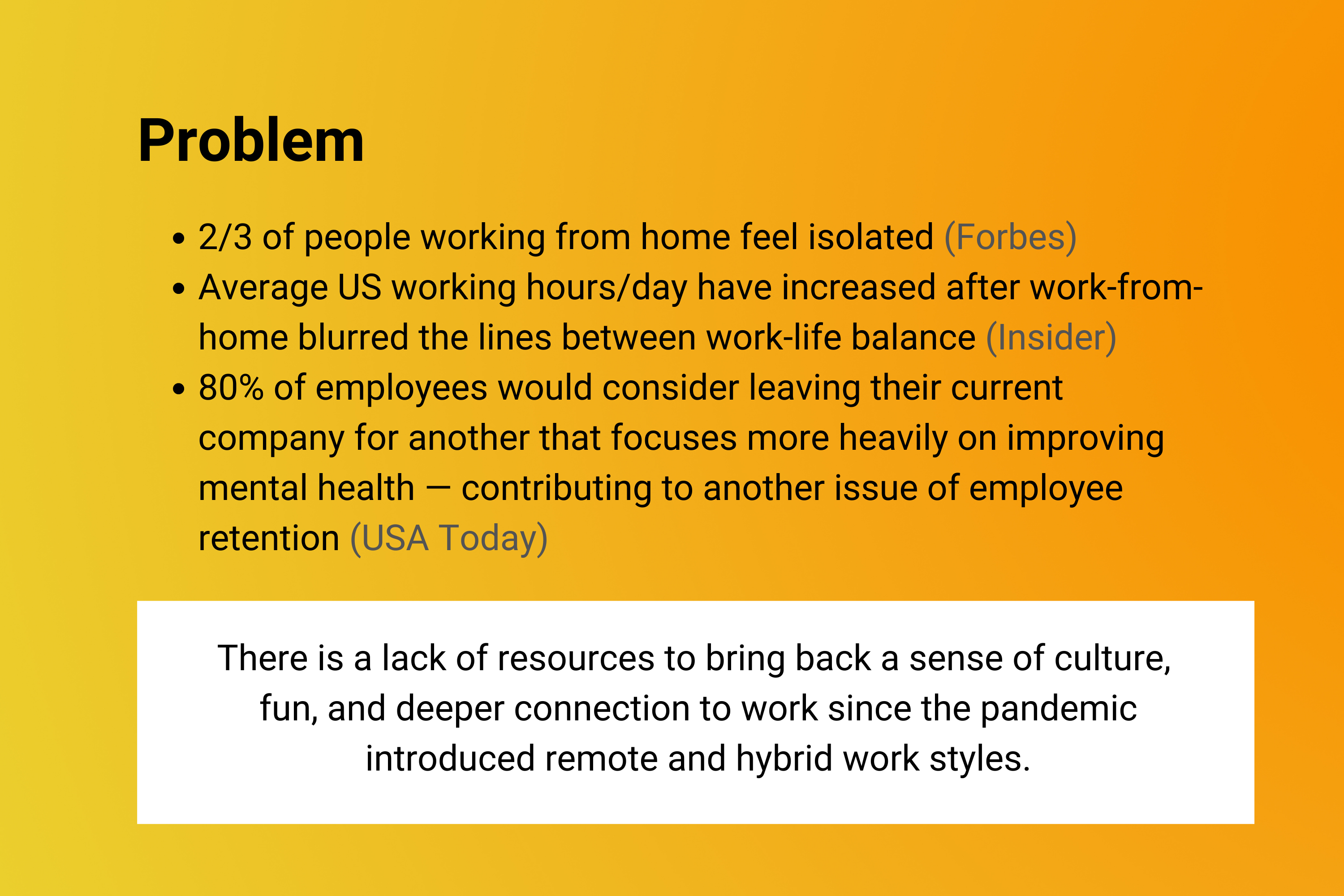
And these interviews aren’t alone. According to Forbes, almost two-thirds of people working from home feel isolated or lonely at least sometimes, and nearly 20% do all the time. This is largely due to US working hours reported by Insider to have increased an extra three hours per day when blurring the lines between work-life balance. Given the ease of switching jobs in a virtual setting, USA Today reports that 80% of employees would consider leaving their current company for another that focuses more heavily on improving their mental health — contributing to another issue of employee retention. Despite work-from-home becoming more prominent and technology making us more independent, there is a lack of resources to bring back a sense of culture, fun, and deeper connection employees feel to their companies.
Idea 💥
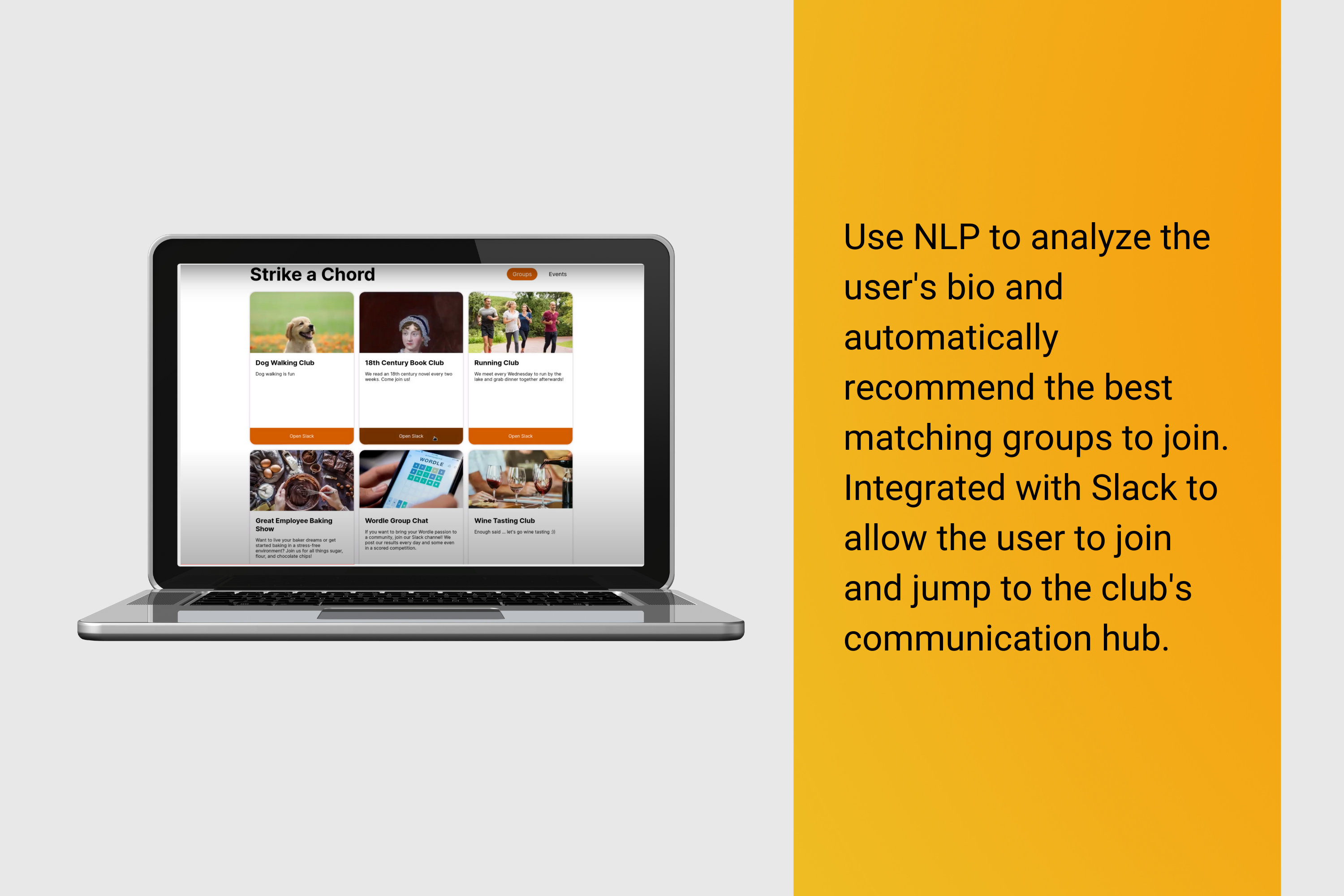
Chord is a web application designed to empower employees to create their own cultural, identity, or interest groups at their companies to bring together coworkers they know or might have never met.
Companies can use Chord as a core method to improve company culture using ML so employees are actually interacting with each other in a way they love and is meaningful. Since many people may be new or have not met many people across teams, they could use Chord to automatically recommend groups and people that match their personalities, vastly improving mental health and work-life balance!
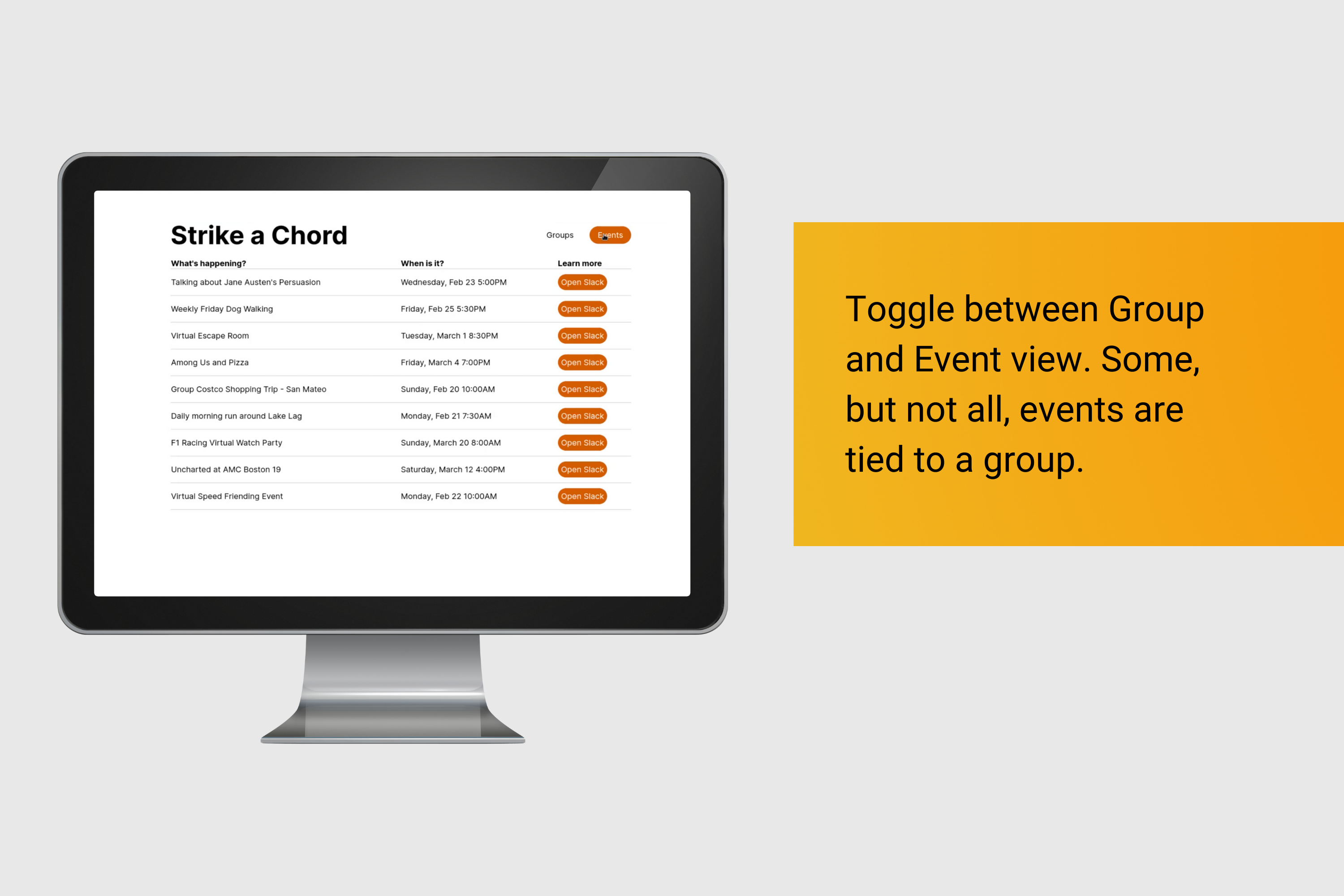
The platform supports (1) Groups and (2) Events. Groups are collections of people that have similar interests that host multiple events throughout the year. Events are single meetups, meals, or parties that can be made with a group or independently, and anyone can join directly through the list. Any employee can make a group/event, but company higher-level executives or HR can also host all their events on Chord in the case they are active or want to influence a certain broad company culture.
Our core idea comes from the definition of chord. Chord (noun) is a group of (typically three or more) notes sounded together, as a basis of harmony. People across the company can find people they are similar to, spend time together, and build memories that tie them to the mission more than just their job tasks. For companies that value deep work, they can work async for 90% of the time and use Chord to build comadre for resilience in hard times.
Validation ✅
We sent out a quick Google Form to some people we knew as we were thinking of what idea to make for the hackathon, and got some interesting insights.
To start, almost 70% said they would like to do more social events across the company teams and 100% of respondents said they enjoy social events with coworkers.
When a respondent mentioned they would host an event on behalf of the company, we asked why. Some of the responses from companies ranging in 4 to 70,000 employees include:
- “To have fun with work friends”
- “To hang out with coworkers and know them better”
- “I enjoy doing things with my coworkers”
- “Want to hang out since we don’t go to the office”
- “Want to provide a place where people can engage other aspects of their “true self” and acknowledge that not everyone, especially underrepresented communities, are able to disengage from their personal life completely while at work”
- “To promote team bonding and trust among team members”
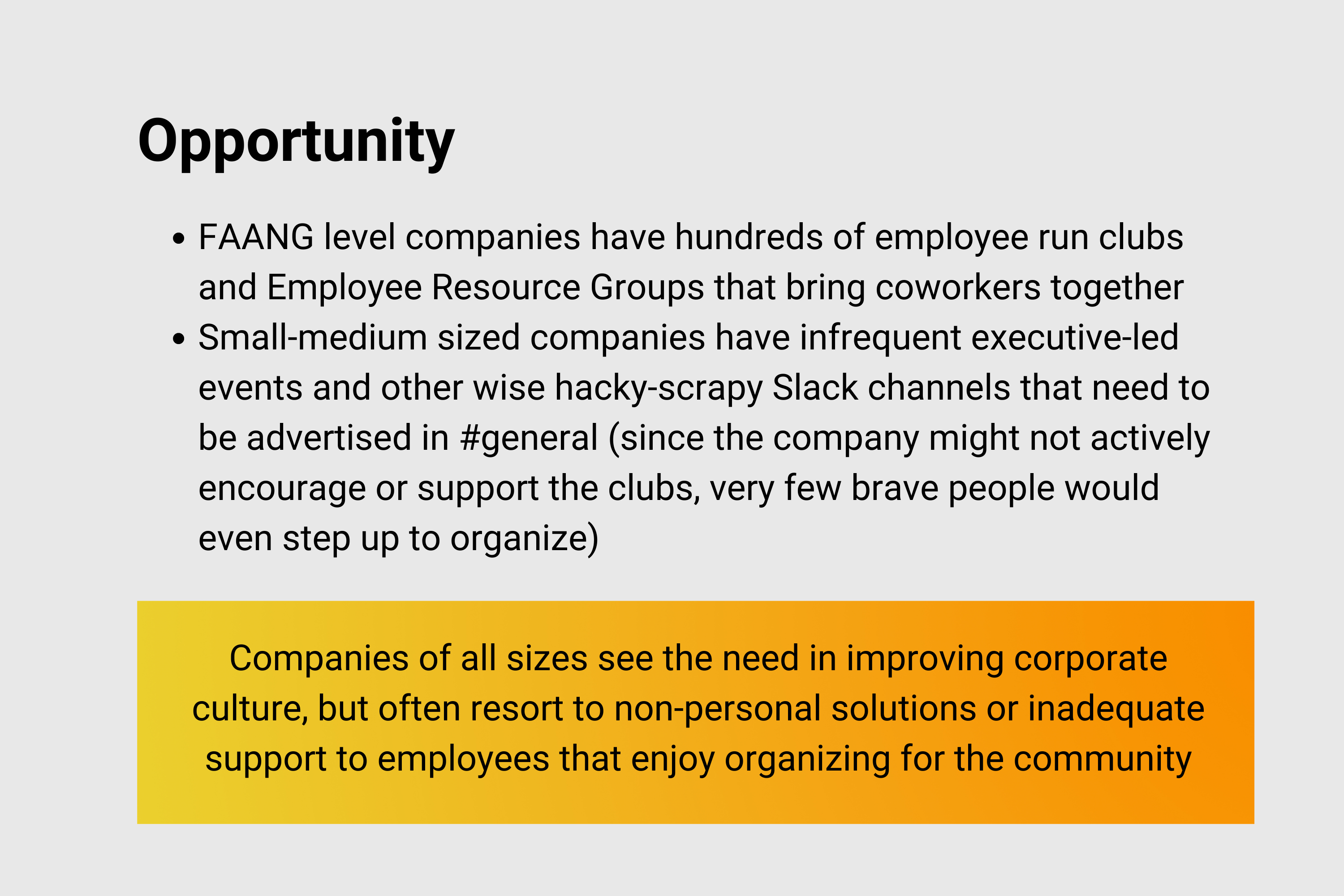
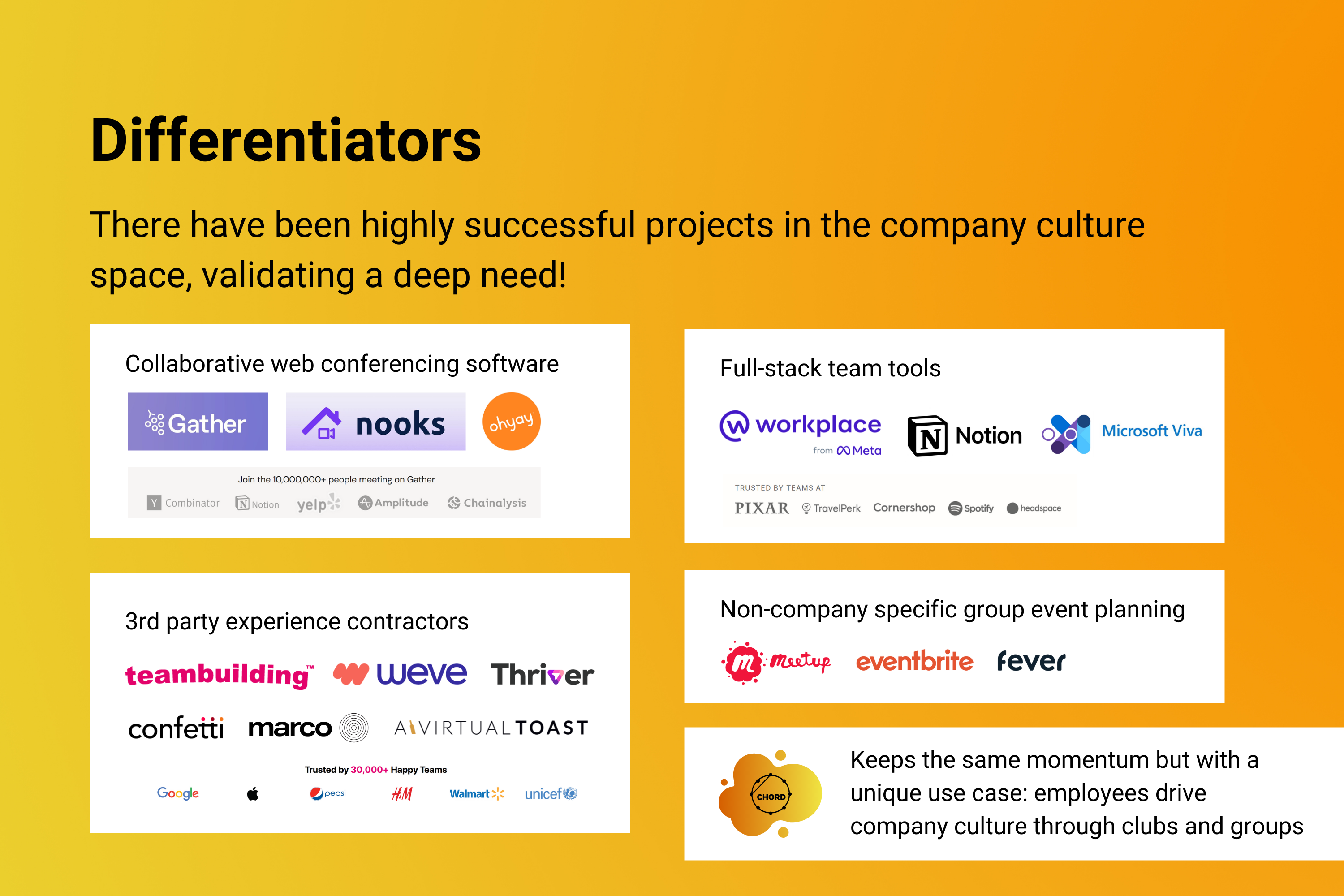
Overall, there are employees who enjoy hosting events and would love the opportunity to join in building company culture! Despite this, there are no products that allow a bottom-up approach to clubs and event planning. Perhaps this could take a lot of the load of top level executives and allow fast, organic growth of people creating and joining groups.
Users 🙌
Part 1: Joining a Group or Event
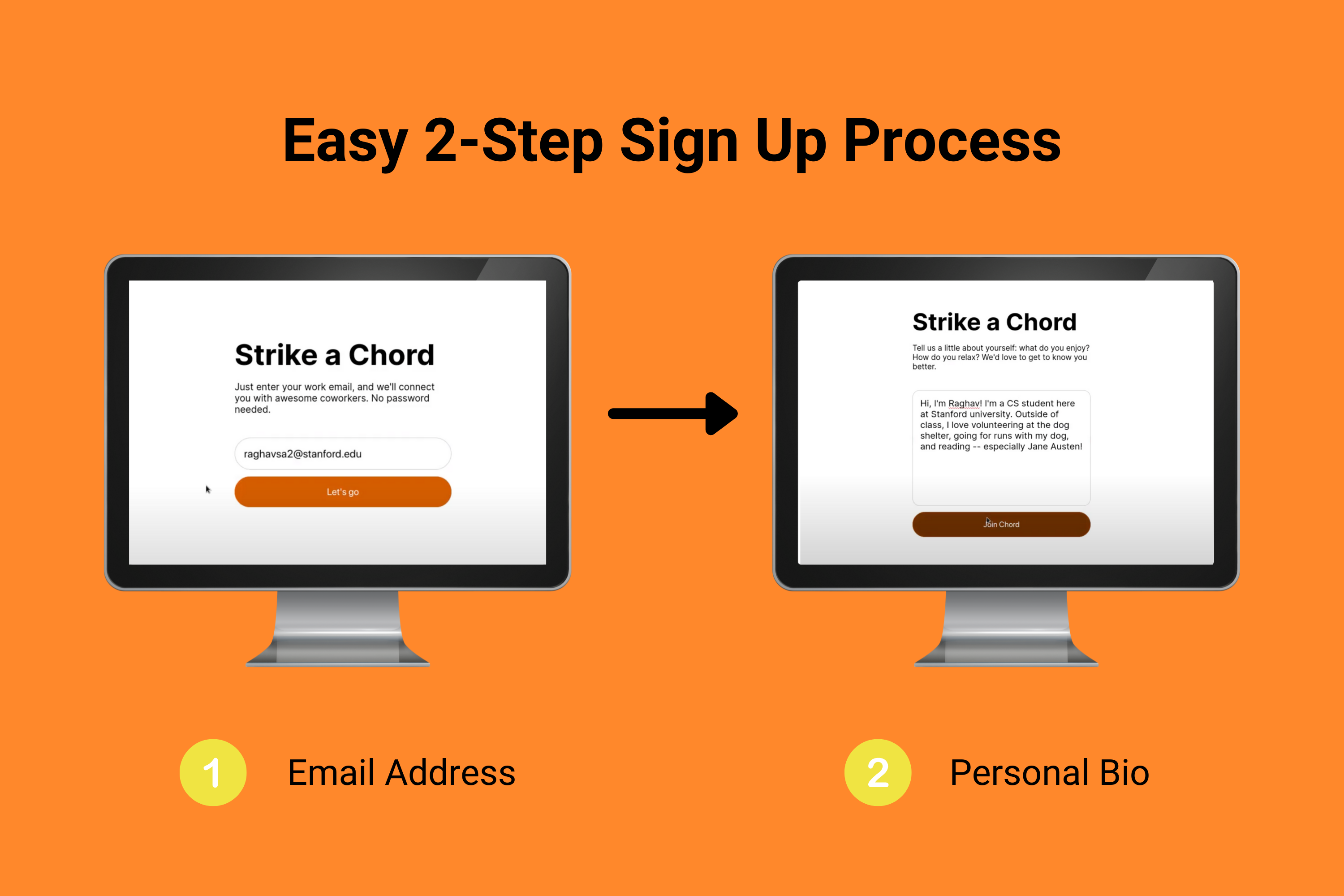
Every employee at a company should join Chord to find groups and events. With just an email and short bio, Chord will display the opportunities that the individual would be most interested in. Our recommendations would also account for if the user describes themselves as virtual, hybrid, or in-person to provide more fit results. The user can see the title, description, and possible times of each group and event to quickly join via Slack and get integrated into a community right away!
Part 2: Creating a Group or Event
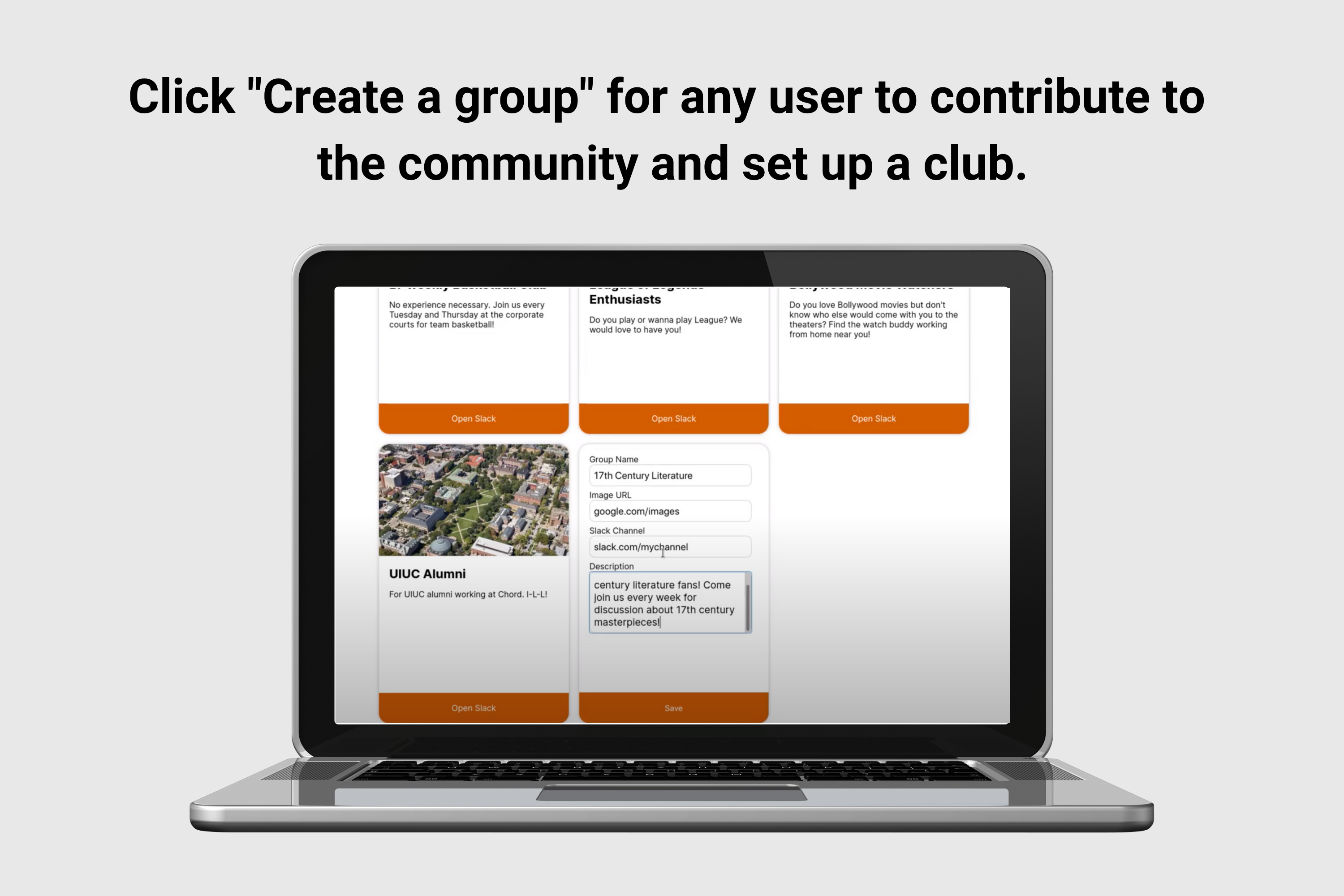
Any individual in the company who is joining groups, can create one as well. These groups can range from identity to interest groups. All they need is a name, image, description, and link to a Slack channel that co workers can easily join. The simplicity of the group creation process encourages culture creation, connecting people in everything from Costco grocery shopping to virtual F1 racing watch parties.
How we Built It 💻
Machine Learning and Security
We leveraged a self-supervised distilled model for computing sentence / paragraph representations as the backbone of our recommender engine. Using cosine similarity, we are easily able to generate scores for how aligned someone would be with a given event / meeting another person. While a great starting point, we can do better than a pretrained model by setting up a fine tuning pipeline based off of user feedback on how a meeting or event went.
This leads to a massive privacy concern, as there are mathematical techniques that can recover the training data used to finetune. This has been done before especially for large, over-parameterized language models with some examples including inferrals of specific Reddit usernames that happened to be part of GPT-3s training set. In our setup, this information we are feeding is even more sensitive as it pertains to internal corporate data.
To mitigate this, we re-worked the Hugging Face implementation of our model from the ground up to be compatible with the advanced Opacus Library developed by Meta. Opacus’s privacy engine has an implementation of Differentially Private Stochastic Gradient (DP-SGD) - an algorithm that strategically adds noise to different parts of the model at different times of the training process. By carefully setting the so-called privacy budget of this algorithm, we can ensure that our model is not over-regularized while at the same time making a data reconstruction attack computationally intractable.
We wrapped this all up in a Flask API which can be accessed by our hybrid frontend/backend.
Hybrid Frontend/Backend
We used the Remix framework to build a hybrid frontend and backend, meaning that our data fetching code was colocated with our frontend components – begone CORS! Each page consists of two to three main parts, a display (using React), a loader function (gets data from the MongoDB database and the ML prediction engine), and an action (processes form submissions). Remix automatically determines which of these to run on the server versus on the browser, and offers pre-fetching, meaning when you hover over a link, we preemptively start loading that page’s data to get you an even smoother user experience. And, with Remix’s out of the box support for edge computing through Vercel and Cloudflare Workers, when we deploy our app we’ll be able to leverage edge computing to get a response time that’s as if users were running our server directly on their laptop.
Of course, this is only one part of what makes a good user interface. According to philosopher John Rawls, the internet is a primary social good just like water – we couldn’t agree more, and that’s why we felt it was our ethical duty to make our website accessible to everyone. We used semantic HTML to ensure our website works with screen readers, and all our colors meet WCAG contrast requirements to aid visually impaired users.
What we learned 🤯
We’d never used Remix before, and it was great to learn. We especially enjoyed that it required us to follow web standards and best practices, even if that made it difficult at first as we unlearned bad habits.
It was interesting to learn that memorization is a core component of how deep models are able to be successful on long-tail datasets (Vitaly Feldman et. al.). This really motivated us on the security / differential privacy front as we messed around with the pytorch internals of Hugging Face models.
What’s next for Chord 📈
Our solution solving issues in employee culture, mental health, and retention is quite ambitious. Our prototype at the moment focuses on the core features of creating, viewing, and joining groups or events with heavy emphasis on user security and privacy first-and-foremost.
Our next additions are integrating a reimbursement system so that HR budgets can contribute to the excitement of employees running the initiatives, similar to FAANG level companies. We also hope to integrate with the user’s calendar to provide better recommendations they can attend. Ultimately, the goal is to build a platform that can integrate easily into a company's internal system so that fun activities and improved culture (whether virtual, hybrid, or in-person) is naturally embedded into their daily experiences.
Also, since our team just built the product we would love to do more user testing and feedback to get a better idea of the needs of employees and the features that would help them!
Ethics ⚖️
Work-life balance has been a top of concern for a while, but especially for the past two years. Companies rely on the dreaded morning stand-ups to make up for coworker interaction and the occasional corporate dinner to boost morale. However, these are not always interactions people care about, and often a situation is created where people would rather work alone and be isolated. But well-being and being happy with what you are doing is a core right — a right that Chord helps solve by helping companies best utilize their collaboration time so employees are interacting with each other in a way they enjoy.
However, given the ambitions of the project, it was interesting to slow down, give up some explicit UI functionality to make sure the application was more ethical. We follow the line of creating a product that is impactful to a lot of people, and just as equally to all marginalized groups without creating subgroups within the user base.
To make sure we didn’t employ an ableist mentality, we made all accessibility features a core part of the same platform everyone used. Anyone can contribute to the culture of the company regardless of employee status, demographics, or other identifying factors. Our built accessible features include all our colors meeting WCAG contrast requirements to aid visually impaired users, up to 120% zoom, adjustable font sizes, contrast and semantic HTML to be screen reader compatible.
We try not to assume technology will always make the situation better by giving employees the ability to steer groups. Furthermore, accessibility to the product can be expanded with use cases in schools, public institutions, or community organizations. Additionally, we hoped to create a tool that helps create jobs rather than take. We don’t replace employee retention teams or mitigate HR efforts, and expand the role of existing Employee Resource Groups.
One particular factor we kept in mind was security and how people could feel unsafe using the project if the AI algorithm recommendations were revealed to the company. Chord recognizes this and employs differential privacy techniques such that user data leaks are properly anonymized even when it's not on our system. Each of the groups are anonymous so you won’t know who started them or how many people are actively in a group until the user joins.
For the group and event creation, we make sure the platform is only a minimal part of the organization and introduction process. It only takes a minute to create an event and instantaneous recommendations so that this doesn’t become “yet another” tech product that pretends to help with meaningful relationships but traps users in an infinite tech spiral. Even for the case where two BFFs are joining the platform together, they can’t do much on the platform itself and will be quickly introduced to each other for an event, supporting meaningful relationships quicker.
However, we are aware that our product as it is right now, also could adversely affect certain groups. For example, we didn’t consider those who do not speak English and didn’t include text-to-speech functionality for those who are blind.
Built With
- cloudflare
- flask
- html
- huggingface
- javascript
- mongodb
- opacus
- python
- pytorch
- react
- remix
- typescript
- vercel


Log in or sign up for Devpost to join the conversation.