Inspiration
The spark for Cholo Shikhi came from a simple but powerful idea: What if we could bring the benefits of one-to-one tutoring to every student, everywhere? Inspired by the "Bloom's 2 Sigma Problem," which shows that personalized tutoring can skyrocket a student’s performance, we wanted to create a tool that brings that level of individualized attention into the hands of every learner. But instead of just dreaming about it, we set out to build it using cutting-edge technology.
What It Does
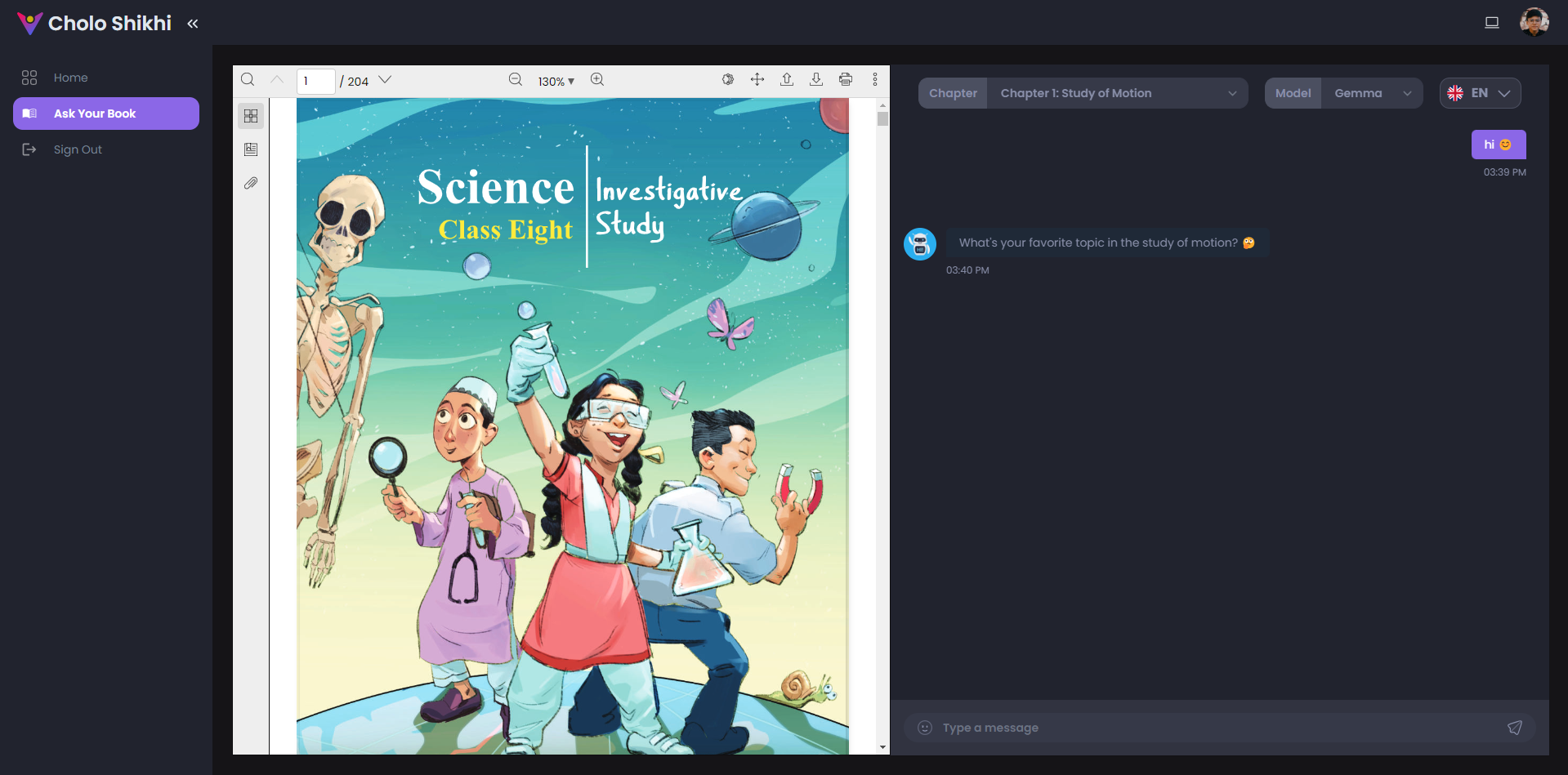
Cholo Shikhi is an intelligent, interactive learning platform designed to transform the way students interact with their study materials. The feature we're most excited about is "Ask Your Book," which lets students have real conversations with their textbooks. Imagine being able to ask your book a question and get a clear, understandable answer right through conversations—no more flipping pages in frustration or endlessly searching the web.
How We Built It
- Python: Handles the llm responses from llama 3.1 (Hosted on Google Cloud and accessed with the requests library), and gemma 2:2b run locally on the computer.
- Flask: Used to run the Python server.
- LangChain: To run RAG on pdf chapters with gemma2:2b on the local machine.
- ReactJS: Delivers a seamless, interactive user interface.
- Redux: Keeps the app’s state under control.
- TypeScript: Helps ensure that the types of variables and functions are consistent throughout the codebase.
Now, here’s where we made a crucial choice: We decided to use open-source models like Gemma and LLaMA 3.1. Why? First, they’re cost-effective—we don’t need to worry about racking up massive bills to provide a high-quality experience. Second, they’re flexible and accessible—these models can run efficiently on various platforms, allowing for fast, responsive answers. The Gemma 2:2b is even run on the local machine and the responses are quite fast and accurate.
Challenges We Ran Into
Building Cholo Shikhi was as much about learning as it was about creating. We decided to take on some new tools like Redux, and TypeScript —all of which were uncharted territory for us. Another big hurdle was getting the models to run quickly and efficiently. We wanted Cholo Shikhi to feel responsive, like it was right there with you as you study. It took a lot of tweaking to find the right balance between speed and performance.
What’s Next for Cholo Shikhi
Next up, we’re working on adding Multilingual Support and Advanced Analytics to make Cholo Shikhi even more powerful and useful for students around the world.

Log in or sign up for Devpost to join the conversation.