-
-
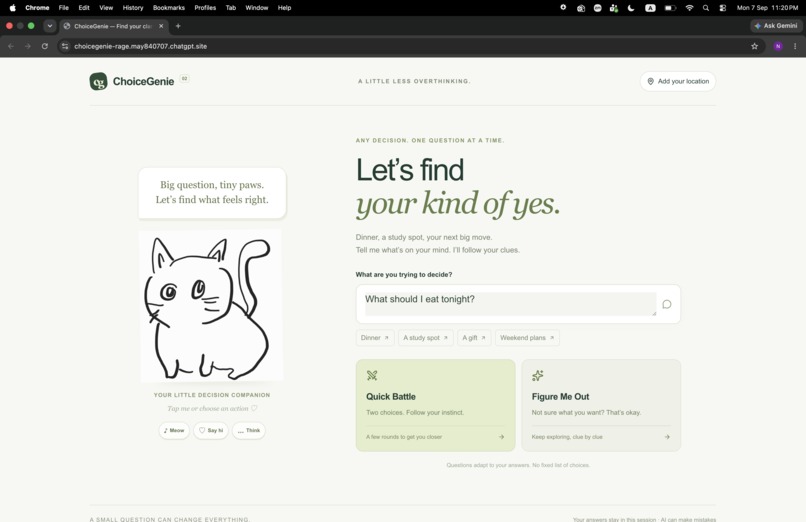
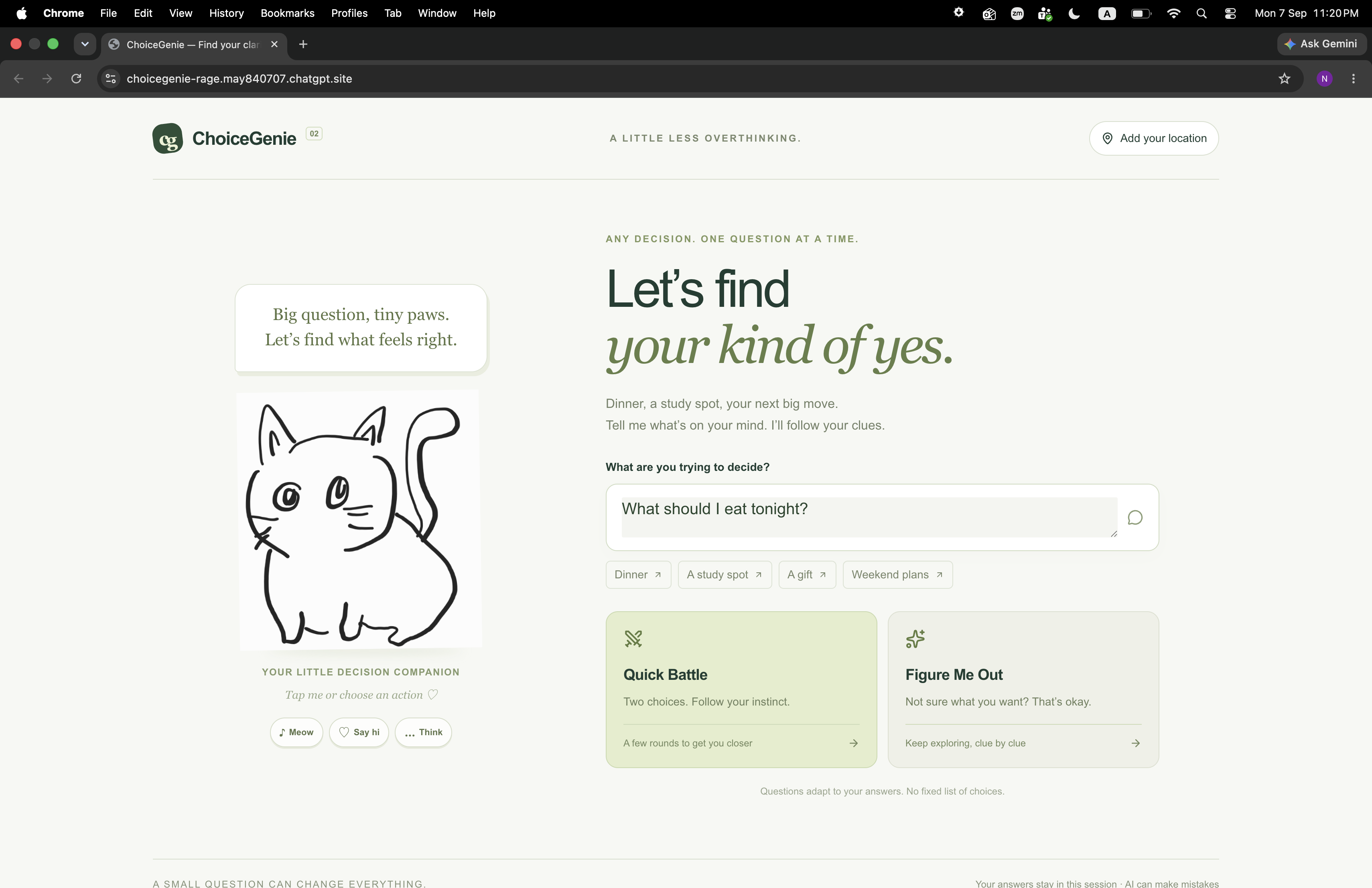
ChoiceGenie Hompage
-
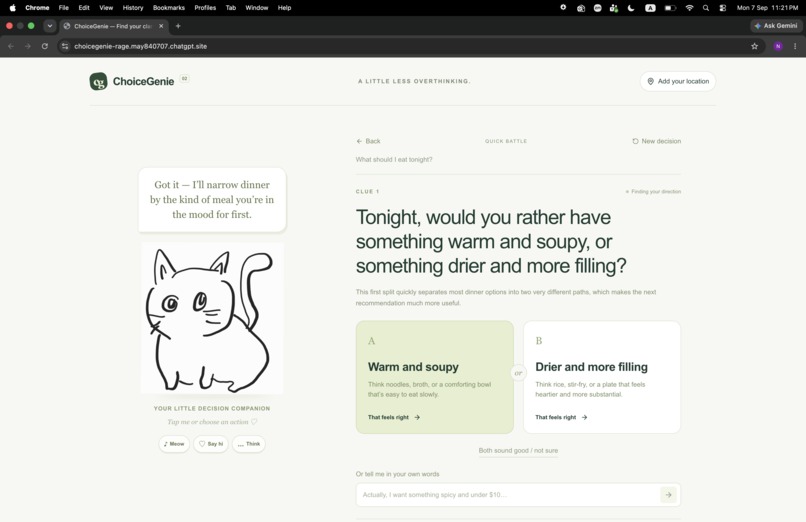
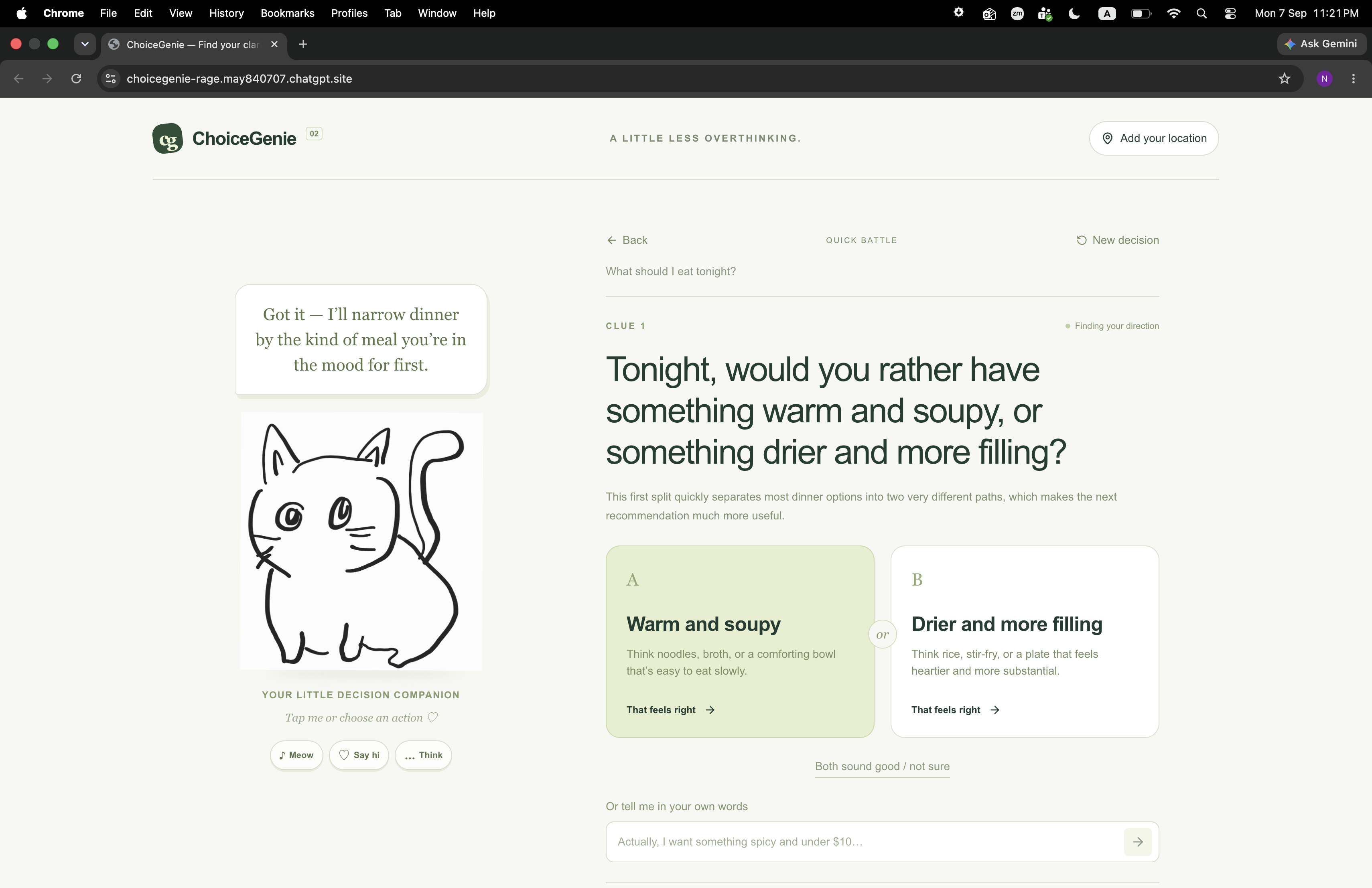
Quick Battle Tradeoff
-
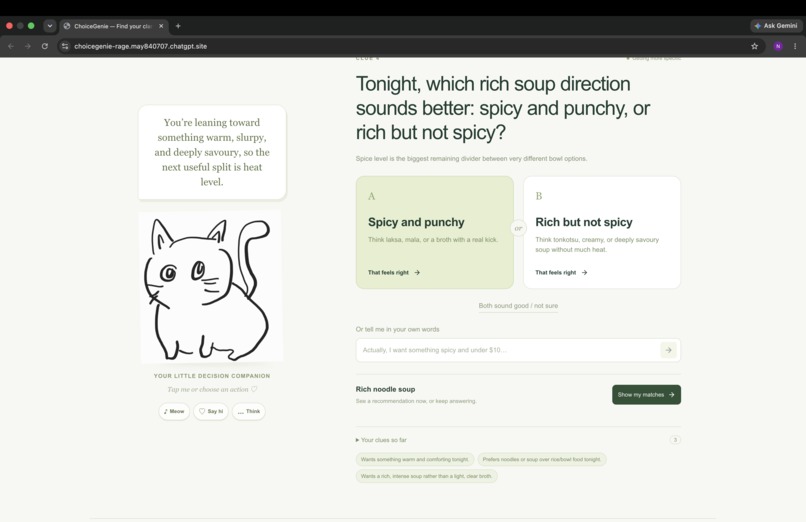
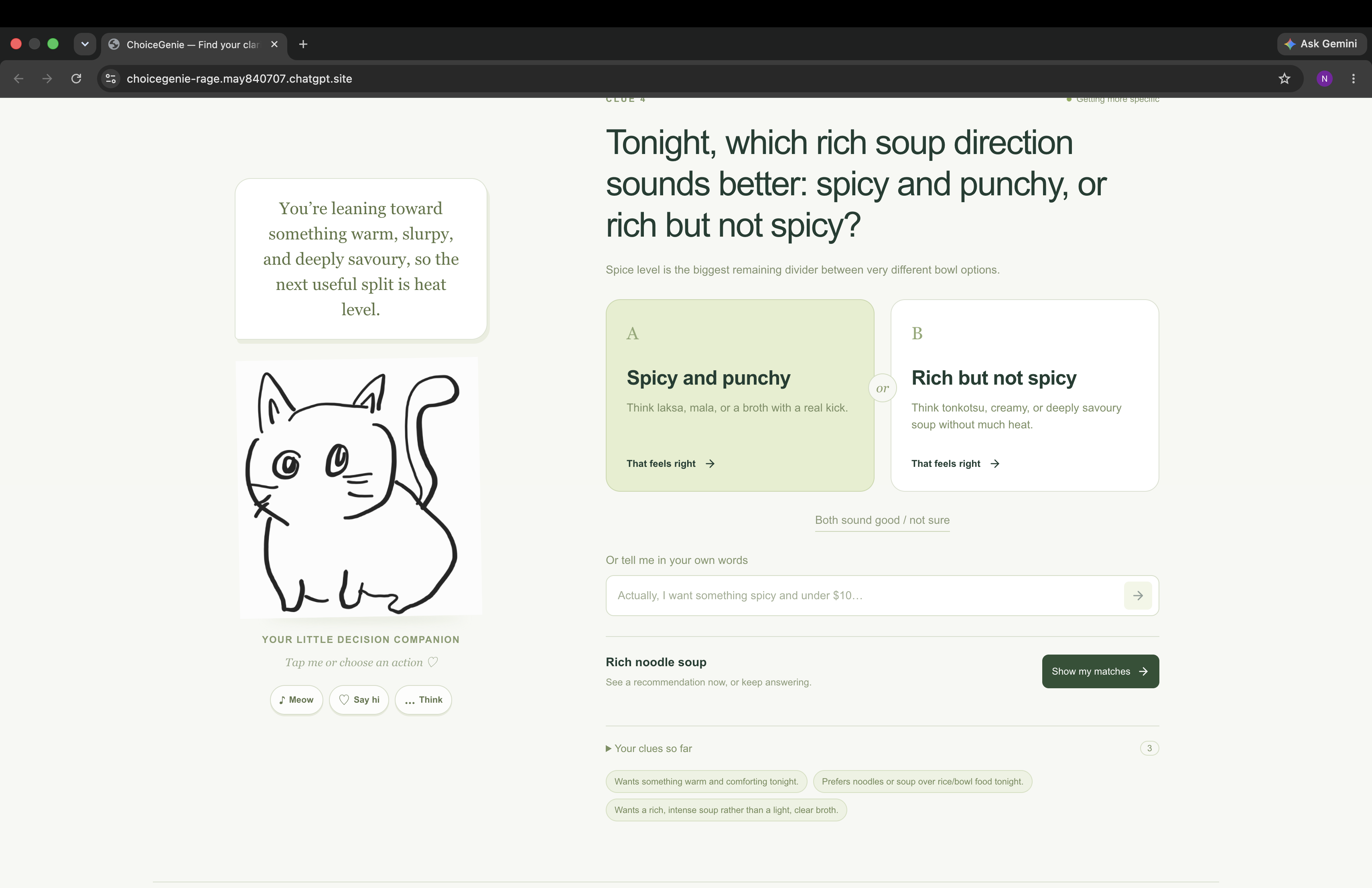
Quick Battle becomes Specific
-
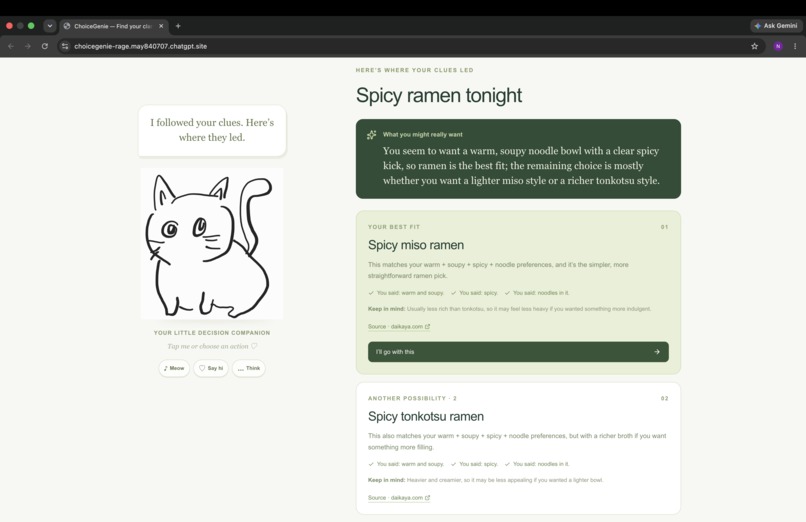
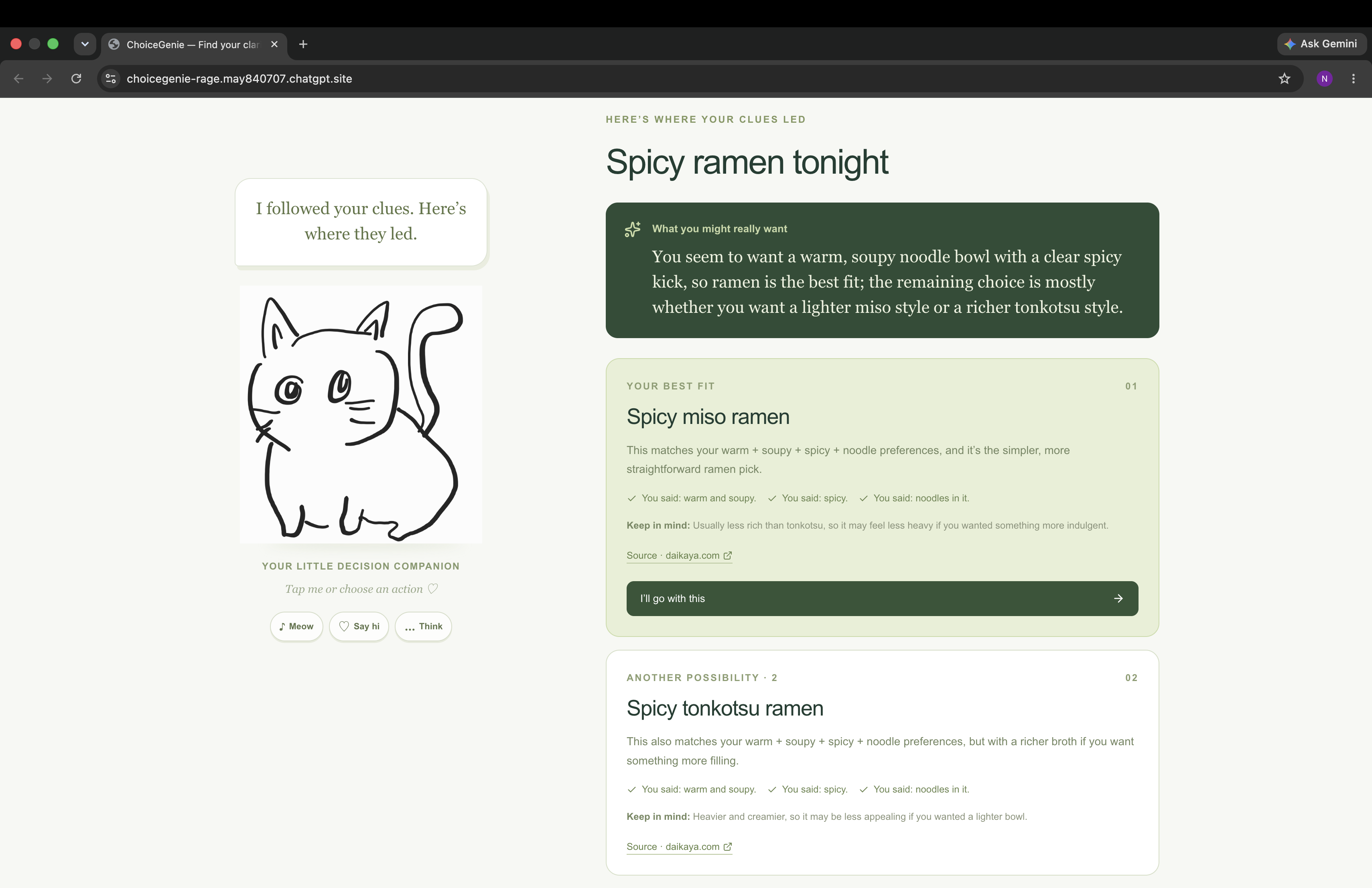
Quick Battle Final Recommendation
-
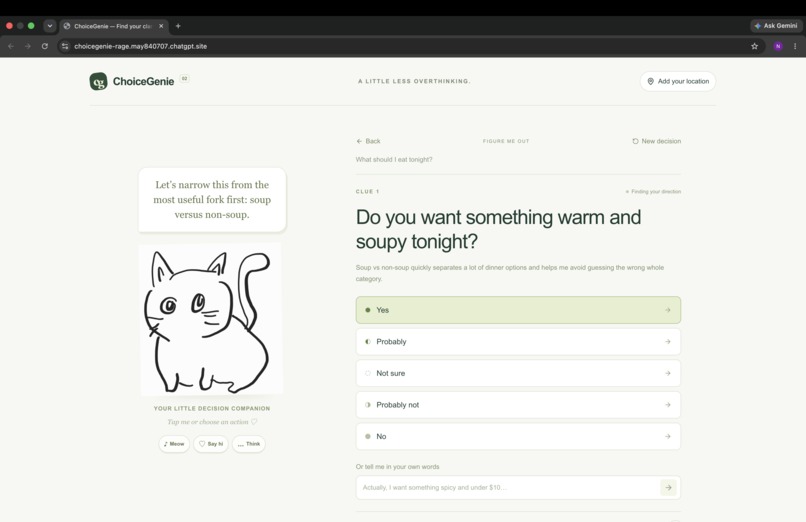
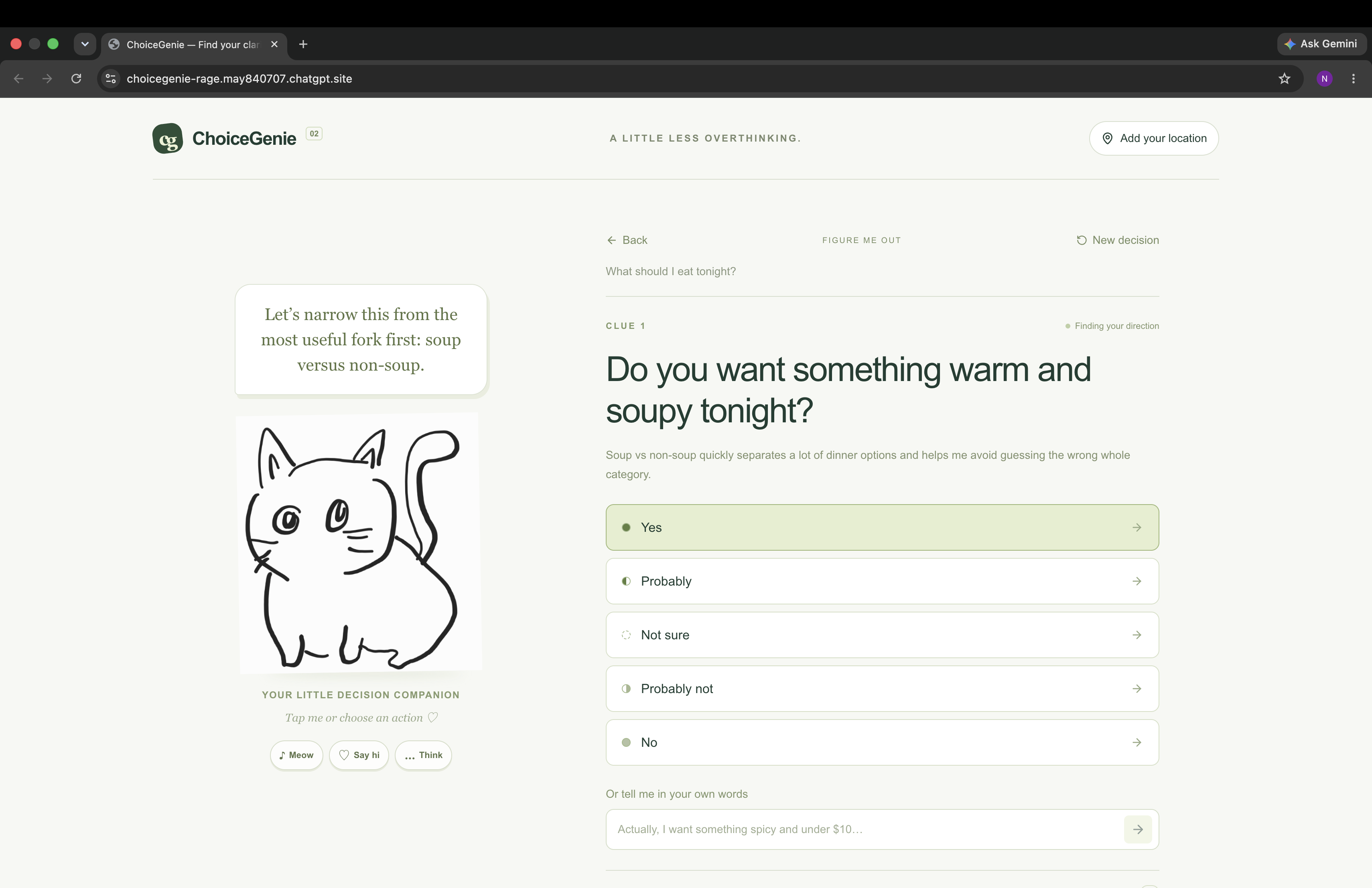
Figure Me Out
-
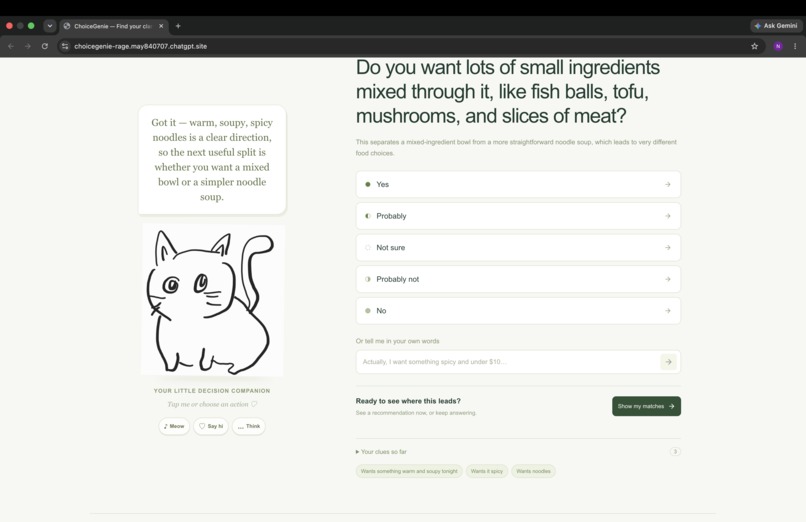
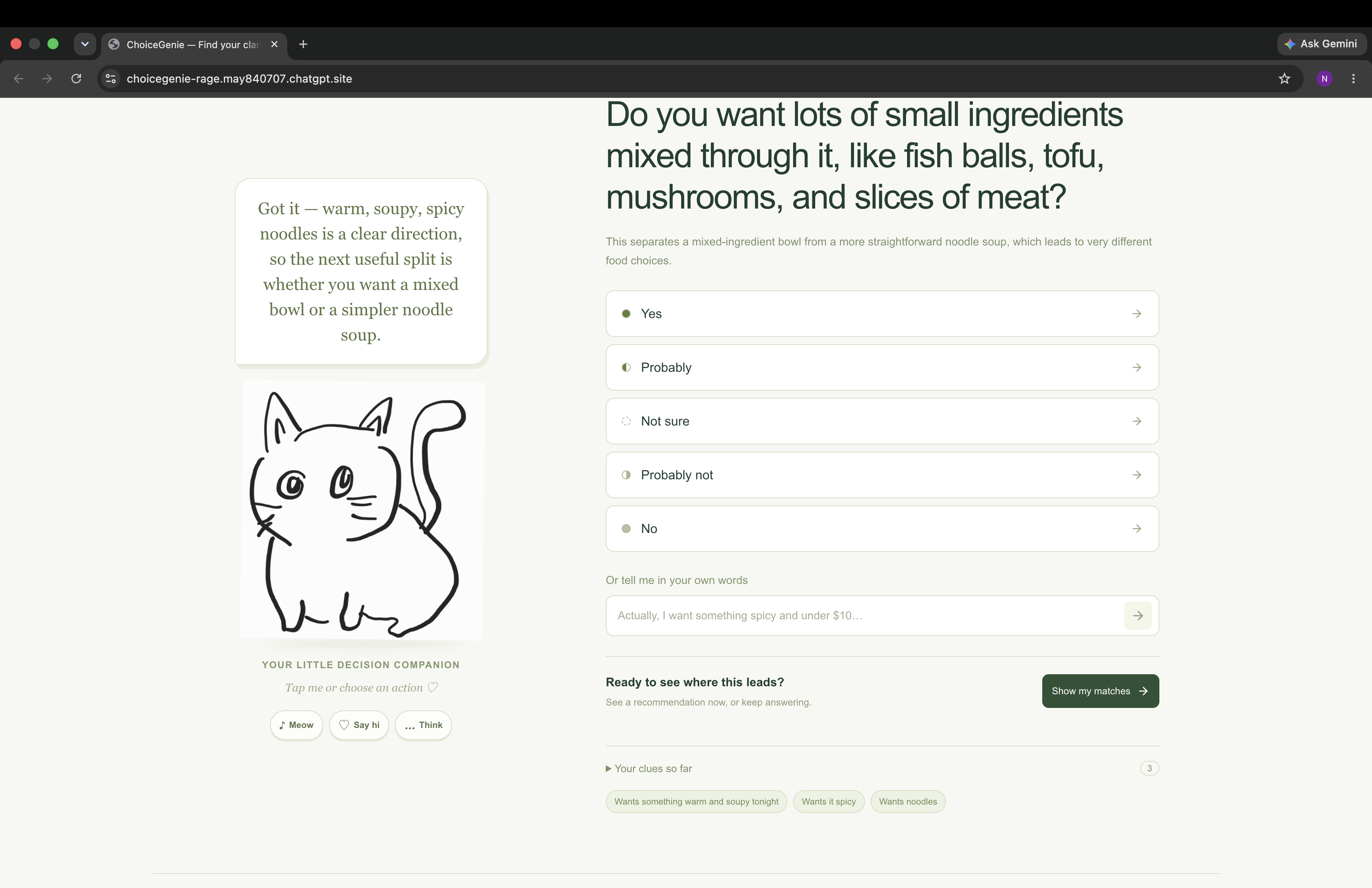
Figure Me Out becomes Specific
-
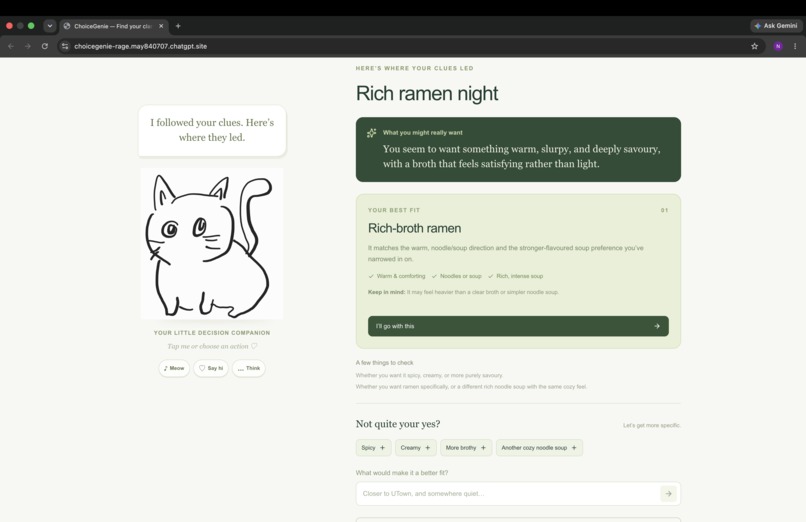
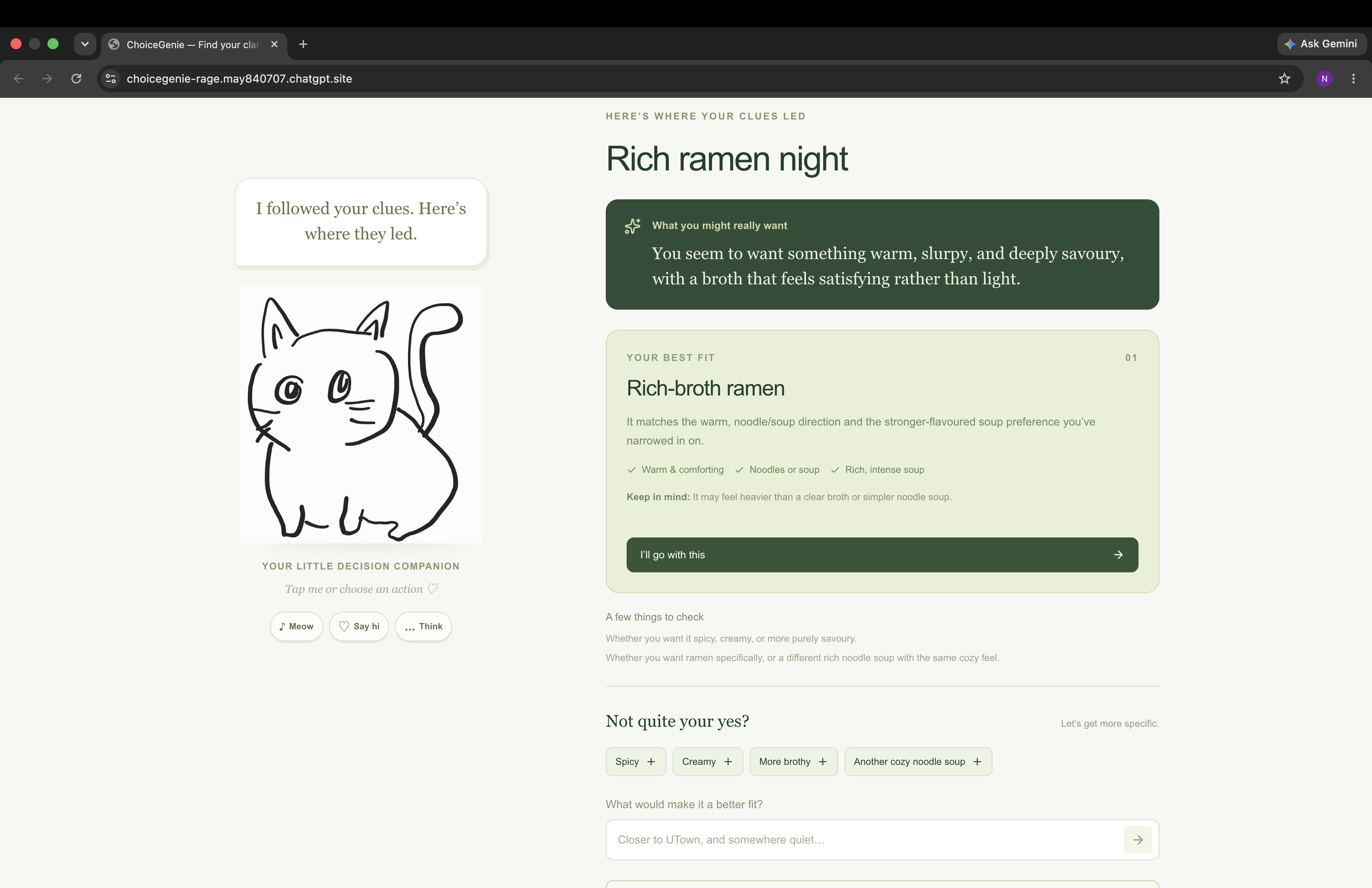
Figure Me Out Final Recommendation
-
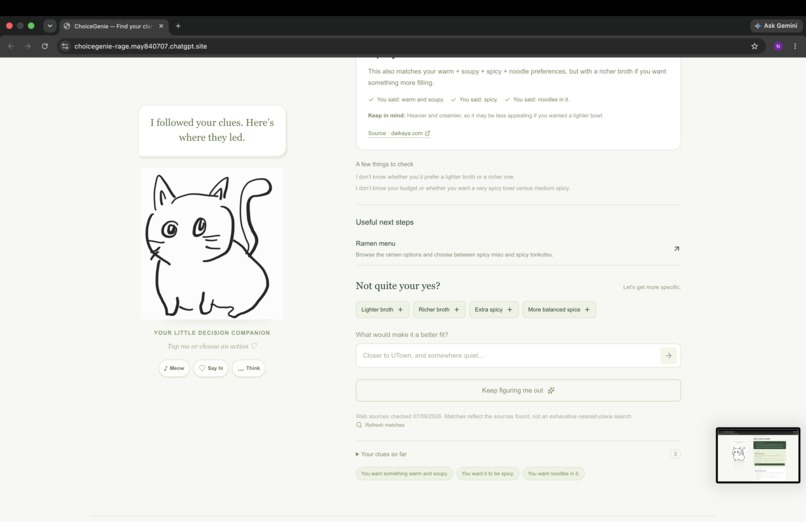
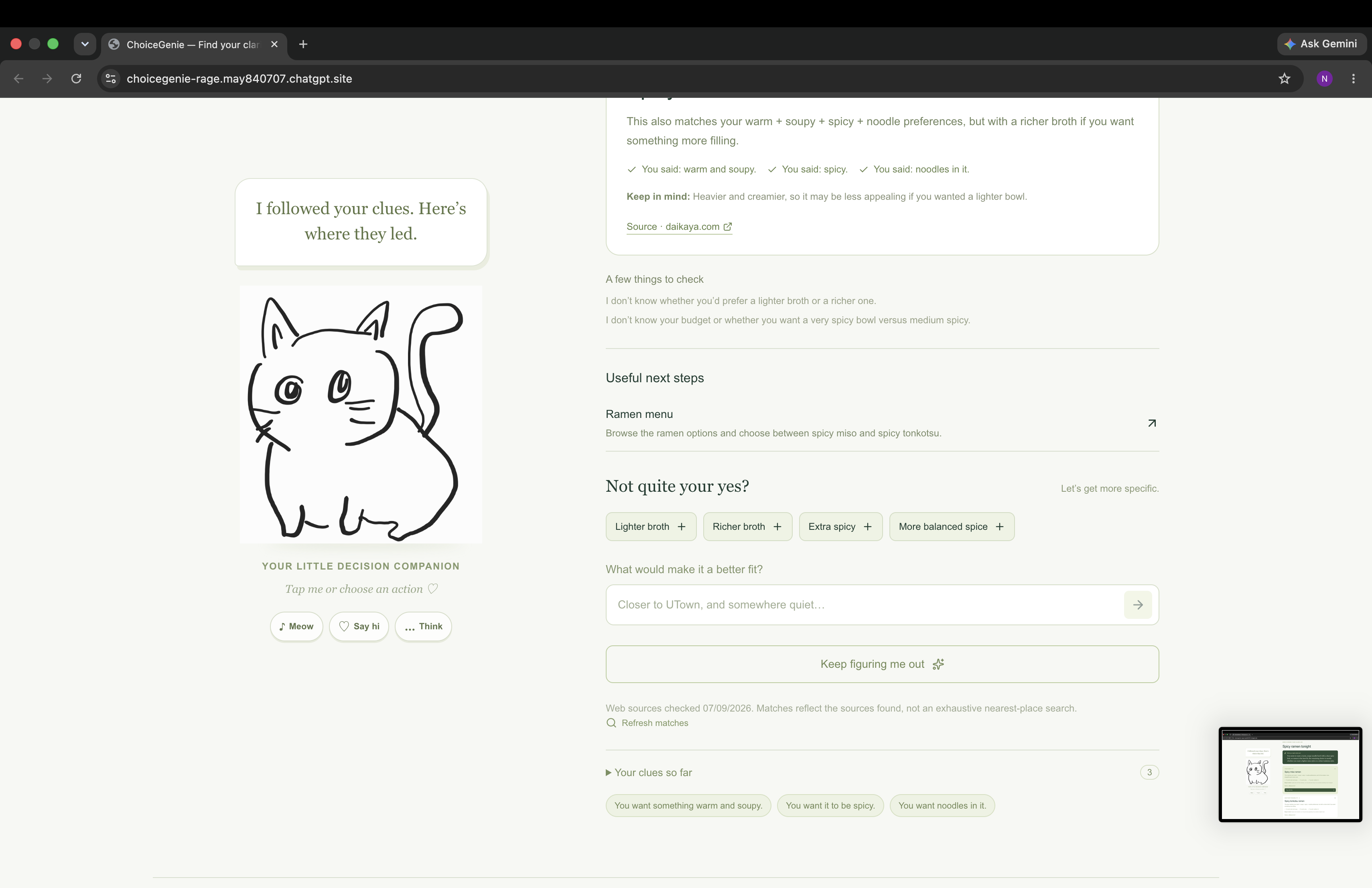
Useful Next Steps / Not Quite Your Yes?
Inspiration
Somehow, the smallest decisions can take the longest.
“What should I eat tonight?” “Where should I study?” “What should my friends and I do this weekend?”
We compare options, change our minds, and sometimes delay the decision until it is too late. Most decision tools ask users to list criteria or explain exactly what they want. That is difficult when the user has not figured out their preferences yet.
ChoiceGenie was inspired by Akinator’s question-based experience. We wondered: what if an app could discover what someone wants by asking small, easy questions?
That idea became ChoiceGenie, a playful decision companion guided by a curious paper cat.
What it does
ChoiceGenie starts with one question:
What are you trying to decide?
It can help with dinner, study locations, gifts, weekend plans, purchases, travel, and other everyday choices. The user can choose between two experiences.
Quick Battle
Quick Battle is for users who want help quickly. It presents two choices at a time, such as:
Cheap and nearby or more expensive and excellent?
Comfort food or something new?
Ramen or mala?
Every choice gives ChoiceGenie another clue about what matters to the user. After a few battles, the user can continue narrowing the options or see the result.
Users can also choose Both good / Don’t know. Sometimes rejecting both options creates the most useful moment. A user comparing rice and noodles might suddenly realise, “Actually, I want salad.”
That still means ChoiceGenie worked. Our goal is to help users reach clarity, even when their final answer was never suggested by the app.
Figure Me Out
Figure Me Out offers a deeper, Akinator-style conversation. Users answer each adaptive question with:
Yes
Probably
Not sure
Probably not
No
ChoiceGenie uses the complete conversation history to decide what to ask next. Users can stop whenever they feel ready and receive the best recommendation based on the clues collected so far.
The final result explains why the choice fits, reveals the user’s hidden priorities, and shows what might change the answer. When location matters, ChoiceGenie can also recommend real places with supporting sources, maps, and directions.
The paper cat makes the experience feel more personal. Users can pet it, hear it meow, ask it to say hello, or watch it think while the next question is prepared.
How we built it
We built ChoiceGenie as a responsive web application using React, Vinext, and Cloudflare.
The OpenAI Responses API powers the adaptive questions and recommendations. The app sends the user’s decision and previous answers to the server, which requests structured output that the interface can display consistently.
Quick Battle and Figure Me Out use the same underlying preference model. Each answer provides clues about priorities such as convenience, novelty, comfort, budget, and quality. The next question uses those clues instead of following a fixed decision tree.
When a recommendation requires current information, ChoiceGenie can use web search to find relevant options. Location is optional and can help the app suggest nearby places.
We kept the API key on the server and designed the conversation so users can change earlier answers. When an answer changes, ChoiceGenie removes the dependent path and builds a new one from the updated preference.
Challenges we ran into
Our biggest challenge was supporting almost any everyday decision. A fixed quiz would have been easier to build, but it would only work for topics and answers that we prepared in advance. We wanted every new question to respond to the user’s specific decision and previous answers, which required an LLM.
At first, we explored running a local LLM so ChoiceGenie could work without an external API. However, a local model would make the website much larger and slower, and we could not assume that every visitor’s device would have enough computing power to run it smoothly.
Using an online model solved those problems but introduced another challenge: the website needed an API connection. We could not place the API key directly inside the browser code because visitors could potentially access it. We therefore moved the AI requests to the server and stored the key securely as a hosting secret.
We also had to balance speed and depth. Some users want an immediate recommendation, while others need more questions before they understand what they want. Quick Battle and Figure Me Out provide these two experiences without showing users complicated technical modes.
Another challenge was handling uncertainty. People do not always prefer one option, so forcing a choice could produce a misleading result. Adding Both good / Don’t know and five levels of answers allowed ChoiceGenie to treat uncertainty as useful information.
Finally, we wanted every result to feel trustworthy. ChoiceGenie explains what it learned from the answers, identifies the preferences behind its recommendation, and provides supporting sources when it suggests real places.
Accomplishments that we're proud of
We are proud that ChoiceGenie can support open-ended decisions instead of relying on a fixed catalogue.
We combined three ideas into one experience:
Decision Battle quickly learns preferences through comparisons.
Preference Akinator explores what the user wants through adaptive questions.
Hidden-preference reveal explains the deeper need behind the recommendation.
We are also proud that the user remains in control. They can give an uncertain answer, edit an earlier response, continue narrowing the result, or stop as soon as they discover their own answer.
The interactive paper cat gave ChoiceGenie its own personality without distracting from its purpose. It turns a stressful decision into a lighter and more enjoyable conversation.
What we learned
We learned that people often find it easier to react to concrete choices than to explain their preferences directly.
A question like “What matters to you?” can feel difficult. A comparison like “five minutes away with average food or twenty minutes away with excellent food?” is much easier to answer. That single choice can reveal whether convenience or quality matters more at that moment.
We also learned that a recommendation does not need to be the only measure of success. If a user rejects both options and discovers a completely different answer, the app has still helped them make a decision.
Most importantly, we learned that good decision support should reduce mental effort while keeping the reasoning understandable.
What's next for ChoiceGenie
Next, we want ChoiceGenie to remember preferences across sessions with the user’s permission. It could learn that someone usually values convenience on weekdays but prefers novelty on weekends.
We also want to support shared decisions. Friends could answer the same questions, and ChoiceGenie could find an option that balances everyone’s preferences.
Future versions could offer more specialised experiences for purchases, travel planning, study locations, and larger life decisions. We would also like to improve the paper cat with more reactions and animations as the conversation changes.
Our long-term goal is simple: when someone feels stuck, ChoiceGenie should help them move forward with a few tiny questions.
Built With
- css
- javascript
- typescript
- vinext
- vite

Log in or sign up for Devpost to join the conversation.