-
-
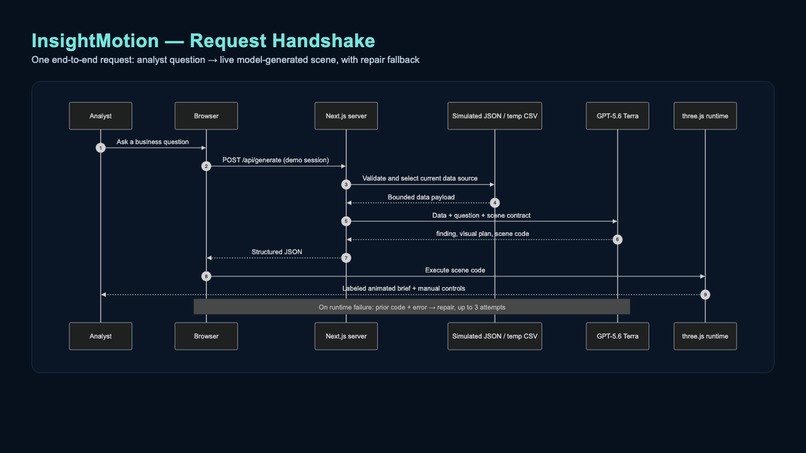
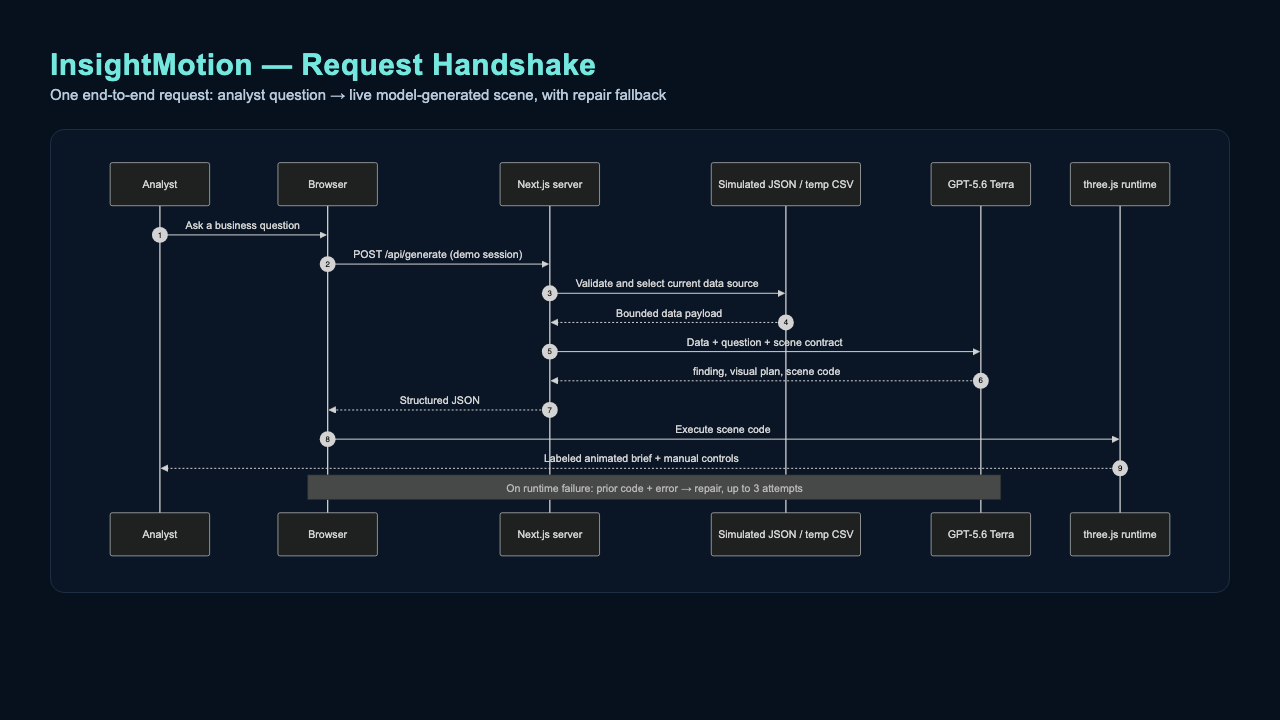
Handshake
-
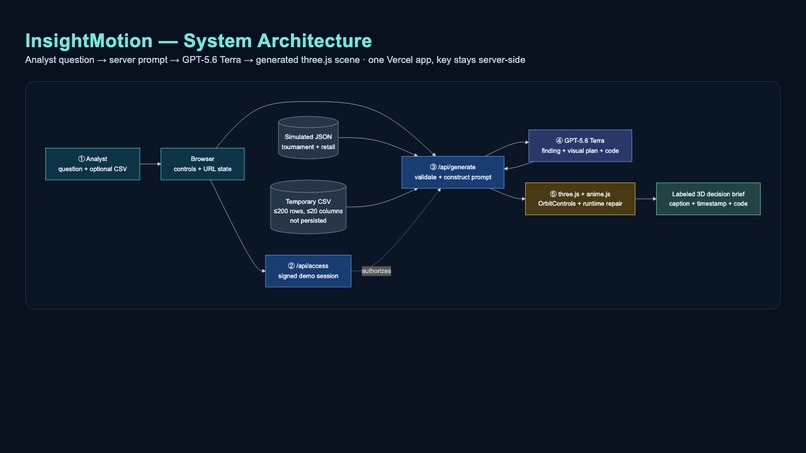
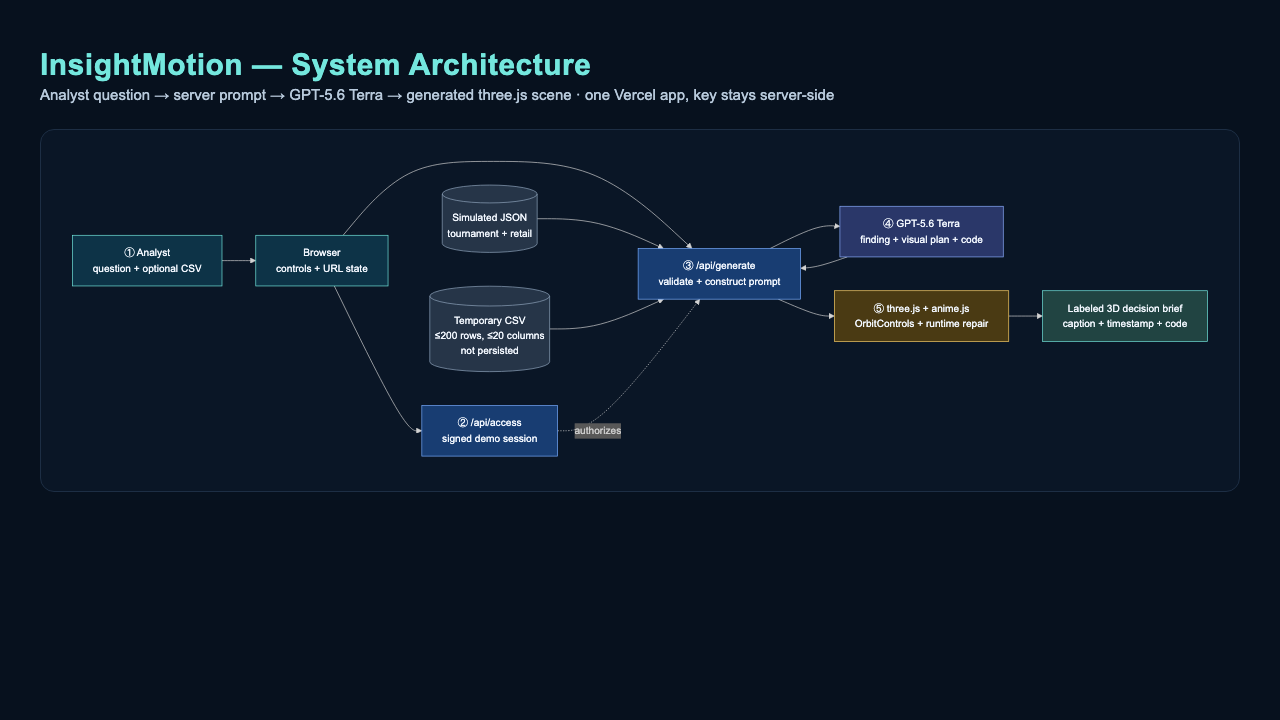
Architecture
-
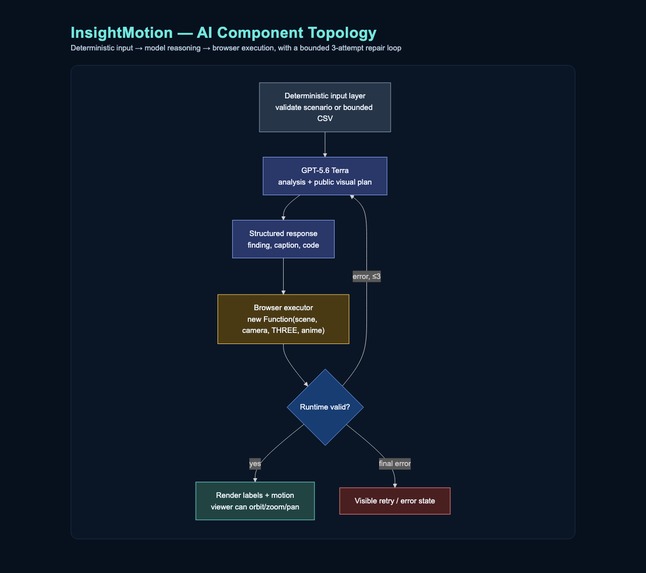
GPT AI Topology
-
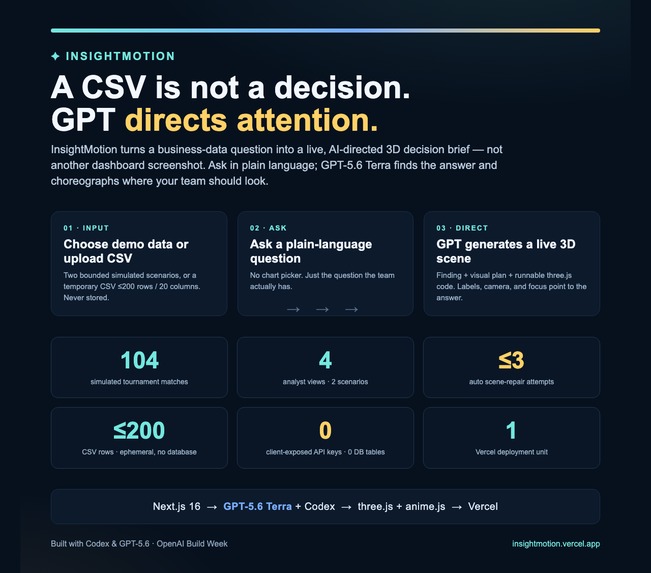
Infographic
-
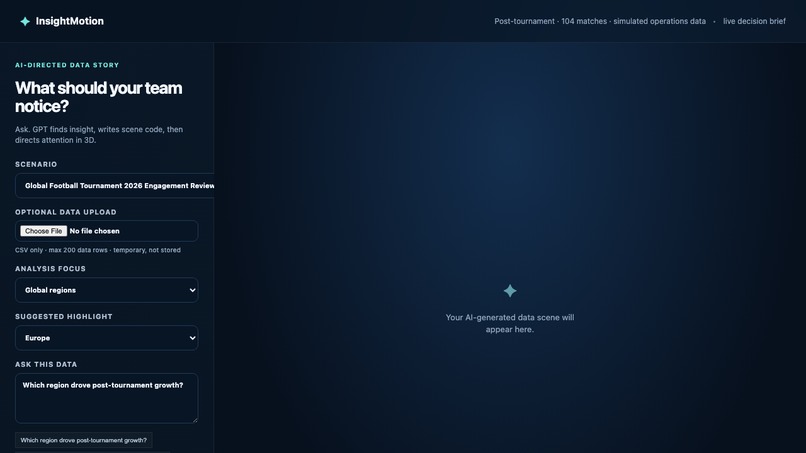
App workspace
-
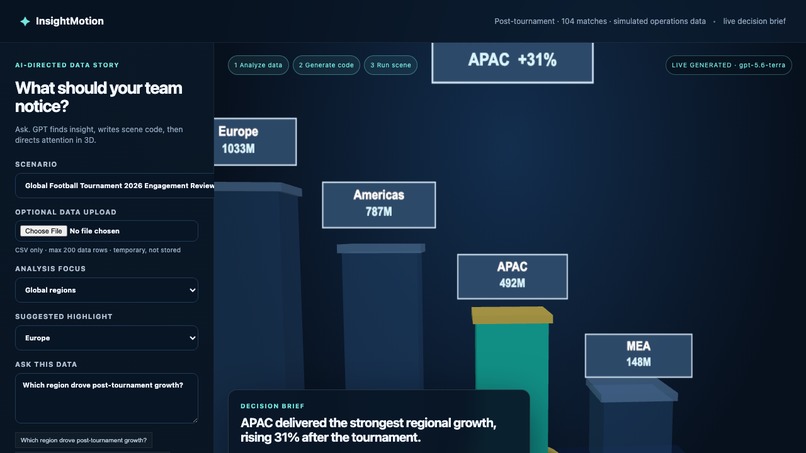
App with Scene
InsightMotion
InsightMotion turns a CSV or business-data question into a live, AI-directed 3D decision brief — not another dashboard screenshot.
Inspiration
Every team is drowning in dashboards, yet the same thing still happens in the Monday review: the data's all there, and someone still has to figure out which chart matters, spot what actually changed, and then walk everyone to it — usually by pasting a screenshot into Slack. By the time it's shared, it's stale, and it's lost the question that made it matter in the first place.
I realized the bottleneck was never the chart. It was the two human steps around it — finding the insight, and directing attention to it. Those are exactly the two things GPT-5.6 is now good at, together: it can reason over the data to find what matters, and choreograph how someone should see it. And because it writes code, it doesn't just describe the answer — it generates a runnable scene that moves your eye straight to it.
So instead of one more tool that answers "what are the numbers," we built the one that answers "where should we look, and why" — generated live, per question, as an explorable 3D brief. That loop only became possible now.
What it does
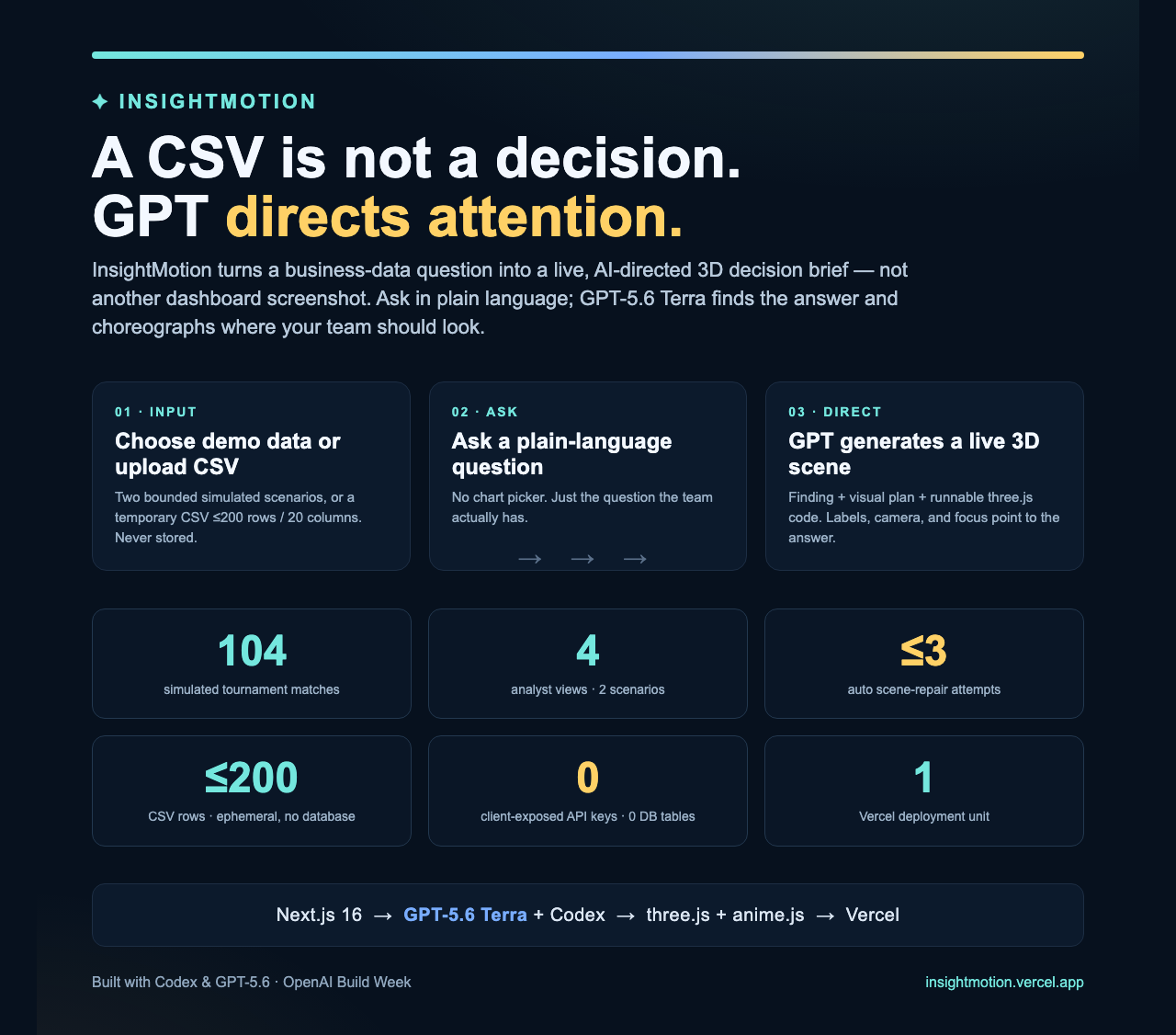
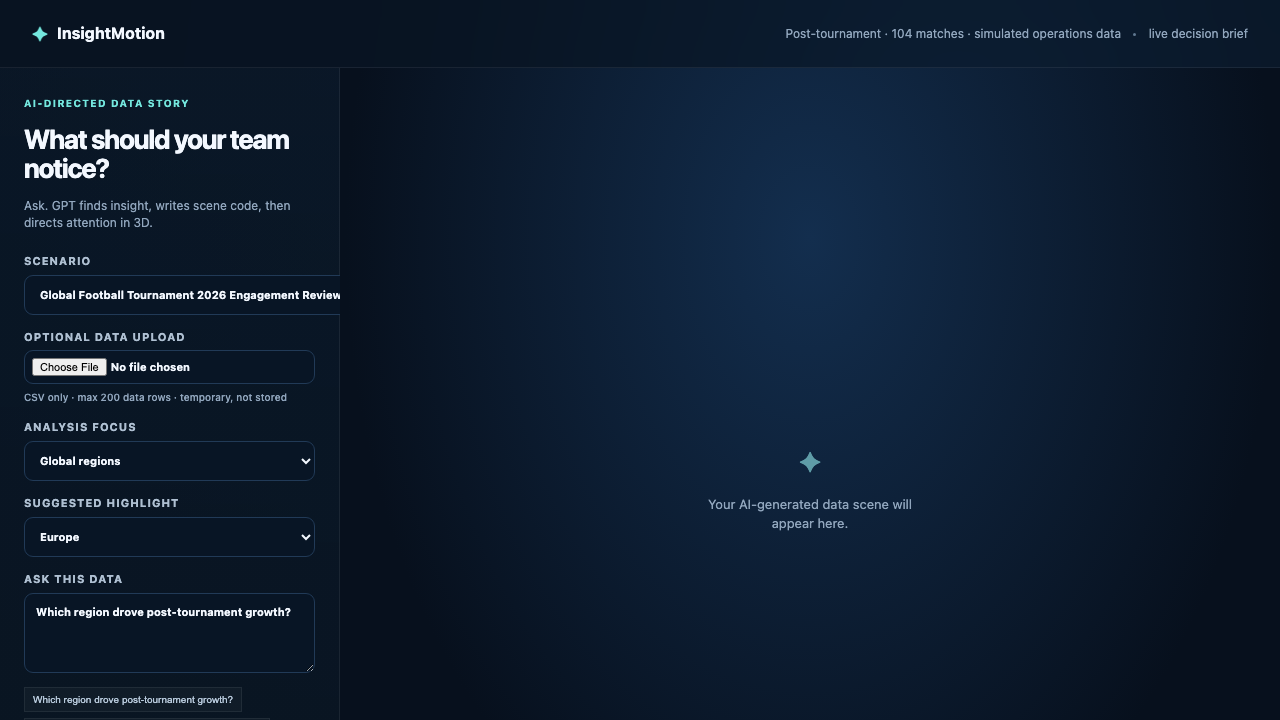
- Start with a repeatable simulated business dataset, or upload a temporary CSV (up to 200 rows and 20 columns).
- Ask a normal business question in plain language.
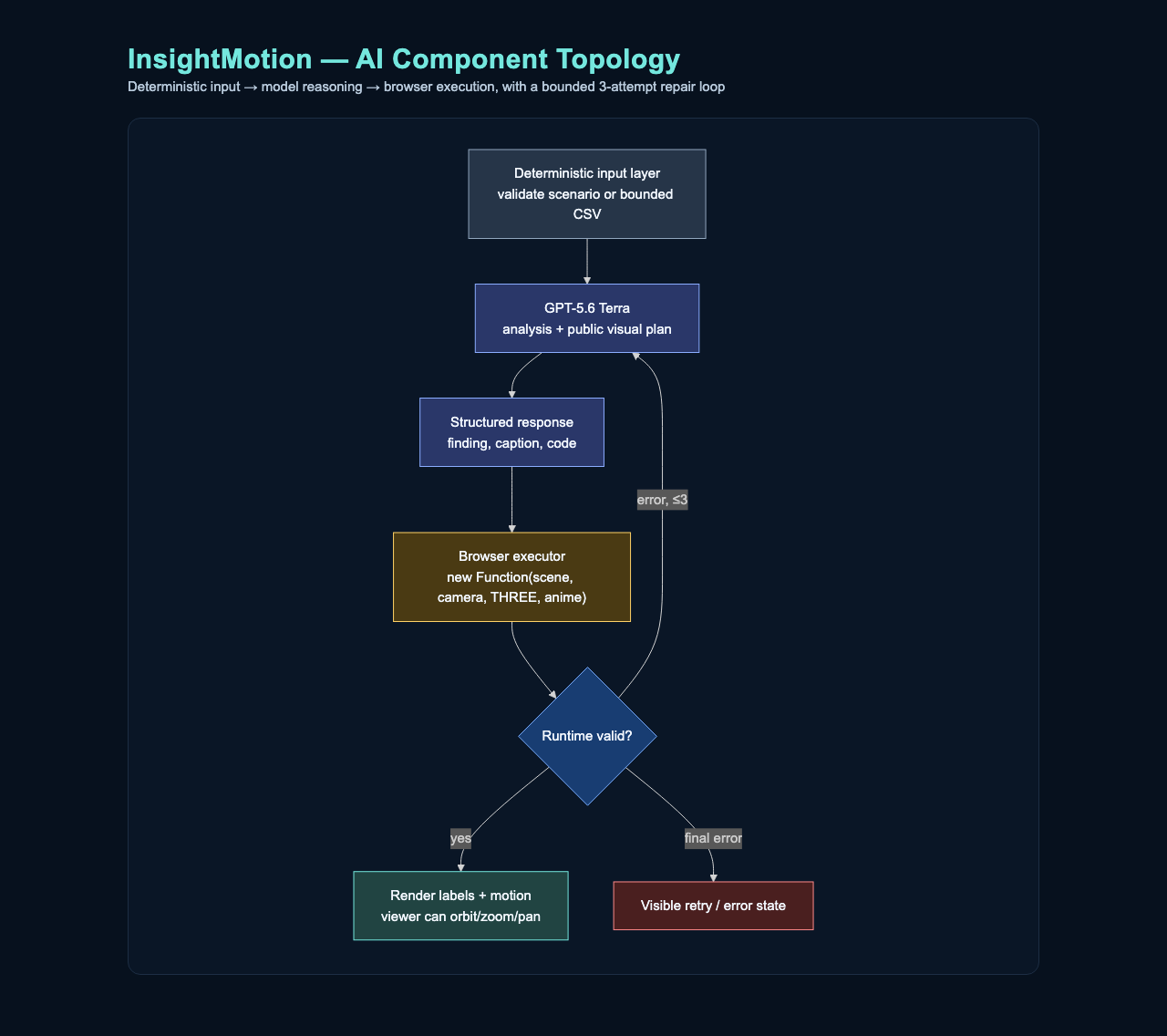
- GPT-5.6 Terra analyzes the current data and question, writes a concise finding and public visual direction, then generates executable three.js/anime.js scene code.
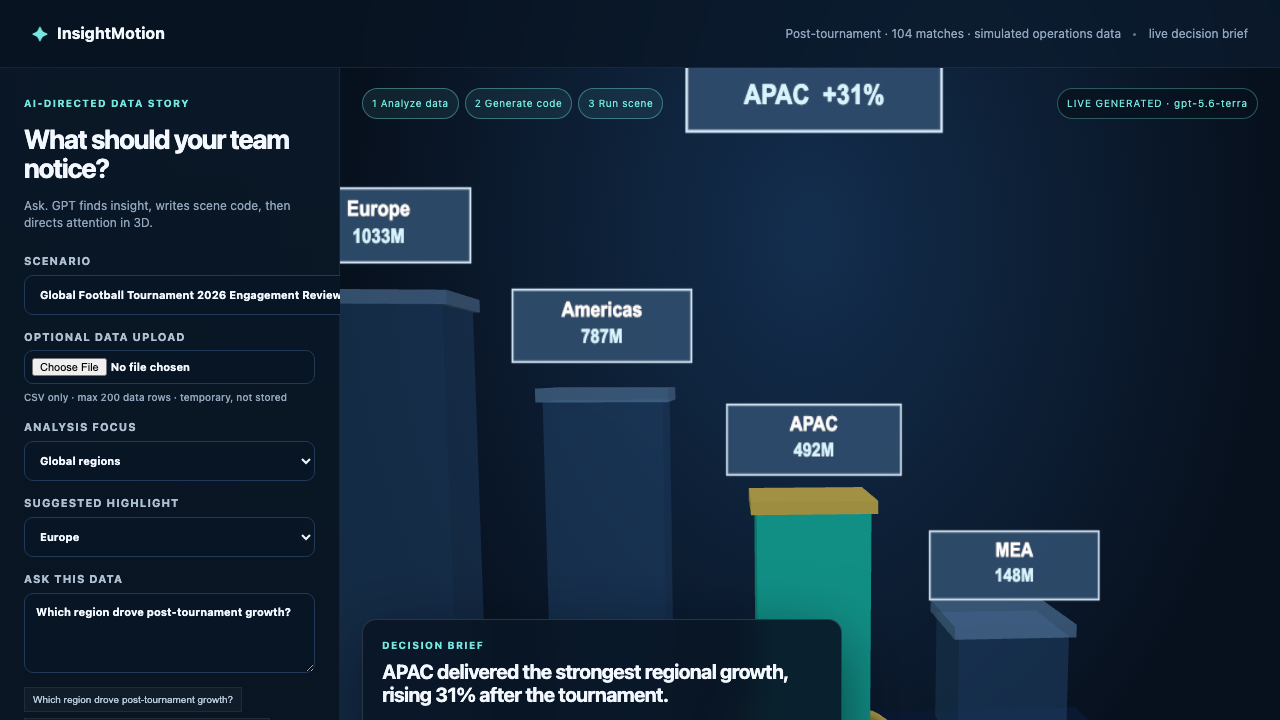
- The browser runs that code as a labeled 3D scene: numeric labels preserve the evidence while camera movement, focus rings, color, and pulse direct attention to the answer.
- The viewer can orbit, zoom, and pan. A timestamp, visible generation pipeline, and code disclosure make the completed live run auditable.
How we built it
- Next.js 16.2 App Router, React 19, TypeScript, and Vercel.
- OpenAI Chat Completions using
gpt-5.6-terrafor live analysis and scene-code generation. - three.js, anime.js, and OrbitControls. The browser supplies
(scene, camera, THREE, anime)to the generated scene contract. - Fence stripping, scene reset, runtime error containment, and up to three model repair attempts.
- Clearly simulated Global Football Tournament 2026 engagement operations and Q2 retail scenarios. Optional CSV input is bounded, temporary, and never persisted.
- The tournament data contains no personal data, wagering, predictions, or advice.
Built with Codex and GPT-5.6
The product lead made the key decisions: position InsightMotion as a Work & Productivity tool, choose two simulated scenarios for demo, establish a visible live-generation moment.
Codex accelerated the build from the written spec and supplied prototype: it translated the execution contract into the Next.js app, preserved the three.js/anime.js runtime, added the server-only generation route and repair loop, integrated controls, ran builds, addressed review feedback, and prepared deployment, documentation, and demo materials.
At runtime, GPT-5.6 Terra receives the bounded data and analyst question, produces the finding and visual direction, then writes the runnable scene code. Codex was the implementation collaborator; GPT-5.6 is the live, question-specific analytical and visual engine.
Challenges that I ran into
Generated 3D code is powerful but brittle. We kept the tested execution contract, reset the scene between runs, and give runtime errors plus prior code back to the model for up to three repairs. We also required in-frame numeric labels and an initial camera/focus cue so scenes remain legible, then added orbit, zoom, and pan for inspection.
Accomplishments that I am proud of
- 2 simulated business scenarios.
- 104 simulated tournament matches across 4 analyst views.
- Bounded 200-row / 20-column ephemeral CSV input.
- Up to 3 generated-scene repair attempts.
- No client-exposed OpenAI API keys, no database, one Vercel deployment.
What we learned
The hard part is not making an AI-generated chart. It is making the claim, labels, camera movement, and viewer control agree. Motion earns its place only when it tells a team where to look faster than a static chart can.
What's next for InsightMotion
Connect approved warehouse/BI sources, replace free-form generated JavaScript with a declarative visual grammar, add saved briefs and analyst feedback, and evaluate visual-plan adherence across larger datasets.
Built With
- anime.js
- codex
- gpt-5.6-terra
- next.js
- openai-api
- react
- three.js
- typescript
- vercel
