Inspiration
Every event creates hundreds or even thousands of photos and videos. Weddings, birthdays, college events, corporate gatherings, and festivals all have the same problem: the memories are captured, but finding your own memories is difficult.
After an event, people usually receive a huge gallery and have to manually scroll through it to find photos of themselves. Photographers and organizers also spend significant time managing, organizing, and distributing these files.
We wanted to change that experience.
Our idea was simple:
What if you didn't have to search for your photos? What if AI could find them for you?
That question led us to build Chitralai.
What it does
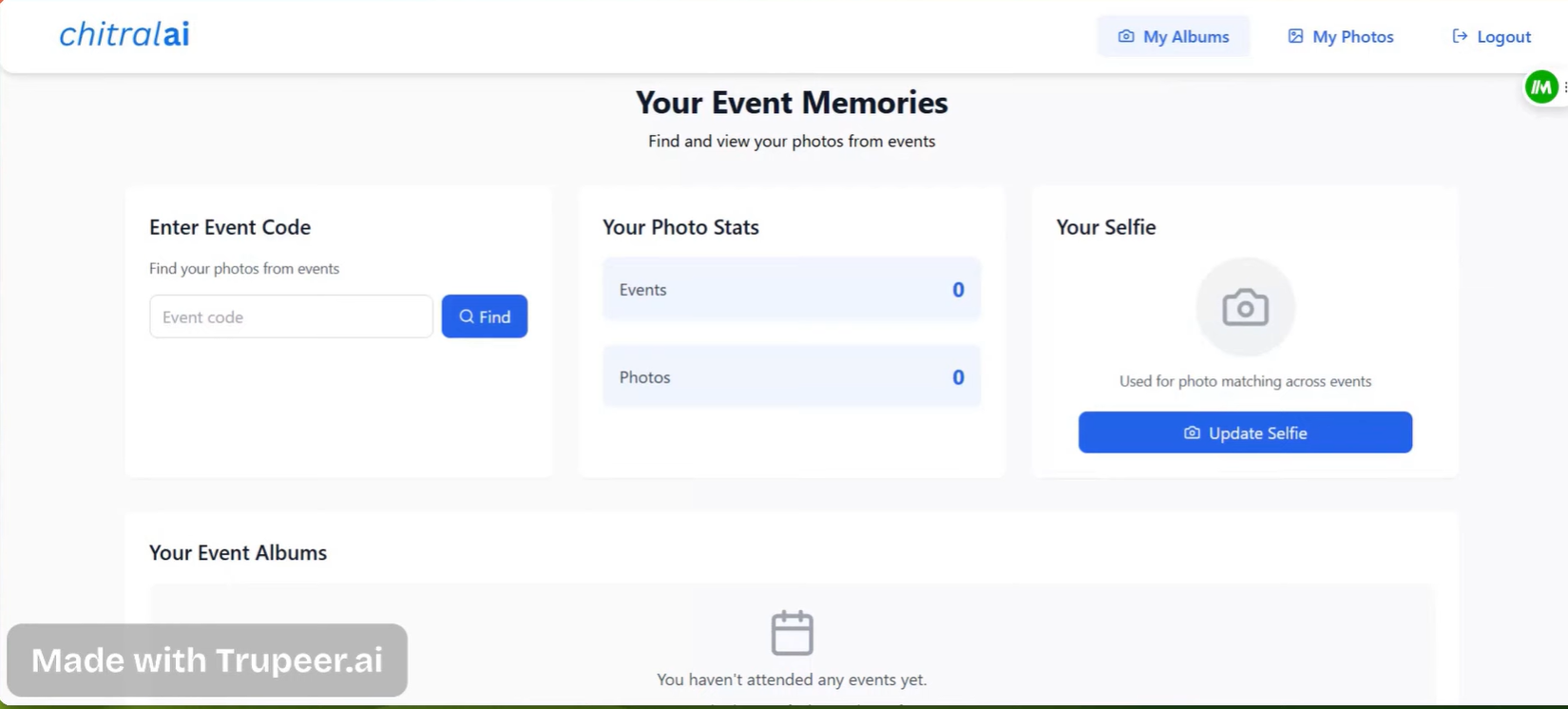
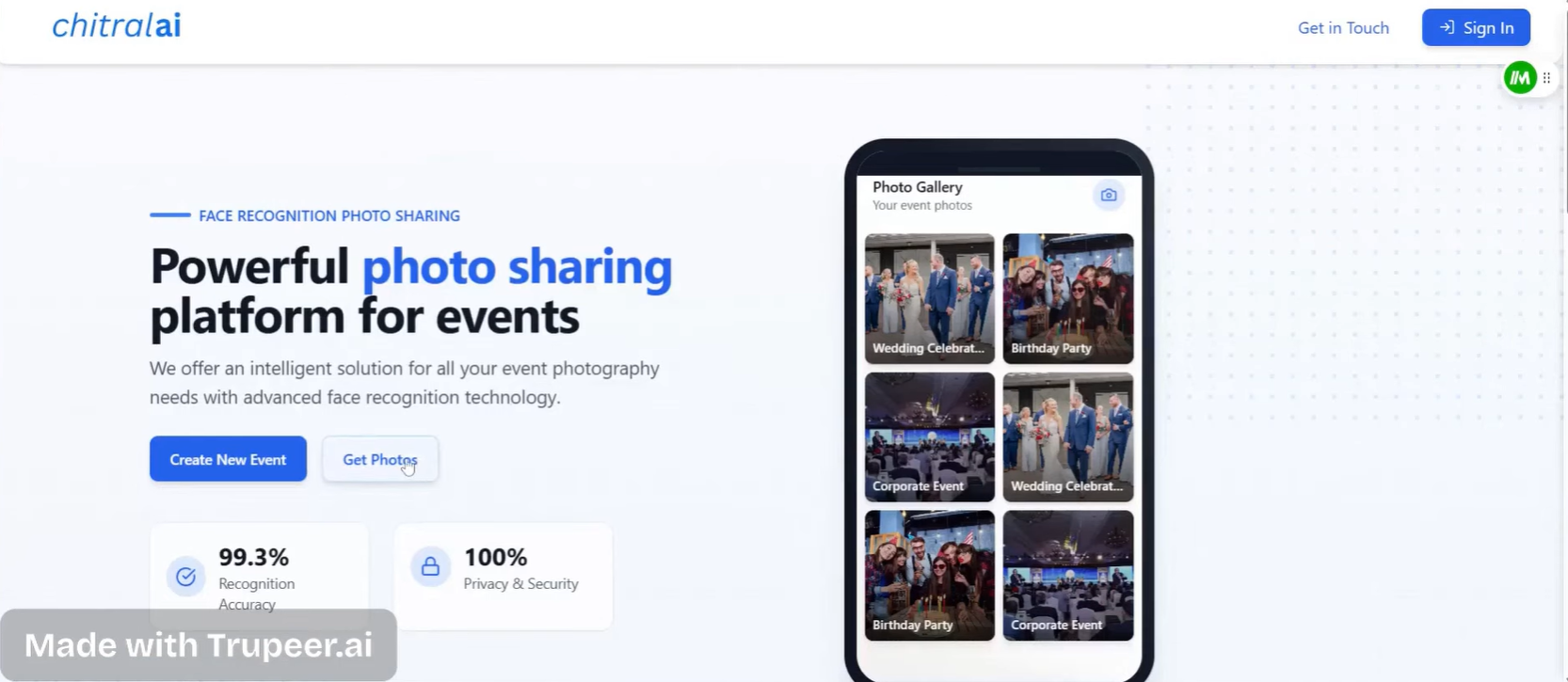
Chitralai is an AI-powered media management and sharing platform for events and communities.
The experience is designed to be extremely simple:
1. Create an Event
An organizer creates an event and uploads the event's photos and videos.
2. Invite Guests
The organizer shares the event link with attendees.
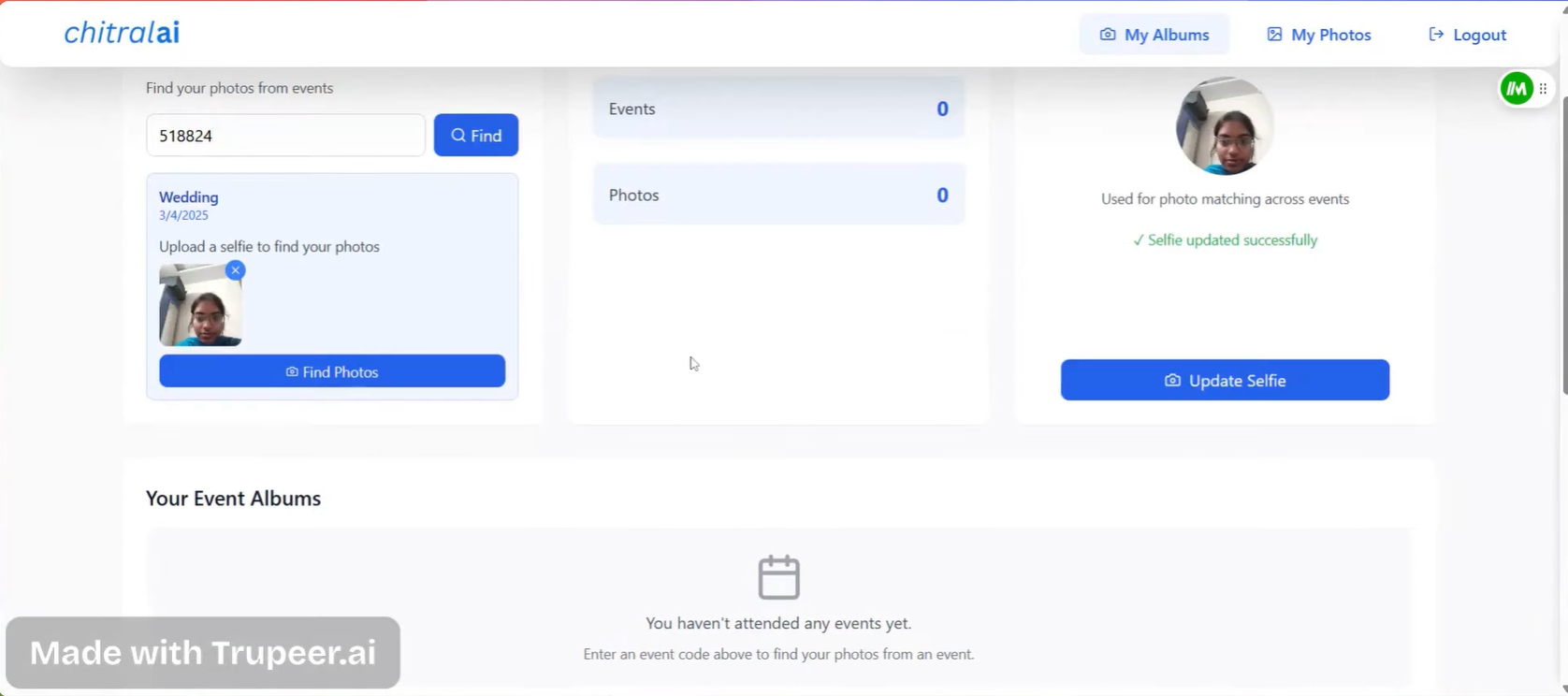
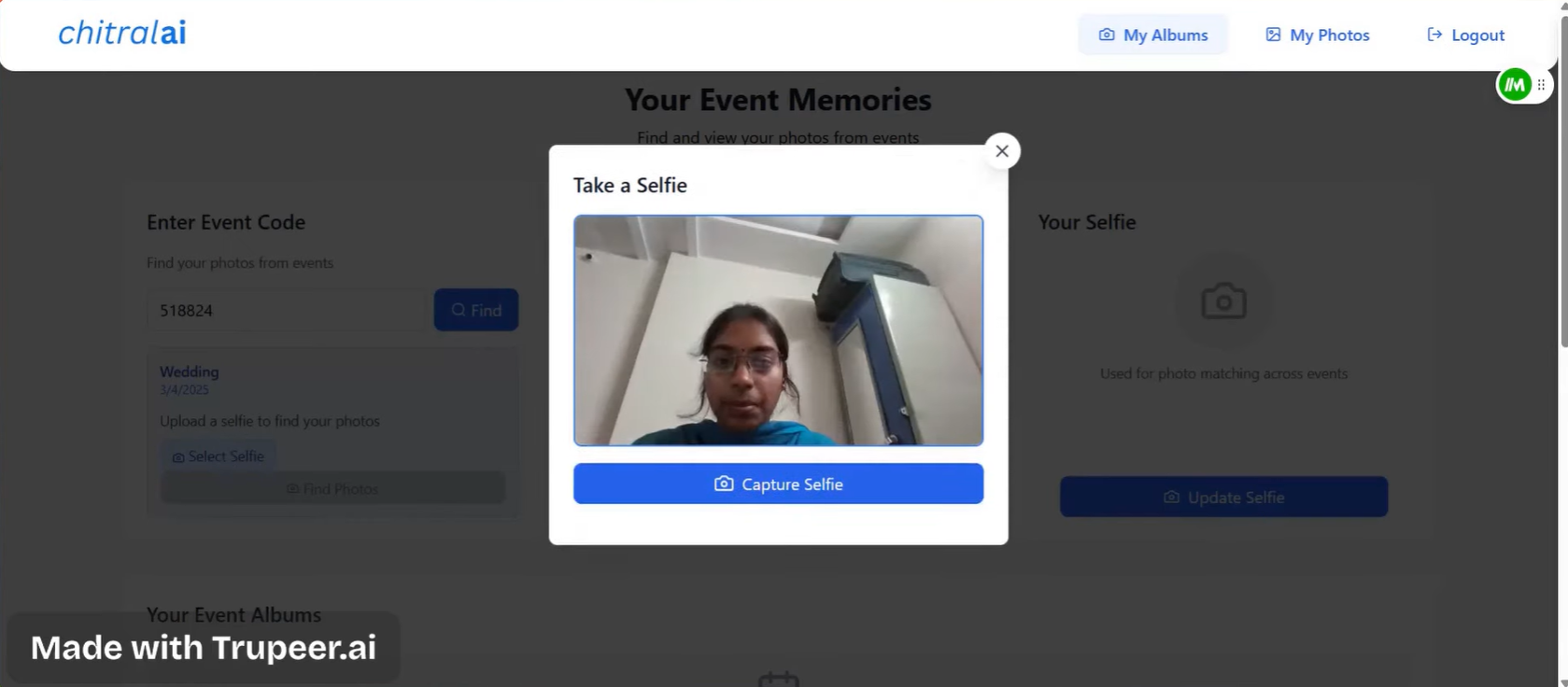
3. Take a Selfie
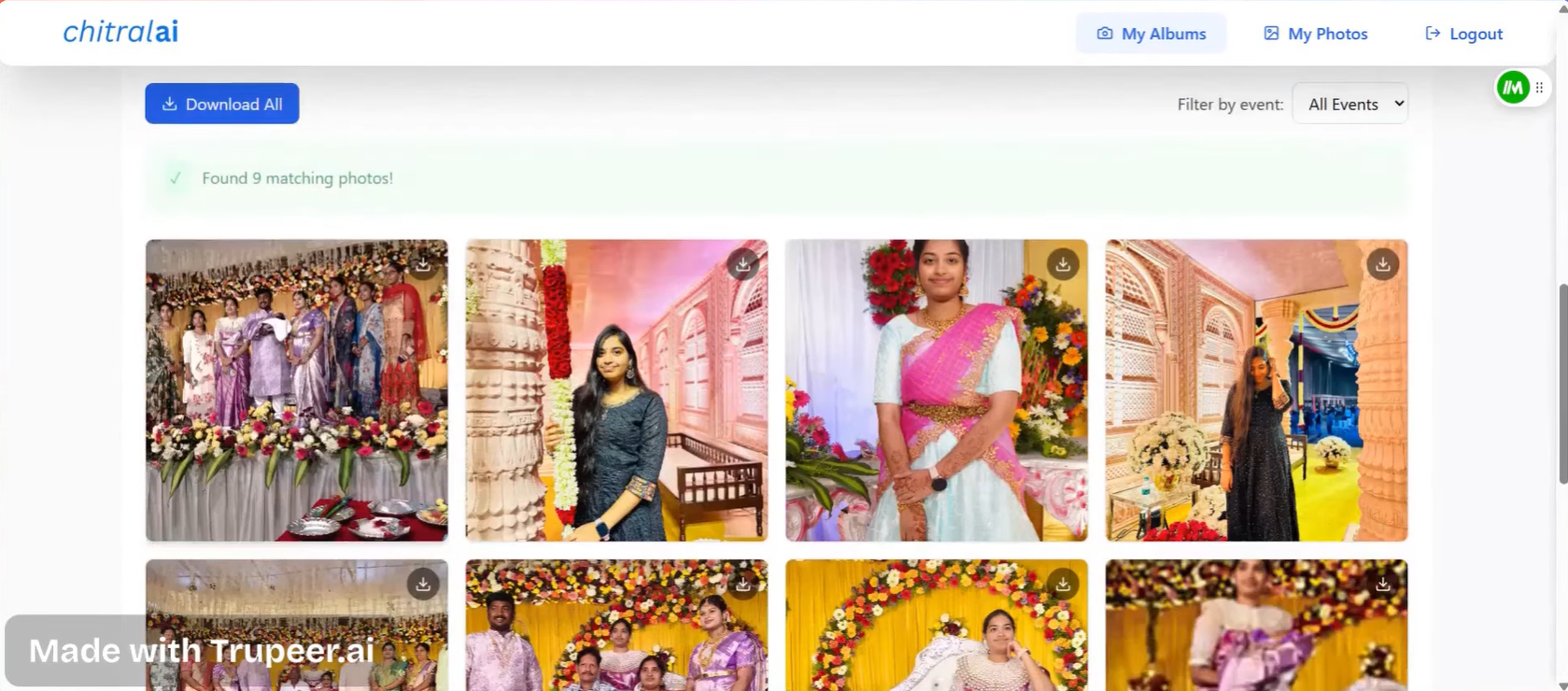
Instead of manually searching through hundreds or thousands of images, a guest simply takes a selfie.
4. AI Finds Their Memories
Chitralai processes the user's selfie and searches the event media to identify relevant photos and videos.
5. View, Download & Share
The guest can instantly view their memories, download them, and share them with friends and family.
The complete experience becomes:
Create Event → Upload Media → Take a Selfie → AI Finds Your Media → Share Your Memories
Chitralai is designed to work across weddings, birthdays, college events, corporate events, festivals, photography studios, and other large gatherings.
How we built it
We built Chitralai as a modern cloud-based web platform combining media management, AI-powered discovery, and an event-based sharing experience.
The core system consists of:
- Event management for creating and managing individual events.
- Large-scale media management for photos and videos.
- AI-powered face-based media discovery to connect attendees with relevant media.
- Selfie-based search so users can find their memories without manually browsing.
- Cloud storage and processing for handling event media.
- Responsive web interfaces for organizers and attendees.
- Secure access and sharing so event media can be accessed through controlled event experiences.
We also incorporated Google Gemini into the AI layer to bring multimodal intelligence into the product experience. Rather than treating AI as a separate chatbot, our goal was to use AI as part of the actual media workflow — helping transform large amounts of raw event content into something users can easily understand and discover.
The architecture is designed so that the complexity of the AI remains behind a very simple user experience.
The user doesn't need to understand embeddings, computer vision, or AI models.
They simply take a selfie and find their memories.
Challenges we ran into
Building a real-world media platform is much more difficult than building a simple prototype.
Recognition in real-world conditions
Event photography is unpredictable. Images can contain:
- Different lighting conditions
- Different camera angles
- Group photographs
- Different distances from the camera
- Partial or side faces
- Different image resolutions
- Large numbers of people in a single photograph
Making the experience reliable across these situations was one of our biggest challenges.
Speed and scalability
An event can contain hundreds or thousands of photos and videos.
Searching through that amount of media for every user request requires careful processing and infrastructure design. We had to think about how to make searches fast without compromising the quality of results.
Privacy
Photos are personal.
When building a system around face-based discovery, privacy and security cannot be an afterthought. We had to consider how user selfies, event media, and access permissions should be handled responsibly.
Making complex AI feel simple
Another major challenge was the user experience.
The technology behind Chitralai can be complex, but the user experience should not be.
We wanted the product to feel as simple as:
Open link → Take selfie → Get photos.
Accomplishments that we're proud of
We're proud that we transformed a common and frustrating problem into a simple AI-powered experience.
One selfie can replace endless scrolling
Instead of asking attendees to search through an entire gallery, Chitralai turns the process into a personalized discovery experience.
Built for real-world events
We designed Chitralai around actual event workflows rather than building an AI demo that only works in a controlled environment.
Photos + Videos
Chitralai is designed not just for photographs but also for video content, giving attendees a more complete collection of their event memories.
A business-ready product
We went beyond a prototype interface and built product features around event creation, media management, user access, sharing, storage plans, and paid event/subscription models.
AI as part of the product
One of our biggest accomplishments is making AI part of the core experience rather than simply adding a conversational AI feature.
The user's interaction with AI happens naturally through the product itself.
What we learned
The biggest lesson we learned was:
A great AI product is not necessarily the one with the most complicated AI. It's the one where AI removes the most friction for the user.
We learned that building an AI-powered application involves much more than connecting an API.
We had to think about:
- User experience
- AI reliability
- Media processing
- Scalability
- Privacy
- Storage
- Search performance
- Cost
- Business models
- Real-world usability
We also learned how important it is to design the AI and product together.
When the AI is invisible and the experience simply works, users don't need to think about the technology behind it.
What's next for Chitralai
Chitralai is only the beginning.
Our next goal is to make the platform significantly more intelligent and useful for photographers, event organizers, communities, and attendees.
Smarter media understanding
We want Chitralai to understand more than who appears in a photo.
Future versions can understand:
- People
- Events
- Activities
- Locations
- Objects
- Moments
- Context
This could allow users to search their memories using natural language, such as:
"Show me the photos where my friends and I are on stage."
or
"Find the best photos from the dance performance."
AI-powered event organization
We want AI to automatically organize large event galleries into meaningful collections and moments.
Better video discovery
We plan to expand intelligent discovery across videos so users can find relevant moments instead of manually watching long recordings.
Photographer and organizer tools
We want to build deeper tools for photographers and event organizers, including smarter gallery management, automated organization, branded event experiences, and analytics.
Scale beyond individual events
Our long-term vision is to make Chitralai an AI-powered memory infrastructure for events and communities — helping people capture, organize, discover, and share the moments that matter to them.
Our Vision
Today, finding one photo of yourself from an event can mean scrolling through hundreds of images.
We believe it shouldn't.
Chitralai makes your memories searchable, personal, and instantly accessible.
Take a selfie. Let AI find your memories.
Built With
- amazon-rekognition
- amazon-web-services
- artificial-intelligence
- computer-vision
- dynamodb
- face-recognition
- google-cloud
- google-gemini
- media-management
- node.js
- react
- tensorflow
- typescript

Log in or sign up for Devpost to join the conversation.