What inspired us?
Version control is one of the greatest innovations in software engineering. It gives developers a complete history of every change, makes collaboration effortless, and creates accountability throughout the development process.
While thinking about this, we realized that many other engineering disciplines don't have anything comparable. In industries like construction, infrastructure development, maintenance, and logistics, changes to physical assets are often documented through scattered reports, spreadsheets, photos, or even paper records.
So we built Chisel, a version control system for physical infrastructure.
What it does?
Chisel is a software platform that brings the principles of version control to real-world infrastructure.
It provides a centralized workspace where every modification made to a physical asset can be tracked throughout its lifecycle. Construction companies, maintenance teams, contractors, and property owners gain complete visibility into the history of a project.
With Chisel, users can:
- Track every change made to infrastructure over time.
- Assign work to employees and monitor individual progress.
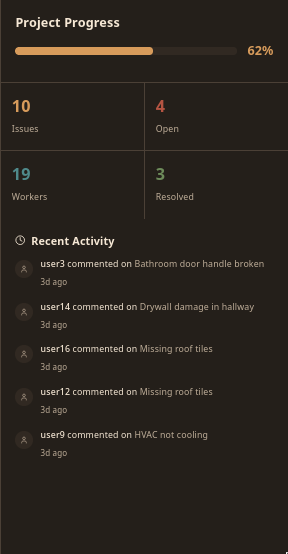
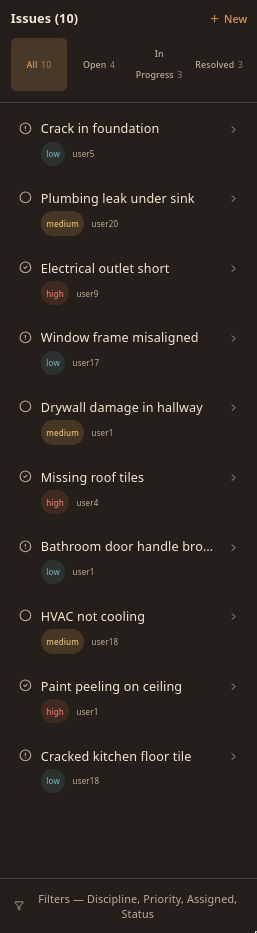
- Report, manage, and resolve infrastructure issues.
- Maintain an auditable history of repairs and modifications.
- Increase accountability by recording who performed each task.
- Provide transparency to property owners through real-time project updates.
- Build verified portfolios of completed work that employees can showcase to future employers.
How we built it?
- Using MERN Stack for frontend and server side functionalities.
- MongoDB Atlas for database.
- Vercel for deployment.
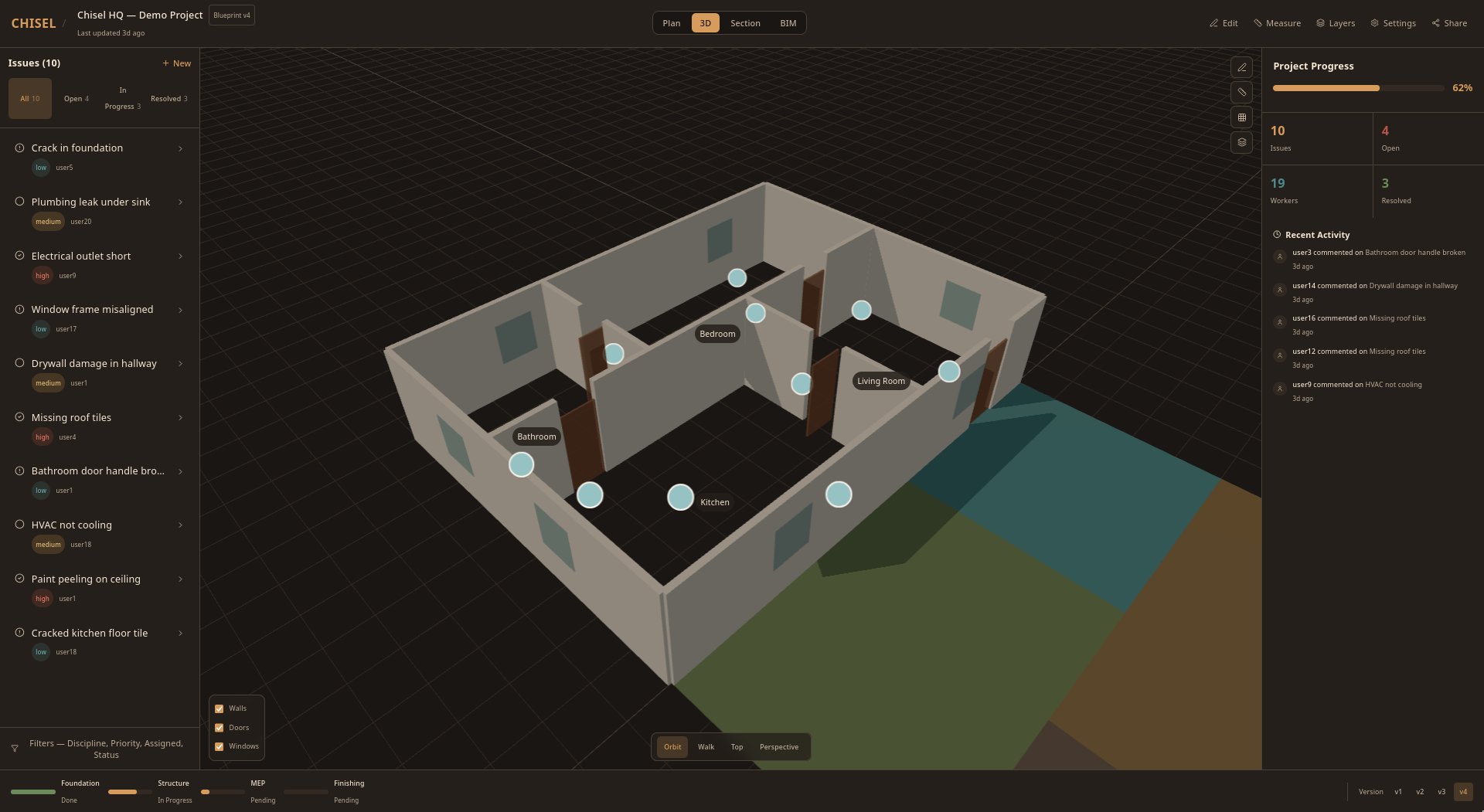
- We built an AI-powered blueprint pipeline where an LLM converts uploaded blueprint images into structured JSON, which is then parsed by our rendering engine to generate interactive Three.js 3D models.
Challenges we ran into
One of the biggest challenges was solving the problem of visualization. Traditional construction blueprints are difficult for many stakeholders, especially clients and on-site workers, to interpret. Reading 2D floor plans requires technical expertise, making it hard to communicate what the final structure will actually look like.
To solve this, we built a pipeline that converts 2D architectural blueprints into interactive Three.js models. This allows users to visualize the project in 3D directly within the browser, making designs far easier to understand and helping bridge the gap between engineers, workers, and property owners.
Another challenge was adapting software version control concepts to the physical world. Unlike software, infrastructure can't simply be rolled back with a click, so we had to rethink what a "commit" should represent. We designed Chisel so that every construction update, maintenance activity, and issue resolution becomes a permanent, traceable record in the project's history.
To make these commits trustworthy, we integrated several AI-powered verification features. Every commit can include geo-tagged location images as proof of on-site work, while an AI-generated image detector helps identify synthetic or manipulated images, ensuring that progress updates remain authentic. This adds an extra layer of transparency and accountability, making project histories far more reliable than traditional documentation.
Accomplishments that we're proud of
We're proud that we took an idea borrowed from software engineering and applied it to an industry that has largely been overlooked by modern collaboration tools.
What we learned
This project taught us that many ideas considered standard in software engineering can create enormous value when adapted to other industries.
What's next for Chisel
This hackathon project is just the beginning. Our long-term vision is to make Chisel the standard platform for infrastructure version control, whether it's used by a small renovation contractor or a large-scale construction company managing hundreds of projects. We want to bring the same level of accountability, transparency, and traceability that software engineers enjoy with version control to every stage of physical infrastructure development.
On the technical side, we're excited to push the platform further with AI and computer vision. One of our biggest goals is to evolve our 3D visualization into a true digital twin of a construction project. Instead of being a static model, it would continuously reflect the current state of the build by analyzing site images and completed work.
We're also exploring visual localization using 360° site imagery, allowing Chisel to automatically determine where a photo was taken on a construction site and attach it to the correct section of the 3D model. Combined with AI-generated progress estimation, this would create an interactive timeline where stakeholders can inspect not only what changed, but exactly where it changed.
Ultimately, we envision Chisel becoming the GitHub for physical infrastructure—a platform where every bridge, building, road, and public asset has a transparent, verifiable, and searchable history throughout its entire lifecycle.


Log in or sign up for Devpost to join the conversation.