Most nature apps teach us to listen, observe, and catalogue the wild world from behind a screen. You hold up your phone, an algorithm scans the audio waves, and a tiny label tells you what’s hiding in the canopy. It turns nature into a spectator sport.
We built Chirp because listening is only half of a conversation.
Humans have an instinctive urge to echo the world around them. We whistle back at chickadees, make clumsy owl calls on quiet evening walks, and try—almost always terribly—to answer the morning chorus outside the kitchen window. There is genuine, childlike joy in trying to speak another creature's language, even if you fail spectacularly.
By blending the gamified habits of language learning with modern bioacoustic audio recognition, Chirp turns imitation into an adventure. You aren't just memorizing species names; you’re learning pitch shifts, trills, and rhythms. You discover how subtle a wood thrush’s harmony is, why a mourning dove’s coo requires such soft diaphragm control, and how hilarious it feels to practice a raven’s guttural croak in your living room.
We created Chirp to bridge the gap between human curiosity and the trees above us—to get people outside, laughing at their own terrible whistles, and slowly learning to talk back.
What it does
Chirp is a gamified language-learning app that teaches humans how to talk back to nature. Instead of just identifying wild birds like Merlin or practicing human languages like Duolingo, Chirp trains your vocal cords to mimic avian vocalizations.
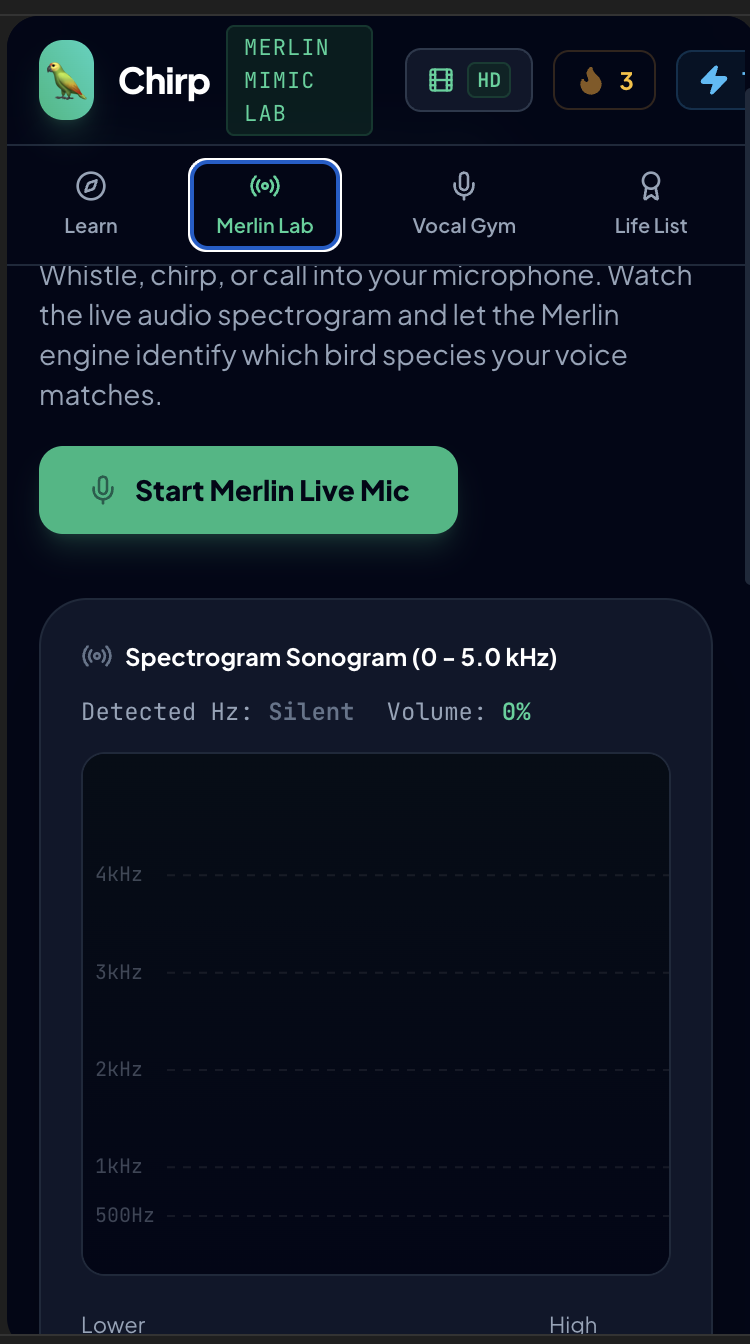
- Listen & Dissect: Users listen to authentic bird calls broken down into bite-sized audio fragments, complete with visual spectrogram tracks showing pitch, cadence, and harmonic layers.
- Vocal Mimicry Engine: Users press record and whistle, chirp, hum, or squawk their best imitation.
- Instant Visual & Audio Feedback: The app aligns the user’s spectrogram against the bird's actual recording, scoring accuracy across pitch accuracy, rhythm, and vibrato.
- Bite-Sized Skill Tree: Structured progression from beginner sounds (Mourning Dove coos, Black-capped Chickadee whistles) up to master-tier complexities (Wood Thrush polyphony, European Starling mimicry).
- Field Quests & Streaks: Daily streak mechanics and localized field challenges encouraging users to venture outside and practice calls in the wild.
How we built it
- Frontend & Mobile UI: Built with Flutter for smooth cross-platform performance, interactive milestone maps, and real-time audio visualization components.
- Audio Capture & Spectrogram Rendering: Used the Web Audio API / native audio bridges alongside custom FFT (Fast Fourier Transform) rendering to display interactive sound waves in real time.
- Audio Comparison Pipeline:
- Audio recordings are normalized, filtered to eliminate background room noise, and converted into log-mel spectrograms.
- We utilized Dynamic Time Warping (DTW) alongside a lightweight audio-embedding model fine-tuned on the Xeno-Canto open-source bird sound library.
The comparison pipeline scores pitch contours and timing offsets independently so beginner whistlers receive actionable feedback (e.g., "Right pitch, but hold the note for 0.5s longer").
Backend & Cloud Infrastructure: Hosted on FastAPI with a PostgreSQL database storing user progression, streak counts, and custom unlockable field badges.
Challenges we ran into
- Human Vocal Limitations vs. Avian Syringes: Birds possess a syrinx, allowing them to produce two independent tones simultaneously or whistle at extreme frequencies (above 8 kHz) that human vocal cords simply cannot reach. We had to design an algorithm that transposes calls down an octave or focuses on phonetic mimicry rather than impossible frequency parity.
- Microphone Discrepancies & Background Noise: Ambient indoor noise, cheap headphone microphones, and outdoor wind distortion caused huge variance in raw audio input. We had to build aggressive noise-gate pre-processors to isolate whistle frequencies.
- Fair and Forgiving Scoring: Pure mathematical difference metrics (like MSE on spectrograms) penalize minor pitch drifts too harshly, making the game frustrating. Tuning the Dynamic Time Warping algorithm to reward effort and relative contour over absolute perfection took dozens of test iterations.
Accomplishments that we're proud of
- Real-Time Spectrogram Overlays: Building a smooth, lag-free UI that overlays the user's vocal wave directly over the target bird call in real time.
- An Intuitive Scoring System: Creating an audio-grading pipeline that genuinely rewards close approximations without being broken by background humming or high-pitched room hiss.
- A Cohesive, Playful Aesthetic: Marrying the clean scientific rigor of ornithology tools with the bright, rewarding energy of modern habit-building apps.
What we learned
- Bioacoustics is Incredibly Nuanced: What sounds like a simple three-note whistle to the human ear often contains micro-trills and rapid frequency drops that only reveal themselves on a spectrogram.
- Gamification Requires Nuance: Striking the balance between "silly party trick" and "authentic wildlife skill" required very intentional UX copy, encouraging feedback prompts, and progressive difficulty tiers.
- Audio Processing on Edge Devices: Real-time digital signal processing (DSP) demands tight memory management to prevent UI stutter on mobile hardware.
What's next for Chirp
- Real-World "Duets" Mode: Using the microphone outdoors to detect an answering bird call in the wild and verifying a successful "call-and-response" exchange.
- Accessibility Modes: Adaptive input mechanics for users who cannot whistle, incorporating vocal hums, clicks, tongue trills, and pitch-slider controls.
- Species Expansion Packs: Regional biome bundles (e.g., Neotropical Rainforest, Boreal Forest, Urban Garden Birds) and seasonal migration events.
- Friend Chirp-Offs: Asynchronous multiplayer duels where users challenge friends to match obscure bird calls and vote on the most accurate imitation.
Built With
- dart
- fluttter

Log in or sign up for Devpost to join the conversation.