-
-
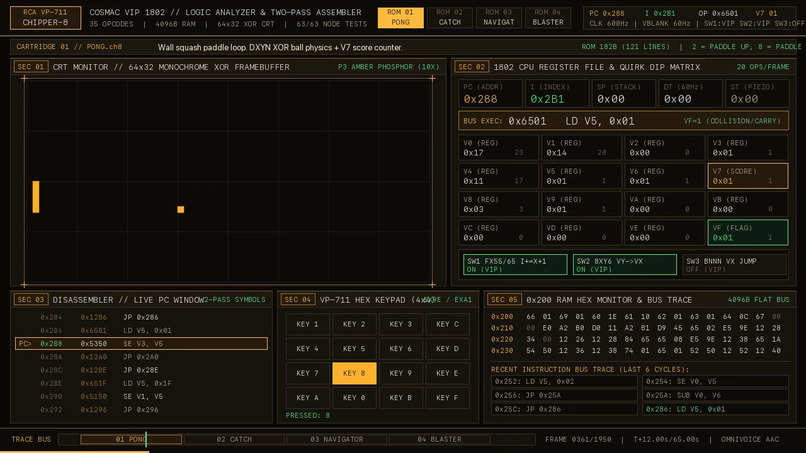
Built from scratch with zero runtime dependencies, interactive browser verification, and automated node:test unit tests.
-
-
-
Inspiration
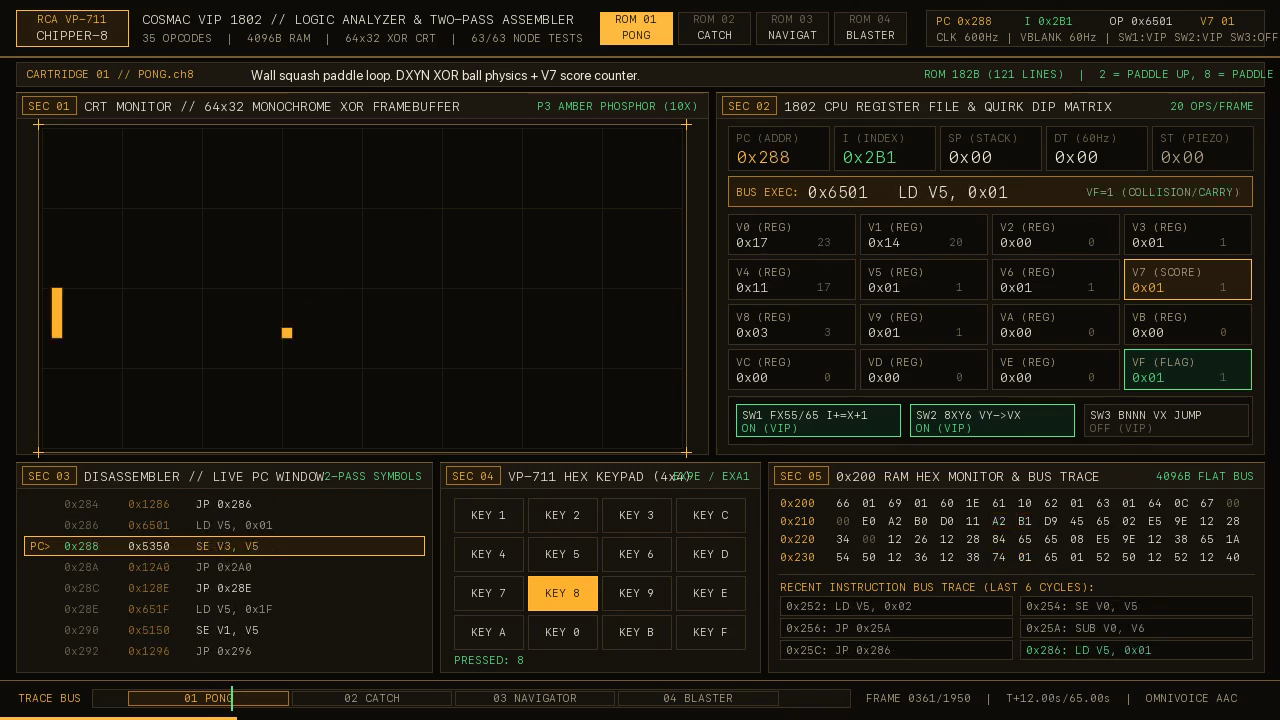
Most browser emulators hide what the CPU is actually doing behind a black-box canvas. We wanted a front-panel CHIP-8 workbench where someone learning computer architecture can type assembly, click one-button experiments, inspect every register and pixel in memory, and toggle historical interpreter quirks from 1977 COSMAC VIP hardware alongside 1990 HP-48 CHIP-48 behavior.
What it does
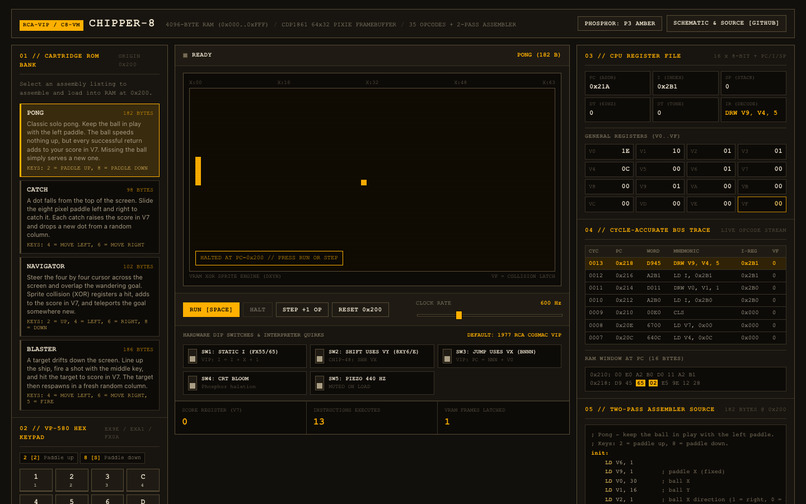
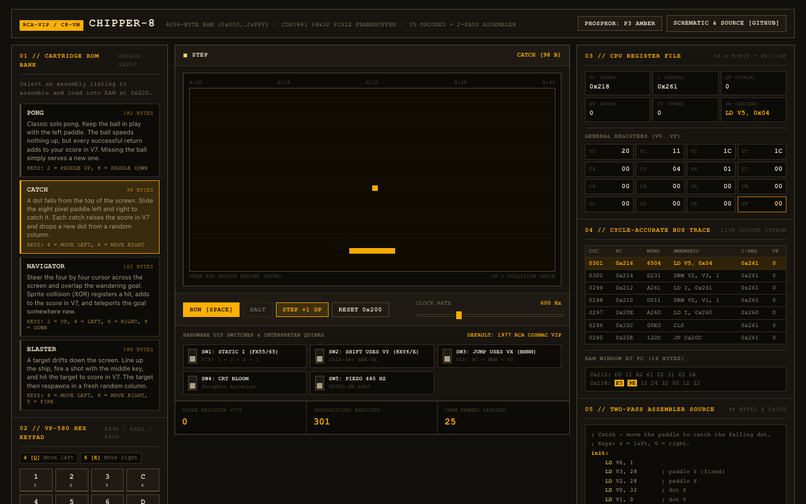
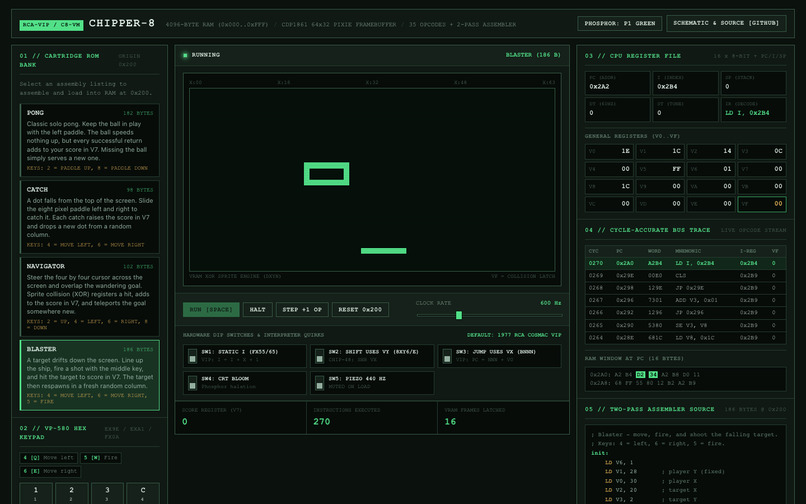
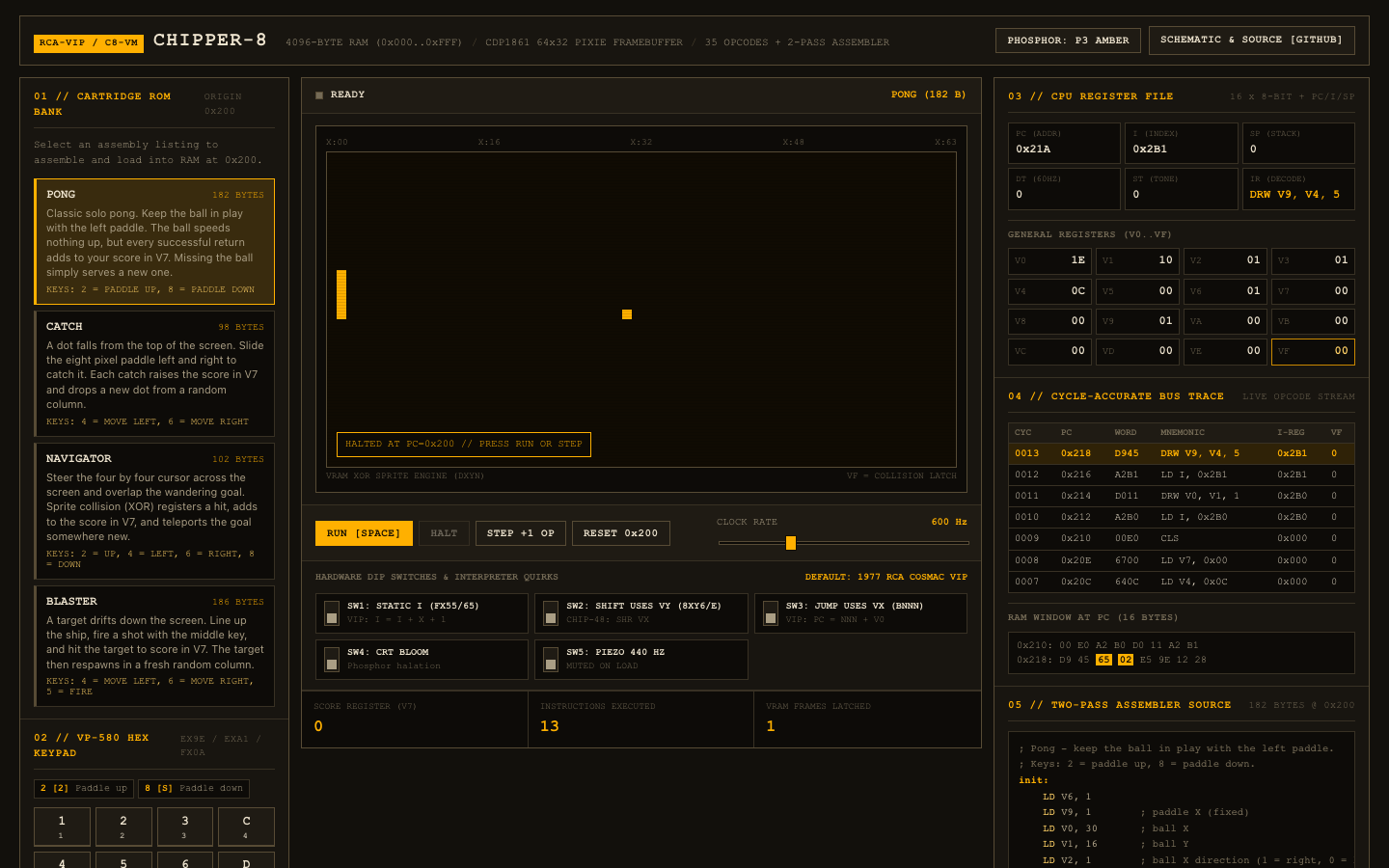
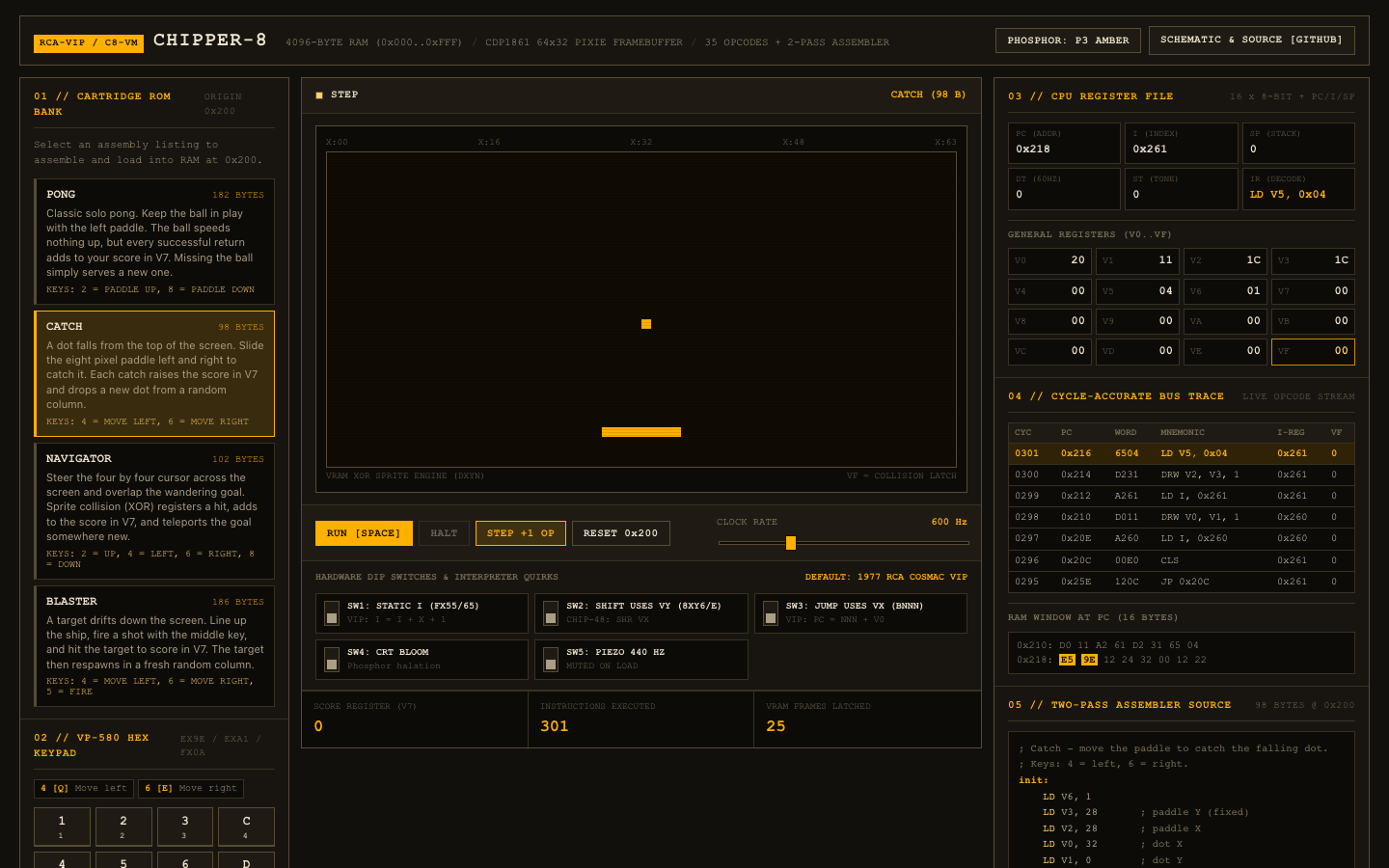
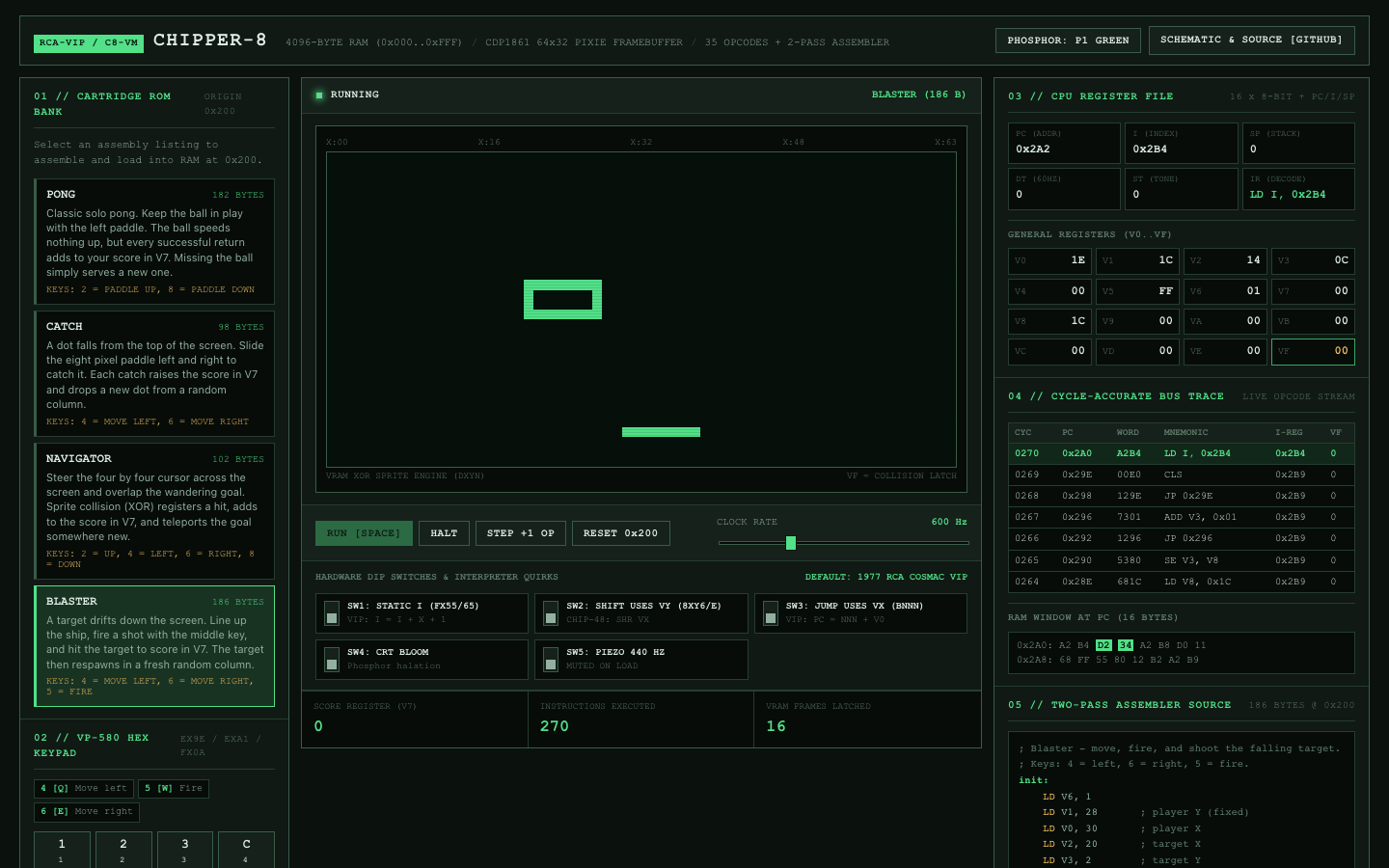
Chipper-8 runs a complete 35-instruction CHIP-8 virtual machine, a two-pass symbolic assembler, and an interactive logic-bench UI with zero external dependencies:
- Four playable original cartridges assembled from source on boot (
Pong186 B,Catch102 B,Navigator106 B,Blaster190 B). - Live Assembly Editor & ROM Exporter: Write or edit CHIP-8 assembly in the browser, load valid ROMs without wiping state on empty/invalid edits, and download raw
.ch8binaries. - Historical Quirk Profiles & DIP Switches: Switch between
Modern,VIP(1977 COSMAC VIP), andCHIP-48presets or toggleI-increment, shift source (VyvsVx), and offset jump (V0vsVx) quirks live. - Instruction-Level Trace, 16-Byte RAM Window & Pixel Inspector: Watch
PC,I,SP,DT,ST, decoded IR,V0..VFchanges, the active[PC, PC+1]RAM window, and live[x, y]framebuffer values and VRAM offsets. - One-Click Diagnostic Showcases: Demonstrate
DXYNXOR draw-vs-erase collision (VF = 0on draw,VF = 1on erase) and live divergence of opcode8126across three independent CPU instances (MODERN,VIP,CHIP48).
How we built it
- Engine (
engine.js): Pure JavaScript VM with 4,096 bytes of RAM, built-in 4x5 hexadecimal font sprites at0x000..0x04F, 64x32 XOR display buffer, 16-level call stack, 60 Hz delay/sound timers, full 35-opcode execution, and lossless 16-bit disassembly (DW 0xNNNNfallback for non-instruction words). - Two-Pass Assembler (
assembler.js): Pass 1 strips;///comments and builds a case-normalized symbol table from0x200; Pass 2 validates register operands, arity, and bounds before emitting big-endian machine code andDB/DWbyte tables. - Independent Clock & Bench UI (
clock.js,app.js): Separates opcode stepping (60..2000 Hz) from 60 Hz timer ticks at any frame rate, tracks physical, pointer, and virtual keyboard input sources independently, and verifies all 35 opcode families on startup via disassemble-assemble round trips.
Challenges
- Historical Quirk Fidelity: Capturing pre-write
VFcollisions in8XYNarithmetic andDXYNsprites whenVxorVyisVFitself across all 256 register-pair combinations. - Safe Input & State Transitions: Ensuring virtual keypad releases or blurs never cancel held physical keys, rejecting empty/comment-only assembly before resetting CPU registers or active cartridges, and updating pixel VRAM readouts immediately whenever
CLSor sprite draws alter the display. - Assembler Determinism: Handling case-insensitive single-letter labels (
i,b,f) alongside register/special operands (I,DT,ST,K,[I]) without mangling label names.
Verification
- 116 tests passed, 0 failed, 0 skipped across engine, assembler, content, regression, and DOM UI suites, verified on Node v26.8.1 with
node --test tests/and zero external packages. - Exhaustive 65,536-word (
0x0000..0xFFFF) disassemble -> assemble round-trip verification passes with zero mismatches. - Startup self-test verifies 35 instruction round trips directly inside the booted workbench.
- Actual cartridge bytecode sizes verified from
roms.js: Pong 186 B, Catch 102 B, Navigator 106 B, Blaster 190 B.
What's next
Add Super-CHIP (S-CHIP) 128x64 high-resolution display mode, configurable memory breakpoints on read/write (FX55/FX65), and step-backwards execution snapshots for classroom debugging.
Built With
- assembler
- canvas
- chip-8
- css3
- disassembler
- emulator
- html5
- javascript
- retro-computing
- webaudio
