Inspiration
Embedded development has a steep barrier to entry: setting up toolchains, configuring PlatformIO/ESP-IDF, debugging compilation errors, and managing drivers. We wanted to make physical computing as effortless as chatting with an AI bridging natural language intent directly to real hardware on your desk.
What it does
Chip turns plain English into running ESP32 firmware in seconds.
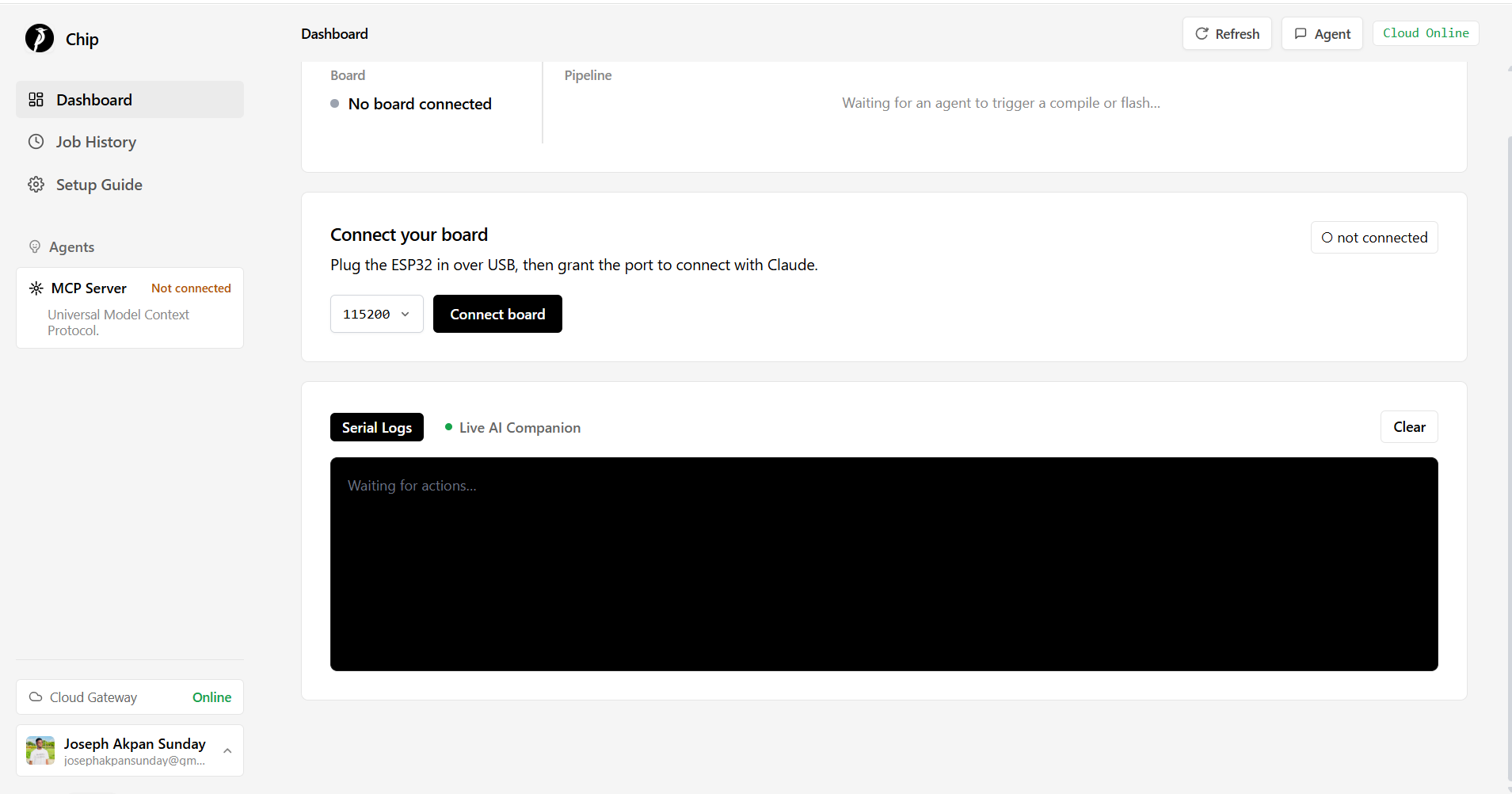
- You plug in an ESP32 and click Connect in the web dashboard.
- You describe what you want in chat (e.g., "Blink the onboard LED every 500ms and read the DHT22 sensor").
- Chip writes the C++/Arduino firmware, compiles it into a
.binfile in the cloud, streams it via WebSockets to the browser, and flashes the board directly over Web Serial.
How we built it
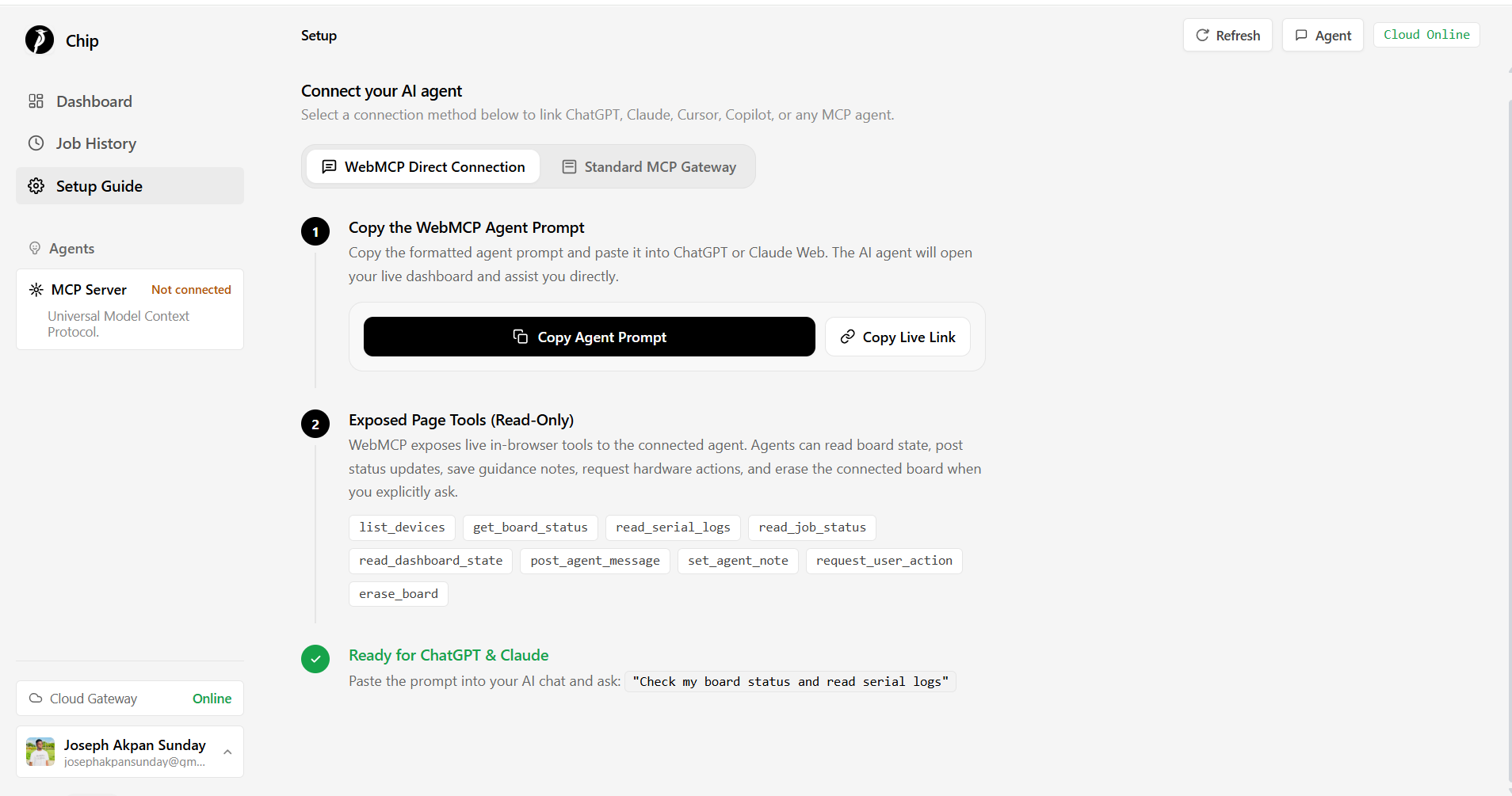
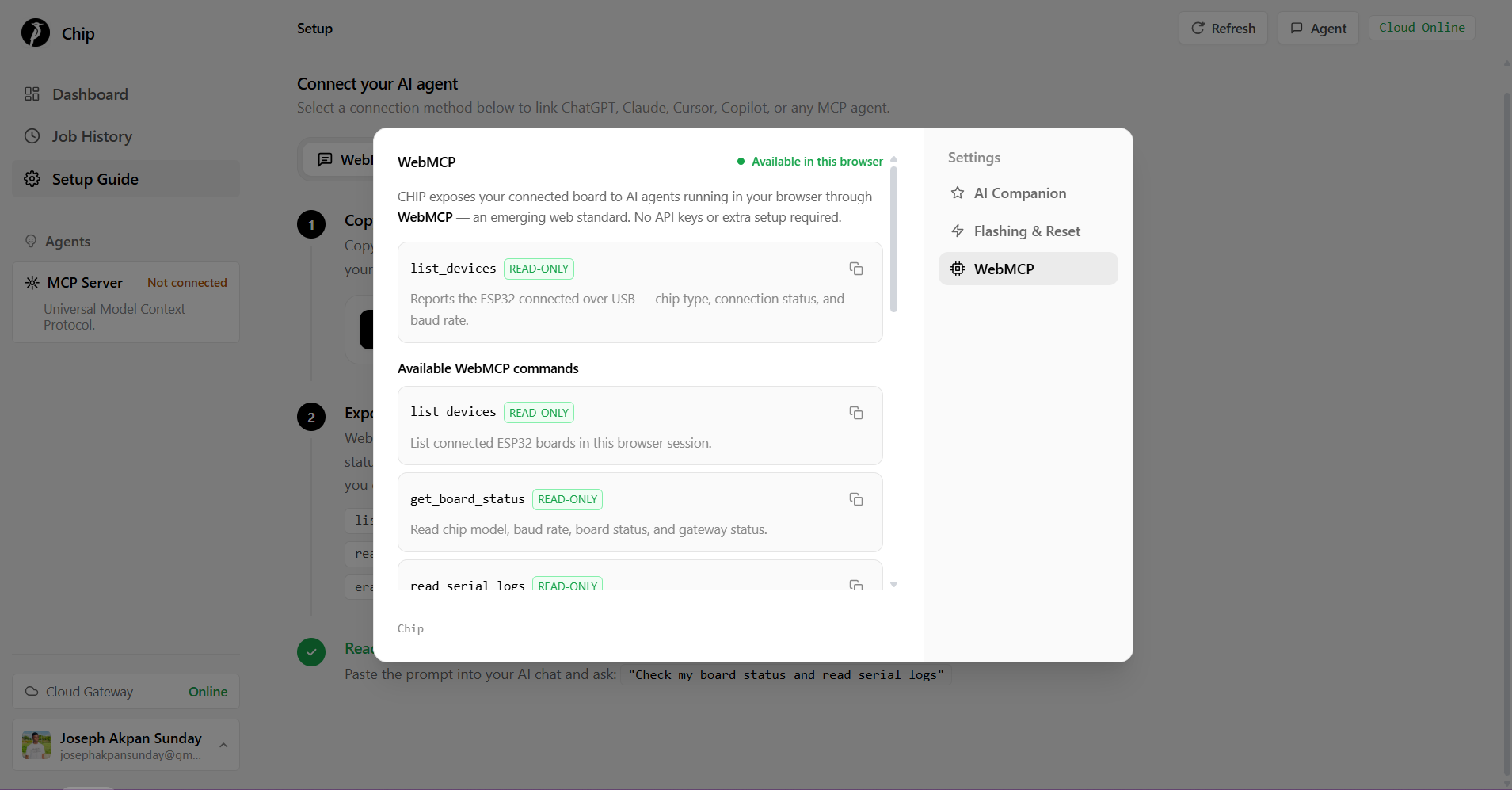
- AI & Protocol: Claude / LLM integrated via Model Context Protocol (MCP) to plan and generate firmware.
- Cloud Backend: Node.js/Express & PlatformIO build worker hosted on Render to compile source code into binaries and coordinate device states via MongoDB.
- Frontend Dashboard: React + Vite + TypeScript interface utilizing the Web Serial API and
esptool-jsto handle physical hardware flashing directly in-browser.
Challenges we ran into
- Browser Security & Physical Separation: A cloud server cannot touch a local USB cable. We solved this by designing an active client-relay architecture: the cloud compiles the binary, while the browser securely flashes the board over Web Serial with real-time progress streaming.
- Fast Build Times: Optimizing PlatformIO compilation pipelines in the cloud to produce
.binartifacts with minimal latency.
Accomplishments that we're proud of
- Achieving a zero-toolchain experience where anyone can program microcontrollers without writing a single line of C++ or opening a terminal.
- Seamless end-to-end flow from natural language prompt to live blinking hardware in under 30 seconds.
What we learned
- Deep dive into the Web Serial API, serial baud-rate timing, and low-level ESP32 flashing protocols.
- Effective orchestration using MCP (Model Context Protocol) to turn conversational AI into an actionable hardware engineer.
What's next for Chip
- Two-way Sensor Telemetry: Streaming live serial logs and sensor feeds back to the AI for closed-loop debugging and auto-tuning.
- Multi-Board Support: Expanding beyond ESP32 to Arduino, Raspberry Pi Pico, and STM32 boards.
- Visual Circuit Diagnostics: Pinout conflict detection and wiring guidance directly in the dashboard. ```
Built With
- arduino
- c++
- claude
- esp32
- esptool-js
- express.js
- hardware
- iot
- mcp
- mongodb
- node.js
- platformio
- react
- typescript
- vite
- web-serial-api
- websockets


Log in or sign up for Devpost to join the conversation.