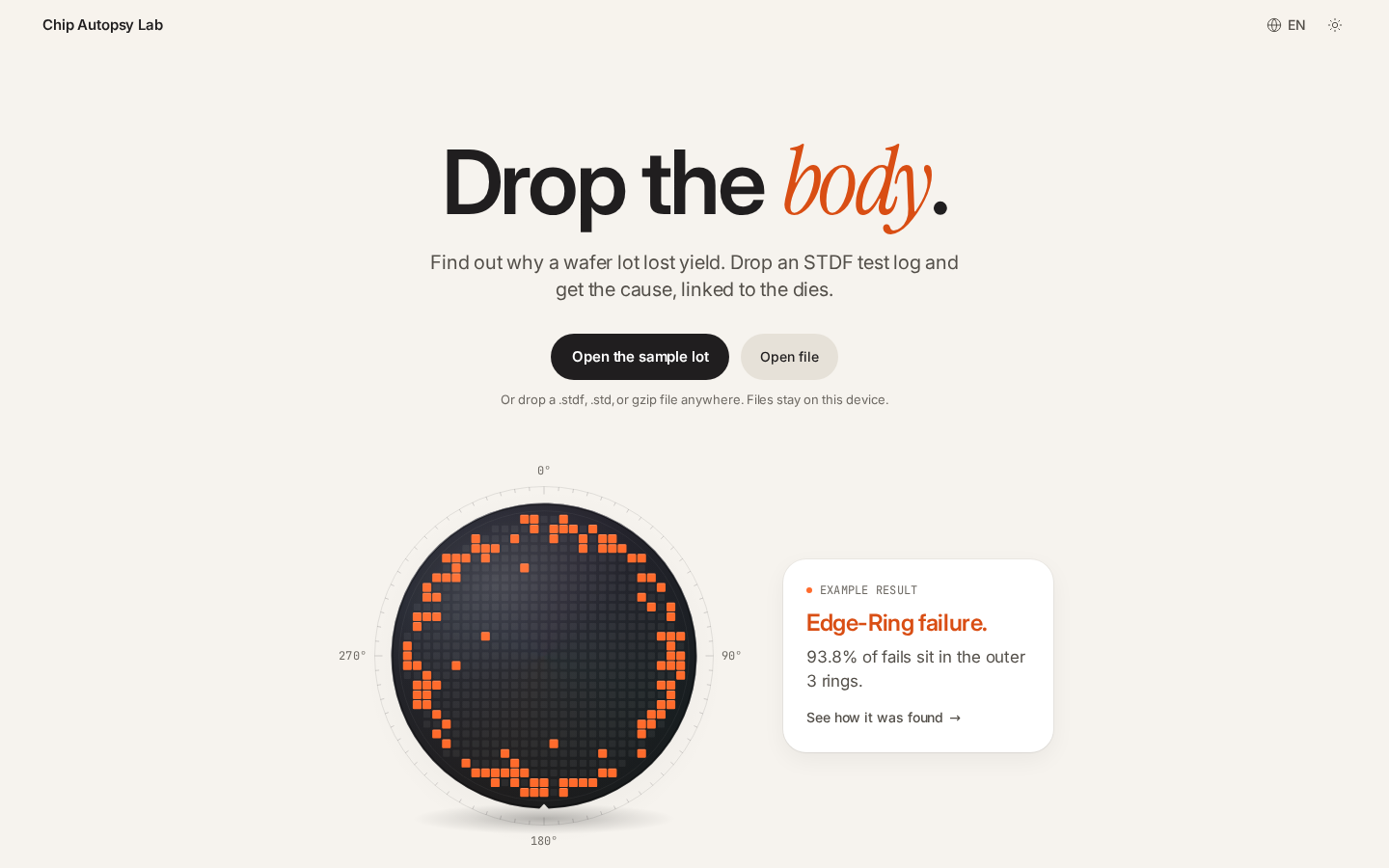
Most people never see this problem, so here it is in plain words: when a chip factory finishes a batch of silicon wafers, it runs millions of electrical tests on every chip and saves the results in one big binary test log. When the yield comes back bad, an engineer has to answer one question — which chips failed, and why? Today that means writing scripts by hand, dumping data into Excel, and plotting wafer maps for hours, often at 2 a.m.
Chip Autopsy Lab answers that in one step. Drag the raw test log into a browser tab, and a few seconds later you get a plain-sentence verdict — the likely cause of death and the exact dies on the wafer map that prove it. No upload, no install, no account: everything is parsed locally in the browser, so a fab's test data never leaves the machine (NDA-safe).
Why Frankenstein
Chip Autopsy Lab stitches four parts that were never meant to share a body:
- The bones: STDF V4, a 1990s binary log format from ATE testers, parsed byte by byte inside a browser Web Worker.
- The eyes: WM-811K, a public research dataset of 811,457 real fab wafer maps, turned into a 9-class spatial classifier.
- The voice: an optional LLM narrator on a short leash. It sees aggregate facts only, and the client rejects any sentence that cites a fact the engine didn't produce.
- The skin: a modern Next.js and Canvas2D interface in 5 languages.
Test-floor data, academic research, generative AI, and the web rarely meet. Stitched together, they turn a raw tester log into a cause of death you can click through to the dies that prove it, with no install.
Inspiration
I'm an IC design undergraduate training as an ATE test engineer. When a wafer lot comes back with bad yield, a small team's workflow is a Python script, an Excel export, and matplotlib, repeated for every wafer. Enterprise yield tools cost too much for small fabless teams and students. The free browser viewers draw wafer maps and Pareto charts, but they leave the diagnosis to you. I wanted a tool that reads the raw STDF log and tells you what killed the wafer, with proof one click away.
What it does
You drop an STDF V4 file (plain or gzip) into the browser, or open one of three built-in demo lots. The app opens with one sentence, such as "Cause of death: Edge-Ring failure", followed by the yield and the bin that lost the most dies.
- Every claim links to evidence. Clicking the verdict or a finding lights up its dies on the wafer map and its bar in the bin Pareto.
- Wafer maps in Pass/Fail, hard bin, soft bin, and parametric modes, with a hover magnifier, zoom, and pan.
- A stacked heatmap across all wafers in a lot shows hot spots that come back wafer after wafer.
- Yield by lot, wafer, and test site, with first-pass yield, final yield, retest counts, and single-site anomaly detection.
- Parametric histograms with test limits, plus mean, sigma,
Cp, andCpk. - A classifier for the 9 WM-811K spatial classes, with confidence and possible causes.
- Brushing a region of the wafer filters the Pareto, yield, and parametric views live.
- A
Cmd-Kpalette understands queries like "show edge failures with Cpk < 1.33" with an offline grammar. - 5 UI languages, light and dark themes, keyboard navigation, and reduced-motion support.
Parsing and analysis run in a Web Worker on your machine. Raw STDF bytes never leave the browser. The optional LLM narrator receives aggregate facts only, and the client rejects any narration that cites a fact the engine didn't produce.
How we built it
I wrote the spec first in Kiro: EARS requirements, a design with 14 correctness properties, and a task list. Then I built the core bottom-up. src/core/ is framework-free TypeScript: an STDF V4 parser and writer for 16 record types, a columnar lot model with retest resolution, analytics, the WM-811K classifier, a report engine, and a filter DSL. ESLint blocks React, Next.js, and DOM imports there. The UI is Next.js, React, and Tailwind v4 over a custom layered Canvas2D wafer renderer, with visx charts, Zustand for one shared selection store, and Comlink to the worker. The demo lots are generated by my own STDF writer and parsed by the same pipeline as a dropped file.
Challenges we ran into
- STDF V4 is unforgiving: optional trailing fields,
PTRdefaults inherited from the first record of a test, multi-site interleaving, and retests. The fix was one shared record table for the parser and the writer, so round-trip property tests cover every field. - My first rule-based classifier scored 51.3% accuracy on the real WM-811K test split. I added handcrafted features and a small logistic regression trained on the train split only, and ran the test split once after freezing the model.
- Keeping motion smooth while the wafer redraws took a perf gate that measures every frame in Playwright.
Accomplishments that we're proud of
- 97.8% accuracy and macro-F1 0.885 on 51,886 held-out real WM-811K wafers.
- 474 unit and property tests in 82 files, including 16
fast-checksuites that cover all 14 spec properties, plus 54 Playwright spec files. - Automated gates for privacy (no third-party requests, no STDF bytes in any request body) and for secrets in the client bundle.
- A judge can open the live demo and reach a linked verdict with no install and no API key.
What we learned
A spec with written correctness properties made the agent's work checkable. When a property failed, it pointed at the bug, not at the test. I also learned that WM-811K labels are noisy, so macro-F1 and per-class recall matter more than headline accuracy, because 85% of wafers are None.
What's next for Chip Autopsy Lab
- Better recall on faint
Loc,Edge-Loc, andScratchpatterns, which are the main misses today. - Re-run the perf gate on real hardware. The sandbox numbers have software-raster caveats.
- Test with real STDF logs from engineers at small fabless teams and OSATs.
How Kiro was used
| Kiro feature | How it was used here | Artifact |
|---|---|---|
| Specs | Requirements, design with 14 correctness properties, and a task list. Every task cites its requirements and must pass lint, typecheck, and tests before it's ticked. Two follow-up specs set the visual and interaction rules. | .kiro/specs/chip-autopsy-lab/requirements.md, design.md, tasks.md, redesign.md, premium.md |
| Steering | Always-included rules for product scope, the locked stack and STDF V4 decoding notes, repo layout and core isolation, and design tokens and copy. | .kiro/steering/product.md, tech.md, structure.md, design-language.md |
| Hooks | On save of a src/**/*.ts(x) file: ESLint plus typecheck, then fix what the change broke. |
.kiro/hooks/lint-typecheck-on-save.kiro.hook |
| Hooks | On save of a src/core/**/*.ts file: run its colocated unit and property tests, and never weaken a design property to pass. |
.kiro/hooks/core-unit-tests-on-save.kiro.hook |
| Hooks | On save of an i18n file: check key and placeholder parity between en, zh-CN, and zh-TW. |
.kiro/hooks/i18n-key-parity-on-save.kiro.hook |
| Agent coding | Spec-driven tasks, then agent implementation, then verification, with every prompt and run log kept. Some tasks were drafted by Gemini through the MCP server below, then verified in Kiro. | logs/progress.md, logs/prompt-*.txt, logs/*.log |
| Agent skills | Reusable skills for accessibility, animation performance, test-driven development, debugging, verification, and Playwright testing. | .kiro/skills/ |
| Property-based tests | Each of the 14 spec properties has a fast-check suite beside its source, from STDF round-trip to LLM payload privacy. |
src/core/**/*.prop.test.ts, src/ui/**/*.prop.test.ts |
| MCP | A local stdio server exposing carbon_task and carbon_ask, which let Kiro hand drafting and review turns to another model. |
.kiro/settings/mcp.json, tools/carbon-mcp/carbon_mcp.py |
Thanks
I've wanted to build this tool ever since I started working in chip testing, and it comes straight from what I've seen on the test floor. A big thank-you to the Kiro team for the Kiroween credits. As a student on a tight budget, I couldn't have built a project this size without them. If Chip Autopsy Lab wins a prize, I'll keep developing it into a fuller system, with Kiro.
Built With
- canvas
- cmdk
- comlink
- fast-check
- kiro
- mcp
- motion
- netlify
- next.js
- playwright
- python
- react
- sonner
- stdf
- tailwindcss
- typescript
- visx
- vitest
- web-workers
- zustand
