Inspiration
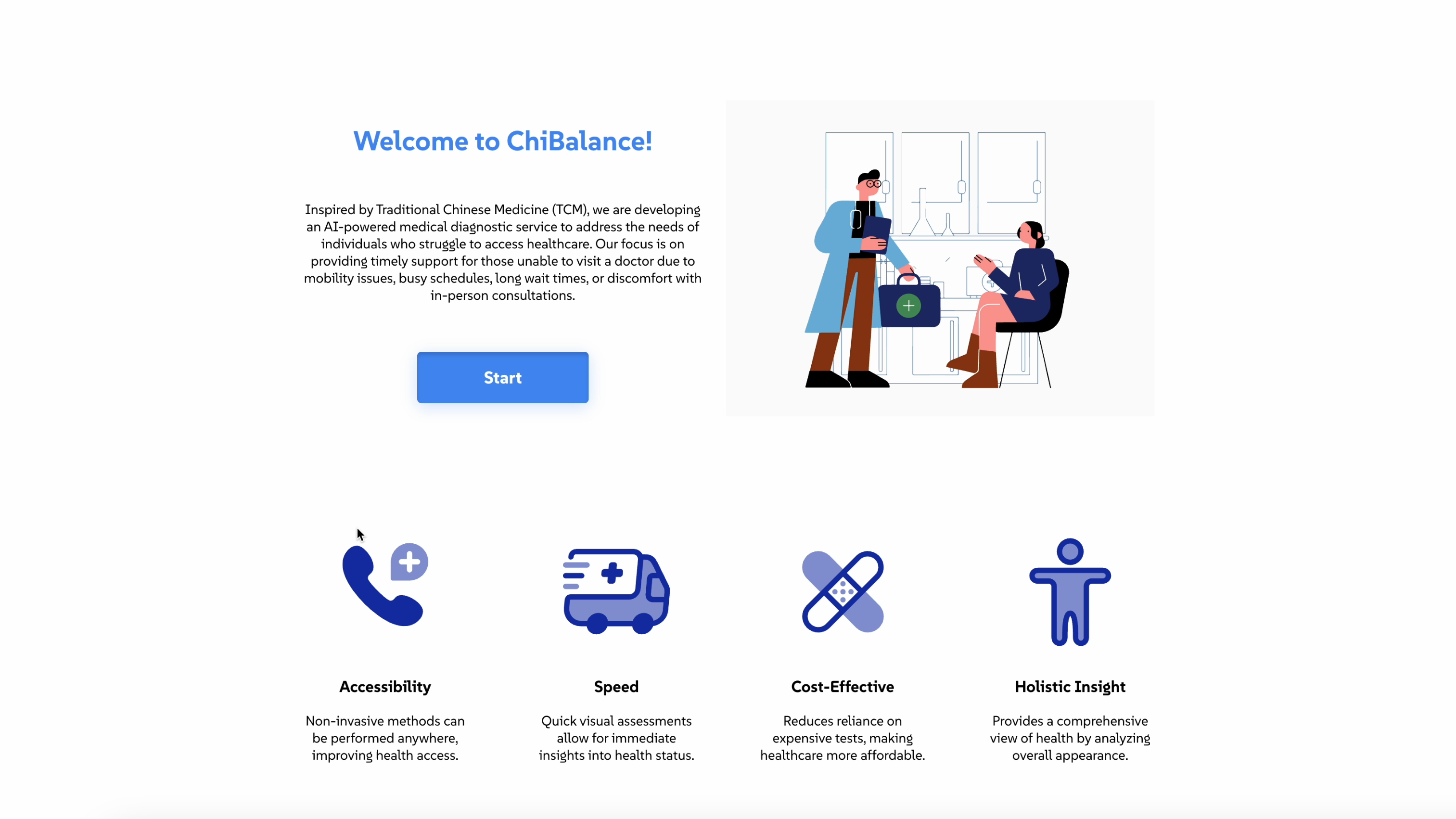
Inspired by Traditional Chinese Medicine (TCM), we are developing an AI-powered medical diagnostic service to address the needs of individuals who struggle to access healthcare. Our focus is on providing timely support for those unable to visit a doctor due to mobility issues, busy schedules, long wait times, or discomfort with in-person consultations.
What it does
Our service utilizes computer vision to analyze facial and tongue images to assess the likelihood of specific health conditions. This allows healthcare professionals to deliver quick and accurate diagnoses, enabling patients to receive essential medical advice without unnecessary delays.
How we built it
We integrated advanced AI algorithms with a user-friendly interface, ensuring that patients can easily upload their images for analysis. Our team collaborated with medical experts to align the AI assessments with TCM diagnostic methods, enhancing the service's credibility.
Frontend Development with React Native: We opted to use React Native for building the frontend, taking advantage of its robust ecosystem for cross-platform mobile development. React Native's reusable components and modular architecture enabled us to efficiently create a responsive, high-performance UI that works seamlessly across multi-platforms. Its rich community and powerful libraries streamlined our development process, reducing overhead while maintaining flexibility for future scaling.
Backend Integration with RESTful APIs: For communication between the backend and frontend, we implemented a RESTful API to handle data exchange. HTTP requests serve as the backbone of this interaction, allowing the frontend to send and receive data from the server efficiently.
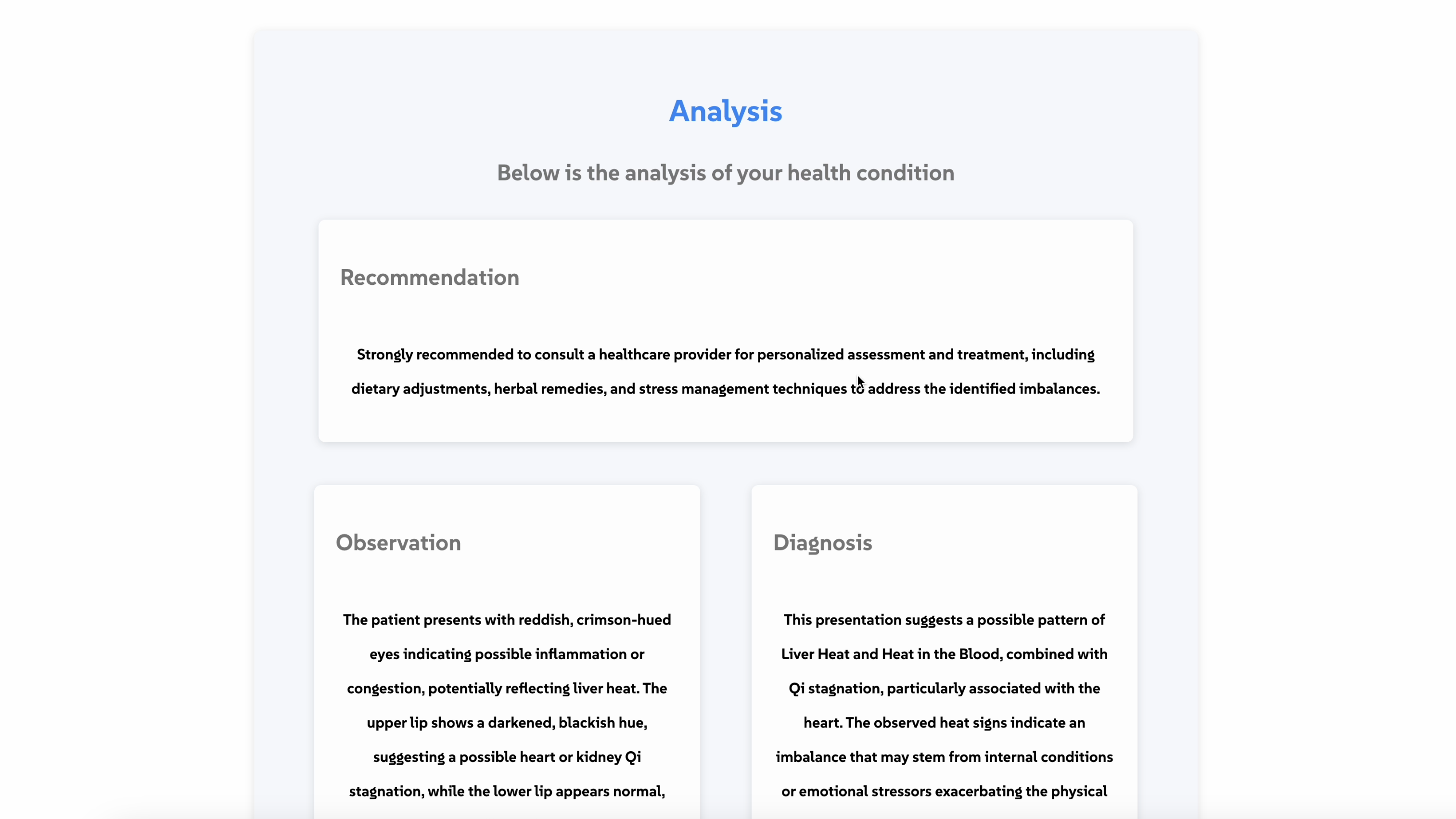
Algorithm Related: We captured an image of a face and an image of a tongue. For the face image, we first use a model to extract the eye region, cheek region, and lip region. Each of these regions is then processed using independently trained models to predict a corresponding result label, which is subsequently mapped to an observation description. The obtained observation descriptions are then passed to our custom-designed LLM API to generate a diagnostic response based on traditional Chinese medicine (TCM).
DeFang Deployment: We have deployed the diagnostic service through DeFang.
Challenges we ran into
We faced challenges in ensuring the accuracy of our AI models and the sensitivity of the data used for training. Additionally, addressing privacy concerns while delivering a seamless user experience required careful planning and implementation.
Accomplishments that we're proud of
We successfully developed a prototype that demonstrates our technology's potential to reduce patient deterioration by providing timely diagnostic support. Our initial testing showed a promising accuracy rate, validating our approach and inspiring further development.
What we learned
We learned the importance of combining traditional knowledge with modern technology to improve healthcare access. Engaging with potential users highlighted the necessity for quick, reliable diagnostics to prevent patient deterioration, reinforcing our mission.
What's next for ChiBalance
Moving forward, we aim to refine our AI algorithms and expand our user base, targeting not only Chinese communities but also individuals worldwide facing similar healthcare barriers. Our goal is to democratize access to fast diagnostics and improve overall patient security through innovation.


Log in or sign up for Devpost to join the conversation.