IMC Chanllenge
Inspiration
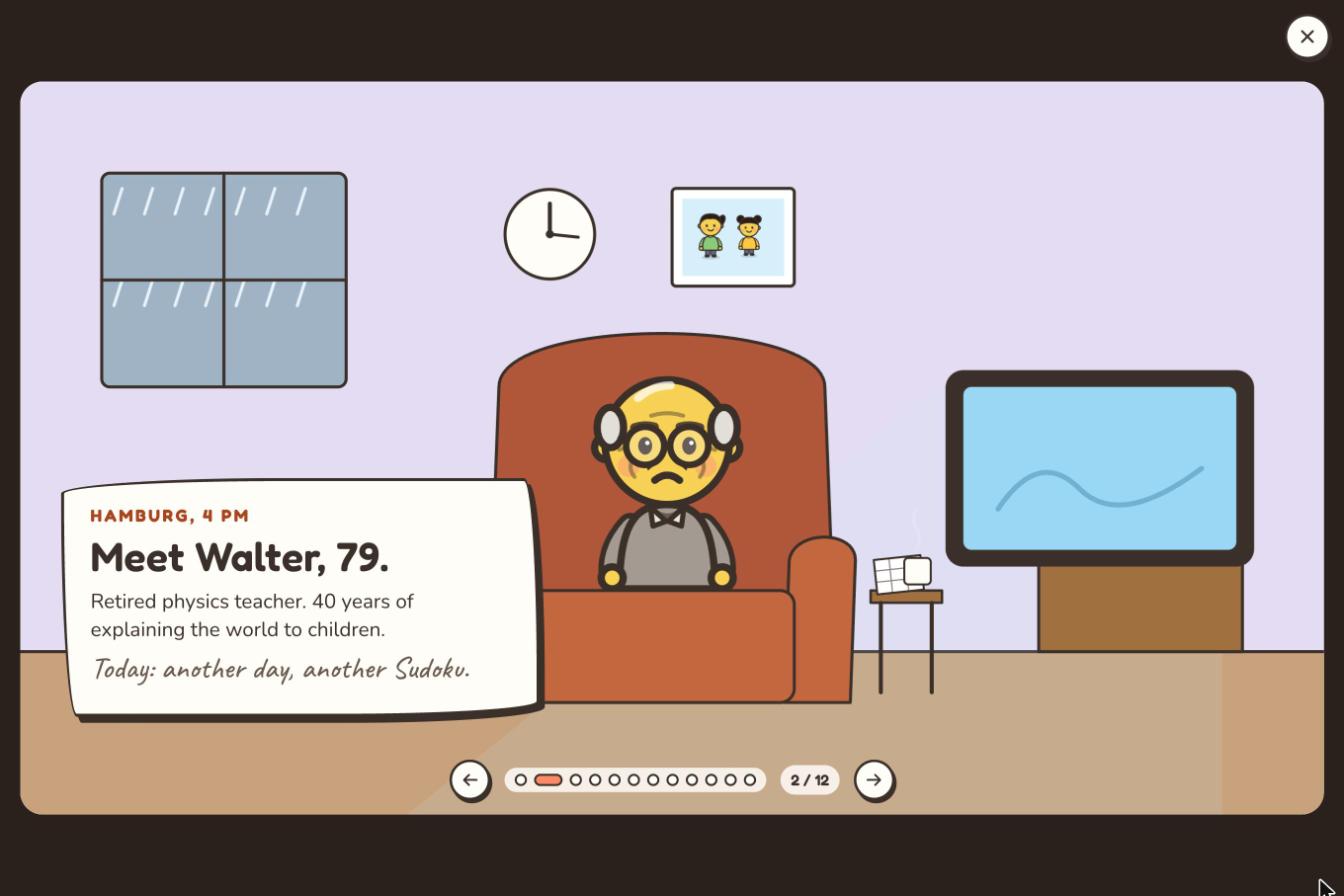
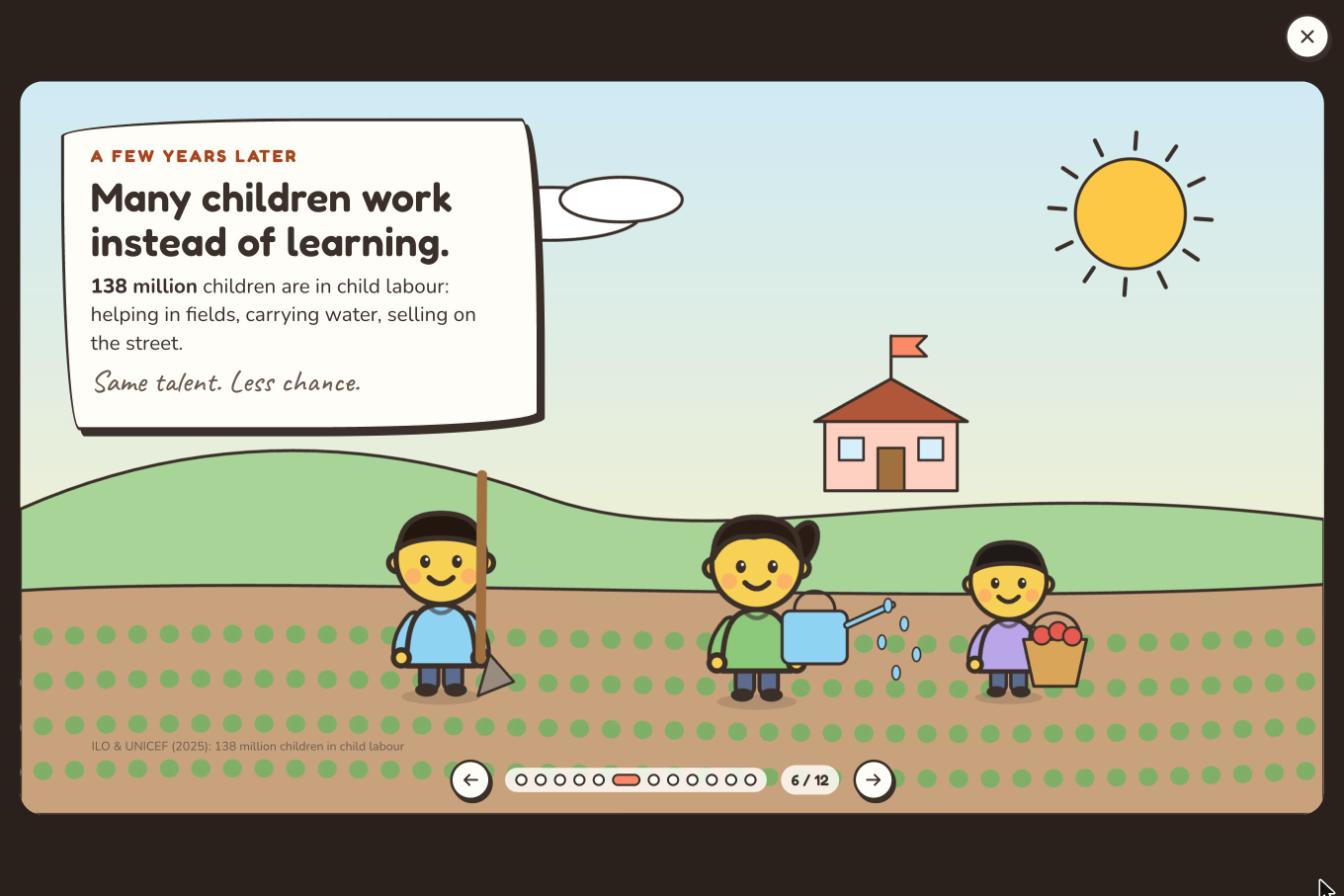
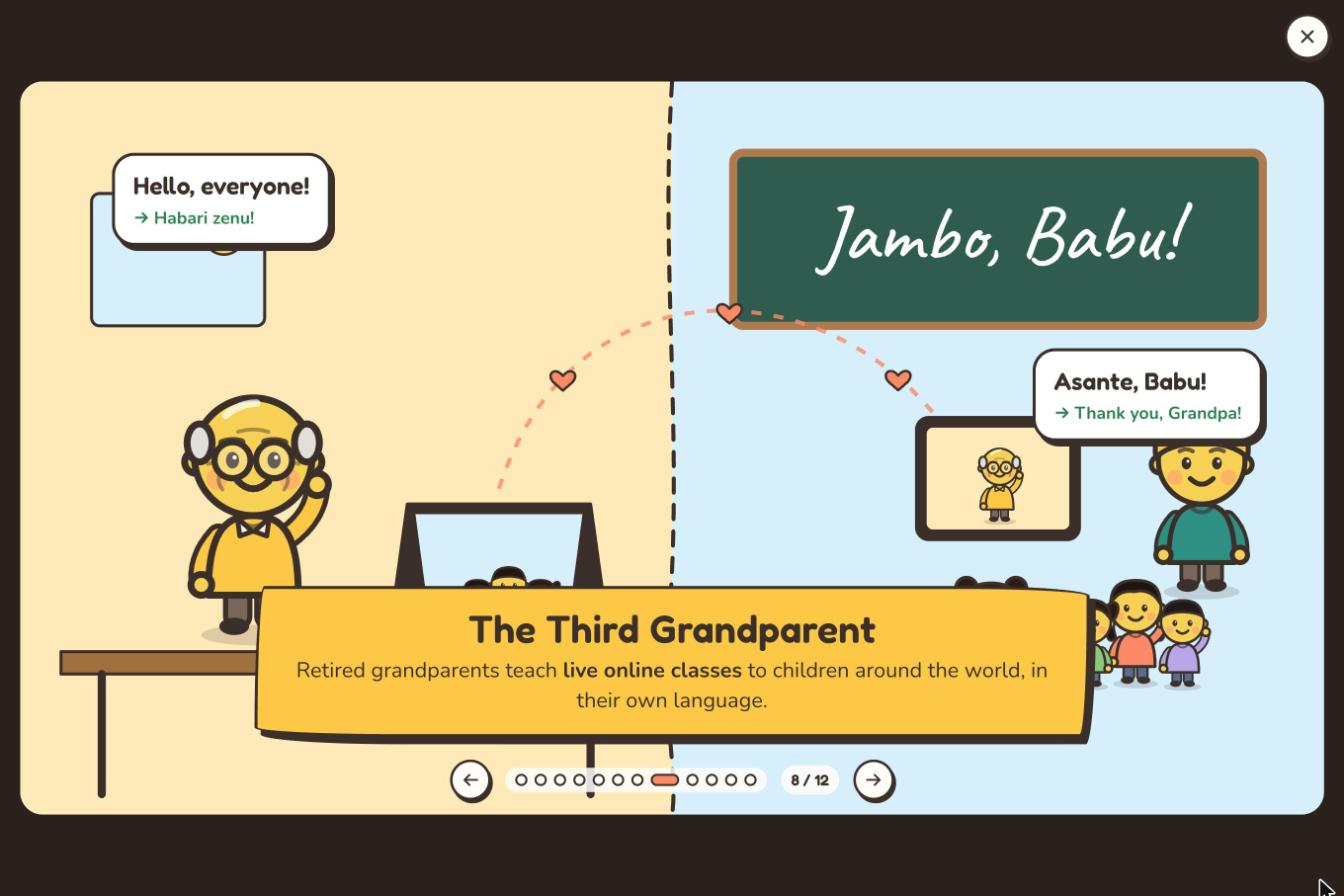
Two problems that look unrelated sit next to each other. Around 1 in 4 older people experience social isolation (WHO), and many of them spent 40 years teaching, nursing or making things. At the same time 273 million children and young people are out of school (UNESCO) and 138 million are in child labour (ILO and UNICEF). Every child has two grandparents. We wanted to give every child a third: a retired teacher who shows up every week, believes in them, and is glad to be needed.
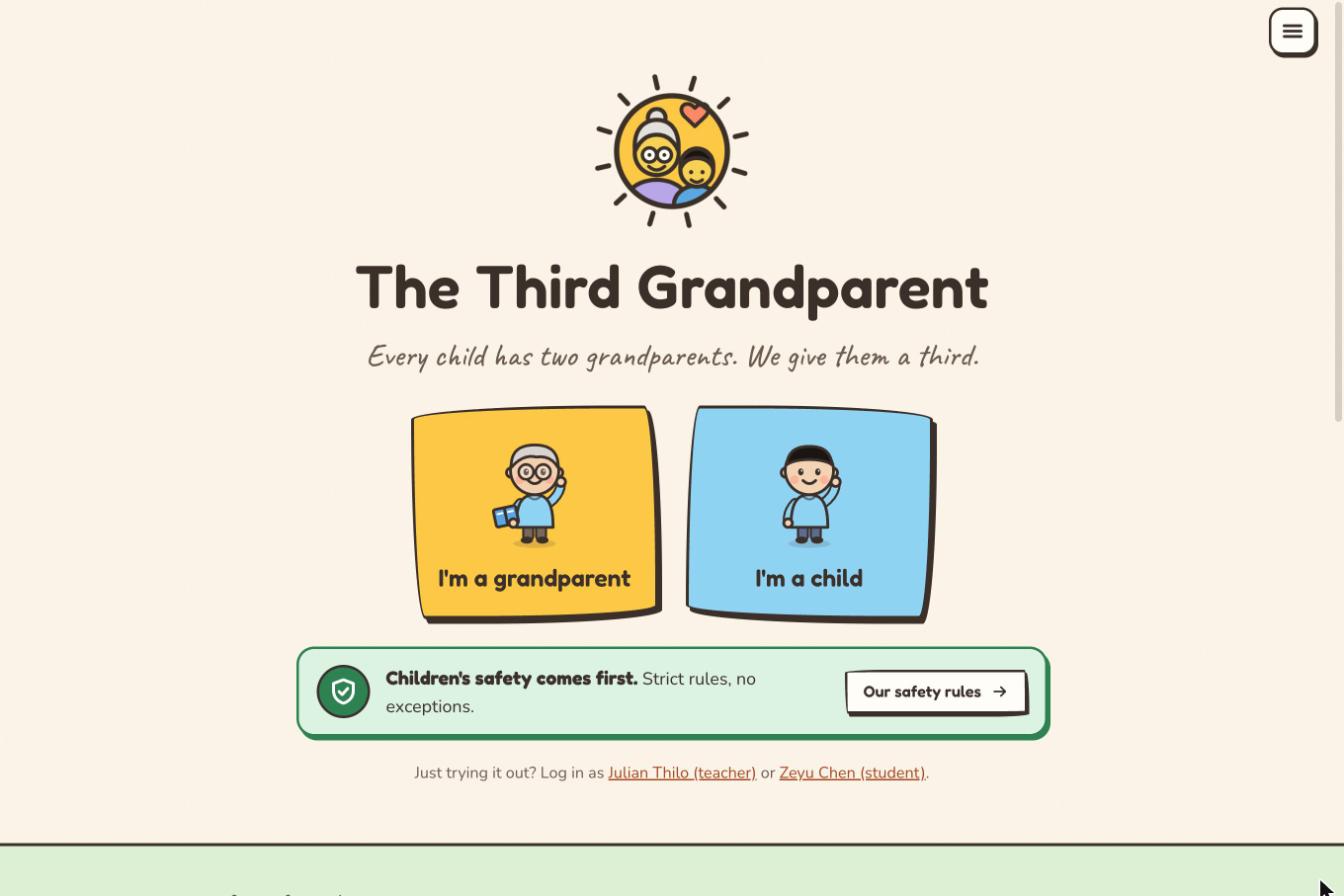
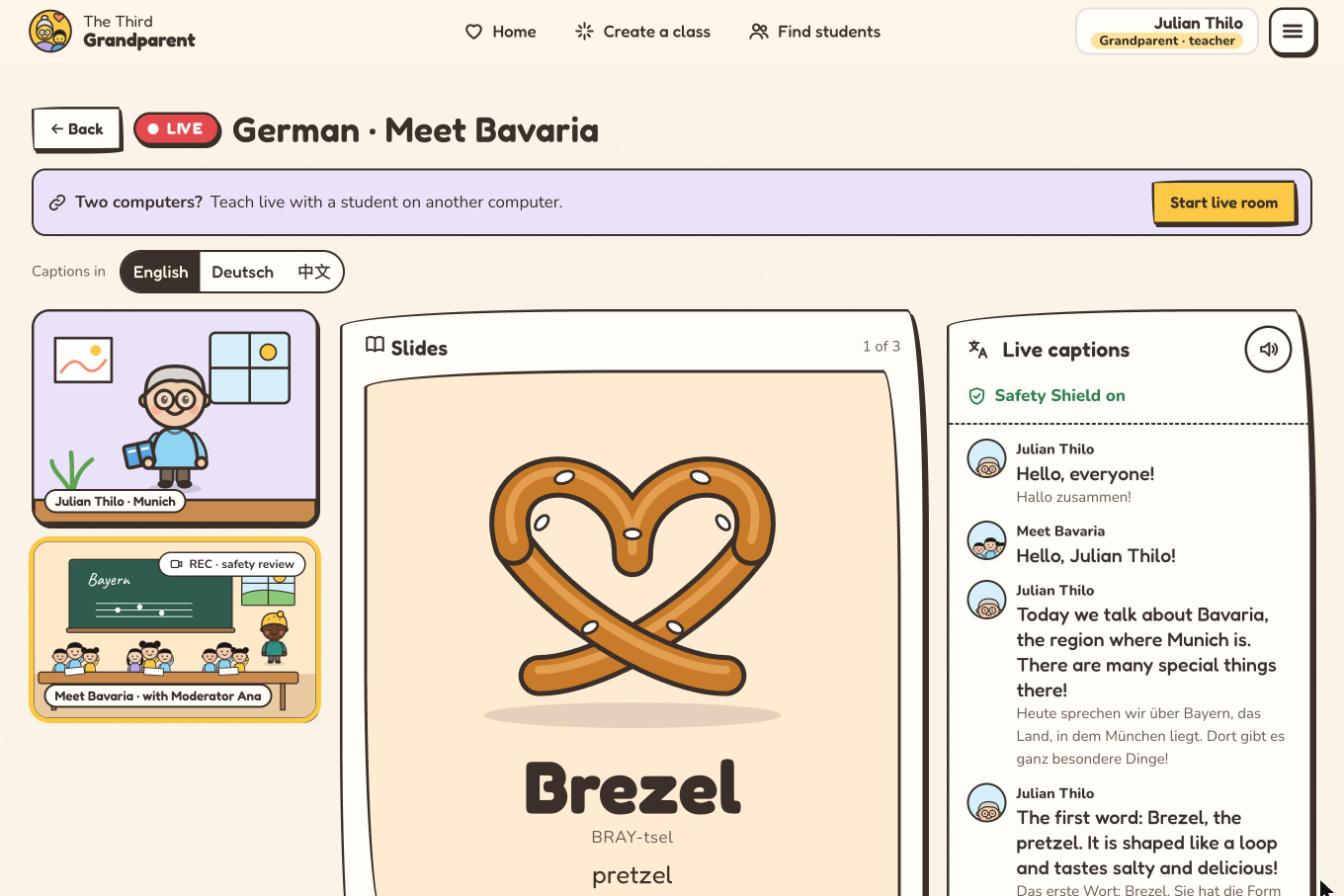
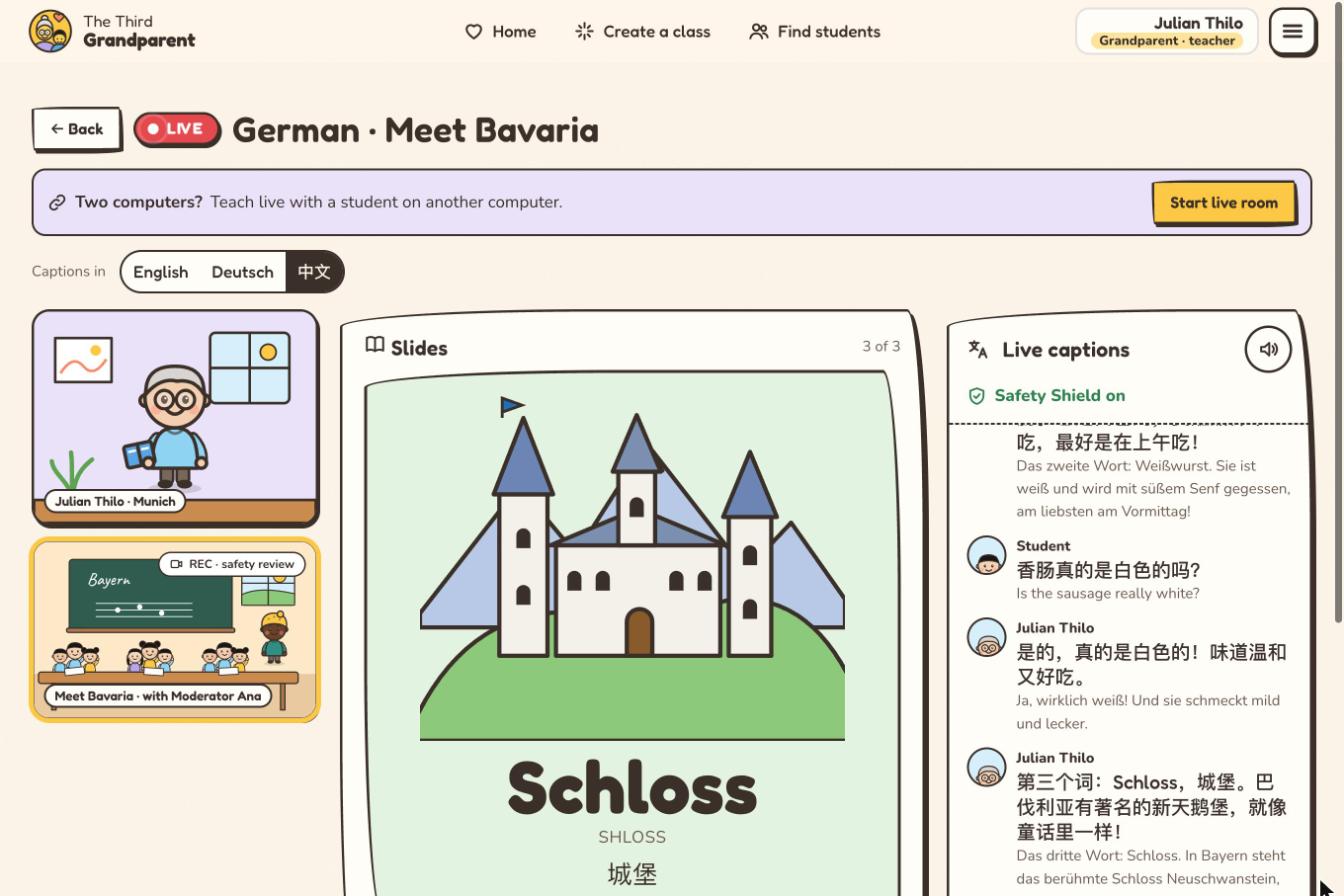
Our demo story: Julian, a retired teacher in Munich, teaches German words to Zeyu, a 10-year-old in China, live, in English.
What it does
- Made for 70+: a 3-minute sign-up that is pre-filled, big text, picture-book illustrations, and an avatar made from one camera photo (the photo stays on the device).
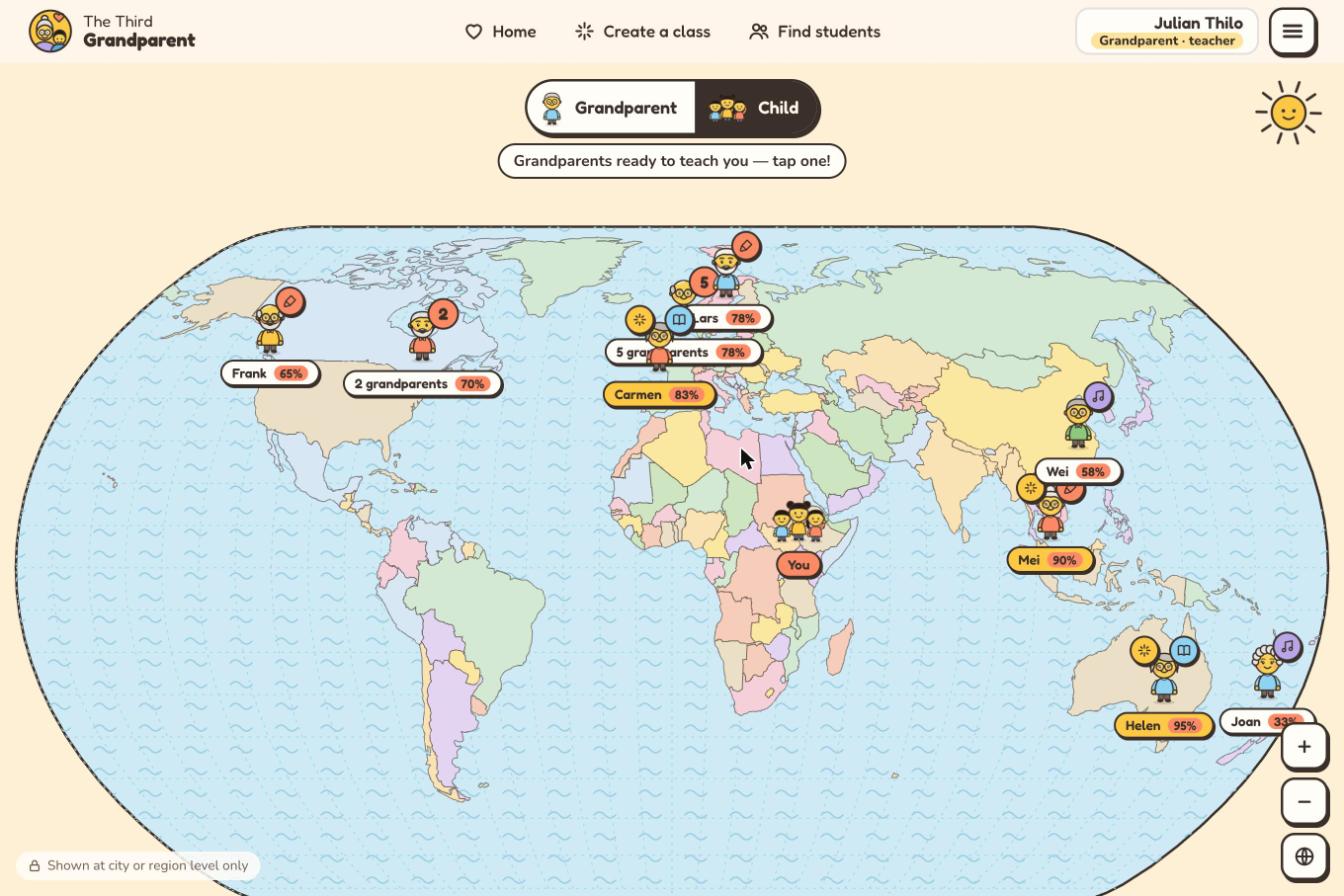
- A world map with little avatars (like a friendly map app) that shows who can teach and who is waiting to learn.
- Classes and schedules shown in each person's own time zone.
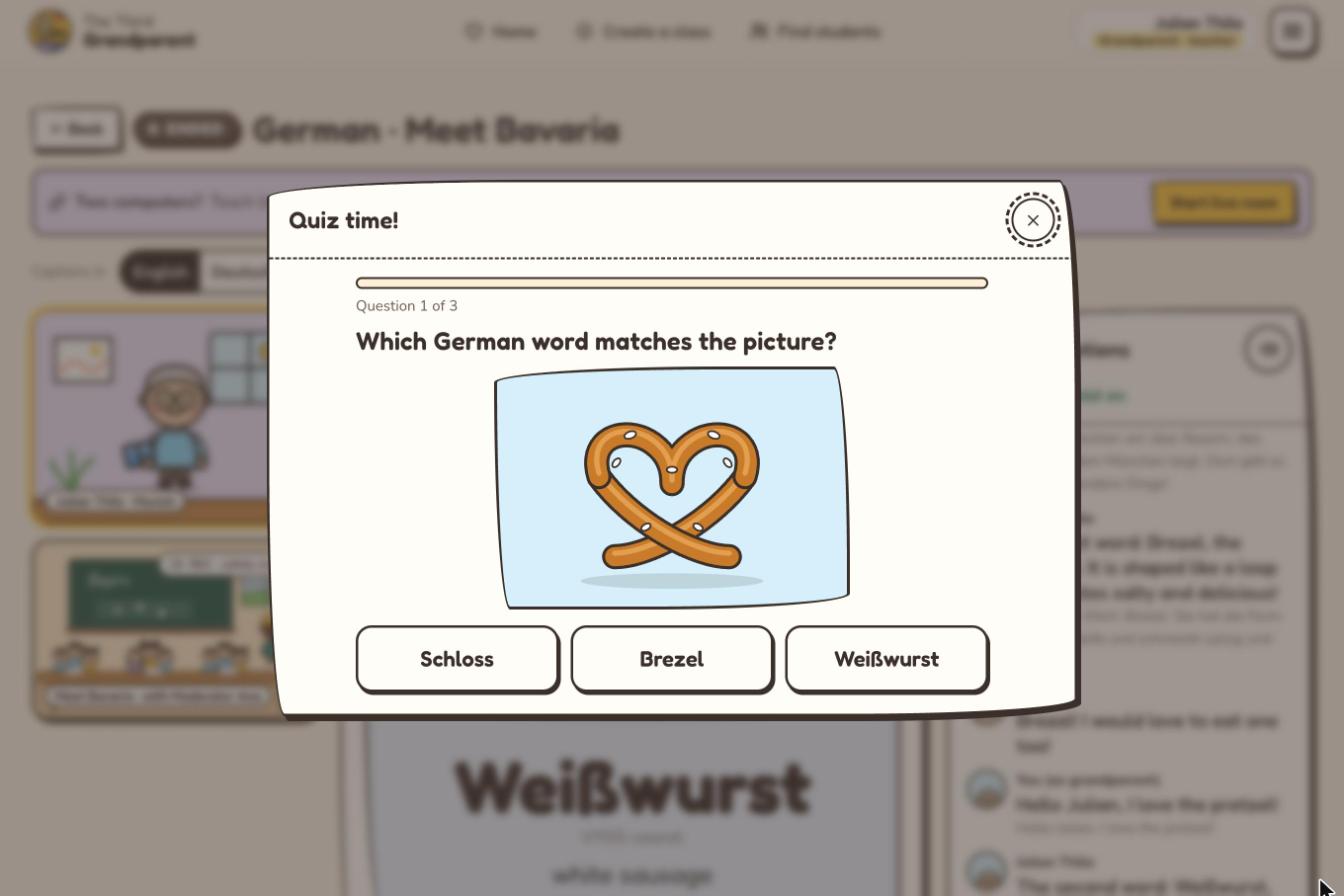
- A lesson in seconds: the grandparent types a topic ("pretzel, white sausage, castle") and gets slides with one picture and one word each, plus a quiz.
- A live classroom: slides, two video boxes, and live captions with translation. You speak, the other person reads it in their language within seconds. English, German and Chinese, including Chinese and English mixed in one sentence.
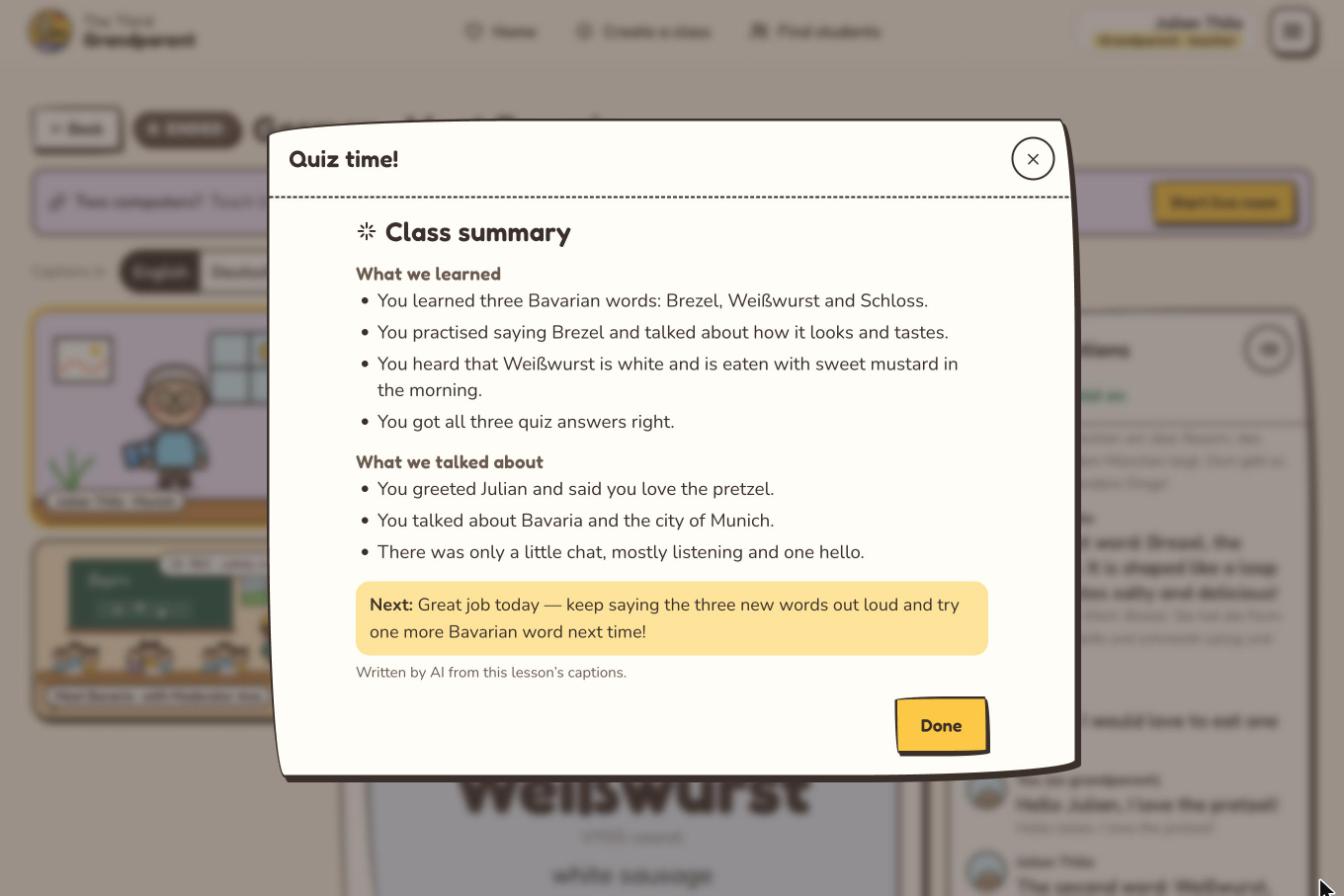
- End class: the quiz opens on the student's computer, one question at a time, followed by an AI summary of what was learned and what was talked about.
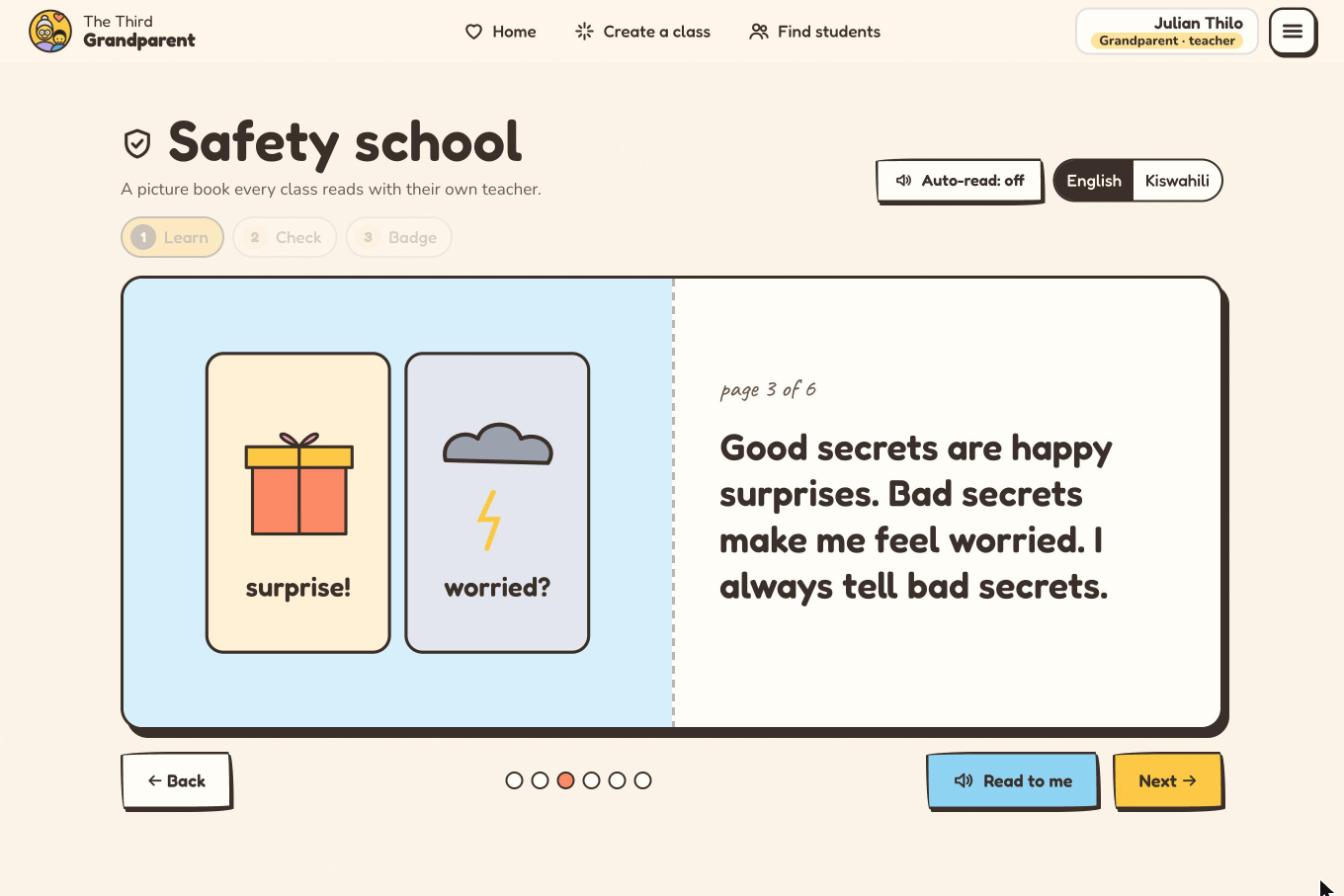
- Safety first: a required Safety school before a child's first class (a picture book read aloud in a child-like voice, then three questions), a private Help Hand button the grandparent never sees, a Safety Shield that scans every sentence for contact details, secrecy and grooming patterns in four languages, and a Safety Center where reports are reviewed by a person.
- Two computers, no backend: the teacher and the student connect peer-to-peer.
How we built it
- Plain HTML, CSS and JavaScript with no build step, so it is fast on cheap devices. Illustrations are SVG drawn in code; the map uses D3.
- WebRTC (PeerJS) carries video, slides and messages directly between the two computers.
- Live voice captions: two small Vercel serverless functions keep the API keys secret. One hands the browser a 2-minute Speechmatics key so the microphone streams straight to the speech service; the other translates each finished sentence with DeepSeek. Every sentence passes the Safety Shield first. If the cloud is missing, the app falls back to the browser's own speech recognition and a free translation service.
- A third function writes the AI class summary from the lesson's words, the quiz result and the captions, with a plain fallback so a summary always appears.
- MediaPipe turns a photo into an avatar on the device. The speech synthesis in Safety school uses the device's own voices, picking a child voice when there is one.
- 119 automated tests, deployed on Vercel. We built it quickly with the help of Claude Code.
Challenges we ran into
- A live lesson with no backend: getting two computers to find each other and share video and captions reliably.
- Streaming speech on a static host: Vercel cannot hold a WebSocket open, so we redesigned around short-lived keys and let the browser talk to the speech service directly.
- Translation that feels live: showing words while someone is still speaking, then translating at the sentence level, and handling mixed-language speech.
- Safety and openness together: scanning every sentence in four languages without blocking normal teaching.
- Browser rules: microphones and automatic speech only start after a touch, and no browser ships a real child voice.
- Representing people respectfully: after feedback we redrew our pitch illustrations. We removed a harsh mine scene and gave every character the same skin tone, so the pictures show people rather than stereotypes.
- Keeping it simple enough for a 75-year-old: we cut buttons and text again and again.
Accomplishments that we're proud of
- A real live lesson works end to end: video, slides, and speech turned into captions in another language within seconds.
- Safety is part of the flow, not a footnote: Safety school is required before a child can join a class.
- A gentle, simple interface that a first-time user can use.
- Everything runs on static pages plus three small functions, with graceful fallbacks when a service is missing.
What we learned
- Design for safety before features: a rule like "never one-to-one" shapes the whole product.
- Latency and trust matter more than perfect translation: show something quickly and fix it.
- How WebRTC, speech streaming and browser permission rules fit together, and why API keys must never reach the browser.
- Pictures carry messages as strongly as words, so we check both.
What's next for The Third Grandparent
- A pilot with a partner school and a local teacher in every class.
- Real volunteer vetting (ID and criminal-record checks, references, a safeguarding test), server-side review of every message, and a trained safety team. Today these are designed and prototyped, not yet operating.
- More languages with better speech and voices (for example Kiswahili), and a low-bandwidth, audio-only mode.
- Recordings with consent, a parent view, and matching by interests.
Optiver Challenge
Inspiration
Financial markets are constantly evolving ecosystems where thousands of decisions interact in real time. Even when individual price movements appear random, order book dynamics, liquidity imbalances, and relationships between correlated assets may reveal trading opportunities.
Inspired by Optiver's approach to quantitative trading and market making, we wanted to explore a fundamental question: Can an automated trading system identify short-lived market inefficiencies while maintaining disciplined risk management?
The eight stocks provided in the HackaTUM 2026 Optiver Challenge belong to the interconnected AI infrastructure ecosystem, creating an interesting opportunity to investigate both individual market behaviour and cross-asset relationships.
What it does
Our project develops an adaptive multi-asset algorithmic trading engine for Optibook, Optiver's simulated stock exchange, covering AMD, AVGO, CRWV, MU, NBIS, NVDA, SNDK and VRT.
The system is designed around:
- Market Microstructure Analysis: analysing bid-ask spreads, order book depth, liquidity, trading activity and supply-demand imbalances.
- Fair Value Estimation: estimating short-term fair prices using observable market information rather than relying solely on the last traded price.
- Cross-Asset Intelligence: investigating correlations and lead-lag relationships between stocks within the AI infrastructure ecosystem.
- Adaptive Trading: identifying opportunities through market making, price deviations and short-term market signals.
- Risk Management: monitoring positions, inventory exposure and potential losses while respecting exchange-imposed position limits.
- Automated Execution: interacting with a live simulated order book through the Optibook Python API.
- Performance Monitoring: evaluating profitability, trading activity, portfolio exposure and PnL development.
How we built it
- Python as the core language for quantitative research and trading execution.
- Optibook Python SDK for accessing live market information, managing orders and monitoring portfolio positions.
- Optibook Historical Data API for accessing historical trades, orders and order book snapshots.
- NumPy, pandas and SciPy as the available quantitative research and statistical analysis stack.
- Jupyter Notebook for exploratory data analysis and research experiments.
- OpenVSCode Server as a shared remote development environment, enabling collaboration between team members.
- Claude Code with Fable 5.2 High as an AI-assisted quantitative research and software engineering tool, supporting strategy development, implementation and debugging.
Our approach separates quantitative research from trading execution, allowing trading hypotheses to be investigated independently before being incorporated into the live trading system.
Challenges we ran into
- Trading in a competitive environment: market conditions continuously change as other teams introduce and optimise their own algorithms.
- Signal versus noise: identifying meaningful short-term price signals without overfitting historical observations.
- Profitability versus risk: balancing potential returns against inventory exposure and adverse price movements.
- Execution uncertainty: a theoretically profitable opportunity does not necessarily translate into an executed or profitable trade.
- Exchange constraints: managing API rate limits, price restrictions, position limits and a single live exchange connection per team.
- Limited development time: balancing quantitative research with the need to deploy, test and improve a functioning trading algorithm within a hackathon.
- AI-assisted development: ensuring that AI-generated hypotheses and implementations are evaluated against empirical evidence rather than accepted at face value.
Accomplishments that we're proud of
- Successfully connected our development environment to Optiver's simulated trading exchange.
- Developed and tested an automated trading approach in a competitive multi-agent market.
- Achieved positive PnL during the practice competition, reaching +252 and 16th place in one observed leaderboard snapshot, with zero reported net position at that moment.
- Established a quantitative research framework covering eight interconnected stocks.
- Integrated AI-assisted research and software development into a collaborative trading workflow.
- Prioritised risk management alongside profitability rather than pursuing returns through unrestricted directional exposure.
What we learned
- A profitable prediction is not necessarily a profitable trade: execution matters as much as prediction.
- Market making involves more than capturing bid-ask spreads; inventory risk, adverse selection and queue competition are equally important.
- Correlated assets may provide valuable information, but statistical relationships must be validated before they become trading signals.
- Absolute PnL alone is insufficient for evaluating a strategy. Risk exposure, drawdown, profitability over time and consistency also matter.
- Historical performance does not guarantee future results, particularly in a market populated by competing adaptive algorithms.
- AI can accelerate quantitative research and software development, but empirical validation remains essential.
What's next for Adaptive Multi-Asset Trading Engine
- More comprehensive event-driven backtesting with realistic execution and fill assumptions.
- Advanced fair value estimation using statistical learning and machine learning.
- Dynamic market regime detection and adaptive strategy selection.
- Portfolio-level risk management incorporating cross-asset correlations and factor exposure.
- More sophisticated execution models accounting for order book dynamics, latency and queue positioning.
- PnL attribution to distinguish market-making profits, directional exposure and cross-asset trading opportunities.
- Further evaluation of risk-adjusted performance across different market conditions.
